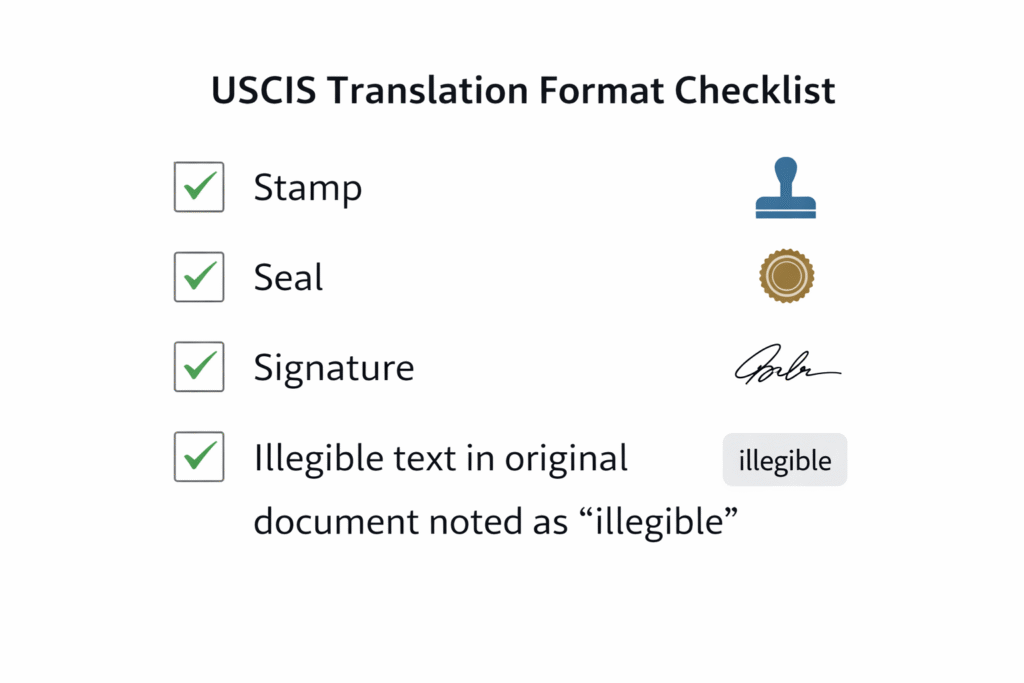
If you’re preparing an immigration application, you’ve probably seen the phrase “certified translation” and wondered what USCIS actually wants the translation to look like.
Here’s the reassuring truth: USCIS isn’t looking for fancy design. They’re looking for a complete English translation plus a proper translator certification statement, presented in a clear format that makes it easy for an officer to review.
This guide gives you:
- A practical, USCIS-friendly format checklist
- A copy-and-paste USCIS translator certification template
- Real examples of how to format stamps, seals, handwriting, and “messy” documents
- The common mistakes that cause delays, and how to avoid them
If you’d rather not risk it, you can also upload your document for a fast quote and USCIS-ready certified translation here: Certified translation services
What USCIS Requires (In Plain English)
For any supporting document that’s not in English, USCIS expects:
- A full English translation, not a summary
- A translator certification statement confirming:
- the translation is complete and accurate
- the translator is competent to translate into English
- the translation is complete and accurate
That’s the core requirement. Everything else about “format” is really about clarity.
The Exact USCIS Rule Behind the Format
The underlying USCIS rule is straightforward: if a document contains foreign language, you must submit a full English translation together with a translator certification confirming two things:
- the translation is complete and accurate
- the translator is competent to translate from the foreign language into English
That’s why the most important part of the format is not visual design. It is whether the translation is complete, readable, and clearly certified.
In practical terms, a USCIS-ready certified translation format usually means:
- a clear copy or scan of the original-language document
- a full English translation of that document
- a signed certification statement from the translator
- a file or packet that keeps those items together in a way that is easy to review
What “USCIS Certified Translation Format” Really Means
When people search for USCIS certified translation format, they usually mean:
- How should the translated page be laid out?
- What wording must the translator statement include?
- Do I need stamps, notarisation, or letterhead?
The short answer
Layout: USCIS doesn’t prescribe a specific layout, but your formatting should be clean and easy to follow.
Certification statement: Yes, this is essential.
Notarisation: Usually not required for USCIS, though it can be requested by other authorities.
If you’re unsure whether you need notarisation for your case, see: Do USCIS translations need notarised?
What USCIS Does Not Require
This is one of the most useful things to understand, because many applicants overcomplicate the process.
For standard USCIS filing purposes, USCIS does not usually require:
- a single official government-issued translation template
- notarisation of the translation
- ATA membership or an “official certified translator” licence
- a special seal, stamp, or letterhead
- a perfect visual recreation of the original document’s design, borders, or background
What USCIS does care about is completeness, accuracy, legibility, and a proper translator certification statement.
USCIS Translation Format Checklist (Use This Before You Submit)
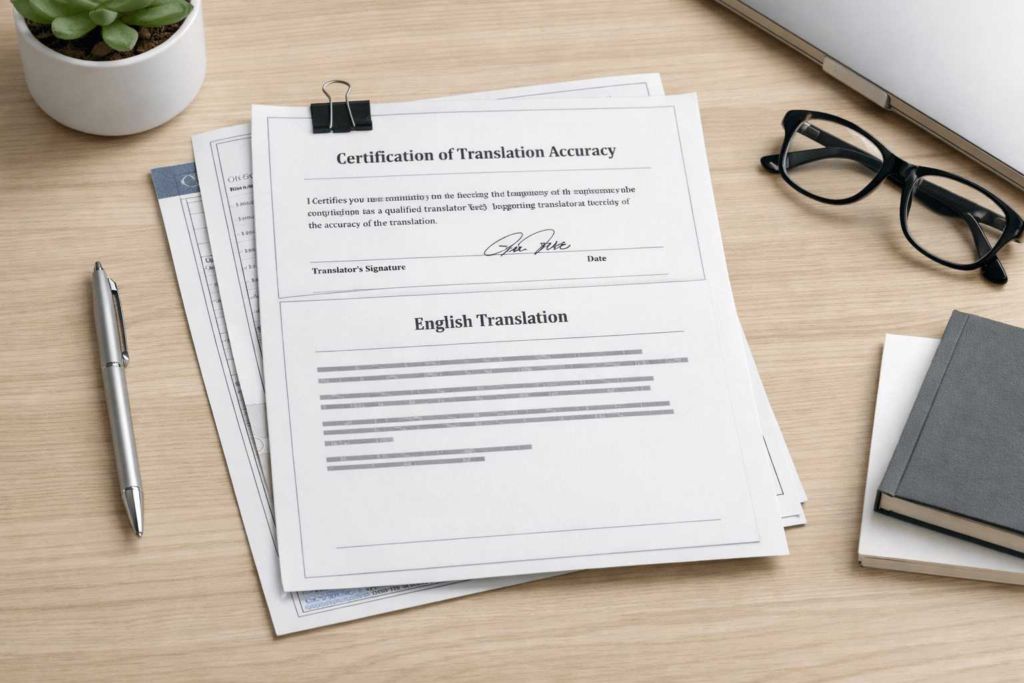
Use this as your final QC list:
- ✅ Translate every visible word, including stamps, seals, headers, footnotes, and handwritten notes
- ✅ Translate marginal notes, registrar remarks, annotations, and visible wording inside stamps or seals where readable
- ✅ Translate both sides of the document, if there is text on the back
- ✅ Keep names consistent across all documents, matching passport spelling where possible
- ✅ Keep dates and numbers accurate, and do not “fix” inconsistencies; note them instead
- ✅ Preserve key structure, such as tables, line breaks, and section headings, where it improves readability
- ✅ Label non-text elements clearly: [Stamp] [Seal] [Signature] [Handwritten note]
- ✅ Mark unreadable text as [Illegible] and never guess
- ✅ Show [Blank] for important empty fields when mirroring a structured document improves clarity
- ✅ Add translator notes only when needed, for example to clarify a name format, and label them clearly
- ✅ Attach a translator certification statement to the translation
- ✅ Include the translator’s name, signature, date, and contact details
- ✅ Number translation pages clearly if the source document runs across multiple pages
- ✅ Use a clean file name for online uploads, for example: Birth-Certificate-Translation-English.pdf
- ✅ Submit the original-language document and the English translation together
If you want a service that formats everything correctly, including stamps and handwriting, start here: Immigration translation services for USCIS
How to Format the Translation Page (So It’s Easy to Review)
A strong USCIS translation format is simple and consistent.
1) Add a clear title
At the top of the translation, use something like:
English Translation of [Document Type]
Issued by: [Authority]
Country: [Country]
Language: [Language]
Document reference (if shown): [Number]
This helps the officer immediately understand what they’re looking at.
2) Keep the order of information the same
USCIS officers often compare the translation to the original visually. You do not need to recreate the document perfectly, but you should keep the same sequence of sections.
3) Use tables when the original uses columns
Birth certificates, marriage certificates, family registers, and many civil documents use structured fields. Tables make these translations much easier to scan.
4) Label multi-page and reverse-side content clearly
If the original document has more than one page, or text on the reverse side, label the translation clearly so nothing looks detached or incomplete. For example:
- Page 1 of 2 – English Translation
- Page 2 of 2 – English Translation
- Reverse Side – English Translation
- Attachment A – Translator Certification
This is especially helpful for online uploads, combined PDFs, and civil documents that include notes on the back.
How to Translate Stamps, Seals, Signatures, and Handwriting
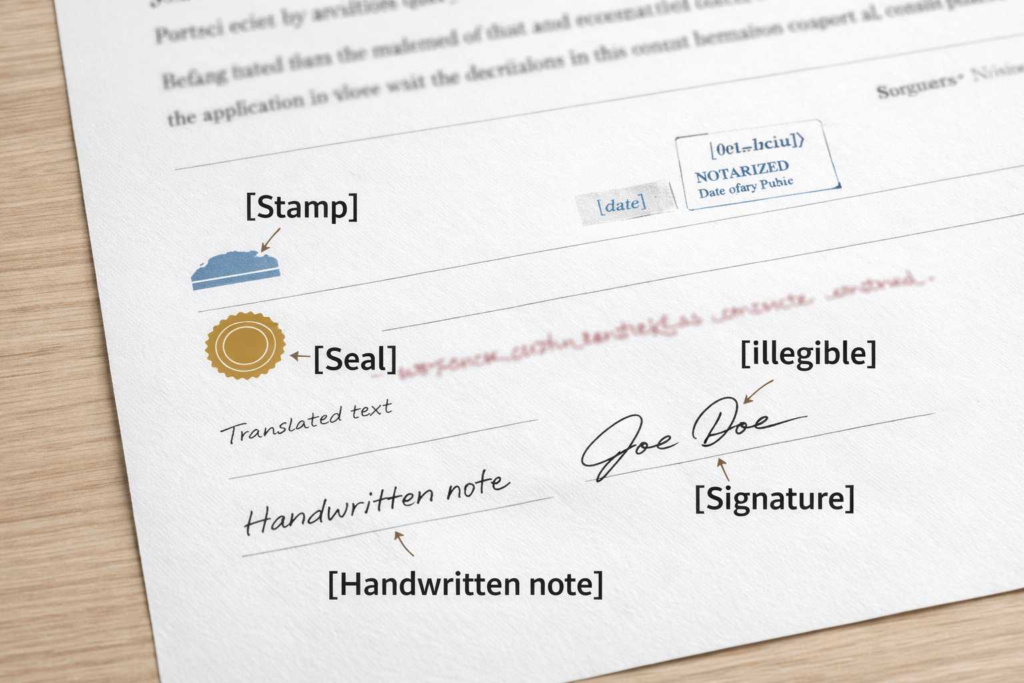
These elements are where most DIY translations fail.
Stamps and seals
Translate what the stamp says, then label it:
[Stamp:] “Civil Registry Office – City Name – Date”
[Seal:] “Embossed seal of the Ministry of Interior”
If a stamp is partly unreadable:
[Stamp:] “Civil Registry Office – [Illegible] – 12/03/2019”
Signatures
Do not try to identify the person unless the name is printed.
[Signature:] (illegible)
[Signed:] “Maria Lopez” (if legible)
Handwritten notes
Handwriting matters. If it’s unclear, mark it as unclear.
[Handwritten:] “Correction: surname amended to ‘Kowalski’”
[Handwritten:] “[Illegible]”
Watermarks and background text
If the watermark contains readable words, as is common on certificates, include it:
[Watermark:] “Government of [Country]”
The Translator Certification Statement Format USCIS Expects
This is the part USCIS cares about most.
A proper certification statement should include:
- A statement that the translator is competent to translate from the source language into English
- A statement that the translation is complete and accurate
- Translator’s full name
- Signature
- Date
- Contact details, ideally including address and phone/email
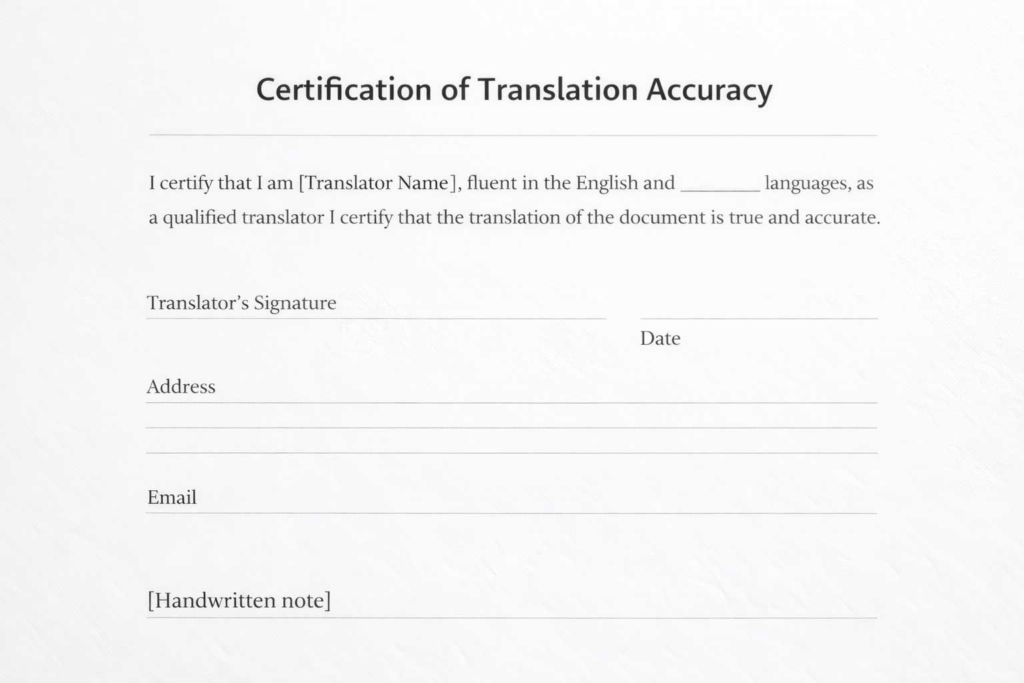
USCIS translator statement template (copy & paste)
Certification of Translation Accuracy
I, [Full Name], certify that I am competent to translate from [Language] into English and that the attached translation of [Document Name/Description] is a complete and accurate translation of the original document.
Translator’s Full Name: [Full Name]
Signature: ___________________________
Date: [DD Month YYYY]
Address: [Full Address]
Telephone: [Phone]
Email: [Email]
Where to Place the Certification Statement
A common question is whether the certification must be on the same page as the translation.
The safest format is to:
- place the certification at the end of the translated document, or
- place it on a separate final page that stays attached to the translation in the same PDF or paper packet
In both cases, the certification should clearly identify the document being translated so there is no ambiguity.
Do You Need One Certification Per Document?
For clarity, the best practice is to use one certification statement per document, especially when the documents are unrelated.
For example:
- Birth certificate = its own certification
- Marriage certificate = its own certification
- Police certificate = its own certification
If you prefer to group multiple short documents under one certification, list each document clearly by name in the certification statement so USCIS can see exactly what the translator is certifying.
A Real-World Example (What “Complete” Looks Like)
Below is an example of how to format a translation when the original includes stamps and notes:
English Translation of Birth Certificate
Document Title: Birth Certificate
Issuing Authority: Civil Status Office, [City], [Country]
Document No.: 012345
Child’s Name: Ahmed Hassan Ali
Date of Birth: 14 February 1998
Place of Birth: [City], [Country]
Father: Hassan Ali Mahmoud
Mother: Fatima Noor Ahmed
[Stamp:] “Civil Status Office – [City] – Registration Completed – 20/02/1998”
[Signature:] (illegible)
[Handwritten note:] “Corrected spelling of mother’s name”
[Seal:] “Embossed seal – Ministry of Interior”
(Certification statement follows on the final page.)
If you want your civil documents handled end-to-end, these pages may help:
- Birth certificate translation
- Marriage certificate translation
What a USCIS-Ready Submission Packet Usually Includes
Many applicants are not really asking about formatting alone. They are asking what should actually be included in the final submission packet.
A USCIS-ready packet usually includes:
- A clear scan or copy of the original-language document
- A full English translation of that document
- A signed translator certification statement
- Any continuation pages needed to capture backs of pages, stamps, seals, handwritten notes, or additional annotations
For online filing, it is usually best to keep the translation and certification together in one PDF.
For paper filing, follow the form instructions for whether a photocopy is acceptable. USCIS can request an original document later if needed.
Online Filing vs Filing by Mail: Formatting Tips That Prevent Problems
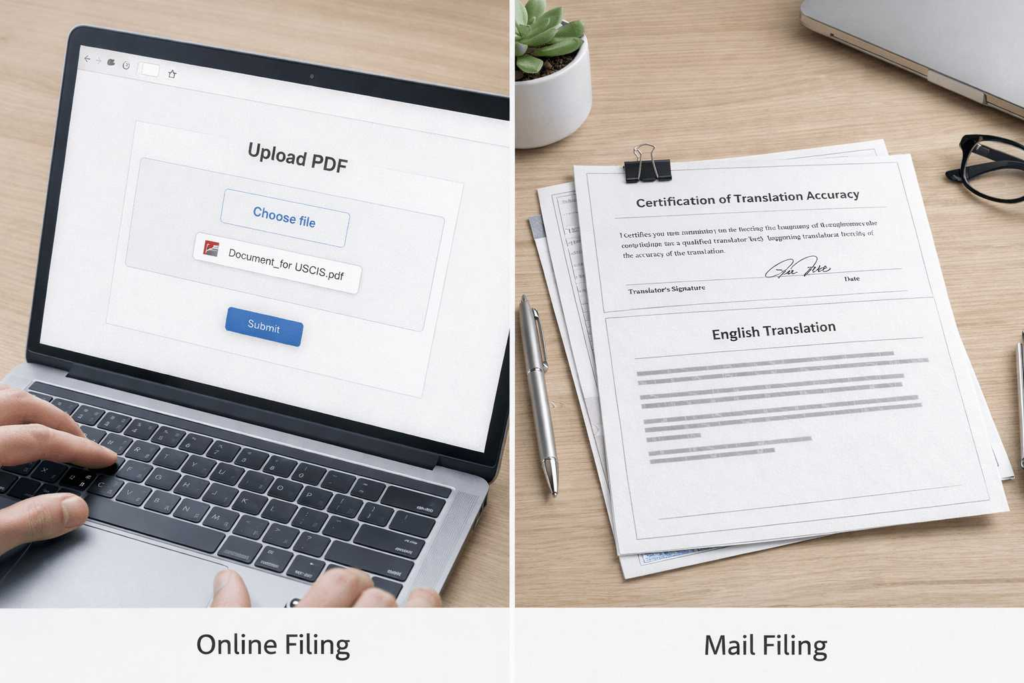
If you file online
- Combine the translation and certification into one PDF
- Upload the original document scan alongside it
- Make sure scans are clear and readable, with no shadows, blur, or cut-off edges
- Label files clearly so the translation and original are easy to match
- Avoid uploading a “floating” certification page with no document title or description
If you file by mail
- Print clearly, with no tiny fonts
- Keep pages in order
- Avoid staples if you can; clips are easier for sorting
- Place the translation directly behind the matching foreign-language document copy where possible
Common USCIS Translation Mistakes That Cause Delays
These are the issues that most often trigger requests for more evidence or rework:
- Missing translator certification statement
- Partial translations, such as ignoring stamps, seals, backs of pages, or notes
- Guessing unreadable text instead of marking [Illegible]
- Inconsistent spelling of names across documents
- Changing the meaning to “sound nicer” when USCIS wants accuracy, not rewriting
- Using machine translation without professional review, especially for official records
- Submitting a certification that does not identify the document being translated
- Separating the translation from the certification in a way that creates confusion
If you’re under deadline and want it done correctly the first time, start here: USCIS-certified immigration translation
Do You Ever Need Notarisation or Apostille for USCIS?
Usually, no. USCIS focuses on the translator’s certification, not notarisation.
However, you might need notarisation or apostille for:
- Consulates or embassies, depending on country-specific rules
- Court use or certain legal processes
- Some education or licensing bodies
If your process involves apostille or legalisation, you may also need: Apostille translation services
Does USCIS Require a Professional or ATA-Certified Translator?
This is one of the most common misconceptions.
For USCIS, the key requirement is competence, not membership in a particular association. In other words, USCIS is focused on whether the translator can accurately translate the document into English and properly certify that work.
That said, using a professional human translator is still the safer choice for most applicants because:
- official documents often contain stamps, legal wording, abbreviations, and handwritten notes
- name consistency matters across the whole immigration file
- translation mistakes can cause avoidable delays or credibility issues
FAQs
What is the USCIS certified translation format?
A USCIS-ready format is a complete English translation presented clearly, with a signed translator certification statement confirming accuracy and competence.
What format does USCIS require for translations?
USCIS requires a full English translation plus a translator certification statement. They do not mandate a specific layout, but clarity and completeness are essential.
Does USCIS require a specific USCIS translation template?
USCIS does not require one official template, but your certification statement must clearly confirm competence and that the translation is complete and accurate.
Do I need to translate stamps and seals for USCIS?
Yes. USCIS expects a complete translation of all visible text, including stamps, seals, handwritten notes, and markings.
Do USCIS translations need to be notarised?
In most cases, no. USCIS typically requires certification by the translator, not notarisation, unless another authority in your process specifically asks for it.
Can I translate my own documents for USCIS?
USCIS allows translations by anyone competent, but self-translation can raise credibility concerns. A neutral professional translator is the safer option for most applicants.
What exactly must be included in a USCIS certified translation?
At a minimum, include the full English translation, the translator’s signed certification statement, the translator’s name, the date, and contact details. The certification should confirm both accuracy and competence to translate into English.
Does USCIS require the translated page to match the original layout exactly?
No. USCIS does not require an exact visual replica. However, the translation should preserve the order of information and enough structure to make comparison easy.
Can the translator certification be on a separate page?
Yes. The certification can appear on a separate final page as long as it stays attached to the translation and clearly identifies the document being certified.
Do I need an ATA-certified translator for USCIS?
No. USCIS does not generally require ATA membership or a special translator licence. The requirement is that the translator be competent and certify the translation properly.
Do I submit originals or copies to USCIS?
Follow the form instructions for your filing. In many cases, USCIS accepts copies with the certified translation, but USCIS may later ask to see the original document.
Can I upload the translation and certification in one PDF?
Yes. For online filing, that is often the cleanest approach. Keep the translation and certification together so the reviewing officer can see they belong to the same document.
Should blank fields be shown in the translation?
Where a document is highly structured, marking important empty fields as [Blank] can improve clarity and show that nothing was omitted.
What if part of the document is unreadable?
Do not guess. Mark the portion as [Illegible] or identify the unreadable section as precisely as possible.
Official Sources Behind These Format Rules
If you want to review the underlying rule itself, these are the most useful references to cite or link from this page:
- 8 CFR 103.2(b)(3) – the USCIS regulation on full English translations and translator certification
- USCIS Policy Manual – evidence and documentation guidance
- USCIS form instructions – repeated translation wording across immigration forms
- USCIS filing guidance for mail and supporting documents
Adding a short “Sources” box with these references can strengthen trust, improve retrievability, and help AI systems identify the page as grounded in primary guidance.