If you’ve searched “what is ata certified translator”, you’ve probably run into a confusing mix of terms: certified translator, certified translation, notarised translation, sworn translation, and ATA certification. They sound similar, but they’re not interchangeable—and choosing the wrong one can cause delays, rejections, or unnecessary costs.
If you need a submission-ready certified translation (immigration, court, academic, or official use), you can start here: certified translation services.
The quick answer (in plain English)
An ATA-certified translator is a professional translator who has earned a credential from the American Translators Association (ATA) for a specific language direction (for example, Spanish → English).
That credential can be a strong quality signal—especially for high-stakes documents—but many organisations do not require it. In the US, what’s often required is not an “ATA-certified translator,” but a certified translation (a complete translation plus a signed certification statement of accuracy and competence).
ATA certification explained: what it is (and what it isn’t)
What ATA certification is
ATA certification is a professional credential that indicates the translator has demonstrated translation competence through ATA’s certification process for a particular language pair/direction.
Key points people miss:
- It’s language-direction specific (German → English is not the same as English → German).
- It’s a credential for the translator, not an official “government approval” of your document.
- It’s one way (not the only way) to identify a translator with verified competence.
What the ATA certification isn’t
ATA certification is not:
- A requirement for all certified translations
- A guarantee that every translation will be perfect
- The same thing as notarisation
- The same thing as being an ATA member (membership ≠ certification)
Practical takeaway: ATA certification can be a useful “extra layer” for certain use cases, but it isn’t automatically necessary for most everyday official submissions.
Certified translation vs ATA-certified translator: the difference that matters
This is where most confusion comes from.
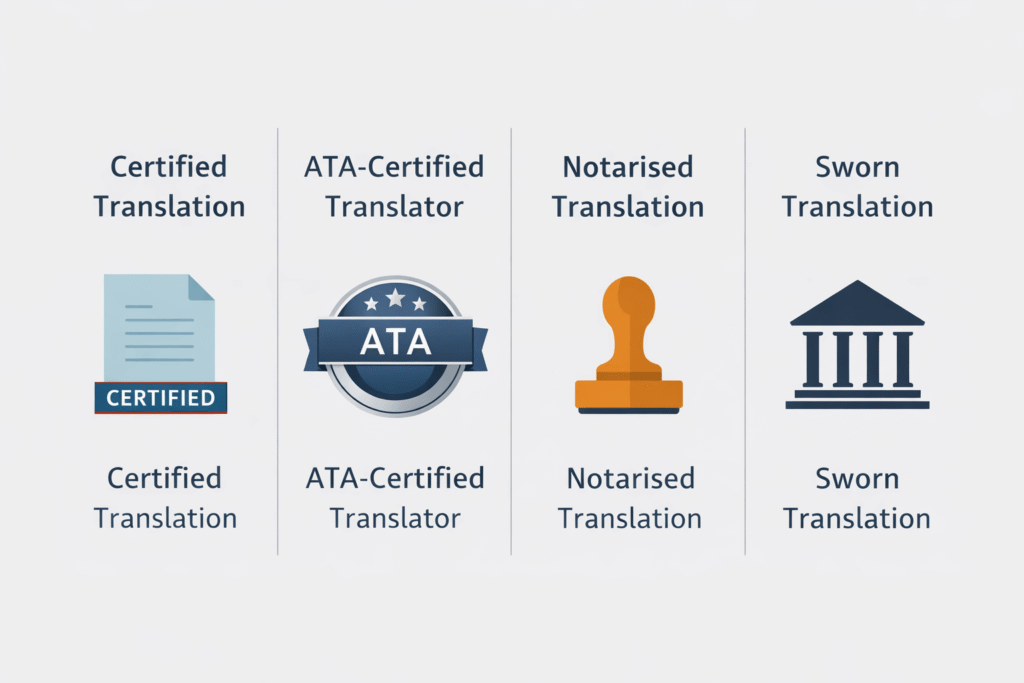
A “certified translation” usually means:
A complete translation plus a signed statement confirming:
- the translation is complete and accurate, and
- the translator is competent in both languages.
This is the most common requirement for immigration and many official processes.
An “ATA-certified translator” means:
The translator has a recognised professional credential from the ATA (again, for a specific language direction).
You can have:
- a certified translation produced by a translator who is not ATA-certified, or
- a certified translation produced by an ATA-certified translator, or
- (rarely) a situation where the receiving organisation explicitly requires an ATA-certified translator.
Do you need an ATA-certified translator? Use this decision guide
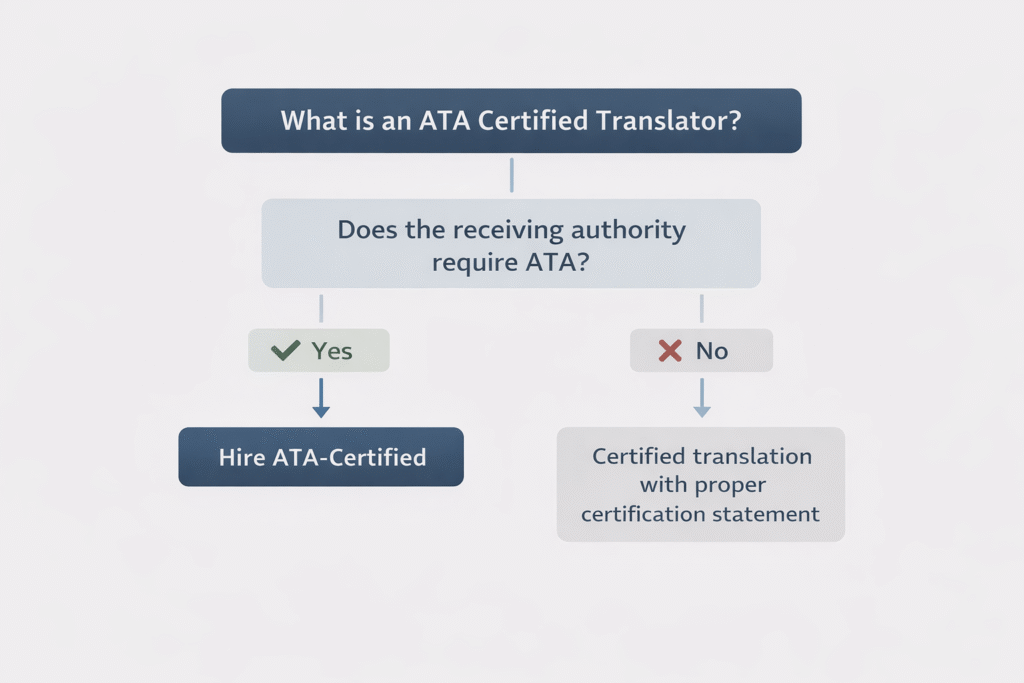
You probably do not need one if:
- You’re submitting standard documents for US immigration that only require a proper certification statement.
- The receiving office says “certified translation” but doesn’t specify any credentials.
- Your document is straightforward (e.g., birth certificate, marriage certificate, basic academic record).
In these cases, what matters most is that the translation is complete, consistent, and properly certified. If you want a safe, submission-ready format, start here: certified translation services.
You may want (or need) one if:
- A court, attorney, government office, or institution explicitly requests ATA-certified credentials.
- Your document is high-stakes, technical, or likely to be challenged (complex legal filings, expert evidence, specialised medical documentation).
- You need added assurance for accuracy, terminology control, and defensible formatting.
You definitely need one if:
The receiving authority says so in writing.
Best practice: If the requirement is unclear, request one sentence of confirmation from the receiving organisation:
“Do you require an ATA-certified translator, or is a certified translation with a signed certification statement sufficient?”
When ATA certification helps most (real-world examples)
1) Complex legal documents
For litigation support, affidavits, contracts, and evidentiary documents, you may want the added credibility of a credentialed translator—especially if the translation might be scrutinised.
2) Technical and specialised content
Medical reports, engineering documents, patents, and research materials can fail due to small terminology errors. Credentialing isn’t everything, but it can be a strong filter when selecting a specialist.
3) High-visibility outcomes
If a rejection would be costly (missed deadlines, delayed hearings, lost filing fees), it’s often worth choosing the safest path—clear formatting, full completeness, and professional certification.
How to verify an ATA-certified translator (without guesswork)
If someone claims they’re ATA-certified, here’s how to check quickly:
Verification checklist
- Ask for their ATA certification details (language direction matters).
- Confirm they’re certified in the exact language pair you need.
- Ask whether they will provide a signed certification statement with your translation (many authorities care more about this than the credential itself).
- Ensure the final file is easy to match to the original (names, dates, stamps, seals, annotations).
If you’re comparing options and want a submission-ready format handled for you, use the simplest route: request a free consultation.
What to ask before you hire anyone (copy/paste)
These questions prevent 90% of “avoidable” issues:
- Will you translate everything (stamps, seals, handwritten notes, back pages)?
- Will the certification statement include accuracy + competence + signature + date?
- Will you keep names exactly as shown (including diacritics) and match my passport spelling if requested?
- What format will I receive (PDF, editable file, both)?
- Can you meet my deadline without rushing quality checks?
- If the authority rejects it, what happens next? (revision policy, reformatting, clarification letter)
The “submission-ready” checklist (the one most people wish they had)
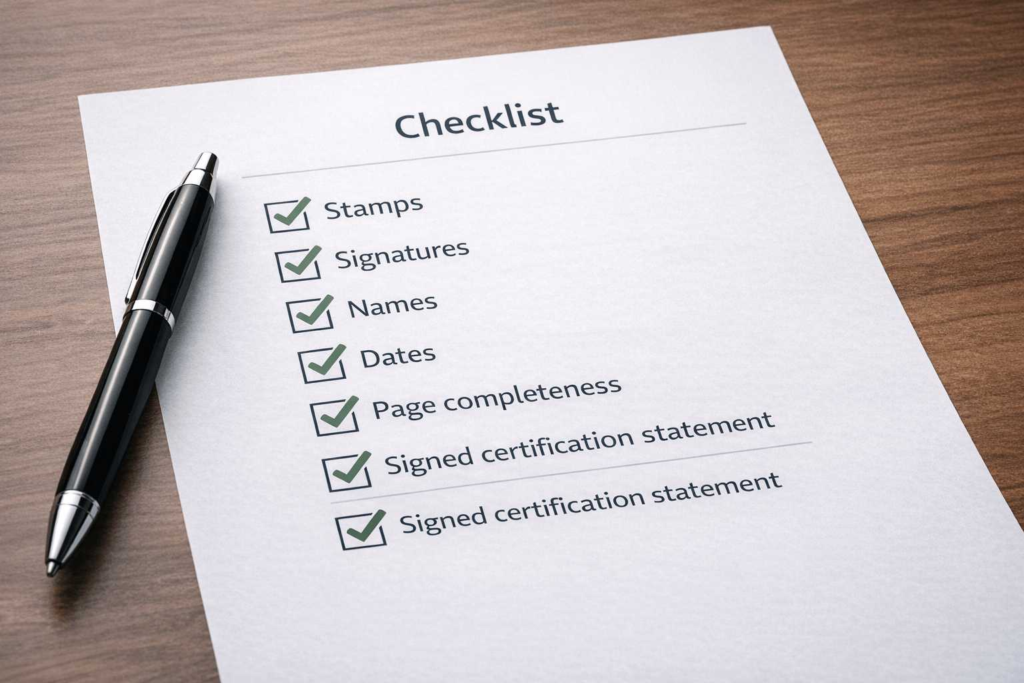
Before you submit, confirm:
- All pages are included (front/back where relevant)
- Names match consistently across the original + translation
- Dates are consistent (and in a clear format)
- Document numbers and issuing authority details are fully included
- Stamps/seals are translated or clearly labelled
- The certification statement is signed and dated
- The translation is cleanly formatted and easy to compare line-by-line
If you’d rather not manage this yourself, you can upload your document and get it prepared in the correct format: certified translation services.
Common myths (and the truth)
Myth: “US immigration requires an ATA-certified translator.”
Truth: Many US immigration filings require a certified translation format (translation + certification statement). ATA certification can be a nice extra, but it’s not automatically required unless stated.
Myth: “Notarised means certified.”
Truth: Notarisation typically verifies the identity of the signer—not the accuracy of the translation itself.
Myth: “If a translator is ATA-certified, any language pair is fine.”
Truth: ATA certification is specific to a language direction. Always confirm the exact language pair.
What does an ATA-certified translator typically provide?
You should expect:
- A complete translation
- A signed certification statement suitable for official use
- Consistent formatting that mirrors the source document structure
- Clear handling of stamps, seals, signatures, and notes
- Professional accountability (revisions for typographical fixes, formatting alignment, and clarity)
A short case-style insight: where people get caught out
A very common issue is not “bad translation,” but missing content:
- a stamp on the back page,
- a handwritten note in the margin,
- a registration number in faint ink,
- or a name that flips order (given name/surname) across documents.
These tiny details cause disproportionate delays. That’s why professional certified translations rely on a completeness-first workflow: everything visible gets translated or labelled—no guessing, no skipping.
FAQs
What is ata certified translator in simple terms?
An ATA-certified translator is a translator who has earned a credential from the American Translators Association for a specific language direction, demonstrating verified translation competence.
Is ATA certification required for a certified translation?
Not usually. A certified translation is typically a complete translation plus a signed certification statement of accuracy and translator competence. ATA certification is only required if the receiving organisation explicitly requests it.
What’s the difference between an ATA certification explained and a notarised translation?
ATA certification explained: a professional credential for the translator. Notarised translation: a notarisation that verifies the identity of the signer, not the translation’s accuracy.
Do I need ATA certified translator for immigration?
In many US immigration cases, you need a properly certified translation (translation + certification statement). You only need an ATA-certified translator if the receiving authority specifically requires that credential.
What does “ATA translator meaning” refer to?
It usually refers to a translator associated with the ATA—either an ATA member or, more specifically, an ATA-certified translator. Membership and certification are not the same thing.
Can a non-ATA translator provide a certified translation?
Yes, in many cases. What matters is that the translation is complete and includes a proper signed certification statement, and that the translator is competent in the language pair.