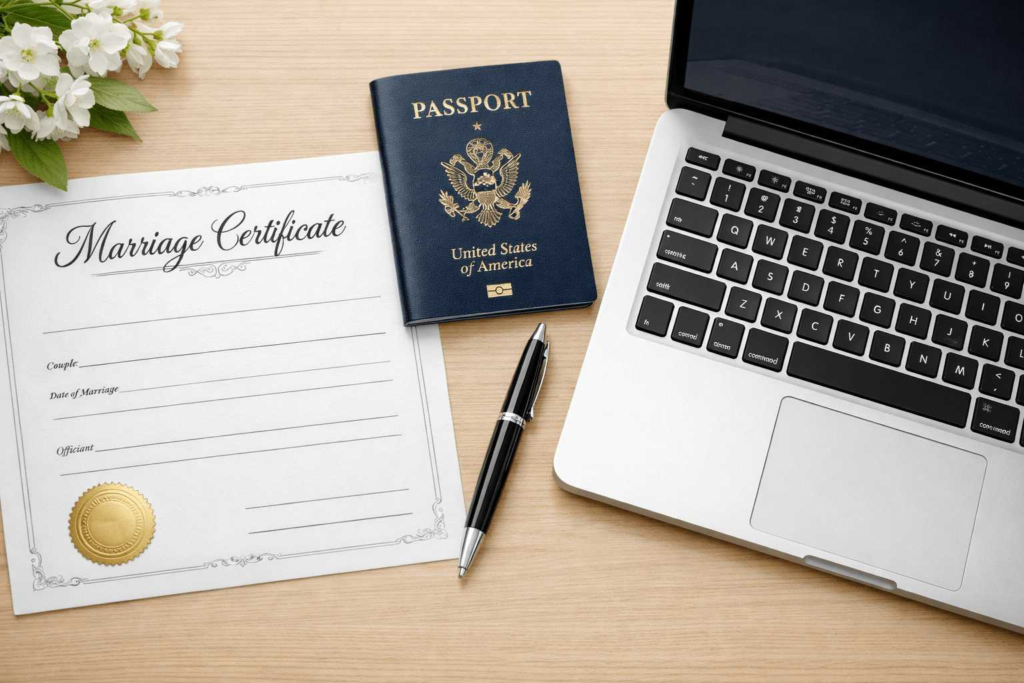
If you need to translate a marriage certificate for immigration, the goal is simple: submit a translation that’s complete, easy to compare with the original, and includes the correct certification—so your case doesn’t get slowed down by avoidable follow-ups.
This guide walks you through exactly what to do, what to avoid, and how to assemble a submission-ready translation packet—whether you’re applying for a spouse visa, a marriage-based green card, citizenship, or a dependent visa.
In a hurry? Here’s the quick version:
Get a clear scan/photo of every page (front, back, stamps, notes, margins).
Translate everything visible (including stamps, seals, handwritten notes).
Keep formatting easy to match the original.
Attach a signed translator certification (accuracy + competence).
Review names/dates carefully and submit original + translation together.
When you’re ready, you can upload your marriage certificate via our contact page, and we’ll confirm turnaround and pricing before we start.
If you need a certified translation of your marriage certificate for UK immigration
If your marriage certificate is not in English or Welsh, the safest approach for a UK visa or immigration application is to submit the original document together with a full English translation and a signed certification from the translator or translation company.
For UK immigration-style submissions, the translation should be complete and independently verifiable. In practice, that means it should include:
- confirmation that it is an accurate translation of the original document
- the date of translation
- the translator’s full name and signature
- the translator’s contact details
If you are applying under a spouse, partner, family, leave to remain, or settlement route, it is also sensible to use a qualified professional translator or translation company and keep their details ready in case the authority wants to verify the translation.
This is the simplest answer to the question most applicants ask: “How do I get a certified translation of my marriage certificate for UK immigration?” You send a clear scan of the certificate, it is fully translated into English, the translator signs the certification, and you submit the original plus the translation together.
Why immigration offices reject marriage certificate translations
Most issues come down to one of these:
Not a full translation (only key fields translated; stamps/notes ignored)
Missing certification (or a certification that lacks key details)
Names don’t match the spelling used on passports/IDs
Pages are missing (back page, registry notes, margins, attachments)
Unclear scan (cropped edges, blur, glare on stamps, low resolution)
Confusing formatting (hard to compare line-by-line with the original)
The fix is not complicated—you just need a repeatable process and a strong final check.
Before you translate: confirm what “marriage certificate” you actually have
Different countries issue different documents that people casually call a “marriage certificate”. Make sure you have the right one for your immigration application.
Common versions include:
Marriage certificate (official certificate issued by a civil authority)
Marriage register extract (often longer and includes registry notes)
Marriage book/family book entry (may include spouses + children)
Religious marriage contract (may not be sufficient without civil registration)
Bilingual certificate (still may require translation, depending on the authority)
Practical tip: If your document has writing on the back, marginal notes, stamps, or endorsements, treat it as a multi-page document even if it’s “one sheet”.
The marriage certificate translation standard that works across most immigration cases
Whether you’re applying in the US, UK, Canada, or elsewhere, the safest approach is:
Translate every visible element (text, stamps, seals, handwritten notes).
Provide a certification statement signed by the translator (or agency representative).
Make the translation easy to compare with the original.
Submit the original-language document + translation together.
If you want a provider to handle this end-to-end, start here: certified translation services.
Step-by-step: translate the marriage certificate for immigration
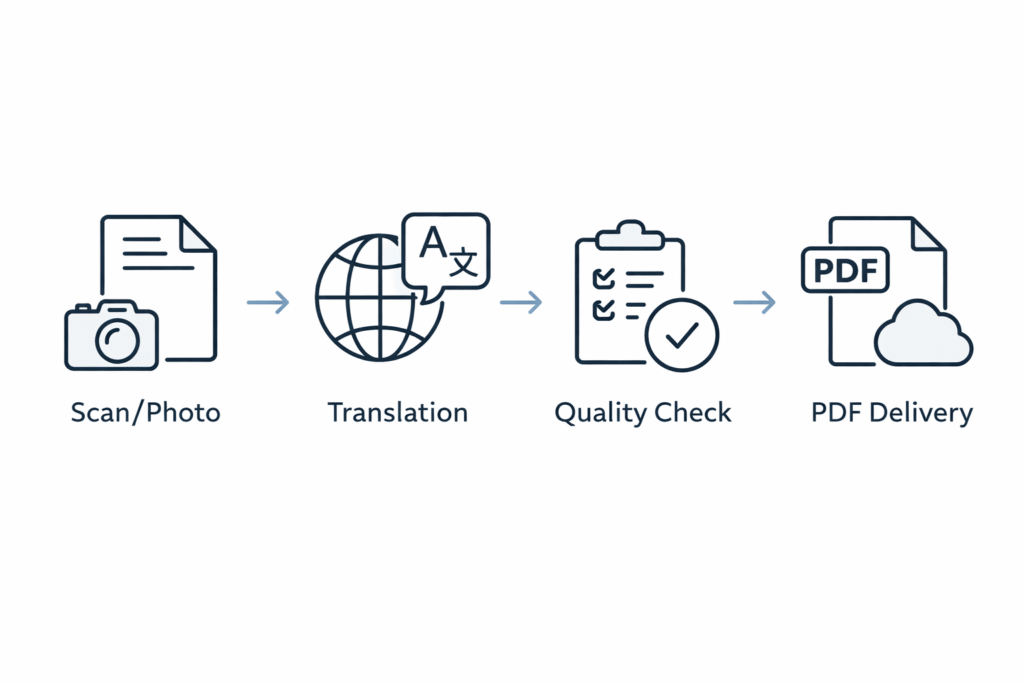
Step 1: Capture a “translator-grade” scan or photo
A clear file prevents errors and avoids delays.
Do this:
Photograph/scan in good light, no shadows or glare
Include the full page (no cropped corners or edges)
Capture front + back, even if you think the back is blank
If there’s an embossed seal, tilt slightly to make it visible
Save as PDF, JPG, or PNG at the best quality you can
Avoid:
Screenshots of zoomed-in sections
Filtered images that reduce legibility
Photos taken through plastic sleeves
Quick check: If you can’t read the stamps when you zoom in, your translator can’t either.
Step 2: Confirm where you’re submitting it (and what language is required)
This matters because “certified”, “sworn”, “notarised”, and “affidavit” mean different things in different places.
Ask yourself:
Is this for USCIS, UKVI, IRCC, an embassy/consulate, or a court?
Do they ask for certified translation, sworn translation, or notarisation?
Do they require an affidavit (common in some Canadian contexts)?
Do they require the translator to include the address/phone?
If you’re unsure, upload the instruction page (or paste the requirement text) along with your certificate so the translation can be prepared to match it.
UK immigration note: when a marriage certificate translation is required
For UK immigration, a marriage certificate that is already in English or Welsh would not normally need translation. If it is in another language, you should submit a full English translation rather than a summary or extract.
If the document contains stamps, registry notes, handwritten annotations, or endorsements in another language, those parts should be translated too. A partial translation can create avoidable delays because the caseworker may not be able to verify the full document record.
Step 3: Decide who should translate it (and when “DIY” is risky)
Some authorities allow any competent person to translate and certify. Even when that’s technically allowed, it can still be risky—especially for immigration—because formatting, completeness, and certification wording must be right.
Use a professional when:
You’re filing a time-sensitive application
The certificate has stamps, handwritten notes, and registry endorsements
The language uses non-Latin scripts (Arabic, Cyrillic, Chinese, etc.)
Names require careful transliteration, or multiple spellings exist
Your case has prior marriages/divorces or name changes
If you choose to use a friend/relative translator, make sure they understand they must translate everything and provide a complete certification statement. If anything looks off, it’s often faster (and cheaper) to redo it correctly once than to fix it after a request for additional evidence.
Step 4: Provide name spellings and “must-match” details upfront
To prevent mismatches, provide the spellings you want used in English (usually matching passports/IDs):
Full legal names for both spouses (as shown on passports)
Any prior names / maiden names (and where they appear)
Dates of birth (confirm format: DD/MM/YYYY vs MM/DD/YYYY)
Places (city/region/country—spellings you prefer)
Document numbers and issuing authority names
Pro tip: If the original uses diacritics (é, ü, ñ) or multiple alphabets, agree on a consistent approach before translation begins.
Step 5: Translate everything—and label what isn’t “normal text”
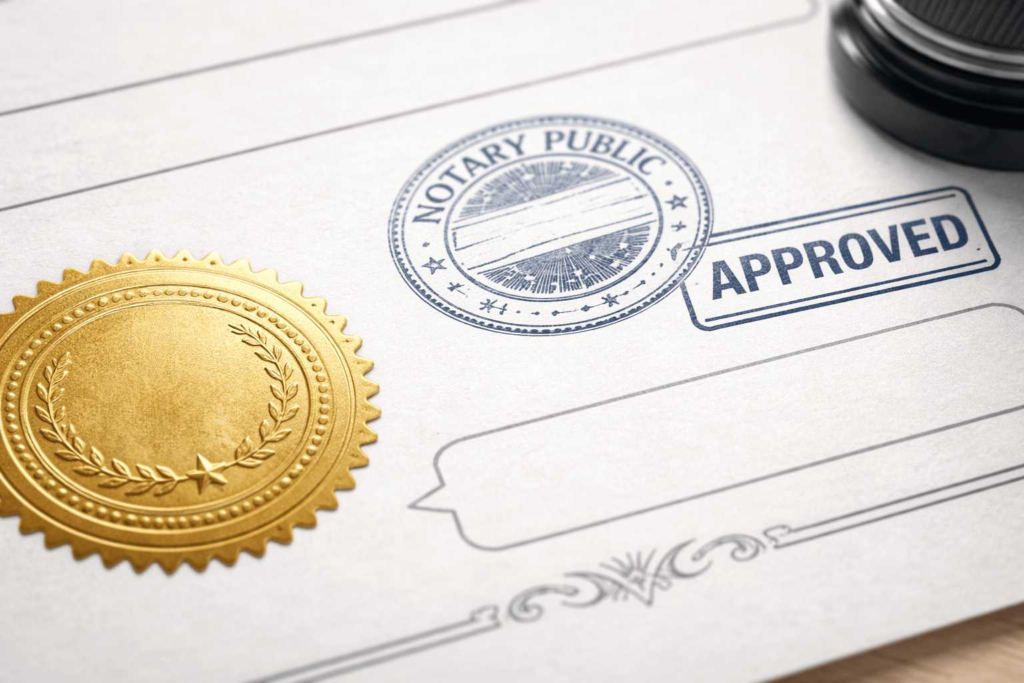
A submission-ready translation typically includes:
All printed fields
Registry notes and margin annotations
Stamps and seals (including partial stamps)
Handwritten entries
Signatures (usually labelled, not “translated”)
Watermarks, if they carry meaningful text (when visible)
Any apostille/endorsement pages attached to the certificate
How to label non-text elements (clean and clear):
[Stamp: City Registry Office – Date]
[Seal: Ministry of Interior]
[Handwritten note: …]
[Illegible stamp] (only if truly unreadable)
[Signature] (optionally: [Signature: Registrar] if named)
This is one of the biggest differences between “a translation” and “a translation that immigration officers accept without question”.
Step 6: Add a proper certification statement (signed and dated)
The certification is not optional in most immigration contexts. It should confirm:
The translation is complete and accurate
The translator is competent in both languages
It is signed and dated
It includes the translator’s printed name (and often contact details)
You’ll find copy-and-paste templates below.
What a UK immigration marriage certificate translation should include
If you want your translation to be submission-ready for a UK immigration application, check that it includes:
- a full translation of every visible part of the marriage certificate
- confirmation that the translation is accurate
- the date of translation
- the translator’s full name and signature
- the translator’s contact details
- where relevant, the translation company name and the authorised signatory
If you are submitting a family-route application, it is also wise to use a qualified professional translator or agency and ensure the translation can be independently verified if requested.
Step 7: Do a final “immigration officer review” before submission
Before you submit, check:
All pages included (front/back/attachments)
Every stamp/seal is accounted for in the translation
Names match the passport spellings you intend to use
Dates are consistent and correctly formatted
The certification is signed and dated
The translation is easy to compare against the original (no missing sections)
If you want a second set of eyes, use our upload form, and we’ll flag any obvious risks before finalising.
Step 8: Assemble the translation packet the tidy way
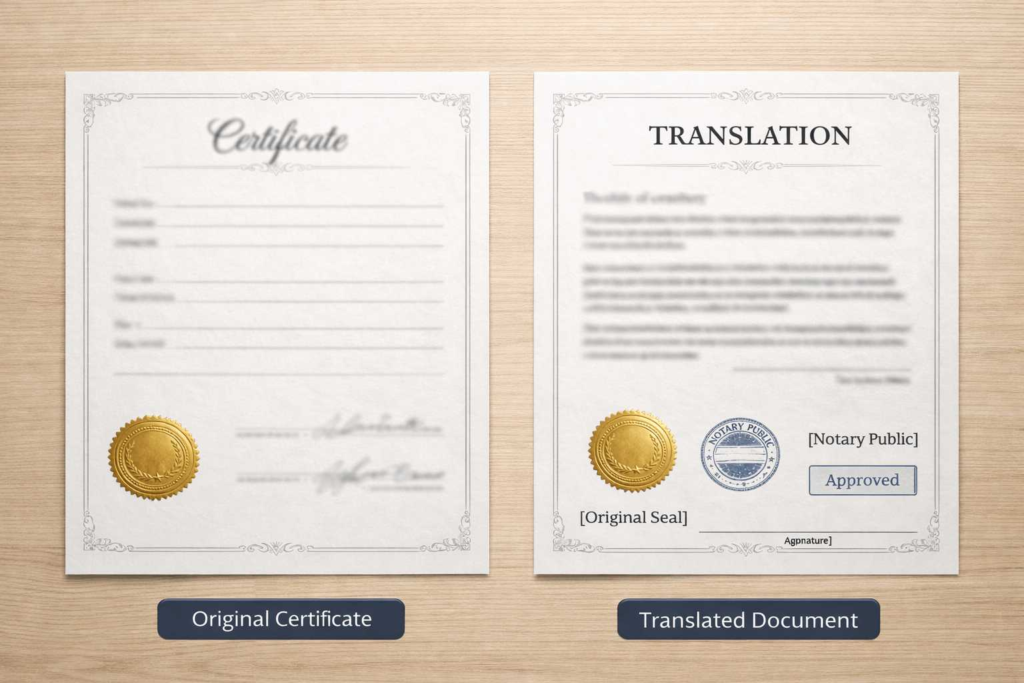
A clean packet reduces confusion:
Original document scan (all pages)
Fully translated document
Certification statement (either on the translation or as a separate page)
If you’re submitting online, keep it as one PDF where possible. If you’re submitting by post, keep pages clipped together in the same order.
Copy-and-paste templates: marriage certificate translation certification
Template A: Translator certification (simple and widely accepted)
Certificate of Translation Accuracy
I, [Full Name], certify that I am fluent in [Source Language] and English, and that the attached translation of [Document Name: Marriage Certificate] is a complete and accurate translation of the original document.
Translator name: [Full Name]
Signature: _______________________
Date: [DD Month YYYY]
Contact details: [Email and/or phone]
Address (if required): [Address]
Template B: Agency certification (clean “submission-ready” format)
Certificate of Translation Accuracy
This is to certify that the attached translation of [Marriage Certificate] from [Source Language] into English is a complete and accurate translation of the original document. The translation was completed by a qualified translator competent in both languages.
Authorised representative: [Name]
Company: Urgent Certified Translation
Signature: _______________________
Date: [DD Month YYYY]
Contact: [Email/phone]
Important: Don’t overcomplicate this. Clarity beats legal-sounding wording.
Formatting rules that prevent delays (and make your translation look professional)
A strong immigration marriage certificate translation is:
Typed (not handwritten)
Complete (everything translated, nothing skipped)
Structured to match the original (same order of fields)
Legible and easy to cross-check
Best-practice formatting choices
Use headings like: Document Title, Issuing Authority, Registry Details
Keep tables as tables if the original is tabular
Mirror field order as closely as possible
Preserve numbers exactly (document numbers, dates, registry references)
Use consistent transliteration for names and places
Dates: choose clarity over assumptions
If the original date format could be ambiguous, present it clearly:
12/03/2024 (12 March 2024)
This prevents confusion where the day/month order differs.
Common mistakes (and exactly how to avoid them)
Mistake 1: Translating only the “main text”
Fix: Translate stamps, seals, marginal notes, handwritten entries, and endorsements.
Mistake 2: Missing the back page or attachments
Fix: Always scan front + back. Include any apostille pages or registry endorsements.
Mistake 3: Names don’t match passport spelling
Fix: Provide your preferred spelling before translation starts and keep it consistent.
Mistake 4: No certification, or certification missing key details
Fix: Use one of the templates above. Ensure it’s signed and dated.
Mistake 5: Unclear or cropped scan
Fix: Retake photos in daylight, include full edges, and avoid glare.
Special situations (that catch people out)
If your certificate is bilingual
Some immigration offices still ask for a certified translation even if English appears on the document—especially if:
The English text is partial
There are stamps/notes only in another language
The officer needs a certified statement for the translation
A safe approach: translate the non-English parts and certify the full document package.
If your marriage was registered late or amended
Late registrations and amendments are common in some countries. Translate the notes carefully, and ensure the timeline reads clearly.
If you have a religious marriage document
If you only have a religious contract, you may also need the civil registration record. Translate what you have, but confirm whether civil registration evidence is required for your specific application.
If there’s an apostille or legalisation page
Translate it too. Officers often look at seals, dates, and authority names on endorsements.
Notarisation, sworn translation, apostille: do you need them?
Often, immigration applications only require a certified translation with a proper certification statement.
You might need notarisation or a sworn translation when:
The receiving authority explicitly requests it
You’re submitting to a court, consulate, or specific government office with stricter rules
You’re using the translation for multiple purposes across different jurisdictions
If you’re not sure, upload the requirement text along with your certificate via our contact page, and we’ll advise what’s typically requested for that authority.
How long does it take (and what affects the cost)
Typical turnaround for a marriage certificate translation
Most standard certificates: same-day to 24–48 hours (depending on language and legibility)
Complex certificates (multiple pages, heavy stamps/handwriting): longer
Rush service: possible if your scan is clear and the requirements are straightforward
What affects price
Language pair (rarer languages may cost more)
Number of pages (including back pages and endorsements)
Density (some “one-page” certificates contain a lot of text)
Urgency
Extra requirements (notarisation, sworn format, affidavits)
If you want a fast, clear quote, start with: Upload your file.
A submission-ready checklist you can use today

Before you submit your immigration marriage certificate translation, confirm:
Front and back scanned (all pages included)
All stamps, seals, and handwritten notes translated or labelled
Names match passport spelling (consistent throughout)
Dates are correct and clearly formatted
Document numbers and issuing authority details included
Certification statement included, signed, and dated
Translation is easy to compare with the original
Final file is clean, readable, and properly labelled
If you’d like us to run this checklist for you, use our certified translation services.
Frequently asked questions
Can I translate my marriage certificate for immigration myself?
Sometimes it may be allowed, but it’s risky. The translation must be complete, correctly formatted, and include a proper certification statement. If anything is missing or unclear, you may face delays. A professional translator reduces that risk—especially when stamps, handwritten notes, or name transliterations are involved.
Do I need a notarised marriage certificate translation for USCIS?
In many cases, notarisation is not required for a standard immigration submission. What matters most is a complete translation plus a signed certification of accuracy and translator competence. Only add notarisation if your receiving authority specifically requests it.
What must the translator certification include for an immigration marriage certificate translation?
At minimum: a statement that the translation is complete and accurate, confirmation the translator is competent in both languages, and a signature with the date. Many authorities also expect the translator’s printed name and contact details.
How much does it cost to translate a marriage certificate for immigration?
Costs vary by language, length, and urgency. A “one-page” certificate with dense text, stamps, and endorsements can require more work than expected. The most accurate way is to upload the document and receive a fixed quote before work begins.
How fast can I translate a marriage certificate for immigration?
With a clear scan and standard requirements, many marriage certificates can be completed quickly (often same-day or within 24–48 hours). If you’re facing a deadline, submit your file early and include your required submission date.
Do I need to translate stamps and seals on my marriage certificate?
Yes. Stamps, seals, registry notes, and handwritten entries are frequently treated as part of the record. If they appear on the document, they should be translated or clearly labelled in the translation.
Do I need a certified translation of my marriage certificate for UK immigration?
If your marriage certificate is not in English or Welsh, you should provide the original document together with a full English translation that includes the translator’s certification details. For UK immigration applications, the translation should be complete and capable of being independently verified.
What must a marriage certificate translation include for UK immigration?
A strong UK immigration translation should include confirmation that it is accurate, the date of translation, the translator’s full name and signature, and the translator’s contact details. It should also translate stamps, seals, notes, and handwritten entries—not just the main typed text.
Can a translation company certify a marriage certificate for UK immigration?
Yes. A translation company can usually certify the translation through the translator or an authorised official, as long as the translation includes the required certification details and can be independently verified.
Does the UK government translate marriage certificates?
No. UK government translation services do not translate civil status documents such as marriage certificates. In most cases, you will need to use a professional translator or translation agency.
If I am applying for a spouse or family visa, does anything extra matter?
Yes. For spouse, partner, family, leave to remain, or settlement applications, it is especially important that the translation is full, dated, signed, and easy to verify. Using a qualified professional translator or agency helps reduce the risk of delays.