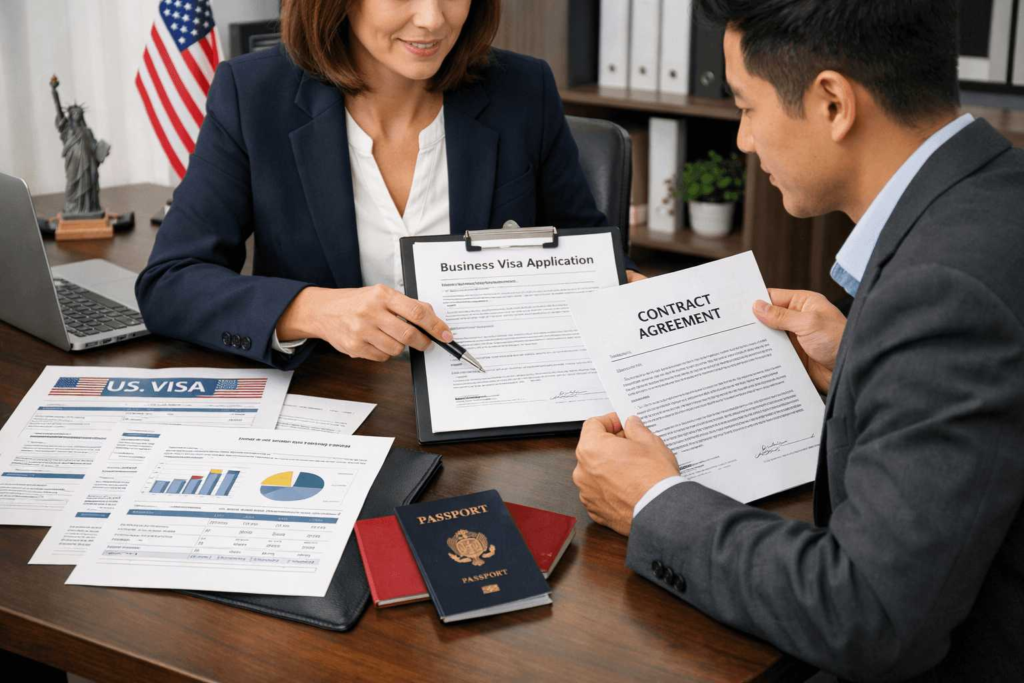
Business immigration cases are often won or lost on documentation quality, not just eligibility. For L-1 and E-2 filings, your evidence usually includes a mix of corporate records, financial documents, contracts, ownership papers, bank statements, and personal civil documents. When even one key exhibit is unclear, incomplete, or inconsistently translated, it can slow legal review, trigger follow-up requests, or weaken an otherwise strong case.
If you are preparing an L-1 or E-2 case, treat translation as part of your case strategy, not a last-minute admin task. A properly prepared translation set helps your attorney or case team build a cleaner narrative, cross-reference evidence quickly, and present a professional package to USCIS or a U.S. consulate.
Urgent Certified Translation supports business immigration applicants, founders, executives, and legal teams with certified translations tailored for visa filings, including high-volume corporate packs and time-sensitive submissions. You can start by uploading your files and getting a document-by-document review, so you know exactly what needs translating before deadlines get tight.
Best business visa translation services in the UK: what applicants should look for
When people search for the best business visa translation services in the UK, they are usually not looking for a basic one-page document translation. They are looking for a provider that can handle certified translations for corporate, legal, financial, and supporting civil documents used in business immigration cases such as L-1 and E-2 filings.
The best business visa translation service for a U.S. immigration case is usually one that can provide certified English translations for foreign-language business records, maintain consistency across a large evidence pack, and organise delivery in a way that supports legal review. In practice, that means the provider should be comfortable translating company formation records, shareholder documents, contracts, bank statements, tax evidence, business plans, leases, and role-related employment documents—not just passports or certificates.
If you are comparing providers, look for a service that offers:
- Certified translations for business immigration submissions
- Experience with corporate, financial, legal, and investor documents
- Consistent terminology across multi-document exhibit packs
- Clear file naming and structured delivery for legal teams
- Fast turnaround for urgent filing or interview deadlines
- Support for both USCIS filings and consular E-2 document packs
If you are searching for a provider in the UK, what matters most is not just speed or price. It is whether the translation team can preserve business meaning across the full evidence set, so company names, role titles, investment records, ownership terms, and financial language all remain consistent from one exhibit to the next.
What makes L-1 and E-2 translation work different from standard immigration translations
Most immigration translation jobs involve civil records (birth, marriage, police certificates, diplomas). L-1 and E-2 cases are different because they are evidence-heavy and business-led. The case usually depends on whether the documents collectively prove a commercial story:
- L-1: qualifying corporate relationship, role, and operational need
- E-2: treaty-country eligibility, investment structure, source of funds, and real business activity
That means the translation work must do more than convert language. It must preserve business meaning, legal structure, and document consistency across a large evidence set.
Why this matters in practice
In business immigration cases, common issues include:
- Company names are translated inconsistently across different exhibits
- Corporate roles rendered differently (e.g., director/manager/executive)
- Financial statements translated without preserving line-item context
- Contracts translated without annexes, stamps, or signature notes
- Scans submitted in the wrong order, making legal review slower
- Exhibits translated, but not indexed to match the final petition bundle
A strong translation workflow reduces all of these risks and makes your legal submission easier to review.
The translation rule you need to follow
For U.S. immigration filings, any foreign-language document submitted to USCIS must be accompanied by a full English translation and a translator certification stating the translation is complete and accurate and that the translator is competent to translate. That requirement is simple, but many applicants still get caught out by partial translations, missing certifications, or inconsistent exhibit labelling.
For consular E-2 processing, requirements can vary by embassy or consulate, and some posts also issue post-specific document packaging instructions. This is why business visa translation should be prepared alongside the consulate’s local checklist (when applicable), not just the general visa instructions.
Do business visa documents need a certified translation?
Yes. If a foreign-language document is being submitted as part of an L-1 or E-2 case, it should normally be translated into full English and accompanied by the appropriate translator certification for USCIS use. This applies not only to personal civil records, but also to corporate records, ownership documents, contracts, bank statements, tax papers, board resolutions, and other commercial evidence that supports the case.
For E-2 consular applications, the exact presentation requirements can vary by post, which is why translation should be prepared with both the core visa rules and the relevant embassy or consulate instructions in mind.
L-1 vs E-2: what needs translating in each case
L-1 visa translation focus (intracompany transfer)

L-1 cases are usually built around a corporate relationship and a qualifying role. Your translations should make it easy to prove:
- The relationship between the foreign entity and the U.S. entity (parent, branch, affiliate, subsidiary)
- The beneficiary’s prior employment abroad
- The beneficiary’s position and duties
- The U.S. role and why it qualifies as managerial, executive, or specialised knowledge
- For new office cases, operational readiness and business capacity
Typical L-1 documents that often need certified translation
Corporate relationship and registration evidence
- Articles of incorporation/certificate of incorporation
- Commercial registry extracts
- Shareholder registers
- Memorandum and articles/bylaws
- Group structure documents
- Board resolutions
- Business licences
- Certificates of good standing
Employment and role evidence
- Employment contracts
- HR letters confirming dates, title, and duties
- Payroll records
- Organisational charts
- Internal reporting lines
- Performance records (where relevant)
- Assignment letters/transfer letters
New office evidence (common for L-1 new office cases)
- Office lease agreement
- Premises evidence (lease, floor plan, utility records)
- Business plan
- Capitalisation documents
- Bank statements
- Vendor contracts
- Service agreements
- Recruitment plans
Supporting commercial evidence
- Invoices
- Purchase orders
- Client contracts
- Tax records
- Annual accounts / financial statements
- Audit documents
If your L-1 case includes a large number of exhibits, ask for a translated package that mirrors your attorney’s exhibit numbering. That one step can save hours during petition assembly.
E-2 visa translation focus (investor or essential employee)

E-2 cases usually require a more detailed documentary trail because the file must demonstrate both the investment and the business reality behind it. Translation quality is especially important when the source-of-funds trail spans multiple countries or multiple document types.
Typical E-2 documents that often need certified translation
Treaty investor eligibility and ownership
- Passports (for nationality evidence)
- Share certificates
- Shareholder agreements
- Articles/bylaws
- Company registration records
- Ownership structure charts
- Operating agreements
Investment and source-of-funds evidence
- Personal and business bank statements
- Sale agreements (property or business sale)
- Loan agreements
- Gift declarations (if applicable)
- Tax returns
- Wire transfer confirmations
- Escrow records
- Capital contribution records
Business viability and operational evidence
- Business plans
- Commercial leases
- Supplier agreements
- Client contracts
- Invoices and receipts
- Payroll records
- Marketing materials
- Licences and permits
- Financial projections
Employee or executive E-2 cases
If the applicant is an executive, manager, or essential employee, translations often need to support:
- Role necessity
- Executive/supervisory or essential function
- Qualifications and experience
- Employer ownership/nationality structure
- Internal operational dependence on the applicant’s role
This is where terminology consistency matters most. The same role title should not be translated one way in the employment letter and another way in the org chart.
Business visa documents that commonly need a certified translation
If you want a quick answer, the business visa documents most commonly translated in L-1 and E-2 cases include:
- Certificates of incorporation and commercial registry extracts
- Articles, bylaws, operating agreements, and board resolutions
- Share certificates, shareholder registers, and ownership charts
- Employment contracts, HR letters, and assignment letters
- Organisational charts and reporting-line documents
- Business plans, office leases, and licences
- Personal and business bank statements
- Tax returns, annual accounts, and financial statements
- Wire transfer confirmations and source-of-funds evidence
- Supplier agreements, client contracts, invoices, and receipts
- Passports and supporting civil records, where relevant
This kind of evidence is central to many business immigration filings. It is not unusual for a single case to include legal, financial, commercial, and personal documents that all need to work together as one coherent submission.
A better way to organise translations for business immigration cases
Most delays happen because documents are translated one file at a time with no case structure. A stronger approach is to use a visa evidence translation matrix before translation starts.
The visa evidence translation matrix (recommended workflow)
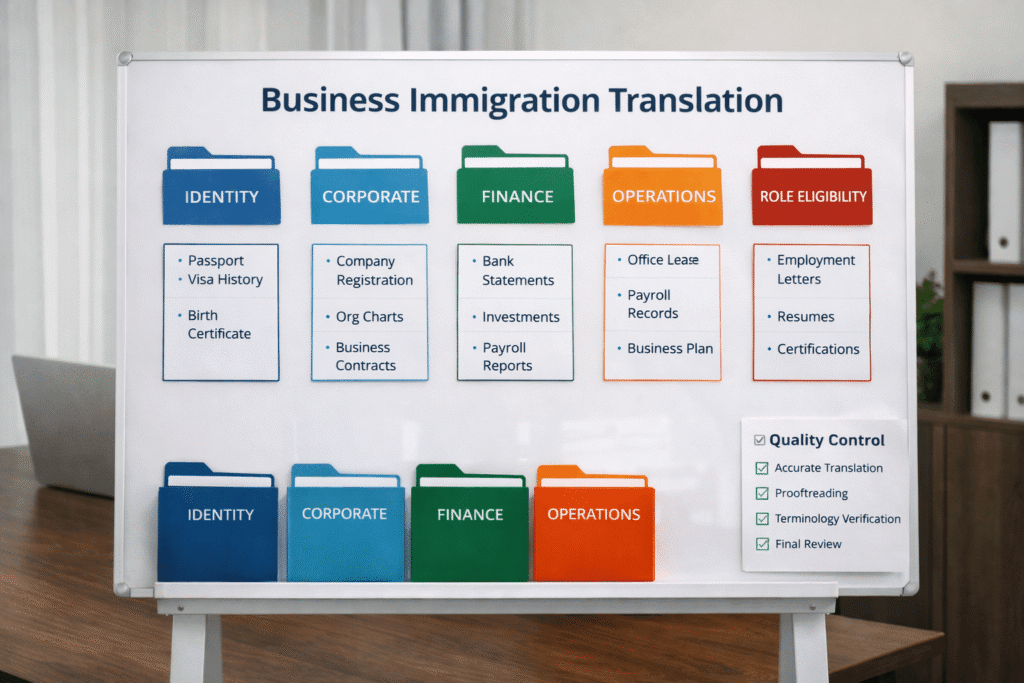
Sort every document into one of these five buckets before sending files for translation:
- Identity & civil
Passports, marriage certificates, birth certificates (dependants), civil status records - Corporate authority
Registration records, shareholder records, articles, resolutions, licences - Funds & finance
Bank statements, tax records, transfer records, source-of-funds evidence, accounts - Operations & commercial activity
Contracts, invoices, leases, payroll, supplier docs, customer docs - Role & eligibility
Employment letters, CVs, org charts, job descriptions, assignment documents
Why this works
- Keeps the legal argument clear
- Prevents duplicate translation of overlapping exhibits
- Helps maintain naming consistency across the entire file
- Makes urgent/rush translation easier to prioritise by evidential value
If you are working with a solicitor or immigration attorney, share the matrix with them before finalising the translation batch. It improves both translation accuracy and legal drafting efficiency.
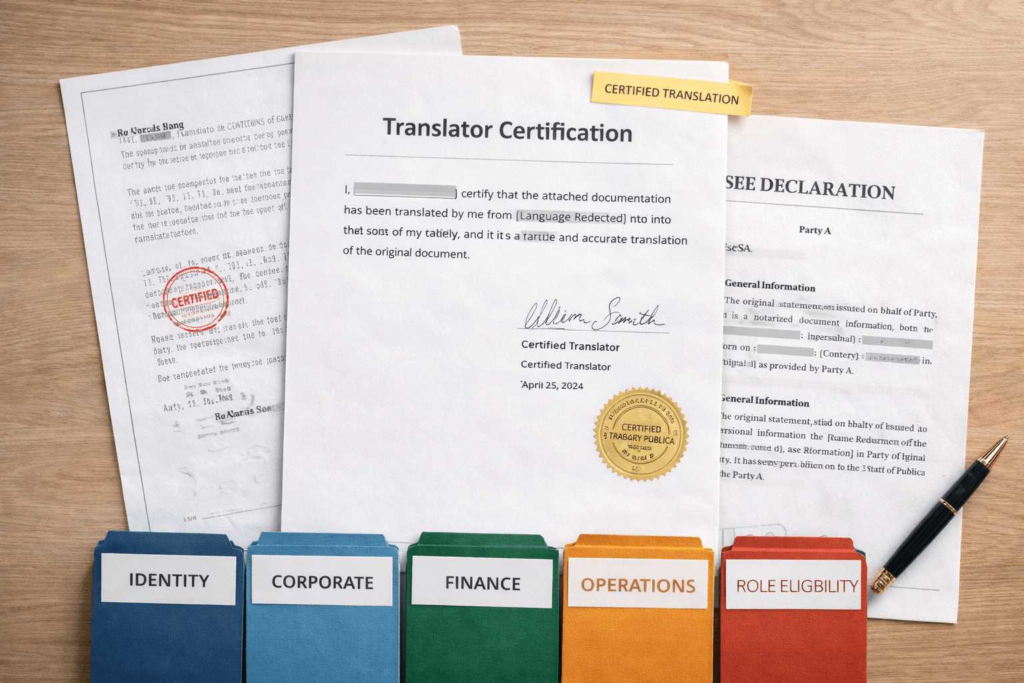
What “certified translation” should include for L-1/E-2 filings
A business immigration translation should be more than a plain translated text document. For professional filing use, your translation set should include:
- Complete translation (not summary-only)
- Translator certification statement
- Clear file naming aligned to exhibit labels
- Preserved business terms (company names, legal forms, titles, numbers)
- Notes for seals, stamps, signatures, and handwritten entries where relevant
- Formatting that matches the source document structure as closely as practical
Certified vs notarised vs sworn translations
These are not the same thing, and mixing them up causes delays.
- Certified translation (U.S. immigration use): English translation plus translator certification
- Notarised translation: translator’s signature is notarised (only needed when specifically requested)
- Sworn translation: a separate legal category used in some countries, often performed by court/sworn translators
For L-1 and E-2 cases, the right choice depends on the filing route and the post-specific requirements. If your attorney or consulate instructions do not require notarisation, do not assume it is mandatory.
Common mistakes that weaken L-1/E-2 cases
1) Translating only “important pages”
Partial translation is one of the fastest ways to create problems in a business immigration file. If a document is submitted, it should usually be translated fully unless your legal adviser instructs otherwise.
2) Inconsistent company names across exhibits
If the same company appears as:
- “ABC Holding Ltd”
- “ABC Holdings Limited”
- “ABC Group”
…in different translations, it can create avoidable confusion in ownership and relationship analysis.
3) Losing legal or accounting meaning during translation
Literal translations can distort:
- capital account entries
- shareholder terminology
- legal entity types
- management titles
- tax classifications
Business immigration translators should preserve legal and commercial meaning, not just wording.
4) Submitting translations with no case structure
Even accurate translations become difficult to use if they are not labelled and grouped properly. For larger L-1/E-2 files, structure is part of quality.
5) Waiting until the interview or petition deadline is close
E-2 packs and L-1 petitions can involve a high number of documents. Translation bottlenecks are common when clients send everything at once, 24–48 hours before filing.
If you are on a deadline, send the documents in tiers:
- Tier 1: core eligibility and filing-critical exhibits
- Tier 2: supporting evidence
- Tier 3: extra corroboration
That approach allows your case to move while the remaining evidence is finalised.
How to prepare your files for faster turnaround and fewer revisions
Before you send documents for translation, do this quick prep:
File prep checklist
- Use clear scans (not phone photos taken at an angle)
- Keep multi-page documents in one file (PDF preferred)
- Do not crop out seals, signatures, or margins
- Keep original file names if your lawyer already assigned exhibit numbers
- Flag urgent filing dates
- Identify the visa type (L-1A, L-1B, E-2 investor, E-2 employee)
- Tell the translation team where the case will be filed (USCIS or consulate/post)
For E-2 source-of-funds files
Source-of-funds evidence is often the largest translation workload in E-2 cases. To make this manageable:
- group by source (salary, property sale, dividends, loan, savings)
- sort chronologically
- include simple notes (e.g., “sale proceeds transferred to US account”)
- highlight the documents your attorney considers primary evidence
This reduces back-and-forth and helps the translator keep the narrative consistent.
L-1/E-2 translation timelines and rush planning
Business immigration translation timing depends on:
- number of documents
- quality of scans
- complexity (legal + financial + corporate)
- formatting needs
- whether the package is being prepared for USCIS or a consular post
Practical planning guidance
- Small file (civil + core business docs): often manageable quickly
- Medium file (corporate + financial + employment): allow extra time for QA
- Large E-2 pack (source of funds + operating evidence): plan in phases
If you need a rush turnaround, the best way to avoid errors is to send a prioritised batch first and let the rest follow. Urgent Certified Translation can review your file set and identify the fastest path to a submission-ready translation package.
Start your project by sending the files you already have, even if the case bundle is not complete yet. That keeps your legal timeline moving.
How to choose the right business visa translation service in the UK
If you are comparing business visa translation services in the UK, check whether the provider can:
- Handle both business and immigration documents in the same file set
- Translate full exhibit packs rather than isolated pages
- Maintain consistent company names, dates, figures, legal terms, and role titles throughout the case
- Include the correct translator certification with each required document
- Preserve seals, signatures, handwritten notes, and source-document structure where relevant
- Deliver in stages when a filing deadline is close
- Organise files in a way that supports legal review and petition assembly
This matters because a provider that mainly handles simple civil-document translations may not be the best fit for an L-1 or E-2 case. Business immigration files are more terminology-sensitive, more document-heavy, and more dependent on pack-level consistency across legal, financial, and operational evidence.
How Urgent Certified Translation supports business immigration filings
We handle L-1 and E-2 translation work with a filing-focused process designed for business documents, not just generic immigration paperwork.
What clients typically need from us
- Certified translations for USCIS-ready submissions
- Consular-ready translation sets for E-2 interviews
- Corporate and financial document translation
- Fast turnaround for filing deadlines
- Consistent terminology across large exhibit packs
- Clean formatting and translator certification included
What you can expect
- A document-by-document review before work starts
- Clear identification of what needs translating first
- Consistent naming and terminology across exhibits
- Delivery files organised for legal review
- Support for follow-up exhibits if your case expands
If you are preparing an L-1 or E-2 case now, upload your files and request a business immigration translation review. A clean, well-organised translation set makes the rest of the case easier.
If you are still comparing options, focus on whether the service can handle the full business evidence pack—not just one or two certificates. For related filing questions, you can also read more translation guides on our blog or contact our team for a document-by-document review before your filing or interview deadline.
Frequently Asked Questions
Do L-1 visa documents need a certified translation for USCIS?
Yes. If you submit foreign-language documents to USCIS in an L-1 filing, they should be accompanied by a full English translation and a translator certification confirming accuracy and competence. This applies to corporate, employment, and supporting business records—not only civil documents.
What is included in an E-2 visa translation package?
An E-2 visa translation package typically includes certified translations of ownership records, bank statements, source-of-funds evidence, company registration documents, contracts, leases, and other operational records. The exact documents vary by case and by embassy/consulate instructions.
Is notarisation required for business immigration document translation?
Not always. Certified translation is commonly what is required for U.S. immigration use. Notarisation may be requested in specific situations, but it is not automatically required for every L-1 or E-2 case.
Can I translate my own business immigration documents?
Some guidance sources discuss self-translation in limited contexts, but for business immigration filings, it is generally safer to use an independent professional translator to avoid credibility issues, formatting problems, and terminology inconsistencies—especially for corporate and financial evidence.
Do E-2 essential employee cases require the same translation depth as principal investor cases?
They often require a different focus, not necessarily less work. Essential employee cases may need more detailed role, operational, and qualification evidence, while principal investor cases often require more source-of-funds and investment-trace documentation.
How fast can I get certified translations for an L-1 or E-2 filing?
Timing depends on file volume and complexity. For urgent matters, the fastest route is to send your documents in priority order (core exhibits first), so the translation team can begin immediately and deliver in stages.
What are business visa translation services?
Business visa translation services are certified translation services for corporate, financial, legal, and personal documents used in business immigration cases. For L-1 and E-2 matters, this usually means translating the evidence that proves company structure, investment history, role eligibility, and ongoing business activity—not just identity documents.
Which business documents usually need certified translation for an L-1 or E-2 application?
The most common documents are corporate registration records, shareholder and ownership documents, board resolutions, employment letters, org charts, leases, business plans, bank statements, tax records, contracts, invoices, and source-of-funds evidence. The exact list depends on whether the case is an L-1 transfer, an E-2 investor application, or an E-2 employee case.
Can a UK translation company prepare documents for USCIS or a U.S. consulate?
Yes. A UK-based translation company can prepare certified English translations for U.S. immigration use, provided the translations meet the relevant filing requirements. What matters is compliance, completeness, certification, and accurate handling of business terminology—not the translator’s physical location.
Do bank statements and company incorporation papers need certified translation for business visa cases?
If they are in a foreign language and you plan to rely on them in the case, they will usually need full translation. In business immigration matters, bank statements, company incorporation documents, shareholder records, tax papers, contracts, and investment evidence are often central exhibits, not secondary paperwork.
What should I look for when comparing business visa translation services in the UK?
Look for a provider that understands corporate and financial terminology, offers certified translations, can manage large evidence sets, keeps terminology consistent across the entire file, and can organise delivery in a way that matches your legal bundle or filing priority.