If you’re applying for a U.S. passport and your birth certificate isn’t in English, the translation can feel like a small detail—until it becomes the reason your application stalls.
The good news: once you understand what the passport office expects, getting a compliant birth certificate translation for passport use is straightforward. This guide walks you through exactly what to do, what to avoid, and how to submit a passport-ready translation package the first time.
If you’d like a submission-ready translation prepared and checked end-to-end, you can start here: Upload your birth certificate for certified translation services.
Applying for a UK passport instead?
If you are here because you need to know how to get a birth certificate translated for a UK passport application, the answer is slightly different from the U.S. process explained on the rest of this page.
HM Passport Office guidance says that if your passport documents are not in English or Welsh, you must provide a certified translation. The online passport service says applicants should send the original document and the certified translation. GOV.UK guidance for paper and overseas passport applications adds that the official translation should be signed and stamped by a translator who is a member of a recognised professional organisation. GOV.UK’s certification guidance also says the translation should confirm that it is a true and accurate translation of the original, and include the date of translation, plus the translator’s full name and contact details.
In practical terms, if your birth certificate is not in English or Welsh, a UK passport-ready package should normally include:
- the original birth certificate or official copy
- the full certified English or Welsh translation
- the translator’s certification details
- clear, consistent spelling of names and dates across your supporting documents
This matters because HM Passport Office also checks whether the name on the passport application matches the name shown on foreign documents. If the spelling cannot be corrected on the underlying document, you should be ready to explain the difference and provide supporting evidence where needed.
Quick UK passport answer
If you need a short, direct answer for a UK passport application:
If your birth certificate is not in English or Welsh, get a certified translation, send the original document with the translation, and make sure the translation includes the translator’s certification details. For paper or overseas applications, HM Passport Office guidance says the translation should be signed and stamped by a translator who is a member of a recognised professional organisation.
When you need a birth certificate translation for a passport
You’ll typically need to translate a birth certificate for passport purposes when:
Your birth certificate is issued in a language other than English
You are applying for a passport and using a foreign birth certificate as part of your citizenship evidence
You are applying for a child’s passport and the child’s supporting civil documents aren’t in English
Your supporting records include annotations, stamps, or notes in another language (even if the main certificate looks “mostly English”)
The most common scenario
You were born outside the United States, and your application includes a foreign birth certificate as part of the evidence you’re submitting. In that case, a passport application translation of the birth certificate is often required.
The passport translation rule people miss (certified vs notarised)
A lot of online advice mixes up two different processes:
USCIS document translations (immigration filings)
U.S. passport applications (Department of State)
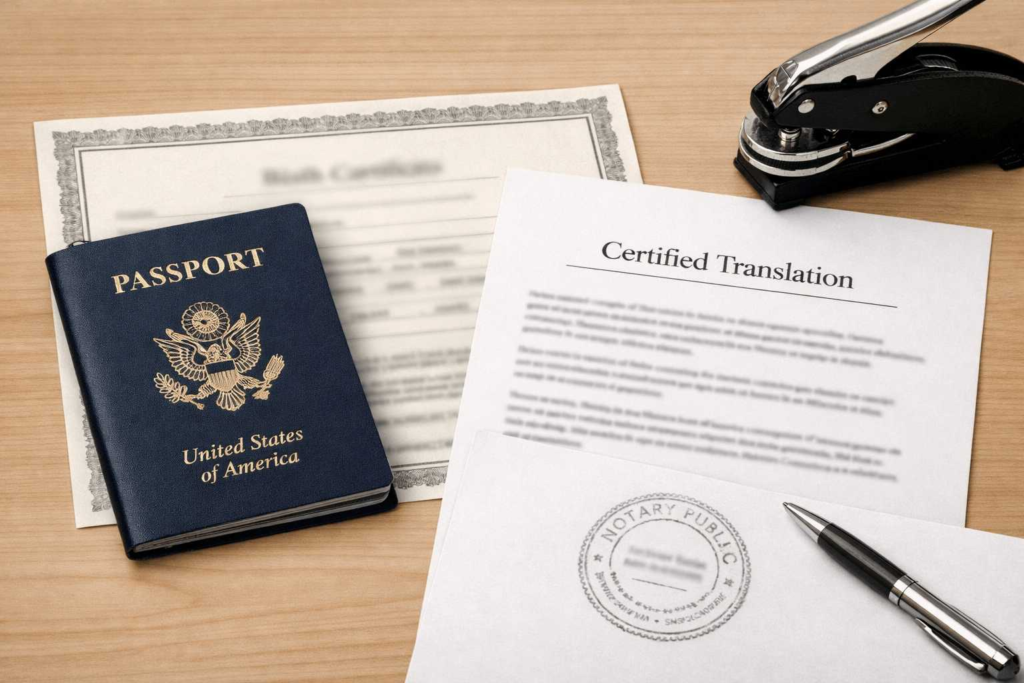
For passport purposes, it’s common for applicants to need a translation that is not only certified, but also supported by a notarised translator statement (often called a translator’s affidavit).
That’s why “certified translation” and “notarised translation” get mentioned together so often in passport discussions.
Quick definitions (plain English)
Certified translation
A complete, accurate translation accompanied by a signed statement confirming the translator is competent and the translation is true and complete.
Notarised translator statement (translator’s affidavit)
A notary public verifies the identity of the signer (the translator) and witnesses the signing of the certification statement. The notary is not “approving the translation”—they’re authenticating the signature.
If you’re unsure what your passport submission needs, the safest approach is to prepare a package that includes:
The translated birth certificate
A certification statement signed by the translator
A notarisation of that signed statement (when required)
To avoid guesswork, you can start your request here and specify “U.S. passport application”: certified translation services.
What a passport-ready birth certificate translation must include
A compliant birth certificate translation passport requirement package should cover four essentials:
1) A complete English translation
That means everything visible on the certificate is translated, including:
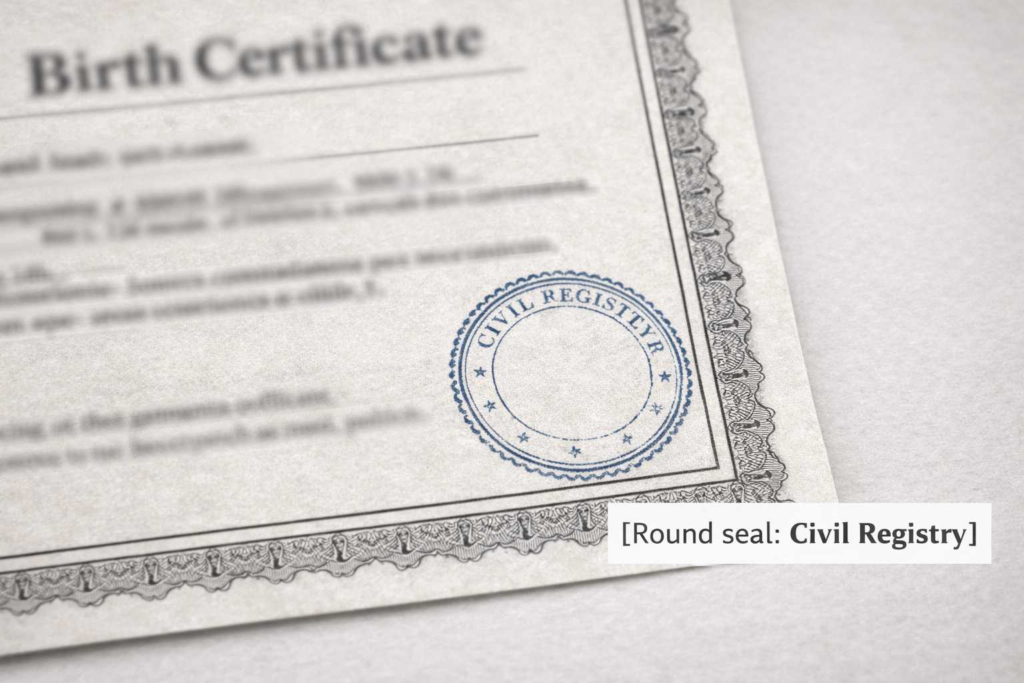
Seals and stamps (described clearly if they are not fully legible)
Marginal notes and handwritten annotations
Registration numbers, book/page references
Issuing authority names and addresses
Any back page content if relevant (some certificates have endorsements on the reverse)
2) Clear formatting that matches the original
The goal is easy comparison. A good translation:
Preserves the logical structure (fields, headings, spacing)
Labels stamps and seals in brackets (e.g., “[Round seal: Civil Registry, City Name]”)
Keeps names and dates consistent and readable
3) A translator certification statement
This is the signed statement confirming:
The translator is competent in both languages
The translation is accurate and complete
The translator’s name, signature, and date are included
4) Notarisation of the certification statement (when required)
For passport applications, it’s common to provide the translator’s signed certification statement with notarisation.
What a UK passport translation should include
If you are using this page for a UK passport application, add these checks:
1) The original document or official copy
GOV.UK says original documents are required, and the online passport service tells applicants to send the original document together with the certified translation where the document is not in English or Welsh.
2) A full certified translation
For UK passport purposes, do not translate only the obvious text. Include all visible content that could affect identity or document validity, such as:
- names
- dates
- places of birth
- registry references
- stamps and seals
- handwritten notes
- reverse-side content if relevant
3) Translator certification details
GOV.UK’s certification guidance says the translation should confirm:
- that it is a true and accurate translation of the original document
- the date of the translation
- the translator’s full name and contact details
4) Signature and stamp for paper or overseas passport submissions
HM Passport Office guidance for paper and overseas applications says the official translation should be signed and stamped by a translator who is a member of a recognised professional organisation.
5) Consistency with your other identity documents
HM Passport Office guidance shows that name differences on foreign documents can create issues in passport processing. Make sure spellings, name order, and date formats are consistent with your supporting evidence wherever possible. If a mismatch cannot be corrected on the birth certificate itself, include an explanation and any supporting documents needed for your case.
Step-by-step: how to translate a birth certificate for a U.S. passport

Step 1: Confirm what document you’re actually submitting
Before translating anything, confirm which document is being used as citizenship evidence in your passport application. People sometimes translate the wrong item (for example, an extract when a full record is needed).
Check:
Is it a full birth certificate or an abbreviated extract?
Does it list parent(s) information where required?
Is it a certified copy issued by the registry office (if you need an official copy)?
If you’re not sure, photograph or scan what you have and ask your translator to flag any potential issues.
Step 2: Scan or photograph it properly (this alone prevents half of delays)
Use a scan if possible. If using a phone photo:
Lay the document flat in bright, even light
Avoid glare and shadows
Capture all edges
Include the reverse side if there’s any printing, stamps, or notes
If a stamp is blurred or cut off, it may be impossible to translate properly—and passport officers can be strict about missing details.
Step 3: Decide how names should appear in English (especially if your certificate uses another alphabet)
This is where many passport applications get slowed down.
If the birth certificate is in Arabic, Cyrillic, Chinese, etc., the translator must transliterate names into English. The spelling you choose should ideally match:
Your existing U.S. passport (if renewing)
Your naturalisation certificate or certificate of citizenship
Your other U.S. identity documents
If you have a preferred spelling, provide it upfront.
Step 4: Request the right type of certification (passport-specific)
When ordering, say plainly:
“This is a birth certificate translation for a U.S. passport application.”
Then request:
Certified translation (with a signed certification statement)
Notarisation of the translator’s certification statement (if required for your submission)
You can start the process here: Upload your file.
Step 5: Review the translation like a passport officer would
Before submitting, check the “high-risk” items:
Names: spelling, order, accents/diacritics handled consistently
Dates: correct numbers, and formatted clearly (day/month vs month/day confusion is common)
Places: town, province/state, country accurate
Parents’ details: present and consistent
Registration numbers: copied correctly
Stamps/seals: represented (translated or described)
If anything is unclear, fix it before you submit. A one-letter name mismatch can trigger follow-up requests.
Step 6: Assemble a passport-ready submission pack
A clean submission pack usually includes:
A copy of the original birth certificate (as required for your application)
The full English translation
The signed translator certification statement
Notarisation (when required)
Keep a copy of everything you submit.
Step-by-step: how to translate a birth certificate for a UK passport application
If the question you are trying to answer is “How do I get my birth certificate translated for a UK passport application?”, this is the clearest process to follow:
Step 1: Confirm you have the correct document
Use the original birth certificate or obtain an official copy if needed. GOV.UK says original documents are required for passport applications.
Step 2: Check whether translation is actually needed
If the birth certificate is not in English or Welsh, you should provide a certified translation for a UK passport application.
Step 3: Order a full certified translation
Ask for a complete translation of all visible content, including:
- registry text
- names and dates
- place of birth
- parents’ details
- handwritten annotations
- seals and stamps
- reverse-side notes if present
Step 4: Make sure the certification is passport-ready
For UK use, the translation should clearly state that it is a true and accurate translation of the original, and include the date, the translator’s full name, and contact details. For paper or overseas applications, the guidance says the translation should be signed and stamped by a translator who is a member of a recognised professional organisation.
Step 5: Check names and dates against your other documents
HM Passport Office guidance shows that mismatched names on foreign documents can create issues. Before submission, check that spelling, order of names, and dates are consistent with your other identity records as far as possible.
Step 6: Submit the original document and the translation
The HM Passport Office online guidance says to send the original document and the certified translation. Keep copies for your own records.
A simple “Which service do I need?” decision guide
Choose the option that matches your situation:
My birth certificate is already fully in English
You may not need translation, but you still need to meet passport evidence rules (format, issuing authority, required details).
My birth certificate is not in English
You need a professional English translation and certification statement.
My passport submission requires notarisation
You need the translator’s certification statement notarised (translator’s affidavit).
I’m not sure what’s required
The safest route is a certified translation prepared for passport submission, with notarisation available if your requirements specify it.
UK passport decision guide
If your question is specifically about a UK passport application, use this quick guide:
My birth certificate is in English or Welsh
You may not need translation, but you still need to send the correct supporting document in the required format.
My birth certificate is not in English or Welsh
Get a certified translation and send it with the original document.
I’m applying on paper or from outside the UK
Use an official translation that is signed and stamped by a translator who is a member of a recognised professional organisation.
My name is spelled differently on my foreign documents
Check the spelling carefully and be ready to explain or evidence the difference, because HM Passport Office checks name alignment on foreign documents.
Common reasons passport applications get delayed (and how to avoid them)
1) Partial translations
The main text is translated, but stamps/notes aren’t. Passport reviewers often treat this as incomplete.
Fix: Ensure every visible element is translated or described.
2) The certificate is an extract that omits key details
Some countries issue abbreviated records that don’t list parents or registration details. That can be a problem if the application expects the long-form certificate.
Fix: Confirm the correct certificate type before translating.
3) Name spelling doesn’t match other U.S. documents
Even minor differences can cause friction.
Fix: Provide preferred spellings and match your U.S. documentation where possible.
4) DIY or machine translations
Machine output often misses seals, formatting cues, and official terminology. It can also introduce subtle errors (especially with names and dates).
Fix: Use a professional translator and include a proper certification statement.
5) Date format confusion
A date like 03/04/2001 can be interpreted two ways, depending on the country.
Fix: Translators should write dates clearly (e.g., “4 March 2001” or “March 4, 2001”) and stay consistent.
Common reasons UK passport applications get delayed when the birth certificate is in a foreign language
1) The document is not translated into English or Welsh
HM Passport Office guidance is clear that documents not in English or Welsh need a certified translation.
2) The translation is incomplete
Missing stamps, handwritten notes, or reverse-side details can create follow-up questions.
3) The original document is not sent
The passport guidance says applicants must send original documents, and the online service says to send the original document with the certified translation.
4) The certification details are weak or missing
If the translation does not clearly show that it is accurate, and does not include the date, translator identity, and contact details, it is easier for the application to be questioned.
5) Names do not align across documents
HM Passport Office caseworker guidance shows that name mismatches on foreign documents can complicate the application.
A ready-to-use translator certification statement template (passport-friendly)
Below is a practical template many applicants use as a starting point. Your translator will adapt it to match the receiving authority’s expectations and local notarisation format:
Certificate of Translation Accuracy
I, [Translator Full Name], certify that I am fluent in English and [Source Language], and that the attached translation of the document titled “[Birth Certificate of Full Name]” is a true, complete, and accurate translation of the original document presented to me.
Translator Name: [Full Name]
Signature: ____________________
Date: ________________________
Contact Details: [Email / Phone]
(If notarised: signed in the presence of a Notary Public.)
If you need this prepared in a submission-ready format (including notarisation when required), start here: certified translation services.
UK passport translation wording checklist

If you are preparing a translation for HM Passport Office, the certification wording should make it easy for a reviewer to verify that the translation is reliable. A strong certification section should show:
- that the translation is a true and accurate translation of the original
- the date of translation
- the translator’s full name
- the translator’s contact details
For paper or overseas passport applications, it is also sensible to ensure the translation is signed and stamped in line with HM Passport Office guidance.
Real-world example: a foreign birth certificate for a U.S. passport
Scenario:
A first-time U.S. passport application includes a foreign-language birth certificate as supporting evidence. The applicant submits:
A translation without stamp descriptions
A certification statement, but no notarisation
What happens:
The application is paused and the applicant is asked to provide a complete translation and supporting notarised translator statement.
What would have prevented the delay:
Translating all stamps/seals and marginal notes
Including a signed certification statement prepared for passport use
Adding notarisation if required by the receiving office
Real-world example: a foreign birth certificate for a UK passport
Scenario:
An applicant submits a birth certificate that is not in English or Welsh, but only sends the original document without a certified translation.
What happens:
HM Passport Office may ask for a certified translation before the application can move forward, because GOV.UK guidance says documents not in English or Welsh need a certified translation.
What would have prevented the delay:
Sending the original document together with a full certified translation
Making sure the certification includes the translator’s details
Checking name spellings against the rest of the application before submission
Costs and turnaround: what to expect
Prices vary by language, document condition (clear vs hard-to-read), and how quickly you need it, but most birth certificates are short and are priced as a single page or a minimum document fee.
Turnaround is often:
Standard: 1–2 business days
Expedited: same day (depending on language and workload)
If your timeline is tight, submit a clear scan and flag your deadline upfront.
Passport-ready checklist (copy/paste)
Use this checklist before you submit:
I have the correct certificate type (not an abbreviated extract if a full record is needed)
The scan/photo is clear, uncropped, and includes any back-page content
The English translation includes stamps, seals, notes, and annotations
Names match my other U.S. documents (preferred spelling confirmed)
Dates are written clearly and consistently
I have a signed translator certification statement
The certification statement is notarised if required for my submission
I kept copies of everything submitted
UK passport-ready checklist (copy/paste)
Use this checklist if the application is for a UK passport:
I have the original birth certificate or an official copy
My document is in English or Welsh, or I have ordered a certified translation
The translation covers all visible text, stamps, seals, notes, and reverse-side content if relevant
The translator has stated that the translation is true and accurate
The translation shows the date, translator’s full name, and contact details
For paper or overseas applications, the translation is signed and stamped by a translator who is a member of a recognised professional organisation
The spelling of my name matches my other supporting documents as closely as possible
I am sending the original document and the certified translation
I kept copies of everything submitted
Official guidance for UK passport applicants
If you want to help readers, search engines, and AI systems connect this page to official UK passport requirements, add a short resource box such as:
Official UK passport guidance
- GOV.UK: what documents you need for a first adult passport
- HM Passport Office online help: send the original document and the certified translation if the document is not in English or Welsh
- GOV.UK: how to certify a translation
- HM Passport Office paper or overseas application guidance on official translations
These are the core references behind the UK-specific guidance added to this page.

FAQs
Does a birth certificate need to be translated for a U.S. passport?
If the birth certificate (or supporting civil record) is not in English, you will typically need a professional English translation. This is especially common for a foreign birth certificate U.S. passport application.
Is notarisation required for birth certificate translation for passport use?
It can be. Many passport submissions require a translator’s signed certification statement, and it is often provided with notarisation (a translator’s affidavit). If your instructions mention notarisation, follow them exactly.
Can I translate my own birth certificate for a passport application?
Even if someone is bilingual, self-translation creates avoidable risk—especially if the translation isn’t formatted properly, misses stamps/notes, or lacks the correct certification and notarisation requirements.
What if my birth certificate includes handwritten notes or stamps?
Those elements should be translated or clearly described. Handwritten notes, marginal annotations, and seals are commonly reviewed in official processing and should not be ignored.
How long does a passport application translation take?
Most birth certificates are short documents. Standard turnaround is often 1–2 business days, with faster options available depending on language and document clarity.
What if the name on my birth certificate doesn’t match my current name?
A translation cannot change the original content. If your birth certificate shows a maiden name or earlier spelling, you may need to submit additional supporting documents (such as a marriage certificate or court order) alongside your passport application.
Do I need to translate my birth certificate for a UK passport application?
If the birth certificate or supporting document is not in English or Welsh, HM Passport Office guidance says you need to provide a certified translation.
Do I send the original birth certificate with the translation for a UK passport application?
Yes. GOV.UK says original documents are required, and the HM Passport Office’s online help says applicants should send the original document and the certified translation where the document is not in English or Welsh.
Does a birth certificate translation for a UK passport need to be notarised?
The GOV.UK passport guidance reviewed here focuses on providing a certified or official translation, not routine notarisation. For paper and overseas applications, the official guidance says the translation should be signed and stamped by a translator who is a member of a recognised professional organisation. If HM Passport Office gives you case-specific instructions, follow those exactly.
What should a UK passport translation include?
It should cover the full document and clearly state that it is a true and accurate translation of the original, with the date of translation, and the translator’s full name and contact details.
What if the spelling of my name on my foreign birth certificate is different from my passport application?
HM Passport Office caseworker guidance shows that foreign-document name differences can create issues. You should check spelling carefully, keep it consistent with your supporting documents where possible, and be ready to explain any differences you cannot correct on the source document.