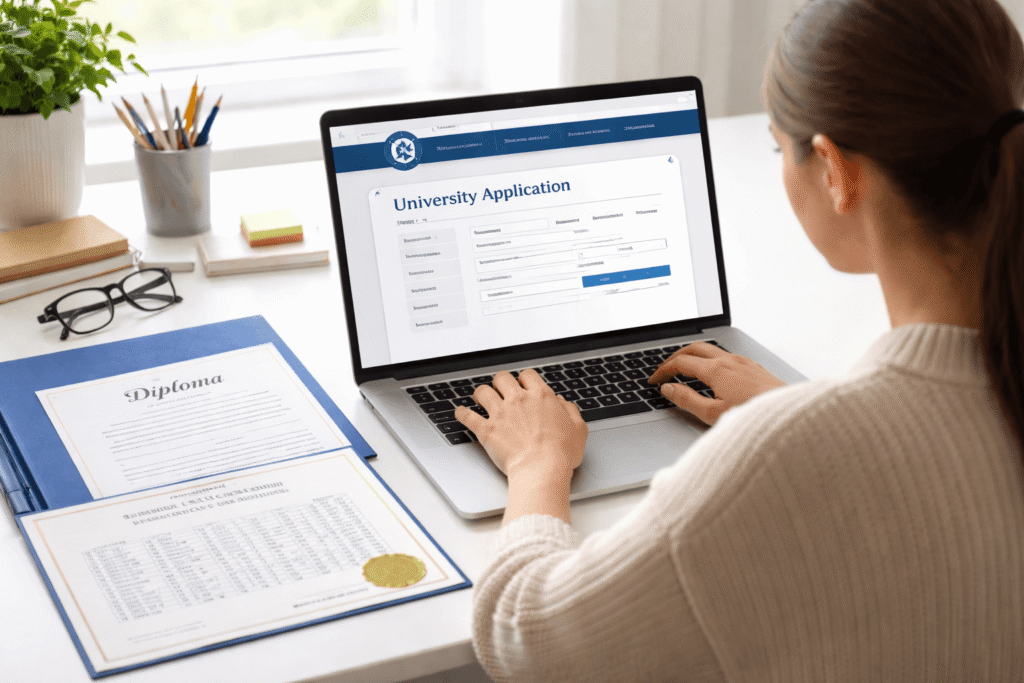
Applying to US universities with non-English academic records can feel like a maze: transcripts, mark sheets, grade reports, sealed envelopes, credential evaluations, certified translations… and every school seems to phrase requirements differently.
This academic transcript translation guide breaks it into a clear, submission-ready process—so you can translate a college transcript (or any foreign transcript) confidently, avoid common delays, and send the right set of documents the first time.
Quick Answer: How Do You Get an Academic Transcript Professionally Translated?
If your academic transcript is not in English, the usual process is:
- Check the university’s admissions page for its exact translation and submission rules.
- Gather every page of the transcript, including grading legends, stamps, signatures, and back pages.
- Send clear scans to a professional translation provider experienced with academic records.
- Ask for a complete certified English translation that preserves subjects, grades, credits, dates, remarks, and formatting.
- Submit the original-language document together with the English translation, and add a credential evaluation if the university specifically asks for one.
This is the safest route for most international applications because it gives admissions teams a readable English version without changing the academic meaning of the original record.
In a hurry? Here’s the simplest rule to follow:
You’ll almost always need (1) the original academic record in the original language and (2) a complete English translation. Some universities (or programmes) also require a credential evaluation from an approved evaluation service.
What US Universities Usually Require (And What They Don’t)
Most US schools want your academic records to be:
- Official (issued by the institution and sometimes sent directly or sealed)
- Complete (every page, every term, all stamps/notes)
- Readable (clear scans or original paper as requested)
- In English (either originally issued in English or accompanied by an English translation)
- Consistent (your name spelling and dates match your passport/ID)
What they typically don’t want:
- A translation that summarises or “cleans up” content
- A translation that converts grades into a US GPA (that’s usually the evaluator’s job, if an evaluation is required)
- A translation missing footnotes, legends, grading scales, stamps, or back pages
What “Professionally Translated” Means for an Academic Transcript
A professional academic transcript translation is not just a basic language conversion. For university applications, it should be:
Complete (every visible word, number, stamp, note, and grading legend is accounted for)
Accurate (course names, grade labels, credit values, dates, and institutional remarks are translated faithfully)
Well-formatted (the English version is easy to compare against the original, especially where tables and course lists are involved)
Certified (a signed certification statement confirms the translation is true and accurate)
Neutral (the translator does not reinterpret the academic record, inflate grades, or convert results into US terms unless a separate evaluator is doing that)
If a translation leaves out footnotes, abbreviations, seals, handwritten notes, or grading explanations, the admissions team may not have enough information to assess the record properly.
Translation vs Credential Evaluation: Know the Difference
These two are often confused—but they’re not interchangeable.
Translation
A translation simply changes the language while keeping meaning and structure intact.
You need translation when:
- Your transcript/mark sheet is not in English
- Your university requires English versions for review
- A credential evaluator requires English translations as part of their process
Credential Evaluation
An evaluation interprets your education in US terms (e.g., US equivalency, credits, grade equivalencies). Some programmes ask for course-by-course evaluations; others don’t require any evaluation at all.
You may need an evaluation when:
- The university states “credential evaluation required” (often for international admissions)
- The programme specifically asks for “course-by-course evaluation” or “GPA equivalency”
- You’re applying through a centralised system (certain professional or graduate pathways)
Practical takeaway:
If the admissions page mentions evaluation, you may need both translation and evaluation. If it only mentions English translation, you likely need translation + originals.
University Transcript Translation Process: A Step-by-Step Checklist
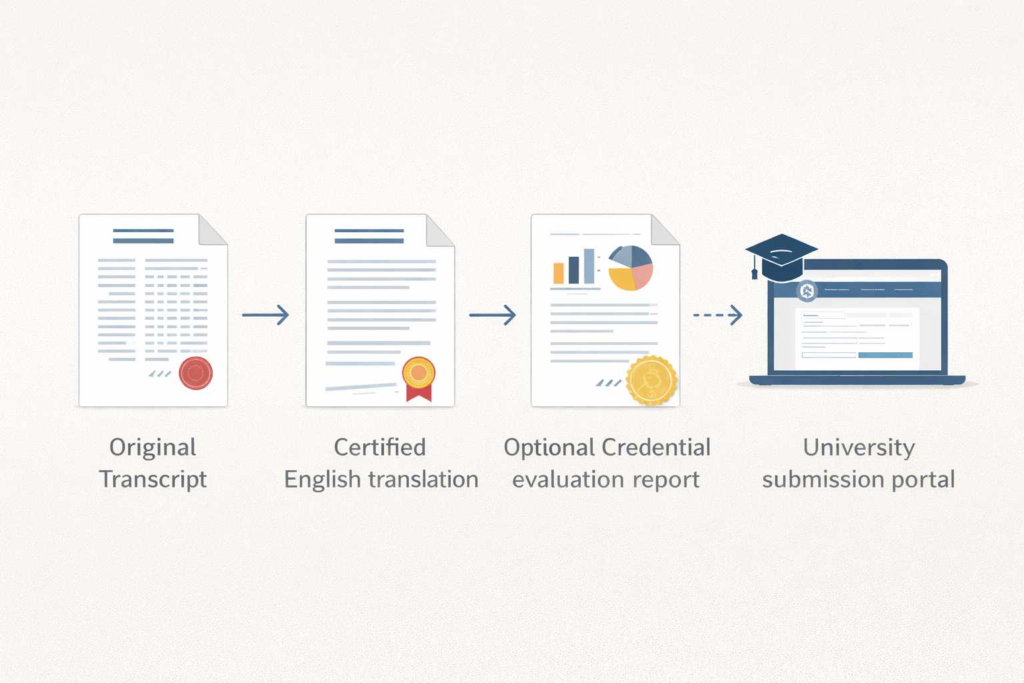
Use this as your university transcript translation process from start to submission.
Step 1: Identify what you’re submitting (and to whom)
Before you translate anything, look for these phrases on your university’s admissions page:
- “Official transcript”
- “Academic records in the original language”
- “English translation required”
- “Credential evaluation required”
- “Course-by-course” or “document-by-document”
- “Sealed envelope” / “sent directly from institution”
- “Upload portal accepts…” (PDF/JPG)
If anything is unclear, note the requirement wording and keep it—your translator can align formatting and certification to match what the school expects.
Step 2: Gather the full set of academic documents
Many applicants only translate the main transcript page and later discover they need additional pages. Common “missing pieces” include:
- Transcript front and back
- Term-by-term mark sheets/grade reports
- Diploma/degree certificate (if requested alongside transcripts)
- Grading scale page (often printed separately)
- Legend for abbreviations (e.g., “CR”, “EX”, “S”, “NS”, “Retake”)
- Notes, remarks, stamps, signatures, and institutional seals
Tip: If you’re applying to multiple US schools, make one complete “master set” so every submission stays consistent.
Step 2A: Prepare the right file set for your translator
Before ordering, send:
A clear scan or photo of every page
Any reverse side with seals, serial numbers, or notes
Any separate grading scale or legend page
The preferred passport spelling of your name
Your university deadline
Any admissions instructions mentioning translation, certification, or evaluation
This helps the translation provider produce a version aligned with the school’s requirements from the start.
Step 3: Standardise your name (before translating)
Admissions delays often start with a small mismatch: your transcript says “Mohammed Al-…” while your passport says “Muhammad Al …”.
Decide the spelling you will use for the US application (usually the passport spelling), and then apply it consistently across:
- Your application profile
- Your translation request instructions
- Any cover letters or document lists
A good translator will mirror the document exactly but can also keep formatting consistent and flag potential mismatches early.
Step 4: Choose the right type of translation (certified vs “regular”)
For US universities, you typically need a certified translation—meaning the translation is delivered with a signed statement confirming accuracy and translator competence.
This is especially important for:
- University admissions offices
- Credential evaluators
- Scholarship bodies
- Professional programme admissions
If you’re unsure what the university wants, default to certified translation—because it’s usually the safest format for official review.
To see what “certified” typically includes and how we prepare it, you can review our certified translation services page.
Step 5: Make sure the translation is “submission-ready”
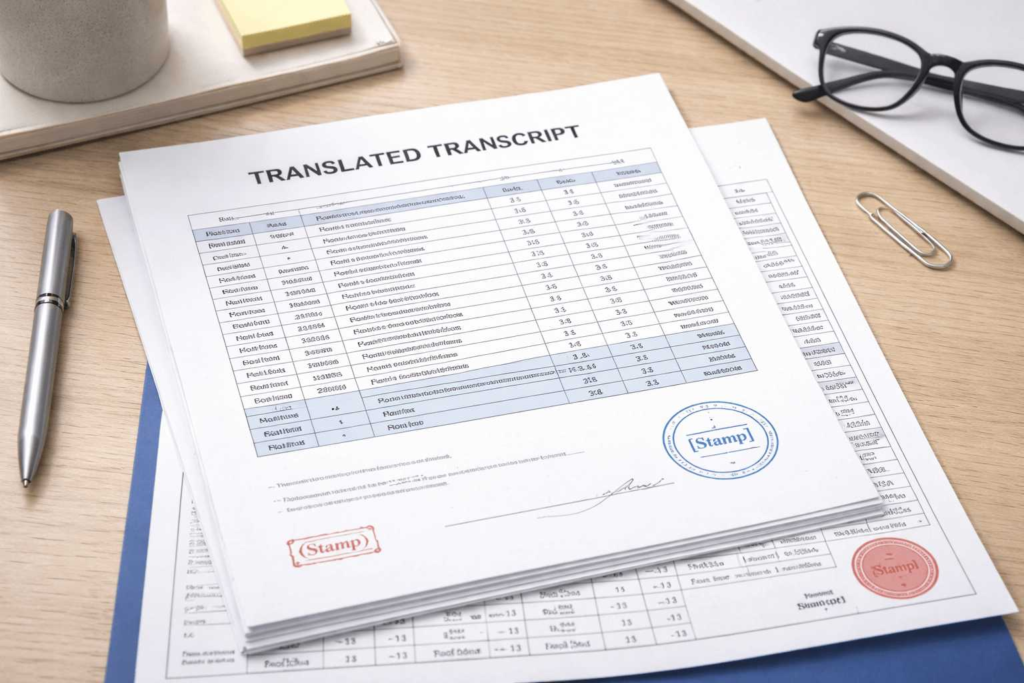
A submission-ready academic transcript translation should:
- Preserve the table structure (course/subject, credits, grade, term)
- Keep course codes intact (e.g., ENG101, MATH-204)
- Translate headings and labels clearly (e.g., “Semester”, “Academic Year”, “Result”)
- Represent stamps/seals as labels like [Stamp], [Seal], [Signature]
- Translate handwritten notes where legible (or label as [Illegible handwriting] if truly unreadable)
- Include a clear grading scale exactly as shown (without converting)
Step 6: Add a proper Certificate of Translation Accuracy
Most US schools and evaluators expect a certification statement attached to the translation. Here’s a practical template (your translator/agency will format it professionally):
Sample Certificate of Translation Accuracy (Template)
I, [Translator Name], certify that I am fluent in [Source Language] and English, and that the above translation is a true and accurate translation of the attached document titled “[Document Name]” from [Source Language] into English.
Translator Name: [Name]
Signature: ____________________
Date: [DD Month YYYY]
Contact Details: [Email/Phone]
Important: Certification is not the same as notarisation. Many universities accept certified translations without notarisation unless they explicitly request it.
What a Strong Academic Transcript Translation Should Include
When you review the finished file, check that it includes:
The document title translated clearly
The institution name is exactly as shown
Course or module names
Grade labels and marks as shown in the original
Credit hours, coefficients, or units
Academic years or semesters
The grading scale or legend
Labels for stamps, seals, signatures, and handwritten remarks
A Certificate of Translation Accuracy
This section is especially useful if you are comparing providers, because it tells you whether the translation is actually suitable for official university review.
Step 7: Submit the right way (upload vs sealed vs direct send)
This is where many applicants lose time.
Common submission routes include:
- Upload to an admissions portal (PDF scans of originals + translations)
- Send sealed official transcripts (from your institution)
- Send records to a credential evaluation service (which may have its own delivery rules)
If a school requires sealed transcripts, don’t open them. Your translation can be prepared from a clear scan/photograph or an unofficial copy (as long as the translation matches the official document content exactly).
Step 8: Keep a “submission pack” for every school

Create one folder per university that includes:
- Originals (scans) in the original language
- Certified English translation PDF
- A simple index (one-page document list)
- Any special instructions (screenshots from the admissions page)
- Proof of dispatch (if you mailed sealed records)
This makes follow-ups painless if admissions asks questions weeks later.
How to Translate a Foreign Transcript Without Mistakes (Common Pitfalls)
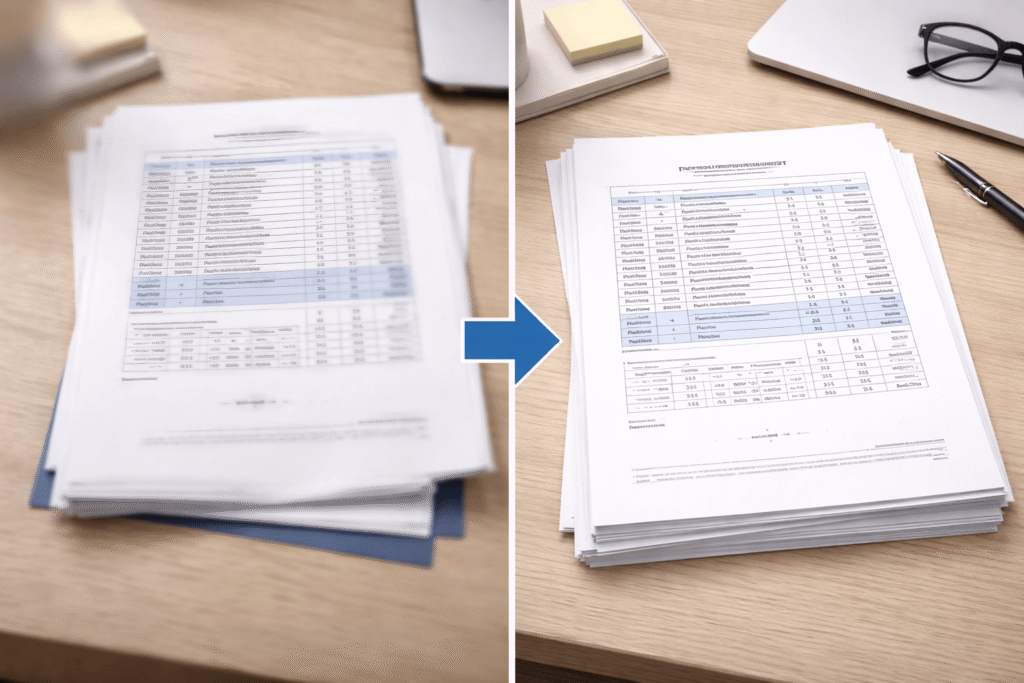
Here are the most common reasons transcripts get questioned—plus the fix.
Mistake 1: Missing pages or back sides
Fix: Always include every page, even if it looks “blank” (many have embossed seals, serial numbers, or hidden marks).
Mistake 2: Translating grades incorrectly (or converting them)
Fix: Translate grade labels exactly and keep the grading scale as shown. If conversions are needed, let a credential evaluator do it.
Mistake 3: Name mismatches across documents
Fix: Use passport spelling consistently and tell your translator what spelling you’ll submit under.
Mistake 4: Broken table formatting
Fix: Choose a provider experienced with academic layouts so your translation is easy to compare line-by-line.
Mistake 5: Leaving stamps and remarks untranslated
Fix: Ensure stamps/seals/remarks are included as labelled elements and translated where readable.
Mistake 6: Submitting translation without originals
Fix: Most schools want originals and translations together. Translation alone is often not enough for review.
A Quick “Acceptance Checklist” Before You Submit
Use this final pre-submit check:
- I have the original language transcript/mark sheets
- I have the complete English translation for every page
- Tables and course lines are easy to match against the original
- Grades/credits are not converted (only translated)
- Stamps, seals, signatures, and remarks are accounted for
- The translation includes a Certificate of Translation Accuracy
- My name spelling matches my passport/application profile
- I’m following the school’s submission method (upload/sealed/direct)
If you want a quick pre-check before you submit, you can contact us here with your documents and deadline, and we’ll confirm what’s needed for a submission-ready certified translation.
Real-World Scenarios (So You Can Spot Yours)
Scenario A: “My transcript is not in English, but my university accepts uploads”
You’ll typically upload:
- Original transcript scan(s)
- Certified English translation PDF
- Any grading scale/legend pages
Scenario B: “My programme requires a credential evaluation”
You’ll usually need:
- Original records (as required by the evaluator)
- Certified English translations
- Evaluator-specific submission route (may require sealed records)
Scenario C: “My transcript includes handwritten remarks and multiple stamp types”
You need a translator who will:
- Preserve layout
- Label stamps/seals clearly
- Translate remarks where legible
- Flag illegible portions early (so you can rescan before ordering)
How Urgent Certified Translation Helps You Submit With Confidence
When you’re applying to US schools, speed matters—but accuracy matters more. A small transcript error can trigger weeks of back-and-forth.
With Urgent Certified Translation, you get:
- Certified translations prepared for official submission
- Careful handling of names, dates, course tables, grading scales, stamps, and notes
- Clear formatting designed for fast review
- Delivery as a professional PDF, ready to upload
If you’re ready to move, start here: certified translation services.
If you have a deadline and want the fastest path, send your files via our contact page and include your submission date.
Applying to UK Universities Instead of US Universities?
If you are applying to a UK university rather than a US university, the process is broadly similar:
Submit the original academic document in the original language
Provide a full English translation if the document is not in English
Make sure grading scales, legends, stamps, and remarks are translated as well
Follow the university’s own instructions for uploads, certified copies, or third-party verification
Check whether you also need a separate qualification comparison or UK ENIC-related evidence for your specific course or purpose
The key point is the same: universities need a complete and accurate English version of the academic record, not a summary and not an unofficial rewrite.
FAQ
Do US universities require certified translation for transcripts?
Often, yes—especially when transcripts are used for admissions review or credential evaluation. Certified translation provides a signed statement confirming accuracy and translator competence.
Can I translate my own college transcript if I’m fluent in English?
Some institutions may allow it, but it can create avoidable risk (formatting issues, missing notes/stamps, or non-standard certification). A professional certified translation is typically safer for official submissions.
Do I need a credential evaluation or just translation?
It depends on the university and programme. Some require English translation only; others require a credential evaluation (and still require translations). Always follow the admissions wording for your target school.
Should grades be converted to a US GPA in the translation?
Usually not. A translation should reproduce grades and the grading scale as shown. GPA/credit conversions are typically handled by credential evaluators when required.
Do academic transcript translations need notarisation?
Not always. Many universities accept certified translations without notarisation unless they explicitly ask for it. If a school requests notarisation, you should follow that instruction.
What if parts of my transcript are hard to read (blurred stamps or handwriting)?
Don’t guess. Retake the scan/photo where possible. If something is truly illegible, it should be labelled as such—otherwise you risk inaccuracies.
How do I get my academic transcript professionally translated for university applications?
Start by checking the university’s admissions instructions. Then gather every page of the transcript, including legends, stamps, and notes, and send clear scans to a professional translation provider experienced with academic documents. Request a complete certified English translation and submit it together with the original-language record.
What should an academic transcript translation include?
It should include all course names, grades, credits, dates, remarks, grading scales, legends, and labelled stamps or signatures. It should also include a Certificate of Translation Accuracy for official submission.
Can I send a scanned copy of my transcript for translation?
Yes, in many cases, a clear scan or high-quality photo is enough for the translation to be prepared. The important point is that all text, stamps, and notes are legible. If the university or evaluator later requires sealed or official records, that submission rule should still be followed separately.
Do I need to translate my diploma or degree certificate as well as my transcript?
Sometimes, yes. Some universities or evaluators ask for the full academic document set, which may include the transcript, mark sheets, and diploma or degree certificate. Always check the exact admissions wording.
How long does academic transcript translation take?
Turnaround depends on the number of pages, document complexity, language pair, and scan quality. A single clear transcript may be completed relatively quickly, while multi-page records with handwritten notes, legends, and multiple mark sheets can take longer.
If I am applying to a UK university instead of a US university, is the process similar?
Usually, yes. UK universities generally need a complete English translation of non-English academic documents, together with the original-language version. Some cases may also involve separate qualification comparison requirements depending on the course or institution.