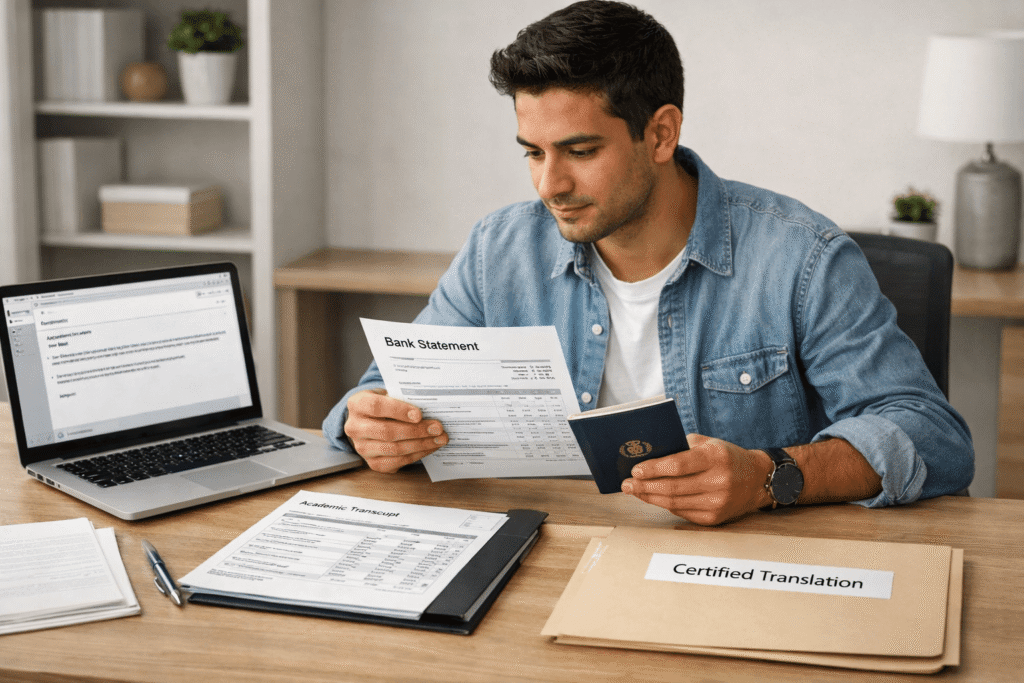
Applying for an F-1 student visa is stressful enough without document issues slowing you down. One of the most common reasons students face delays is simple: they submit documents in the original language without a proper English translation, or they submit translations that are incomplete, uncertified, or formatted poorly.
This guide explains exactly what to translate, what a proper certified translation should include, and how to prepare your documents so your school, the embassy or consulate, and any U.S. immigration office can review them without confusion. If you are preparing an F-1 application, changing status to F-1, or submitting documents for an F-2 dependent, this checklist will help you stay organised and avoid preventable delays.
If you want your documents reviewed before translation, upload your files and get a clear quote with turnaround time upfront so you know exactly what will be submitted and when.
Avoid confusion: F-1 is a U.S. student visa, not a UK Student visa
Many people search for “F-1 visa documents in the UK” because they are applying from the UK or using a UK-based translation provider. The F-1 visa is a U.S. visa category for studying in the United States.
In most cases, the “UK” part refers to where you are located, where your documents are being translated, or where your translation provider is based. The translation requirements themselves are usually driven by the U.S. school, the U.S. embassy or consulate, and USCIS, where applicable, rather than by UKVI.
At a glance: F-1 visa translation requirements
If you want the clearest and safest starting point, follow these rules:
- Translate any document that is not fully in English if you are submitting it to your school, a U.S. embassy or consulate, or USCIS.
- Use a complete translation, not a summary.
- Include a signed certification statement confirming that the translation is complete and accurate and that the translator is competent.
- Submit the original document and the English translation together.
- Do not assume notarisation is required. In most cases, certified translation is enough unless the receiving institution specifically asks for notarisation.
- Always check any post-specific embassy or consulate instructions, because local document expectations can vary.
Need your documents reviewed before you apply? Upload your files and get a clear quote with turnaround time before you submit anything.
What F-1 applicants usually need translated
Not every F-1 applicant will translate the exact same documents. Your requirements depend on:
- Your school’s admissions office or international student office
- The U.S. embassy or consulate handling your interview
- Whether you are applying abroad or filing something with USCIS inside the U.S.
- Whether you are applying alone or with F-2 dependants
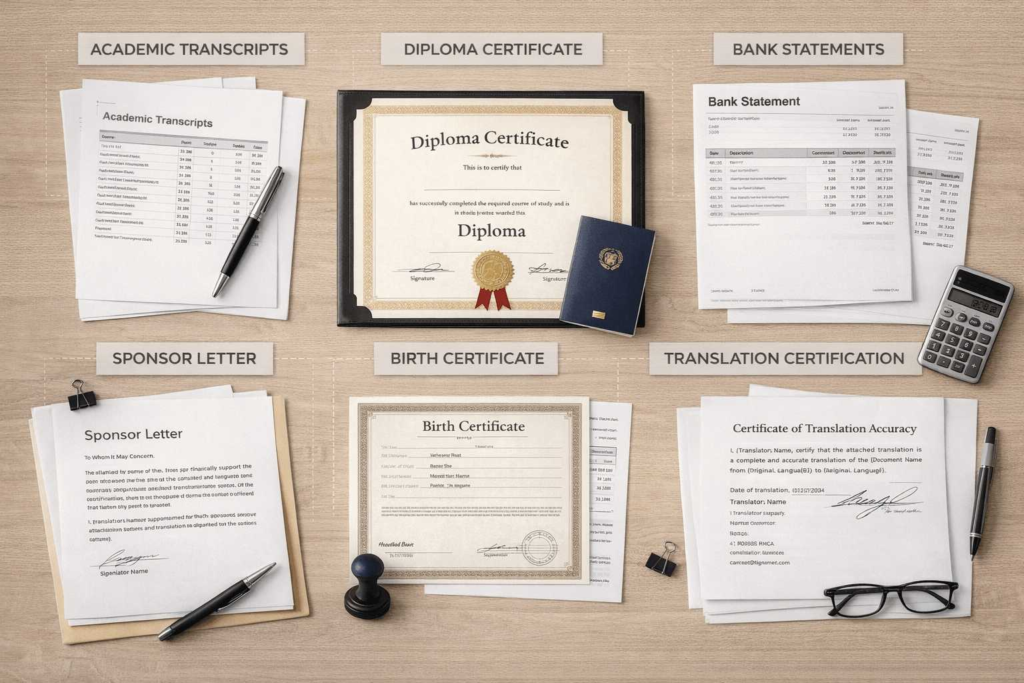
That said, most students need certified English translations for some combination of the following:
- Academic transcripts
- Diplomas or degree certificates
- Financial documents (bank statements, sponsor letters, affidavits)
- Civil documents (birth certificate, marriage certificate for dependants)
- Police or court records (if specifically requested)
- Supporting letters or official documents issued in a non-English language
A simple rule that prevents most mistakes
If a document is being submitted to a U.S. authority, school, or visa office and it is not fully in English, prepare a certified English translation.
Do not assume a bilingual document will always be accepted. Some institutions accept bilingual formats, while others still want a certified translation for consistency and recordkeeping.
Who can translate and certify F-1 documents?
Students often ask whether they need a U.S.-based translator, a sworn translator in the UK, or a notary. In most F-1 cases, what matters is that the translation is complete, accurate, and properly certified.
In most cases:
- A UK-based professional translator or translation company can provide a compliant, certified translation for F-1 use
- A sworn translator is usually not required
- A notary is usually not required
- A self-translation is risky and best avoided
For F-1 purposes, a certified translation usually means a translation accompanied by a signed certification statement from the translator or translation company. It does not usually mean a government-issued certification, notarisation, or apostille unless a specific school, attorney, embassy, consulate, or USCIS-related filing requirement says otherwise.
The 3 checkpoints that decide whether your translation is accepted
A lot of online articles treat “F-1 translation requirements” as one single rule. In practice, students usually pass through three different checkpoints, and each one can have slightly different expectations.
1) University or college admissions review
Your school may request translated academic records and, in some cases, translated proof of funds before issuing your Form I-20. Some schools also ask for a credential evaluation, depending on the country and institution.
2) U.S. embassy or consulate interview stage
The consular officer reviews your visa application and may ask for additional supporting documents. Local post instructions can vary, so applicants must always check the specific embassy or consulate website.
3) USCIS stage (if applicable)
If you are filing with USCIS (for example, change of status to F-1, reinstatement, or certain dependent filings), foreign-language documents must be submitted with a complete English translation and translator certification.
This is where many students get mixed up: the F-1 visa itself is typically handled through the U.S. Department of State, but translation rules also matter for school documents and for any USCIS filings connected to student status.
F-1 visa translation checklist by document type
Academic documents for student visa and school processing
These are the most common items students need translated.
Usually translate these
- School transcripts/mark sheets
- Secondary school certificates
- Degree certificates and diplomas
- Academic letters issued by schools (completion letters, enrolment letters)
- Course descriptions (if requested for evaluation)
Translation tips for academic documents
- Keep subject names, grades, dates, and award titles exactly as shown
- Preserve stamps, seals, signatures, and handwritten notations
- Do not “convert” grades or rewrite the grading system in the translation body
- If a school requests an explanation of the grading scale, provide it as a separate note, not a changed translation
If your school asks for a credential evaluation
Some institutions ask students to use a credential evaluation agency in addition to translation. Translation and evaluation are not the same thing:
- Translation converts the document into English
- Evaluation compares your education to a U.S. equivalent
If evaluation is required, get the translation right first. Poor translations create problems for evaluators and can slow everything down.
Financial documents for F-1 visa applications
Financial evidence is one of the most important parts of the student visa process. If your bank statements, sponsor documents, or proof of income are in another language, translate them before submission.
Common financial documents to translate
- Bank statements
- Bank balance certificates
- Sponsor letters
- Employment letters for sponsors
- Tax records (if requested)
- Scholarship award letters
- Loan sanction letters/education loan approvals
What to include in financial translations
Financial translations must be complete, not summarised. That means:
- Account holder name
- Bank name and branch details
- Dates and statement periods
- Currency amounts
- Notes, stamps, and bank seals
- Any limitations or conditions stated in the original
Do not send a “summary translation” unless the receiving institution explicitly allows it in writing.
Civil documents for F-1 and F-2 dependents
Civil documents are especially common when you are applying with a spouse or child (F-2) or when identity/relationship evidence is requested.
Documents often translated
- Birth certificate
- Marriage certificate
- Divorce decree (if relevant)
- Family registry/household records
- Adoption papers (if relevant)
Important note
For non-immigrant visa cases, civil documents are not always requested in every case the same way they are for immigrant visa processing. Still, many applicants are asked to provide supporting records depending on the case, country, or interview questions. That is why preparing translations in advance can save time.
Passports, IDs, and travel records
Students often ask whether the passport itself must be translated.
In many cases
- The passport biographic page is already in a standard bilingual/machine-readable format and may not need translation.
But translate if needed
- Non-English observations or annotations
- Entry/exit stamps that are relevant to your case
- Supporting IDs or records submitted alongside your application that are not in English
If an officer, school, or attorney asks for it, translate it. Avoid guessing.
Supporting documents that are often forgotten
These documents are commonly missed and can trigger back-and-forth emails or interview delays:
- Name change certificates
- Court dispositions (if applicable)
- Police certificates (if requested)
- Sponsor relationship proof
- Affidavits and sworn declarations
- Prior visa refusal or immigration correspondence (if being submitted and not in English)
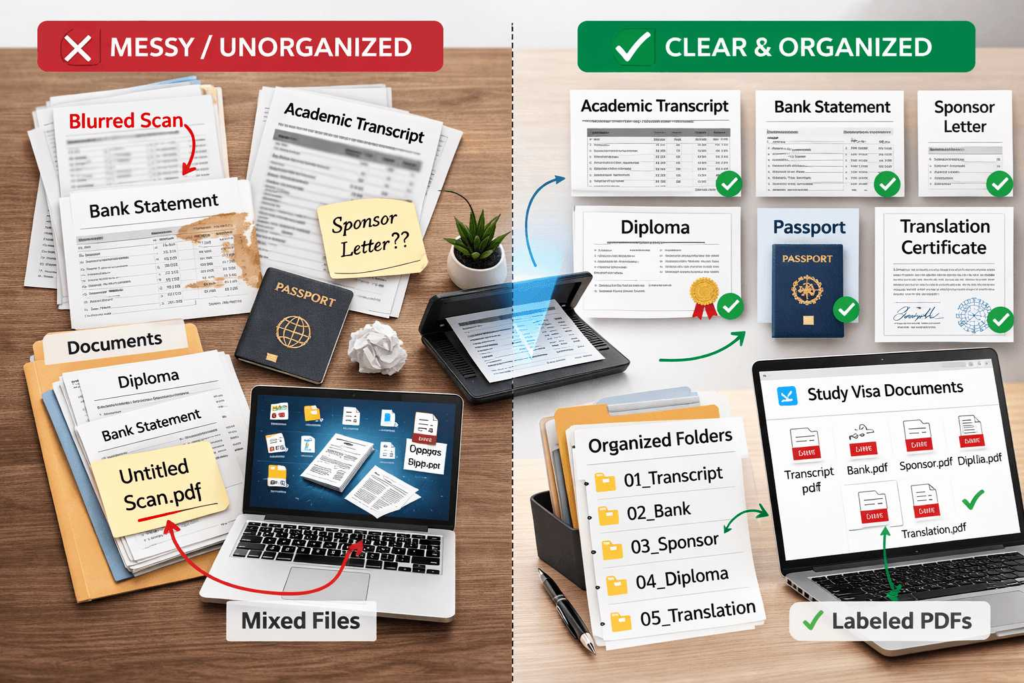
A good practice is to create one folder called “Originals” and one called “English Translations” so you can instantly see what is still missing.
What a compliant certified translation should include
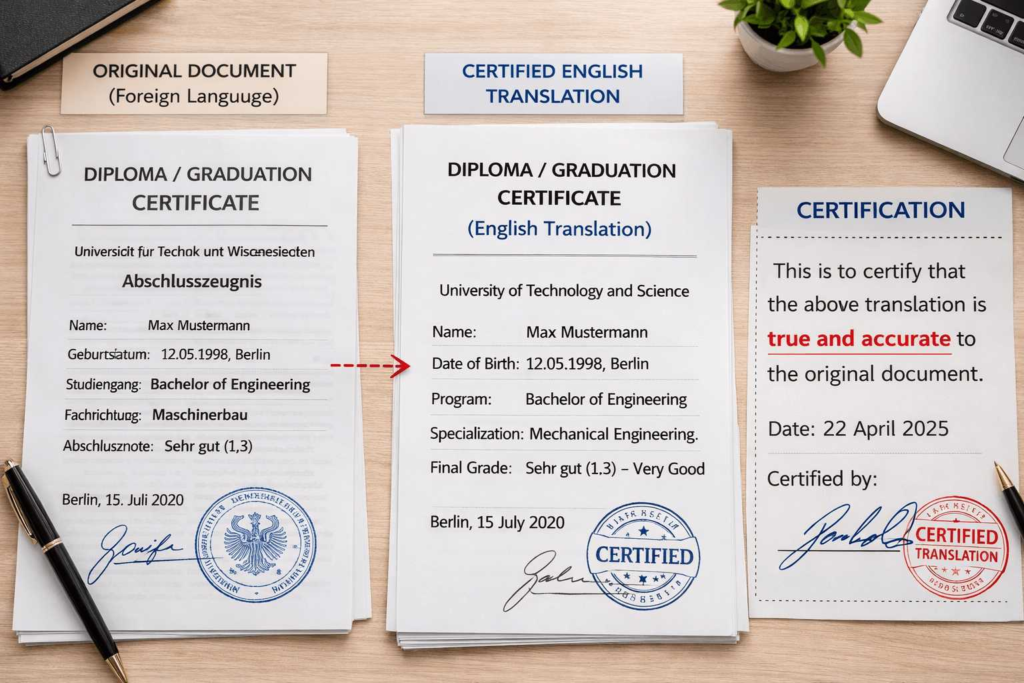
A certified translation for student visa documents is not just a translated page. It should include a proper certification statement confirming:
- The translation is complete and accurate
- The translator is competent to translate the document
- The certification is signed and dated
Best-practice format for a certified translation package
For each document, include:
- Clear copy of the original document
- Full English translation
- Translator certification statement
- Translator/signatory details (name, signature, date, contact information)
Quality standards that improve acceptance
- Word-for-word completeness (no skipped sections)
- Same page order as the original
- Clear labels for seals, signatures, and stamps
- Consistent spelling of names across all documents
- Accurate dates and numbers (especially financial figures)
If the original contains handwriting, stamps, or seals, those should be reflected in the translation (for example: “[Stamp: Ministry of Education]” or “[Signature]”).
General certification wording
I, [Full Name], certify that I am fluent in [Source Language] and English, and that the attached translation of the [Document Name] is a complete and accurate translation of the original document.
Name: [Full Name]
Signature: ____________________
Date: [DD Month YYYY]
Contact details: [Email] | [Phone]
Alternative wording often used for USCIS-related filings
I, [Full Name], certify that I am competent to translate from [Source Language] into English and that the attached translation is complete and accurate to the best of my knowledge and ability.
Name: [Full Name]
Signature: ____________________
Date: [DD Month YYYY]
Contact details: [Email] | [Phone]
Notarisation and apostille: when they are and are not needed
Most F-1 document submissions require certified translation, not notarisation or apostille.
Notarisation is a separate step in which a notary verifies the identity of the signer, often the translator. An apostille is a separate legal authentication used for certain public documents in international contexts.
In most F-1 cases, applicants do not need these extra steps unless the school, embassy, consulate, attorney, or receiving institution explicitly asks for them.
Start your project now and get a certified translation package prepared in the correct format, including the translator certification statement.
Digital vs printed submissions
Students often ask whether scanned PDFs are acceptable and whether they must bring hard copies to the interview.
A safe approach is:
- For schools and admissions teams, PDF scans of originals and certified translations are often accepted through portals or by email
- For visa interviews, it is safest to bring organised, printed copies of the original documents and the matching certified translations unless your post says otherwise
- For USCIS filings, paper submissions usually need the full English translation and signed certification included in the filing package
Even when you submit digitally, keep print-ready versions of everything so you can present the same set consistently if asked later.
Common mistakes that cause delays
Even strong students lose time on avoidable translation errors. These are the most common ones:
1) Translating only part of the document
Submitting just the “main text” is risky. Footnotes, seals, marginal notes, and back-page endorsements may matter.
2) Name mismatches across documents
One document says “Mohammad”, another says “Muhammed”, another says “Mohamed”. The translation should preserve the original spelling, but your translator should flag inconsistencies so you can prepare an explanation if needed.
3) Using low-quality scans
Blurry scans lead to translation errors and rework. If a stamp or grade is unreadable, your file may be delayed.
4) Submitting uncertified translations
A translated file without a proper certification statement can be rejected, even if the translation itself is accurate.
5) Waiting until the interview is booked
Translation should be done earlier in the process. Rushed translation right before interview day increases the chance of missing pages or inconsistent names.
How to prepare your files before sending them for translation
A clean submission to your translation provider saves time and improves accuracy.
File preparation checklist
- Scan in colour where possible
- Use flat, straight images (no shadows or fingers on the page)
- Include front and back if there is any text, stamp, or note
- Keep each document in one file (or clearly named files)
- Do not crop out seals, margins, or headers
- Send the final version (not a draft or partial page)
Extra file preparation tip
If you have multiple pages, stamps on the back, or attachments, bundle them as one clear document set, for example:
- Transcript + back page + stamp page
This helps the translation mirror the full original and reduces the risk of missing pages later.
Naming convention that works well
Use a simple naming format, such as:
- Passport_BioPage.pdf
- Transcript_BSc_2019-2023.pdf
- BankStatement_Sponsor_Jan-Mar2026.pdf
- BirthCertificate_Applicant.pdf
This makes it much easier to track what has been translated and what is pending.
Suggested translation timeline for F-1 applicants
The safest approach is to treat translation as part of your visa preparation timeline, not a last-minute admin task.
Recommended timing
- At the admission stage: Translate academic documents and any school-required financial records
- After Form I-20 is issued, review the interview document list and translate any remaining supporting records
- Before DS-160 submission/interview booking: Finalise translations for all documents you may present
- Before interview day: Print copies and organise originals + translations in matching order
If you are filing a USCIS application inside the U.S., prepare translations before the form package is assembled so nothing is missing at submission.
If your interview date is close, send your files today so your academic, financial, and civil documents can be translated together and checked for consistency.
Example scenarios
Example 1: Student applying from abroad
A student has transcripts, a degree certificate, and sponsor bank statements in Arabic. The school requests English copies before issuing the I-20. The student submits complete certified translations for all academic and financial documents, receives the I-20 without delay, and then uses the same translation set during visa preparation.
Example 2: F-1 with F-2 spouse
The primary applicant’s documents are in English, but the spouse’s marriage certificate and the child’s birth certificate are in Turkish. Certified translations are prepared in advance, avoiding a last-minute scramble when relationship evidence is requested.
Example 3: Change of status to F-1 inside the U.S.
An applicant filing with USCIS includes foreign-language financial evidence and civil records. The package is submitted with complete English translations and signed certifications, which helps prevent evidence-related delays.
Final F-1 visa translation checklist
Before you submit anything, confirm all of the following:
- I know which documents my school requires in English
- I checked the U.S. embassy/consulate instructions for my interview location
- I translated every non-English document I plan to submit
- Each translation is complete (not partial)
- Each translation includes a signed certification statement
- Names, dates, and numbers match the originals exactly
- Originals and translations are organised in the same order
- I have PDF copies saved for quick resubmission if requested
If you want a faster, cleaner process, send your files early and get your translations reviewed as one package rather than document by document. That usually reduces back-and-forth, improves consistency across names and dates, and gives you a better chance of a smooth F-1 application process.
Ready to move forward? Upload your student visa documents and get a certified translation package prepared in the correct format for school review, visa preparation, and USCIS submission, where applicable.
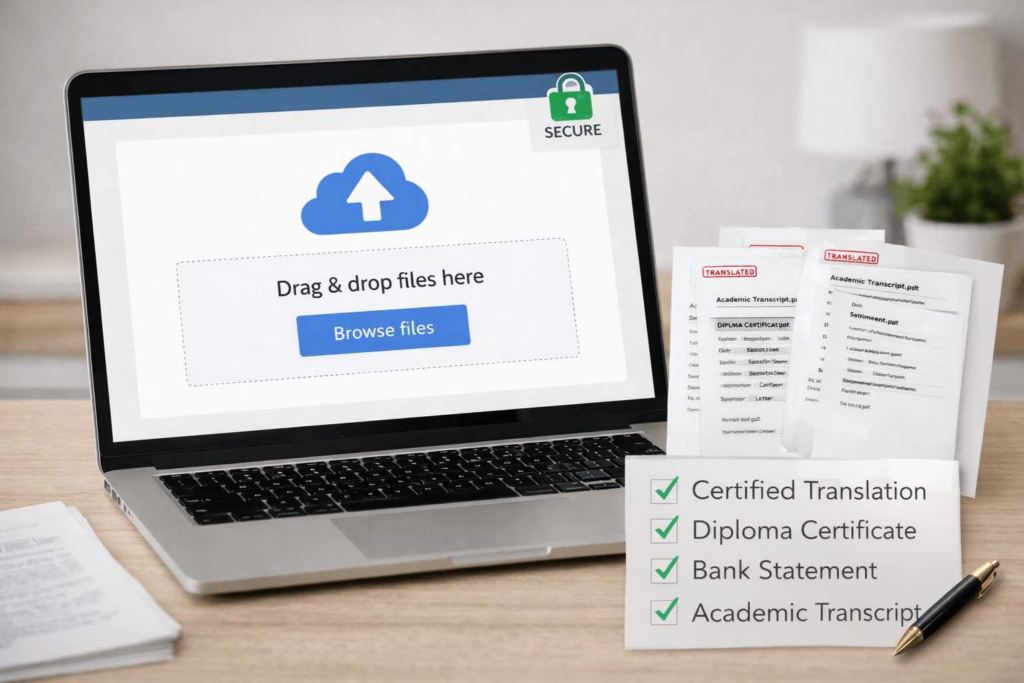
Upload your file today and get your F-1 student visa documents translated accurately and ready for submission.
FAQ Section
Frequently Asked Questions
Do I need a certified translation for all student visa documents?
You only need a certified translation for documents that are not in English and that you are submitting to the school, embassy/consulate, or USCIS. If a document is already fully in English, translation is usually not needed.
What are the F-1 visa translation requirements for USCIS filings?
For USCIS submissions, foreign-language documents must include a complete English translation and a signed certification stating the translation is complete, accurate, and prepared by a competent translator.
Can I translate my own documents for an F-1 visa application?
It is risky. Some immigration contexts discuss translator competence broadly, but many applicants avoid self-translation because it can lead to credibility issues, inconsistencies, or rejection. A professional certified translation is the safer option.
Which student visa documents usually need translation first?
Start with academic transcripts, diplomas, and financial documents (bank statements and sponsor letters). If you have dependants, add birth and marriage certificates early as well.
Do embassies and consulates have different translation rules for F-1 visa documents?
Yes, they can. The interview process is handled by the U.S. embassy or consulate, and local instructions may vary. Always check your specific post’s requirements before the interview.
Is notarisation required for F-1 visa document translation?
Usually, applicants need certified translation, not notarisation. Notarisation is a separate service and is only needed when the receiving institution specifically asks for it.
Do I need to translate my passport for an F-1 application?
Often, no. Many passport biographic pages are already in a standard bilingual or machine-readable format. However, you should translate any non-English observations, annotations, relevant stamps, or supporting IDs if they are being submitted and not in English.
Do I need a sworn translator in the UK for F-1 documents?
In most cases, no. F-1 submissions usually require a complete English translation with a signed translator certification statement. A sworn translator is only necessary if your school, embassy, consulate, or attorney explicitly requires one.
Can a UK-based translation company provide certified translations for U.S. F-1 use?
Yes, in many cases. What matters is that the translation is complete and accurate and includes the certification statement, signature, date, and translator or company contact details.
Will a scanned PDF of the certified translation be accepted?
Often, yes, for school portals and pre-interview preparation. For interviews, it is safest to bring printed originals and matching translations unless your post states otherwise. For USCIS filings, the signed certification statement should be included with the submission.
Do translations have to be in American English?
Usually, no. Decision-makers are looking for clear, accurate English. The priority is correctness and consistency, especially for names, dates, and figures, rather than whether the spelling follows UK or U.S. style.
Should grades, currencies, or date formats be converted in the translation?
No. Do not convert grades or rewrite financial figures inside the translated text. Keep the translation faithful to the original. If an institution requests explanations, such as a grading scale, provide that separately rather than changing the translated content.
What if my document is bilingual?
Do not assume it will automatically be accepted. Some institutions still require a certified translation for the non-English parts for consistency and recordkeeping.