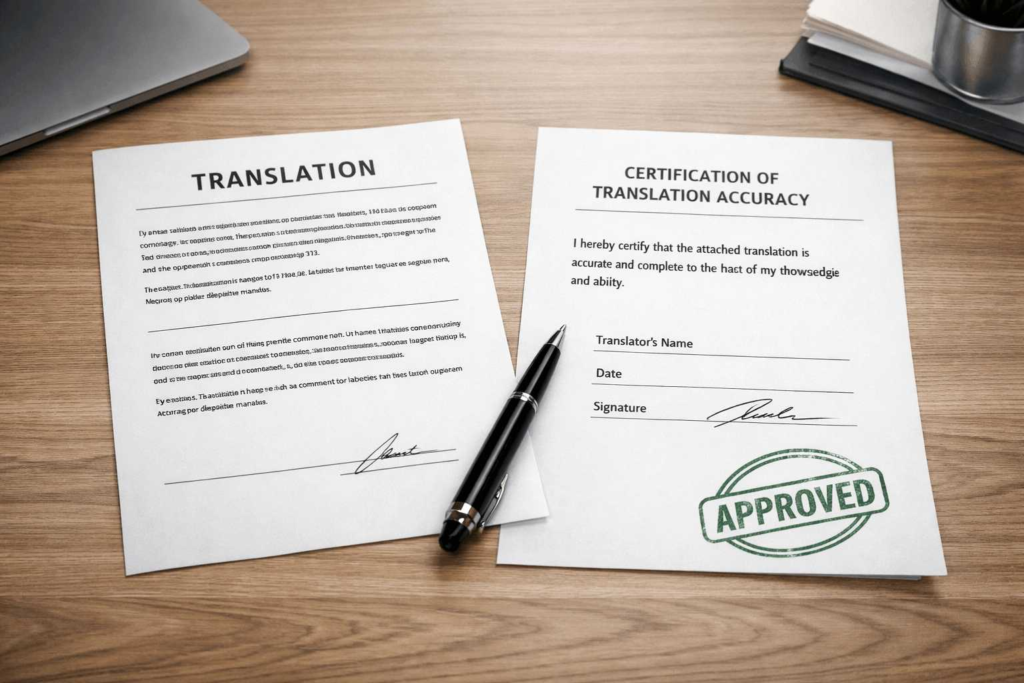
If you are submitting translated documents for immigration, court, university, or official use, the translation itself is only half the job. The other half is the translation certification statement—the signed declaration that makes the translation usable for formal submissions.
This is where many people get caught out. The document may be translated correctly, but if the certification statement is missing, incomplete, or vague, the whole pack can be questioned. That can mean delays, requests for more evidence, or having to pay for a replacement translation at the worst possible moment.
At Urgent Certified Translation, we treat the certification statement as part of the document package, not an afterthought. If you need a translation that is ready for submission, upload your file, and we will prepare the translation and certification in the correct format for your destination authority.
Direct answer: what a translation certification statement is and why it is important
A translation certification statement is the signed declaration attached to a translated document confirming that the translation is complete, accurate, and prepared by a competent translator.
It is important because many authorities do not treat a translation as officially usable unless this statement is included. In practical terms, it is the part that helps turn a translated document into a submission-ready certified translation for immigration, court, university, visa, and other formal use.
Why this matters in real submissions
A translation certification statement matters because it:
- proves that a named translator or provider stands behind the translation
- shows the receiving authority that the translation is intended for official use
- reduces the risk of rejection, delay, or requests for a corrected version
- helps caseworkers, universities, courts, and visa officers verify the document more easily
- forms part of the evidence pack for many immigration, legal, and academic submissions
What a translation certification statement actually is
A translation certification statement is a signed declaration attached to a translated document confirming two things:
- The translation is complete and accurate
- The translator is competent to translate the document into the target language (usually English)
That is the core purpose. It gives the receiving authority confidence that the translation is reliable and that a named person or provider stands behind it.
A simple definition
A translation certification statement is the translator’s signed statement of accuracy and competence attached to a translated document for official use.
What it is not
This is the point that causes the most confusion.
It is not the same as translator certification
A translator certification statement (attached to a translation) is not the same thing as a translator qualification or credential (such as ATA certification).
- Certification statement = statement attached to the translated document
- Translator certification (credential) = professional qualification the translator may or may not hold
A translator can produce a valid certification statement even if they do not hold a specific industry credential, as long as the receiving authority accepts that format.
It is not the same as notarisation
Notarisation usually confirms the identity of the person who signed the statement. It does not confirm the linguistic quality of the translation.
- Certified translation = translation + signed certification statement
- Notarised translation = certified translation + notary verification of signature (when required)
Some authorities ask for notarisation. Many do not. If you are unsure, send the request letter or document checklist and we will confirm what is actually needed before you order.
It is not the same as a sworn translation
In some countries, “sworn” or “official” translation has a very specific legal meaning and must be completed by a court-authorised translator.
For U.S. immigration and many UK submissions, what is usually needed is a certified translation with a proper certification statement, not a sworn translation.
Why certification statements get documents rejected or delayed
Most problems are not caused by the translation itself. They happen because the certification statement is weak.
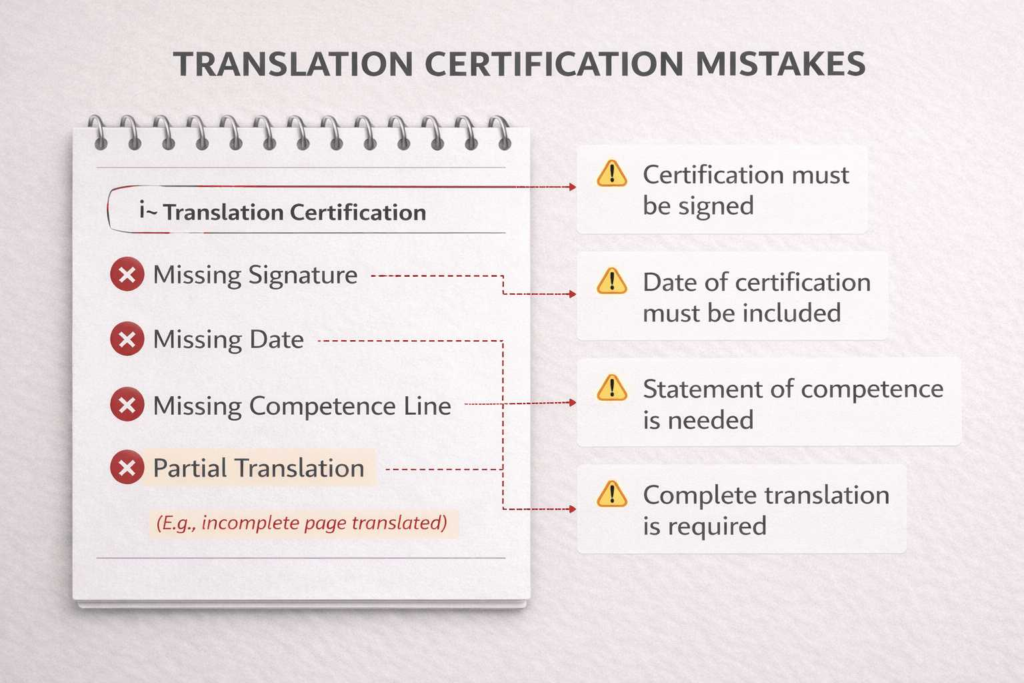
Common failure points
- No certification statement attached at all
- No signature
- No statement of translator competence
- No clear statement of accuracy/completeness
- No translator name or contact details where required
- Vague wording that does not identify the document
- Partial translations presented as “certified”
- Stamps, seals, handwritten notes, or annotations left untranslated
The 4-point acceptance check
Before sending any translated document, use this quick check:
- Complete – every visible element is translated (including stamps/seals/notes)
- Clear – the translated document is readable and logically formatted
- Certified – a signed statement of accuracy and competence is attached
- Connected – the certification clearly refers to the attached document
If one of these is missing, the risk of delay goes up.
What a translation certification statement should include
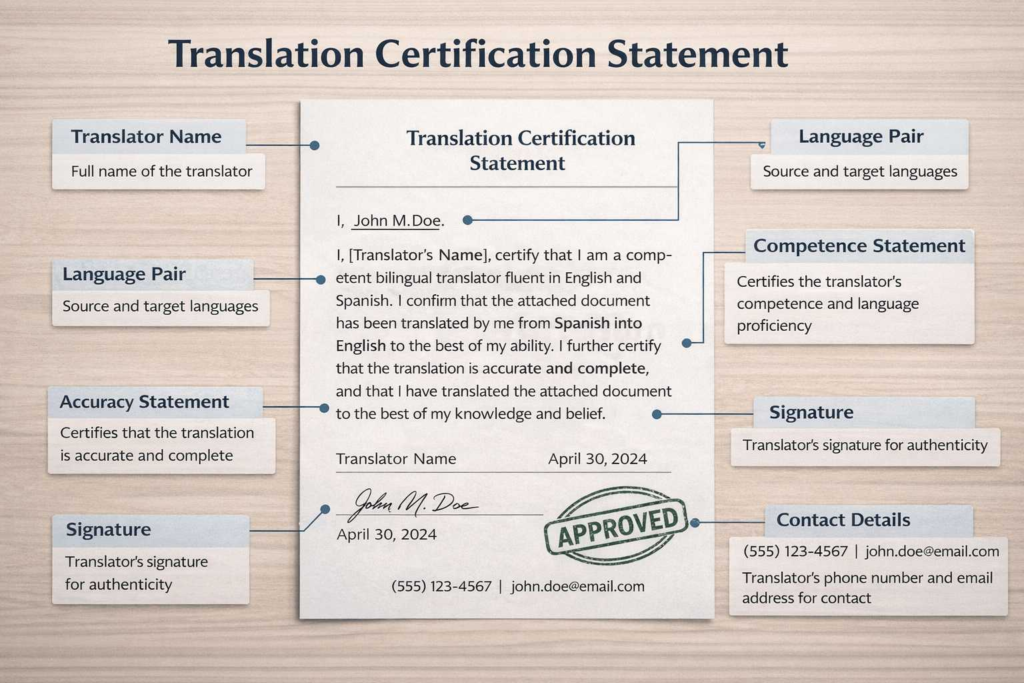
Requirements vary slightly depending on the authority, but this format works well for most official submissions and can be adjusted when needed.
Core elements (the universal checklist)
A strong certification statement should include:
- Translator’s full name
- Source language and target language
- A statement that the translation is complete and accurate
- A statement that the translator is competent to translate
- Identification of the translated document (for example, “Marriage Certificate”)
- Date of certification
- Signature
- Contact details (especially useful for immigration, visa, and legal submissions)
Extra elements are often requested
Depending on the destination, you may also need:
- Translator’s address
- Agency letterhead
- Agency contact details
- Order/reference number
- Notary block (if notarisation is requested)
- Stamp/seal (agency stamp, where used)
If you want a compliant pack without guessing, start your project, and we will format it to the authority’s expected standard.
When a translation certification statement is usually required
You will usually need a translation certification statement when translated documents are being submitted for:
- immigration applications
- visa submissions
- court proceedings
- university admissions
- professional licensing
- registrar or civil record processes
- government or official authority checks
Common examples include
- birth certificates
- marriage certificates
- divorce certificates
- police clearance certificates
- academic transcripts and diplomas
- bank statements used as supporting evidence
- court orders
- medical or vaccination records
- contracts or legal agreements submitted in official proceedings
When it may not be necessary
You may not need a certification statement if the translation is only for:
- personal understanding
- internal business reference
- informal review
- draft preparation before final official submission
If there is any doubt, the safest option is to use a certified translation format from the start rather than risk a rejection later.
Sample translation certification statement format
Use this as a practical model. It is intentionally clear and submission-friendly.
CERTIFICATE OF TRANSLATION ACCURACY
I, [Translator Full Name], certify that I am competent to translate from [Source Language]
into English, and that the attached translation of [Document Name] is a complete and
accurate translation of the original document to the best of my knowledge and ability.
Translator Name: [Full Name]
Signature: ______________________
Date: [DD/MM/YYYY]
Contact Details: [Email and/or Phone]
Address: [Optional / If required by authority]
UK-style variation (commonly requested)
For UK submissions, a certified translation often needs:
- confirmation it is an accurate translation of the original
- date of translation
- translator’s full name and signature
- translator’s contact details
If your submission is for UKVI, court, or another UK authority, we can prepare the statement in that wording format from the start.
Agency format vs individual translator format
Both are commonly used, but the safest approach is:
- Put the statement on agency letterhead (if available)
- Include the named translator or responsible signatory
- Add contact details
- Sign clearly (digital or wet-ink, depending on requirements)
Who can sign a translation certification statement
In many cases, the certification statement can be signed by:
- the individual translator who completed the work, or
- an authorised representative of the translation company issuing the certified translation
What matters most is that the statement clearly confirms
- the translation is complete and accurate
- the translator is competent in the relevant language pair
- the translated document is properly identified
- the signatory can be contacted if verification is needed
Can you write or sign it yourself?
For official submissions, the safest approach is usually to use an independent professional translator or agency rather than preparing your own certification statement.
Even where self-prepared wording is not expressly forbidden, self-certified translations can create avoidable scrutiny, especially for immigration, court, academic, or legal use.
Where the certification statement should go
There is no single universal layout rule, but in practice the cleanest format is:
- Copy of original document
- Full translated document
- Certification statement page (or certification block attached to the translation)
Best practice layout tips
- Keep the certification on its own page for multi-page documents
- For short documents, a certification block at the end can also work
- Use the same client/document reference across the translation and certificate
- Keep names, dates, and document titles consistent throughout
- Preserve visible labels such as seals, signatures, and stamps in the translation text
A good format makes it easier for caseworkers, admissions staff, or legal teams to review your file quickly.
Translation certification statement explained by use case
Not every authority checks the same details with the same intensity. The wording is similar, but the priority changes by use case.
Immigration submissions (USCIS and similar authorities)
For immigration, the main focus is usually:
- completeness
- accuracy
- translator competence
- clear identification of the document
This is why immigration packs often fail on small omissions (for example, untranslated annotations or stamps), not just obvious translation errors.
Practical tip: If the original contains a stamp, handwritten note, margin note, or seal text, include it in the translation. Do not assume it is “not important.”
UK visa and immigration submissions
For UK submissions, certified translations are commonly expected to include:
- accurate translation confirmation
- date
- translator’s full name and signature
- contact details
This is one of the reasons generic templates copied from random blogs can cause problems—they often miss one or more of these points.
Courts, universities, and consulates
These institutions may ask for extras such as:
- notarisation
- sworn translator status
- specific wording
- original hard copies
- institution-specific templates
If the requirement letter is unclear, send it to us before ordering. We will review it and confirm the correct format so you do not pay twice.
Certified translation statement format mistakes that cost time and money
1) Using a generic statement that does not name the document
A statement that says “I certify this translation is accurate” is too generic.
It should identify the document, such as:
- Birth Certificate
- Marriage Certificate
- Police Clearance Certificate
- Academic Transcript
2) Leaving out the translator competence line
Accuracy alone is not enough. The certification should also confirm the translator is competent in the relevant language pair.
3) Treating “summary translations” as certified translations
Official submissions generally expect a full translation, not a summary. If only certain sections were translated, it should be clearly labelled as an extract—and only used where extracts are accepted.
4) Forgetting signatures
A typed name is not the same as a signed certification in many contexts. If your authority requires a signature, make sure one is present and clear.
5) Confusing notarisation with certification
Adding a notary when not required can increase cost and delay. Skipping notarisation when it is required can cause rejection. The right answer depends on the receiving authority.
6) Inconsistent names and dates across the packet
Even if the translation is accurate, inconsistent transliteration or date formatting across documents can trigger extra scrutiny.
Mini case examples
Case 1: Marriage certificate for immigration
A client submitted a translated marriage certificate, but the certification statement only said “accurate translation” and did not mention translator competence. The application was delayed while a corrected certificate was requested.
Fix: We issued a revised certification statement with full wording, signature, and document identification.
Case 2: Academic transcript for university admission
The translation was accepted, but the admissions office asked for contact details on the certification statement for verification.
Fix: We added the translator contact line and reissued the pack the same day.
Case 3: Court filing with “notarised translation” request
The client ordered a standard certified translation first, but the court clerk later requested notarisation.
Fix: We added a notarised certification layer without retranslating the document, saving time and cost.
If you want to avoid these rework scenarios, contact us today before you submit. A quick requirement check can save days.
How to choose a provider for certified translation statements
When comparing providers, do not just compare the per-page price. Ask these questions:
Checklist for choosing the right service
- Do you include a proper certification statement with every order?
- Can you adapt the wording for USCIS, UKVI, courts, or universities?
- Will you translate stamps, seals, and handwritten notes?
- Can you provide notarisation if requested later?
- Do you provide rush turnaround if I have a deadline?
- Can you issue a revised certificate quickly if an authority asks for a format change?
At Urgent Certified Translation, we build the certification statement into the delivery workflow from the start. That means you receive a submission-ready pack, not just a translated text file.
Upload your file to get a fast quote and we’ll confirm the correct format for your use case.
Quick comparison: certification statement, notarisation, and sworn translation
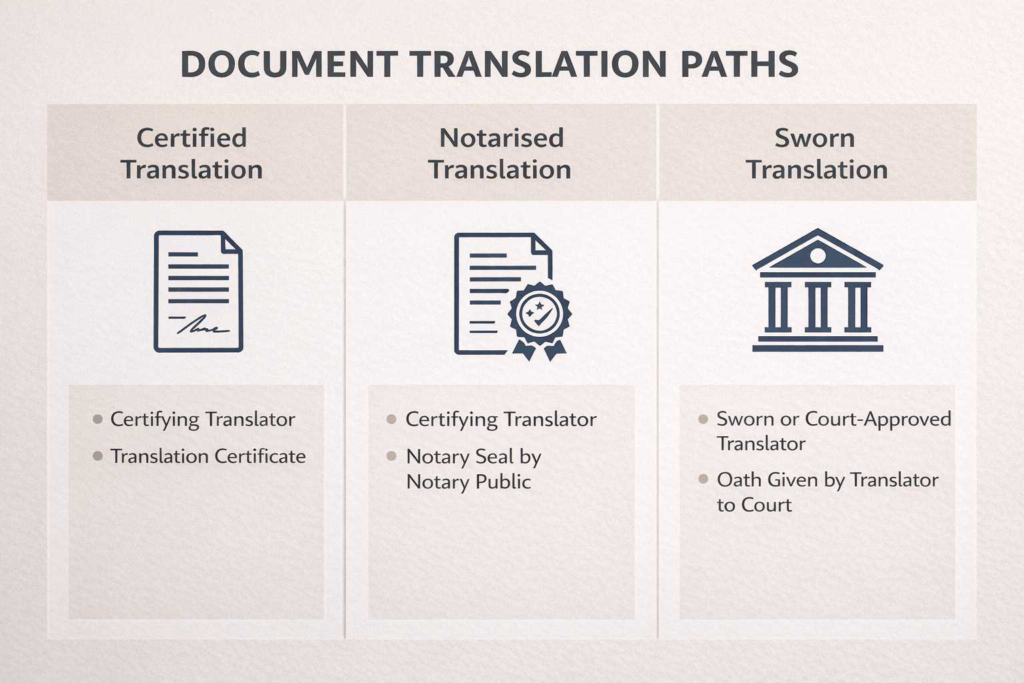
Certified translation (most common)
Use when an authority asks for a certified translation or a certificate of accuracy.
Includes:
- translation
- certification statement
- signature
Notarised translation
Use when the authority specifically asks for notarisation.
Includes:
- certified translation pack
- notary verification of signature
Sworn translation
Use when the destination country or court specifically requires a sworn/official translator.
Includes:
- translation by authorised sworn translator
- jurisdiction-specific formalities
If the request wording is unclear, send us the exact phrase (for example, “certified”, “notarised”, “sworn”, or “legalised”). We’ll tell you what is actually needed.
Final takeaway

A translation certification statement is not a minor admin detail. It is the part that makes an official translation credible and usable.
If your statement is missing the right wording, signature, or document reference, the translation can still be challenged—even if the language is perfect.
The safest approach is simple:
- use a full translation
- include a clear certification statement
- match the authority’s formatting expectations
- keep everything consistent in one clean packet
If you need a translation for immigration, UK visa, court, university, or official use, request a free consultation or start your project today. We’ll prepare the translation and certification in the right format the first time.
Frequently Asked Questions
What is a translation certification statement?
A translation certification statement is a signed declaration attached to a translated document confirming the translator is competent and that the translation is complete and accurate.
What is a translator certification of accuracy?
A translator certification of accuracy is another name for the certification statement. It is the statement that makes a translation “certified” for many official uses.
What should a certified translation statement format include?
A certified translation statement format should include the translator’s name, language pair, accuracy/completeness statement, competence statement, document identification, date, signature, and contact details where required.
Is a translation certification statement the same as notarisation?
No. A translation certification statement confirms translation accuracy and translator competence. Notarisation confirms the identity/signature of the person signing, and is only needed when specifically requested.
Can a translation company sign the certification statement?
In many cases, yes. A translation company can issue the certification statement through an authorised signatory, provided the statement clearly confirms competence and accuracy and meets the authority’s requirements.
Do I need a different certification statement for USCIS, UKVI, or court use?
The core wording is similar, but formatting and supporting details can differ. USCIS, UKVI, courts, and universities may each expect slightly different certificate wording or add-ons (such as contact details or notarisation).
Why is a translation certification statement important?
It is important because it confirms the translation is accurate, complete, and prepared by a competent translator. For many authorities, this is what makes the translation acceptable for official use.
When is a translation certification statement required?
It is usually required when a translated document is being submitted to an immigration authority, court, university, government department, or other official body.
Who signs a translation certification statement?
It is commonly signed by the translator or by an authorised signatory from the translation company, depending on the service model and the authority’s expectations.
Can I create my own translation certification statement?
For official use, the safer option is to use a professional translator or agency. A self-prepared statement can lead to extra scrutiny or rejection if the receiving authority expects independent certification.
Does a translation certification statement make a translation notarised?
No. A certification statement makes the translation certified. Notarisation is a separate step used only when the receiving authority specifically asks for it.
What is the difference between a certificate of accuracy and a translation certification statement?
In many contexts, they refer to the same thing: the signed statement confirming that the translation is complete, accurate, and prepared by a competent translator.