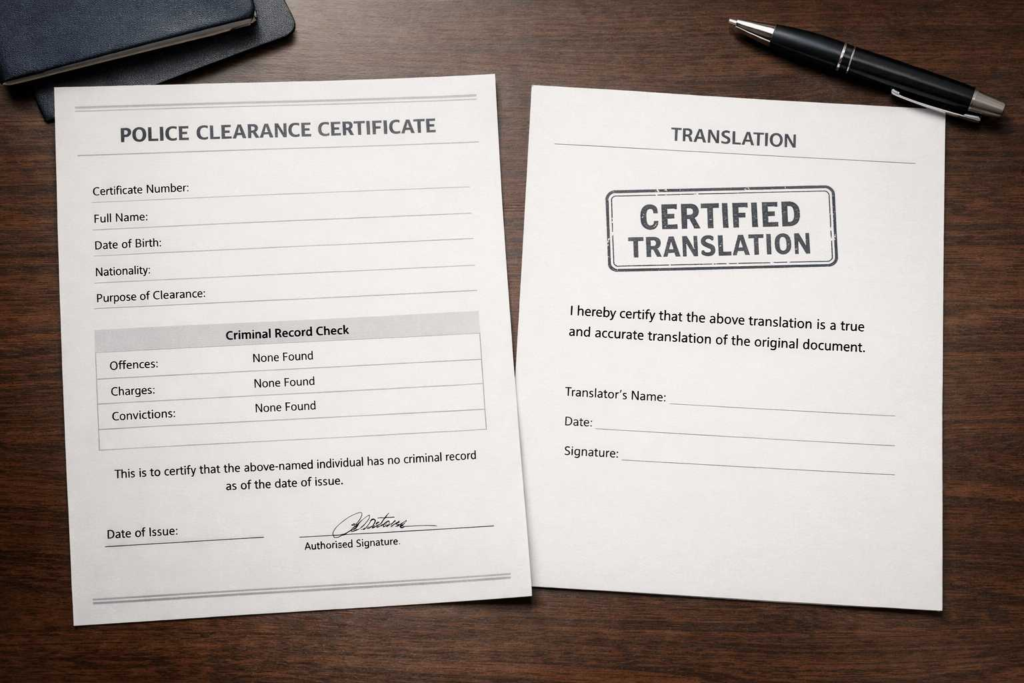
If you need to translate a police clearance certificate for immigration, a visa, a job, or a background screening, the margin for error is tiny. One missing stamp, a name that doesn’t match your passport spelling, or a certification statement that’s “almost right” can trigger delays, extra fees, or a request to resubmit.
This guide walks you through a practical, submission-ready process: what to prepare, what a certified translation should include, and the most common pitfalls to avoid.
How Can I Get a Police Clearance Certificate Translated for UK Immigration?
If your police clearance certificate is not in English or Welsh, the safest approach for a UK immigration application is to submit the original document together with a full certified translation that can be independently verified. In practice, that means sending a clear scan of every page to a professional translator or translation company, making sure the translation includes all text, stamps, seals, notes, and reference numbers, and checking that the certification statement includes the translator’s confirmation of accuracy, the date, full name and signature, and contact details. For many Home Office routes, guidance also refers to a fully certified translation from a professional translator or translation company.
For most applicants, the simplest route is:
- prepare a clear scan of every page
- state that the document is for UK immigration or a Home Office submission
- request a full certified translation service
- check that names, dates, document numbers, and stamps match the original exactly
- submit the original plus the certified translation together, where required by the destination process.
What a Police Clearance Certificate Is (And Why Translation Gets Rejected)
A police clearance certificate can be issued under different names depending on the country, such as:
- Police Certificate
- Certificate of Good Conduct
- Criminal Record Extract
- Certificate of No Criminal Record
- Background Check (in some contexts)
- PCC (Police Clearance Certificate)
Even if the document looks simple, it often contains details that reviewers check closely:
- Full legal name (including diacritics and multiple surnames)
- Date and place of birth
- Passport or national ID number
- Issue date and reference number
- Issuing authority details
- Seals, stamps, signatures, QR codes, notes, and disclaimers
- Sometimes: convictions, cautions, or “no trace” wording with legal phrasing
Translation gets rejected most often because the translation is incomplete, the certification is missing or not acceptable for the destination, or the formatting makes it hard to verify against the original.
Police Certificate vs DBS vs ACRO: Which One Do You Translate?
This is one of the most common points of confusion. For immigration, visa, citizenship, and overseas submission purposes, the document required is often a police certificate or overseas criminal record certificate, not necessarily a DBS certificate. UK DBS guidance notes that DBS cannot access criminal records held overseas, so a DBS check may not provide a complete view of a person’s record if they have lived outside the UK. ACRO also states that its Police Certificate is for people who want to emigrate, travel, need a visa to live and/or work abroad, or are looking to obtain citizenship or residency. If you are unsure which document the receiving authority wants, check the exact wording in the request and, if relevant, the official Get a copy of your police records (UK) guidance.
Before You Translate: Confirm the “Destination Rules” in 2 Minutes
Different organisations use different standards. Before you do anything else, confirm:
- Required language (usually English, sometimes French, sometimes the local language of the receiving office)
- Type of translation required
- Certified translation (most common)
- Notarised translation (sometimes requested)
- Sworn translation (common in some European jurisdictions)
- Legalisation/apostille (sometimes required for cross-border use)
- Whether scans are accepted or originals must be shown
- Whether translations by friends/family are rejected (often yes)
- Validity window (some certificates “expire” depending on the authority)
Quick reality check
If the receiving body says “certified translation”, don’t assume notarisation or apostille is required. Those are different steps, and they can be unnecessary unless explicitly requested.
UK Immigration: What the Home Office Expects in the Translation
For UK immigration applications, the most useful rule to follow is the Home Office requirement for a full translation that can be independently verified where the original document is not in English or Welsh. The translation should include:
- confirmation from the translator that it is an accurate translation of the original
- the date of translation
- the translator’s full name and signature
- the translator’s contact details
Across Home Office caseworker guidance, you will also see wording that refers to a fully certified translation from a professional translator or translation company. That is why it is important to provide every page, every stamp, and the exact purpose of the application from the start.
If you are comparing destination requirements, it helps to check the wording against official sources such as UK Home Office guidance on translated supporting documents, USCIS translation requirements, and the IRCC police certificate translation rule.
The Police Clearance Translation Guide: A Step-by-Step Process
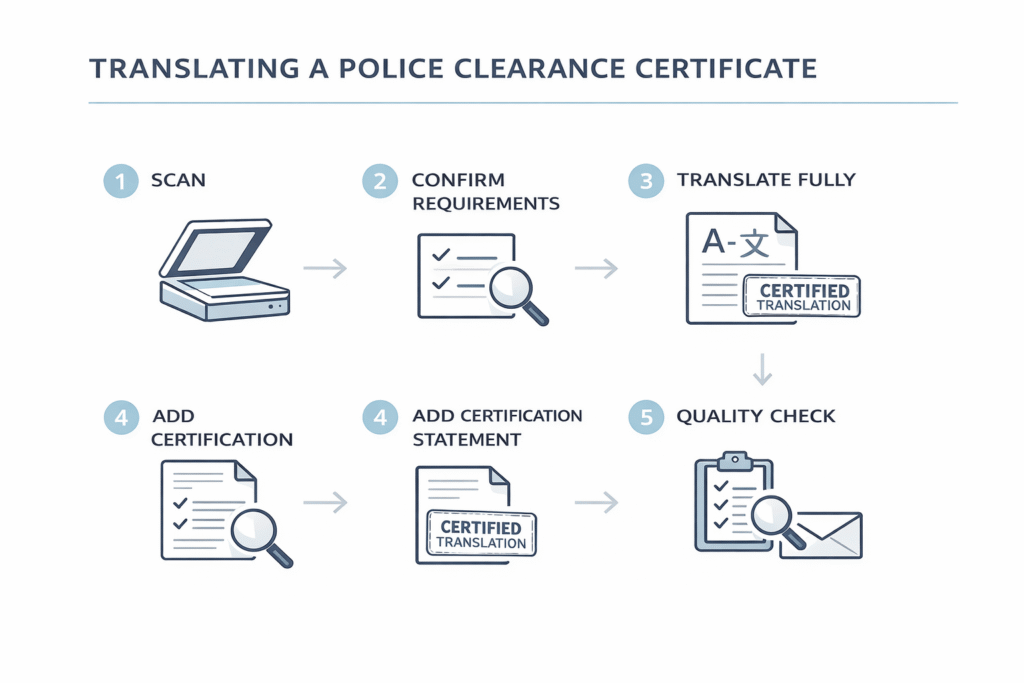
Step 1: Make sure you have the correct certificate version
Before translating, verify:
- It’s issued by the correct authority (not a lookalike printout or unofficial portal screenshot)
- It’s the most recent version you intend to submit
- All pages are included (front/back where relevant)
- Any attached pages, footnotes, or endorsements are included
- Any digital verification elements (QR, verification code, reference number) are visible
Tip: If your certificate has a watermark, embossed seal, or faint stamp, scan at higher contrast or take angled photos so it’s clearly visible.
Step 2: Create a “translation pack” (this reduces mistakes fast)
Send your translator:
- A clear scan/photo of every page
- The purpose and destination (e.g., immigration, employer screening, university)
- Your preferred name format exactly as shown on your passport
- Any required spelling rules (e.g., “use machine-readable zone spelling”)
- Your deadline and whether you need a PDF, hard copy, or both
- Any instructions from the receiving body (even a screenshot is fine)
Mini checklist for scan quality
- No cropped edges
- No glare on stamps
- Text readable at 100% zoom
- All corners visible
- Straightened (not skewed)
Step 3: Choose the right type of translation (certified vs notarised vs sworn)
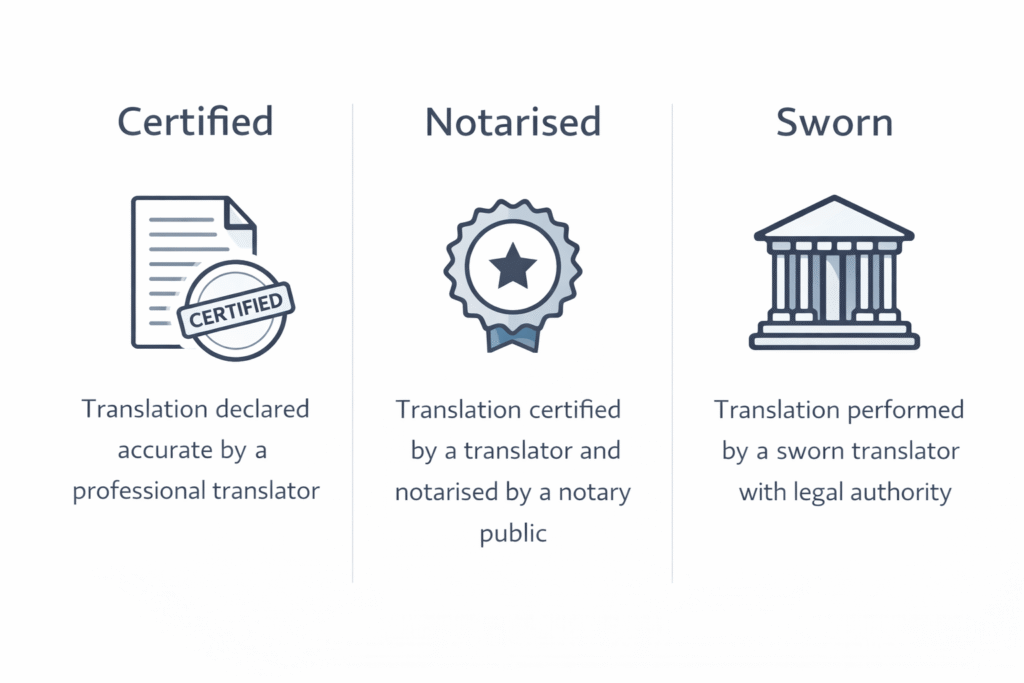
These terms are often confused:
Certified translation
A complete translation accompanied by a signed statement confirming accuracy and translator competence. This is what most immigration and official submissions ask for.
Notarised translation
A notary verifies the identity of the person signing the certification (not the translation quality itself). Only do this if explicitly requested.
Sworn translation
A translation produced by a translator authorised in a specific jurisdiction (common in some countries). Required mainly where the receiving authority mandates a sworn translator.
Apostille/legalisation
A separate authenticity step for cross-border use. It applies to documents/signatures, depending on the destination requirements.
If you’re unsure, the safest approach is to follow exactly what the receiving body requests. More steps don’t always mean “more accepted”.
Step 4: Ensure the translation is truly complete (including stamps and notes)
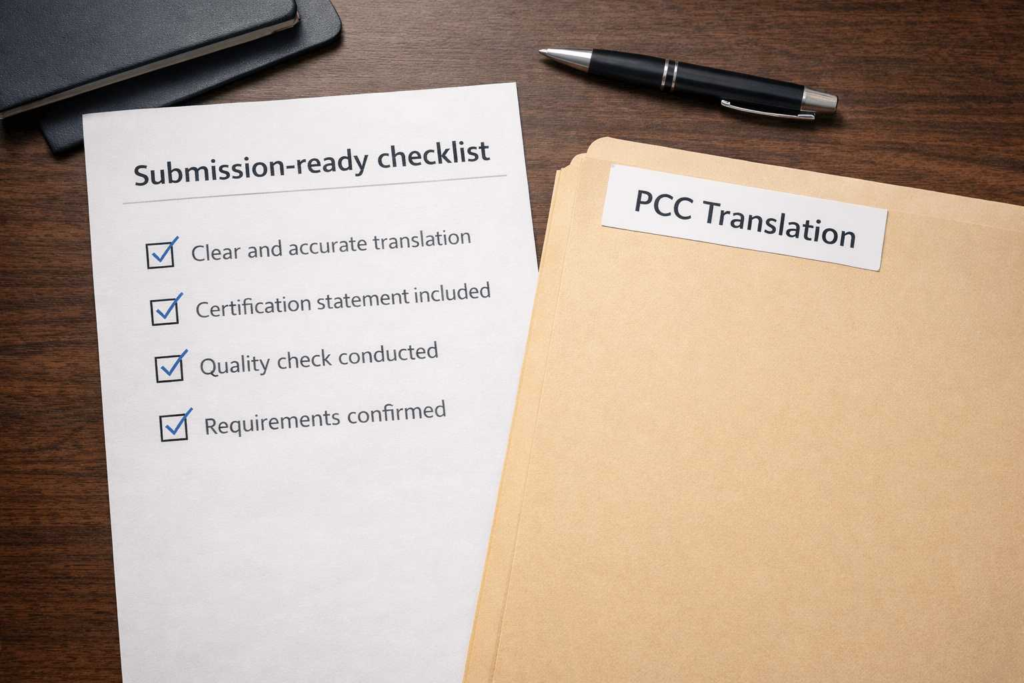
A submission-ready police certificate translation should include:
- Every line of text (including headers, disclaimers, and footnotes)
- Stamps, seals, signatures (described clearly if not fully legible)
- Handwritten notes (translated if readable, labelled if unclear)
- Reference numbers and verification codes (preserved exactly)
A common reason for rejection is when “small print” is skipped because it looks repetitive or unimportant. On police certificates, that “small print” often contains the legal meaning.
Step 5: Add a certification statement that matches real-world expectations
This is the part many people get wrong.
A strong certification statement should include:
- Translator’s full name
- Signature
- Date of certification
- Contact details (or agency details)
- A clear statement that:
- the translation is complete and accurate, and
- the translator is competent in both languages
Example certificate of accuracy (copy-and-paste template)
Certificate of Translation Accuracy
I, [Translator Full Name], certify that I am fluent in [Source Language] and English, and that the attached translation of the [Police Clearance Certificate / Police Certificate] is a complete and accurate translation of the original document.
Translator name: [Full Name]
Signature: ____________________
Date: [DD Month YYYY]
Contact details: [Email / Phone]
Address (optional if required): [Address]
Tip: If the destination body provides a required wording, use that wording exactly.
Step 6: Do a final “acceptance check” before you submit
Before you submit, compare the translation to the original and confirm:
- Names match your passport spelling (including order)
- Dates are consistent (and formatted clearly)
- Document number/reference is identical
- The issuing authority is translated consistently
- Stamps/seals are accounted for and labelled
- All pages are included and numbered
- The certification statement is signed and dated
If anything is unclear on the scan, fix the scan first. A perfect translation of a blurry stamp still looks incomplete to a reviewer.
Common Mistakes When You Translate a Criminal Record Check
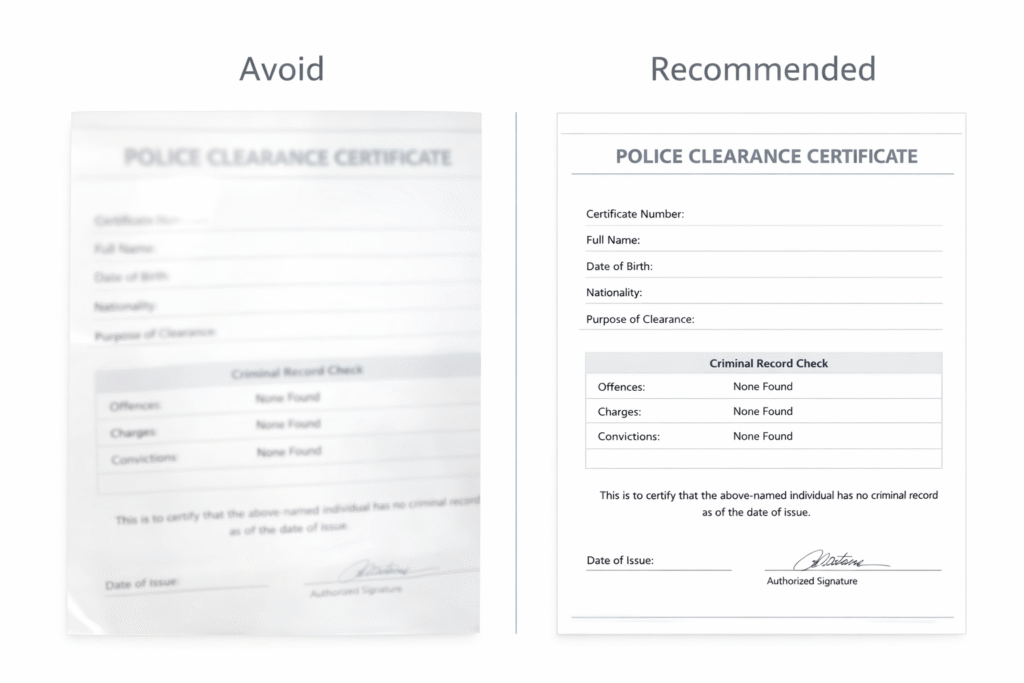
These issues cause the most delays:
- Translating only the “main body” and skipping notes/stamps
- Missing reverse pages, attachments, or endorsements
- Name mismatch (especially with multiple surnames or transliteration)
- Reformatting dates without clarifying the original format
- Leaving “standard phrases” untranslated
- Using machine translation without a proper certification statement
- Submitting a translation that is not clearly linked to the original (no doc title, no reference number, no page identifiers)
- Getting notarisation/apostille unnecessarily, and still missing the required certified translation format
Special Situations (And How to Handle Them)
If your police certificate includes convictions or cautions
The translation must remain neutral and precise. Avoid “softening” language. If a term has no direct equivalent, the translator should use the closest legal term and, if necessary, add a brief clarification in brackets.
If you lived in multiple countries
Immigration processes often require certificates from multiple places. Keep each certificate as a separate translation pack and label them clearly by country and issuing authority.
If the certificate is digital (PDF with QR / verification code)
Do not crop out the QR code or verification block. Translators should preserve the code and translate the surrounding labels. If the PDF includes a verification link, keep it visible (even if you don’t translate the URL itself).
If you’re worried about expiry
Some authorities treat police certificates as time-sensitive. If your certificate is older, check the submission rules before paying for translation.
If your destination authority publishes its own civil document rules, compare your certificate date and validity window against that source as well, such as the U.S. Department of State civil documents guidance (police certificates).
A Practical “Submission-Ready” Checklist You Can Use Today
Use this before you upload your documents:
- I have every page (including reverse/attachments)
- Scans/photos are readable, not cropped, no glare
- I confirmed the destination language and requirements
- Translation includes stamps, seals, notes, and reference numbers
- The certification statement is signed and dated
- Names match my passport spelling and order
- I have the correct delivery format (PDF / hard copy)
Simple UX Ideas to Improve Engagement on This Page
If you’re publishing this guide on your site, these elements increase time-on-page and reduce drop-offs:
- A one-page downloadable “Police Certificate Translation Checklist” (PDF)
- A “What do I need?” decision widget (Certified vs notarised vs sworn vs apostille)
- A scan-quality carousel showing good vs bad examples (blur, glare, cropping)
- A short “common rejection reasons” infographic
- A copy-and-paste certification statement block (as above)
Need Help Choosing the Right Format?
If you are unsure whether you need a certified, notarised, sworn, or apostilled translation for a police certificate, the safest step is to check the receiving authority’s wording and get the translation prepared to match that requirement exactly. If you want help reviewing the document type or the expected format before ordering, contact us.
FAQ Section
Do I need a certified translation to translate a police clearance certificate?
In most official and immigration contexts, yes. A certified translation includes the full translation plus a signed statement confirming accuracy and translator competence.
Can I translate my own police clearance certificate for immigration?
Some authorities accept self-translations in theory, but it often creates avoidable risk. Missing certification wording, incomplete stamps, and formatting issues are common reasons for delays.
What’s the difference between a police clearance certificate and a criminal record check?
Terminology varies by country. A police certificate is often issued for visa/immigration use, while a criminal record check can be a domestic screening document. Always translate the document you’re actually required to submit.
Do I need notarisation for a police certificate translation?
Not always. Notarisation is usually only needed if the receiving organisation explicitly asks for it. If they only request a certified translation, notarisation may be unnecessary.
Should stamps and seals be translated?
Yes. Stamps, seals, signatures, and handwritten notes should be translated or clearly labelled so the reviewer can match the translation to the original.
How fast can a police clearance certificate be translated?
Turnaround depends on language, scan quality, complexity, and whether stamps/notes require careful formatting. If you have a deadline, provide it upfront so the translation can be prepared accordingly.
How can I get a police clearance certificate translated for UK immigration?
For UK immigration, the safest route is to send a clear scan of the original certificate to a professional translator or translation company and request a full certified translation. The translation should include all text, stamps, seals, and reference numbers, and the certification should include the translator’s confirmation of accuracy, the date, full name and signature, and contact details. Where required by the application process, submit the original document together with the translation.
What must a UKVI-compliant police certificate translation include?
As a practical checklist, it should include the full translation of the original document, confirmation that it is an accurate translation, the date of translation, the translator’s full name and signature, and the translator’s contact details. Home Office caseworker guidance also refers to a fully certified translation from a professional translator or translation company.
Do I need to submit the original police certificate as well as the translation?
For many immigration processes, yes — the translation accompanies the original document rather than replacing it. That is why the translation should mirror the original closely and preserve the document title, reference numbers, and page structure wherever possible.
Can I use a DBS check instead of a police certificate for immigration?
Not always. A DBS check and a police certificate are not interchangeable. DBS guidance states that DBS cannot access criminal records held overseas, while ACRO states its Police Certificate is intended for emigration, travel, visas, work abroad, citizenship, and residency purposes. Always follow the wording used by the authority asking for the document.
Can I translate my own police certificate for UK immigration?
Even where a destination authority does not spell out a ban on self-translation, it adds unnecessary risk. Home Office guidance focuses on a translation that can be independently verified, and caseworker guidance refers to a fully certified translation from a professional translator or translation company. Using an independent professional is the safer option.