If you’re searching for how to get a notarized translation, you’re probably dealing with a high-stakes submission: immigration, a university application, a court matter, or an overseas registration. The good news is the process is straightforward—once you understand what “notarized” actually means in translation.
A notarized translation is usually a certified translation (with a signed statement of accuracy) plus an extra step where a notary public verifies the identity of the person signing the certification and witnesses that signature.
This guide walks you through the exact steps, what you need to prepare, where to get a notarized translation, and how to avoid the most common reasons documents get rejected.
How do I get a certified notarized translation for official documents in the UK?
If you need a certified notarized translation for official documents in the UK, the safest route is to treat it as a four-part process:
- Start with a clear copy of the original document, making sure every page, seal, stamp, note, and handwritten entry is visible.
- Get a full certified translation prepared, with a signed statement confirming that the translation is true and accurate.
- If the receiving authority specifically requires notarisation, have the translator’s or authorised signatory’s certification signed in front of a notary public so the notary can witness the signature and apply the notarial seal.
- If the document is being used abroad and the destination authority asks for legalisation, arrange an apostille after notarisation.
In many UK cases, the receiving authority only asks for a certified translation, not a notarised one. That is why the most important step is to check the exact wording of the requirement before you order anything extra.
As a practical rule, you should usually submit the original-language document together with the translation, because many official bodies want to compare both.
What “Notarized Translation” Means (and What It Doesn’t)
A notarized translation typically includes:
The translated document
A Certificate of Translation Accuracy (signed and dated)
A notary public’s stamp/seal and notarial wording confirming the signature was witnessed
Important: In most cases, the notary is not verifying the translation’s linguistic accuracy. The notary is confirming the identity of the signer and that they signed in the notary’s presence.
In UK practice, the translation itself is usually certified by the translator or translation company. The notary is a separate professional step used only when the receiving authority wants the certification signature notarised.
If you also need the document recognised internationally, you may be asked for legalisation (often an apostille) on top of notarisation. That’s a separate step and depends on the country and receiving authority.
If you’re not sure whether you need certified or notarized, start here: Certified Translation Services.
When You Usually Need a Notarized Translation
Notarised translations are commonly requested for:
Academic admissions or credential evaluations
Court filings, affidavits, and legal proceedings
Certain embassy/consulate submissions
International business documents and overseas registrations
Situations where the receiving authority explicitly says: “translation must be notarized”
If the instructions don’t clearly say “notarized”, don’t assume you need it. Many organisations accept certified translations without notarisation.
A Quick “Do I Need Notarisation?” Check
Before you pay extra or lose time, ask these three questions:
Who is the receiving authority? (court, university, embassy, employer, government office)
What exact wording do they use? (“certified translation”, “notarised translation”, “sworn translation”, “legalised/apostilled”)
Do they need paper originals, or will a digitally signed PDF be accepted?
If you can’t get a clear answer, request written confirmation from the receiving authority—or send us the instructions and we’ll help you interpret what they’re asking for.
Best next step: Upload your document and requirements and we’ll confirm the right format before we start.
Do You Need the Original Document Certified, the Translation Notarised, or Both?
This is one of the most common points of confusion, and it causes unnecessary delays.
These are different steps:
The original document or a certified copy
Some authorities want to see the original foreign-language document. Others will accept a certified copy of it. This is separate from the translation itself.
The certified translation
This is the translated document plus a signed statement confirming it is a true and accurate translation of the original.
The notarised translation
This is the certified translation after the translator’s or authorised signatory’s certification has been signed in front of a notary public and notarised.
The apostille or legalisation
This is a further authentication step used when a document package or a public official’s signature needs to be recognised abroad.
A simple way to think about it is this:
the translator certifies the translation,
the notary notarises the signature on the certification,
and the apostille legalises the relevant UK signature or seal for international use.
Important: if your document was issued outside the UK, the UK legalisation service does not legalise the foreign original document itself. In that situation, you may need legalisation in the country where the document was issued, while the UK step may apply only to the notarial act or UK certification attached to the translation.
Step-by-Step: How to Get a Notarized Translation
Step 1: Collect the right version of your document
Most delays happen because the document provided isn’t suitable for official use.
Use this checklist before sending anything:
All pages included (front/back where relevant)
Stamps, seals, notes, and handwritten entries are visible
Nothing cropped off at the edges
Names and dates are readable
If your document is double-sided, photograph/scan both sides
If you only have a phone photo, that’s fine—just make it sharp and well-lit.
Step 2: Confirm the destination requirements (one minute that saves days)
Notarised translation requirements vary depending on where the document is going.
You should confirm:
Target country and institution
Required language
Whether they accept digital notarisation or require wet-ink originals
Whether they require an apostille/legalisation after notarisation
Any formatting requirements (for example, how names and dates should appear)
If you have a screenshot or email from the receiving institution, include it.
For UK submissions, what should the translation include?
If your documents are being submitted to a UK authority or professional body, the translation should usually be complete and easy to verify against the original. A strong submission-ready package should include:
Confirmation that the translation is true and accurate
The date of translation
The translator’s full name
The translator’s signature or authorised sign-off
The translator’s or translation company’s contact details
A complete translation of all visible content, including stamps, seals, headings, and notes where relevant
Where possible, submit both the original-language document and the English translation together, because some authorities specifically ask for both.
Where to Get a Certified Notarized Translation in the UK
You generally have two practical parts to arrange: the translation and, if required, the notarial step.
For the translation, look for a professional translator or translation company experienced in official documents. In the UK, public directories are maintained by recognised professional bodies such as CIOL, ITI, and ATC.
For the notarial step, use a genuine notary public. In England and Wales, a notary public is a separate regulated legal profession. A solicitor is not automatically authorised to perform notarial acts unless they are also a notary. In Scotland, notaries are regulated under a different system.
For most clients, the simplest option is to use a translation provider that can coordinate the certification and notarisation together, so the wording, signing method, and delivery format all line up correctly.
Step 3: Choose where to get a notarized translation
You generally have three options:
Option A: A translation service that arranges notarisation for you (simplest)
This is usually the fastest route because the workflow is integrated: translation, certification, notarisation, and delivery.
If you want a submission-ready package without chasing multiple parties, start with Urgent Certified Translation and request notarisation as an add-on.
Option B: Your own translator + a local notary (works, but must be coordinated)
This can work well, but only if:
The translator is willing to sign the certification in the notary’s presence (or follow the notary’s approved method)
The notary is comfortable notarising a translator’s declaration/certificate
You understand exactly what the notary is notarising (signature, affidavit, declaration)
Option C: Remote/online notarisation (convenient where accepted)
Some authorities accept digitally notarised documents; others require paper originals. Always check first.
Step 4: The translation is completed and certified
A proper certified translation should be:
Complete and faithful to the original (including stamps, seals, headings, marginal notes where visible)
Clearly formatted so an officer can compare it to the source document
Delivered with a Certificate of Translation Accuracy signed and dated by the translator (or authorised representative)
At Urgent Certified Translation, we follow a submission-focused quality check to reduce rejections:
Names and spelling consistency (including diacritics)
Dates and number formatting
Document numbers and issuing authority details
Missing pages/stamps/annotations
Clear labelling of seals and stamps
Step 5: The certificate is notarised (the key moment)

This is the step that turns a certified translation into a notarised translation.
Typically:
The signer presents a valid ID to the notary
The signer signs the certificate/declaration in front of the notary (or follows an approved alternative method)
The notary applies a stamp/seal and notarial wording
Avoid this common mistake: trying to take a pre-signed certificate to a notary afterwards. Many notaries will refuse because they didn’t witness the signature.
Step 6: Delivery in the format your institution will accept
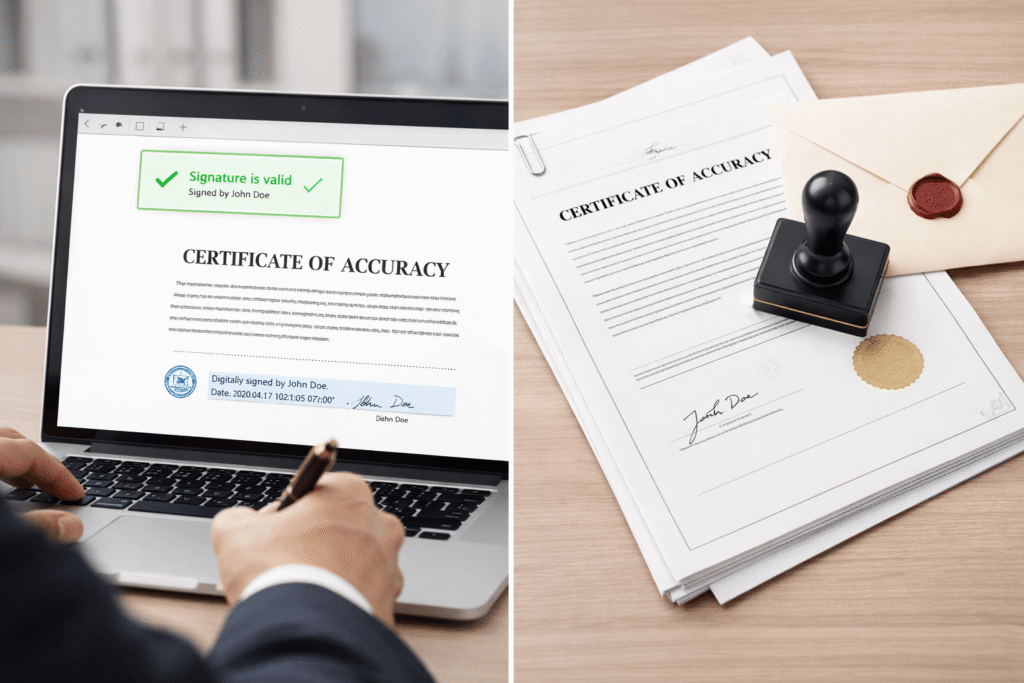
Before you finalise, confirm whether you need:
A digital PDF for online submission
Paper hard copies for mail/in-person filing
Multiple notarised copies (some institutions keep one and return none)
If you need printed, notarised copies, ask for this upfront so the package is prepared correctly from the start.
Ready to start? Upload your file here and we’ll come back with the fastest compliant option.
Notarized Translation Requirements (What You’ll Typically Need)
Most receiving offices expect a notarised translation package to include:
The translated document (complete)
A Certificate of Translation Accuracy (signed and dated)
Notary stamp/seal and notarial wording
Notary’s jurisdiction/commission details (varies by location)
Clear file naming (so it matches your application checklist)
To speed things up, send:
Your document (scan/photo)
A note telling us where it’s being submitted
Any requirement wording from the receiving authority
Your deadline and whether you need hard copies
If the submission is going to a UK authority, it is also sensible to make sure the translation certificate includes the translator’s name, signature, date, and contact details, because these are common verification points in official UK requirements.
Notarised vs Certified vs Sworn vs Apostille (Quick Clarity)
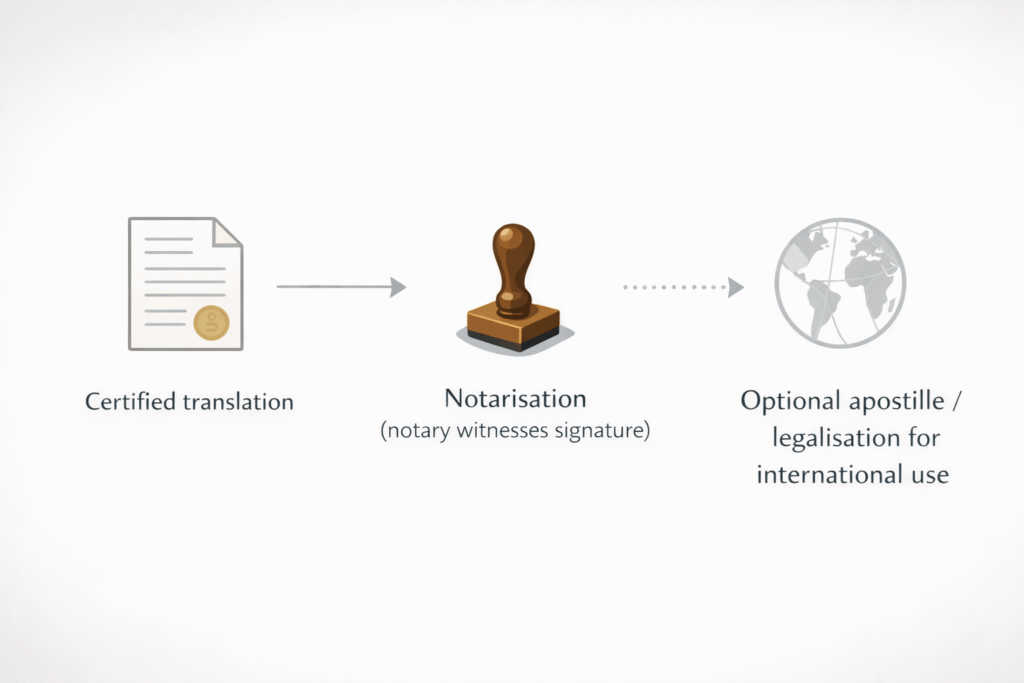
People often mix these up. Here’s the practical difference:
Certified translation: translation + signed certificate of accuracy
Notarised translation: certified translation + notary witnesses the signer’s signature
Sworn translation: a different legal model used in some countries, where a sworn translator’s work carries legal status
Apostille/legalisation: validates a public official’s signature/seal for international use (often after notarisation)
If the receiving authority is overseas, ask whether they want notarisation, apostille, or both.
Also remember: legalisation is not the same thing as notarisation. Notarisation is done by a notary. Apostille/legalisation is handled separately when the receiving country wants official recognition of the relevant signature or seal.
How Long It Takes (and What Actually Determines the Timeline)
Timelines depend less on the notary and more on:
Document length and complexity
Language pair availability
Whether hard copies are required
Whether your institution requires additional legalisation steps
If you’re working to a deadline, send the document and the requirement wording first—then choose the fastest acceptable route.
Common Reasons Notarised Translations Get Rejected
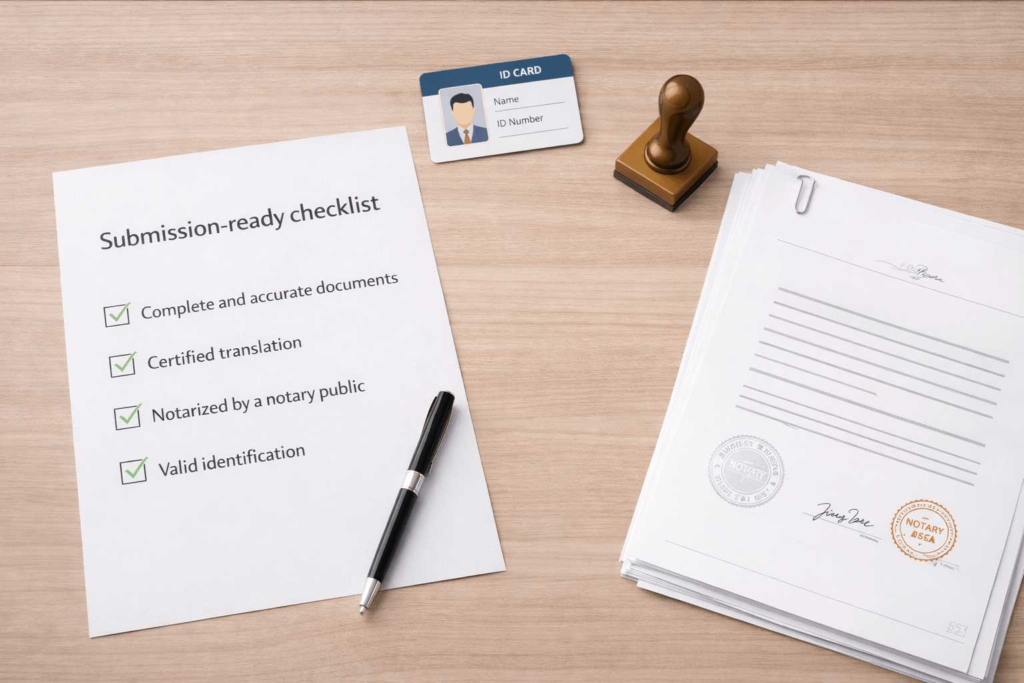
Avoid these (they cause most rework):
Missing pages (especially backs of certificates)
Cropped stamps/seals or unreadable photos
Names/dates don’t match the ID used in the application
Certification wording doesn’t match what the receiving authority expects
Notary didn’t witness the signature (or wording suggests they didn’t)
The institution requires a sworn translation or an apostille instead of notarisation
Digital notarisation is submitted where wet-ink originals are required
If you’re unsure, it’s safer to get clarity before notarising—because re-notarising often means starting the signing step again.
Another common issue is misunderstanding what needs to be legalised. Some applicants try to get a foreign-issued original document legalised in the UK, when the legalisation may need to happen in the country where the original document was issued.
A Simple Example: What You Should Send to a Translation Provider
Copy/paste this when requesting a quote:
Document type: (e.g., birth certificate/diploma/court order)
Language: (from → to)
Submission country and institution:
Deadline:
Do they require a notarised translation? (yes/no/unsure – attaching instructions)
Do they accept digital PDF notarisation? (yes/no/unsure)
Do you need hard copies delivered? (yes/no; how many)
Name spelling preference (exactly as in passport/ID):
Fastest way to proceed: Contact us here and attach your document.
What Clients Value Most in Notarised Translations
When the outcome matters, clients usually prioritise three things:
Submission-ready formatting (easy for an officer to compare)
Correct certification wording (signed, dated, properly presented)
No surprises (clear turnaround and delivery format)
Recent client feedback:
“The best decision I’ve made for my documents. The translation service is accurate, dependable, and ensures my paperwork is accepted worldwide.”
If you want the same “done-right” approach, start here: Upload your document.
Helpful Official Resources
If you need to double-check the wording of a requirement, these official and professional resources can help:
GOV.UK guidance on certifying a translation
GOV.UK guidance on getting a document legalised
GOV.UK regulated profession guidance for a notary public
CIOL certified translation resources and translator directory
GMC guidance on translating documents that are not in English
These resources are especially useful if you need to confirm whether you need a certified translation only, a notarised translation, or a further apostille/legalisation step.
FAQ Section
How to get a notarized translation quickly?
Upload a clear scan/photo, include the receiving authority’s requirements, and request notarisation at the start. Speed depends on language, length, and whether you need hard copies.
What is the notarized translation process?
The notarized translation process is: translate the document, add a signed certificate of accuracy, then have a notary witness the signing and apply a seal/stamp.
Where to get notarized translation services?
You can get notarized translation services through a professional translation provider that arranges notarisation, or by coordinating a translator and a local notary (ensuring the notary witnesses the signature).
What are notarized translation requirements?
Notarized translation requirements typically include the full translation, a signed and dated certificate of accuracy, and the notary’s seal/stamp and notarial wording confirming the signature was witnessed.
Can I notarize a translation myself?
Usually no. Notarisation requires a notary public, and the notary typically must witness the signature of the person signing the certification statement.
Do I need an apostille after notarising a translation?
Sometimes. If the document is for international use, the receiving authority may require legalisation (often an apostille) after notarisation. Always confirm with the destination institution.
How do I get a certified notarized translation for official documents in the UK?
In the UK, the usual process is to provide a clear copy of the original document, get a certified translation with a signed accuracy statement, and then notarise that certification if the receiving authority specifically requires it. If the document is for use abroad, you may also need an apostille after notarisation.
Does the notary verify the translation itself?
Usually no. The notary generally verifies the identity of the person signing the certificate and witnesses the signature. The translator or translation provider is responsible for the accuracy of the translation.
Do I need to send the original-language document with the translation?
In many cases, yes. It is best practice to submit the original-language document together with the translation so the receiving authority can compare them.
Do I need the original document certified first?
Sometimes. Some institutions want the original foreign-language document, while others accept a certified copy. That step is separate from certifying or notarising the translation, so you should check exactly what the receiving authority wants.
Can I use a scan or phone photo of my document?
Usually, yes, as long as it is clear, complete, and readable. Every page, stamp, seal, note, and handwritten entry should be visible.
Can the UK legalise a foreign-issued original document?
No, not usually. If the original document was issued outside the UK, legalisation of that original normally has to be done in the country where it was issued. The UK step may apply only to the UK notarial or certification part of the package.
Where can I find a UK notary and a qualified translator?
You can start with recognised translator directories such as CIOL, ITI, and ATC for the translation side, and a genuine notary public for the notarial step. In England and Wales, a notary is a separately regulated legal professional.
Do I need wet-ink originals, or can I use a PDF?
That depends entirely on the receiving authority. Some accept digital PDFs, while others insist on wet-ink originals or hard-copy notarised sets. Always check before ordering.