- Our Services
Translation and Notarization Services — One-Stop Solution
- Translation for Official Acceptance
- Accurate, Delivered Fast
When you need your document translated and notarised—fast—you don’t want to coordinate multiple providers, chase appointments, or worry about whether the final pack will be accepted.
With Urgent Certified Translation, you get translation and notarization services handled end-to-end professional translation, a properly signed certified, and notarisation by a commissioned notary (where required). One point of contact. One clear process. One finished pack you can submit with confidence.
Translate and notarize a document without the runaround
Most people searching for translation and notary services want one of two outcomes:
- A certified translation accepted by receiving authority, or
- A certified translation plus notarisation because the authority requires a notary seal on the certification.
We make the requirement clear before we start—so you don’t pay for extras you don’t need.
When notarisation usually means (in plain English):
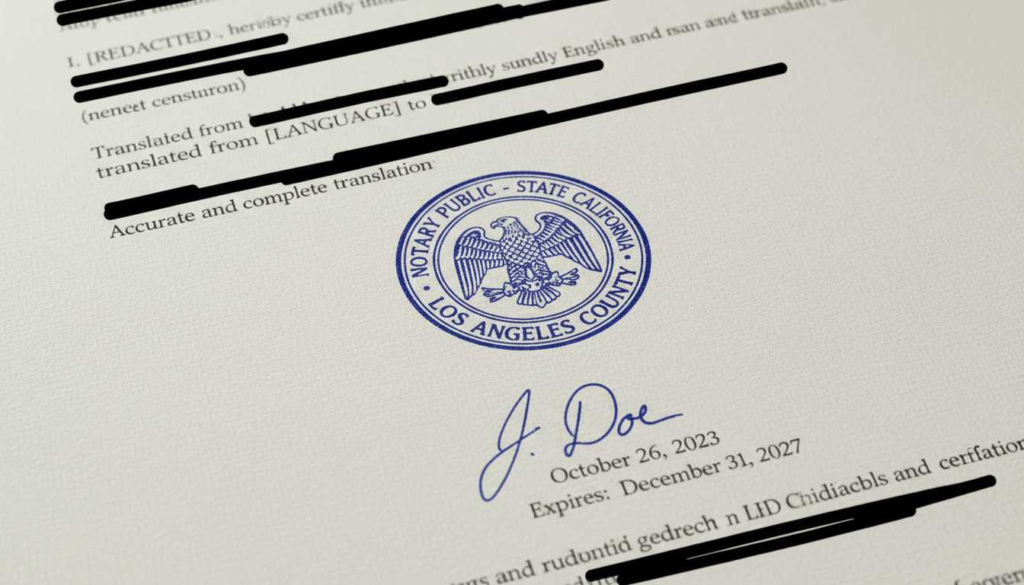
A notary typically verifies the identity and signature of the person signing the translator’s certification statement. the notary does not verify the language accuracy of the translation itself—you translator certified accuracy, and the notary witnesses the signature.
Documents we can translate and notarize
Our notary and translation services cover common personal and legal document types, including:
Birth,
Marriage, divorce, and death certificates
Passports,
IDs, driving licenses
Academic Transcripts,
Diplomas, letters from schools/universities
Police Clearance Certificates
Background checks
Court Documents,
Affidavits, statutory declarations
Medical Letters
And reports
Company Documents
Incorporation, certificates of good standing, board resolutions
Contracts
And notarised statements
- How It Works
Fast, simple process (built for urgent deadlines)

Upload you document
Send a scan or clear photo. If you don't have a scanner, a phone phot is fine—just ensure it's readable.
We confirm price and turnaround
You'll receive a clear quote based on language, length, and deadline—no surprises.


Translation + quality check
Your translation is produced, reviewed, and prepared with the correct certification wording.
Delivery
You receive your certified translation by email as a professional PDF. If you need printed copies, ask about delivery options when you submit.
What you receive
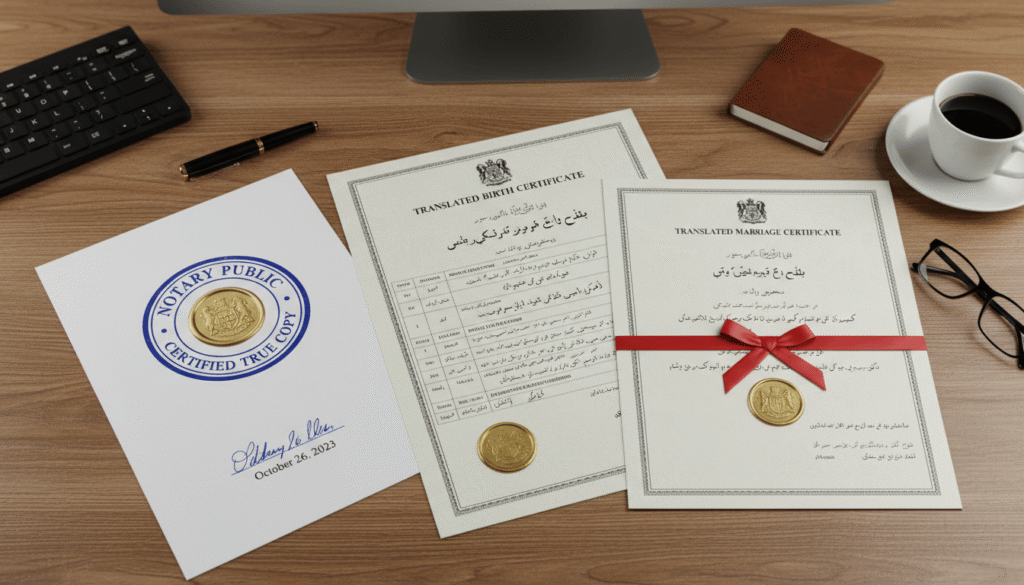
Every order is prepared for official use and includes:
Professional Translation
matching the layout and content of the original
Certiification Statement
signed by the translation or authorised representative
Notary Notarisation
of the certification (when requested/required)
Digital Delivery (PDF)
for easy submission and printing
Optional:
hard copy delivery if you need a physical pack
- add-ons
Choose the right translation certification
Not sure what to order? You’re not alone. Many rejections happen because the wrong type of certification was provided.
Certified Translation
Best for most official and administrative uses. A certified translation confirms that the translation is accurate and complete and is supplied with an appropriate certification statement.
Apostille/Legalisation
If you’re submitting documents internationally, you may need authentication for cross-border recognition. This is common for overseas authorities, international study/work, and certain legal processes.
“The best decision I’ve made for my documents. The translation service is accurate, dependable, and ensures my paperwork is accepted worldwide.”
Notarised Translation
A notarised translation adds an extra layer of verification. This is typically requested when a receiving party need formal confirmation of the translator’s identity/signature.
Sworn Translation
Some countries require sworn translators appointed/recognised by courts or official bodies. If your destination authority specifies “sworn translation”, tell us the country and purpose.
When do you need notary translation services?
Not every situation needs notarisation. Many clients only discover the notary requirement at the last minute—often after an authority rejects a submission or requests a “notarised translation”.
You may need translation and notarization for:
- Embassy / consular processes (civil status, visas, registrations)
- Overseas legal or property matters (powers or attorney, declarations)
- Certain court or solicitor requests (case-by-case)
- Some academic or professional licensing submissions
- Banking / compliance checks for international use
Mini insight (what we see most):
If your documents are for US immigration, a certified translation is typically what people request first; notarisation is more commonly requested for international/embassy use or where a third party insists on a notary seal. If you tell us the destination authority, we’ll guide you to the right option.
Frequently Asked Questions
Do you provide translation and notarization services nationwide?
Yes. Our workflow is designed to support clients across the United States. You can submit documents online, and we deliver digitally (and by post if required).
What does notarisation cover in notary translation services?
In most cases, the notary witnesses the signature on the translator’s certification statement (verifying identity/signature). The translator certifies accuracy; the notary does not confirm translation quality.
Can you translate and notarize a document for an embassy or overseas authority?
Often, yes—but requirements vary by country and authority. Some require notarisation in a specific jurisdiction or additional steps. Tell us where it’s being submitted and we’ll confirm what’s needed.
Is a certified translation the same as a notarized translation?
Not exactly. A certified translation includes a signed statement confirming the translation is complete and accurate. A notarised translation typically adds a notary seal to the signed certification.
Do I always need notarisation, or is certification enough?
Certification is often enough, but sometimes authorities request notarisation. If you’re unsure, tell us the receiving organisation, and we’ll recommend the right option so you don’t overpay.
Can you notarise my original document?
We can notarise the certification statement attached to your translation when required. Notarising an original document is a different service and depends on what you need notarised and where.
What file format should I upload?
A clear PDF is ideal, but sharp phone photos are usually fine. If a stamp or handwriting is unclear, we’ll ask for a clearer image before starting.
How fast can you deliver translation and notarization?
Turnaround depends on length, language pair, and whether notarisation is required. Many short documents can be completed quickly with urgent handling—share your deadline and we’ll confirm the fastest option.
Will my translation match the original formatting?
Yes. For official submissions, layout and completeness matter. We keep formatting clean and consistent, including stamps, seals, tables, and annotations where relevant.
Can you handle multiple documents as one submission pack?
Yes. If you’re submitting a bundle (e.g., civil records + supporting letters), we can prepare a cohesive pack with consistent naming and formatting.