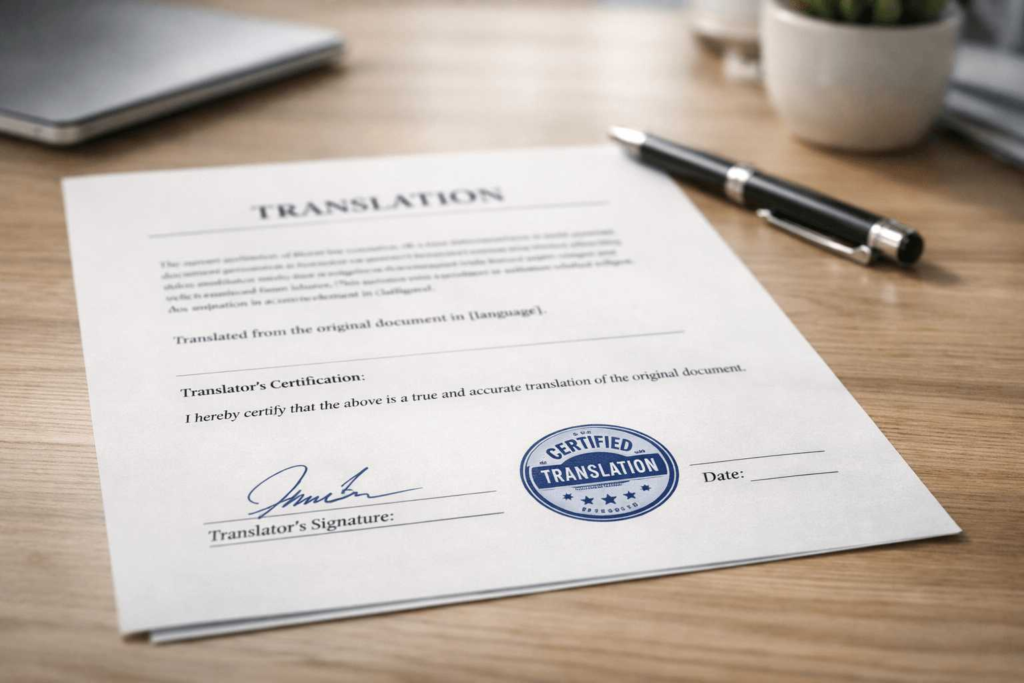
If you’re searching “what is a sworn translator”, you’re probably dealing with an official process where a standard translation won’t be accepted. The short version: a sworn translator is a translator who’s been authorised by a court or government body (in countries that use this system) to produce translations that carry legal or official status.
The tricky part is that “sworn translator” doesn’t mean the same thing everywhere — and some countries don’t use sworn translators at all. So the real question is often:
What does the receiving authority require in the country where you’re submitting the document?
This guide explains the meaning of a sworn translator, the difference between a sworn translator vs certified translator, and how to avoid the most common rejection reasons.
Quick answer: what most people mean when they ask “what is a sworn translator?”
A sworn translator is a translator who has official legal authority in a particular country to produce translations accepted for official use by courts, ministries, registries, or other public bodies.
In simple terms:
- a certified translator usually confirms accuracy with a signed certification statement
- a sworn translator has an additional official status recognised by a court, ministry, or government system
- whether you need one depends on the destination authority, not just the document type
This is why two people can have the same birth certificate translated, but only one of them needs a sworn translator: the deciding factor is usually where the translation will be submitted and what that authority requires.
Sworn translator meaning (in plain English)
A sworn translator is a qualified translator who has been granted official authority (usually through a court or ministry) to certify translations for legal/official use in that jurisdiction.
A sworn translation typically includes:
- The translation itself (complete, including stamps/notes visible on the original)
- The translator’s certification statement
- The translator’s signature
- An official stamp/seal (format varies by country)
- Sometimes, binding, pagination, and/or a registration/reference number
Key point: In many countries, a sworn translation is treated as an official document for administrative or legal purposes — not just a translation with a signed declaration.
Sworn translation explained: why it exists
Authorities need a way to trust documents that were issued in another language. A sworn translator system is one method (common in many civil-law countries). It works because the authority trusts:
- the vetting/appointment process, and
- the translator’s legal responsibility for what they certify.
Not every country uses this approach. In places like the US, the UK, and often Canada and Australia, “official” translation is usually handled through certified translations (a translation plus a signed certification statement), rather than a sworn translator register.
Does the UK have sworn translators?
This is one of the most common points of confusion.
The UK does not generally operate a single national sworn translator system in the same way as countries such as Spain or the Netherlands. For many UK-facing applications, what is normally requested is a certified translation rather than a sworn translation.
However, if your documents are being submitted outside the UK, the relevant rule is usually the requirement of the receiving country or authority. So even if you live in the UK, you may still need a sworn translation if the document is going to a country or institution that specifically asks for one.
Practical point:
- for UK submissions, certified translation is often the correct format
- for foreign submissions, the destination authority may require sworn translation, notarisation, apostille, or a combination of these
Sworn translator vs certified translator (what’s the difference?)
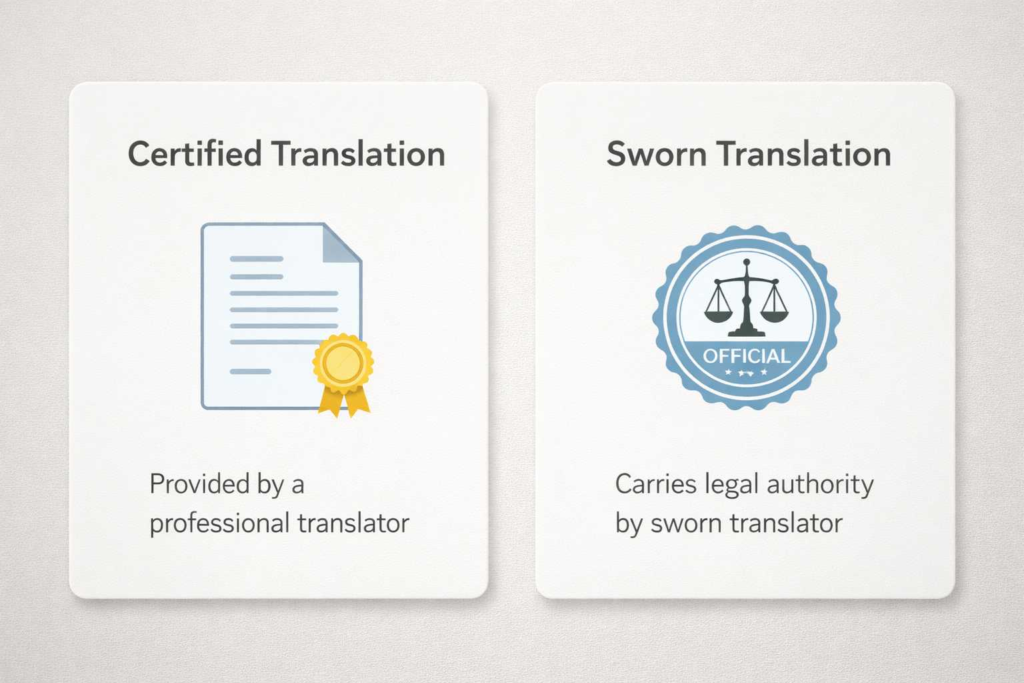
Here’s the comparison people most often need:
| Feature | Certified translation | Sworn translation |
| Who can provide it? | Often a professional translator/agency (rules vary by country) | A translator officially authorised by a court/ministry (in countries that have a sworn system) |
| What makes it “official”? | A signed certification statement (accuracy + competence) | Official authorisation + stamp/seal + sworn certification format |
| Where is it usually required? | US immigration (e.g., USCIS), UK visa submissions, many institutional uses | Many European/civil-law jurisdictions, courts, ministries, some consulates |
| What does it look like? | Translation + certificate page (or attached statement) | Translation with sworn wording + stamp/seal (sometimes bound/registered) |
| Common misunderstanding | “Certified” always equals “sworn” | “Sworn” is not universal — and may be country-specific |
Practical takeaway:
If the authority says “sworn translation”, a standard certified translation may be rejected — even if the translation is perfect.
Can a certified translator do a sworn translation?
Not automatically.
A professional translator or agency can usually provide a certified translation, but that does not make the translation sworn. To issue a sworn translation, the person finalising it normally needs the official status required in that jurisdiction.
That means:
- a certified translator can provide a certified translation
- a sworn translator can provide sworn translation where they are officially authorised to do so
- a translation provider may coordinate the work through an authorised sworn translator if the destination country requires it
This distinction matters because a translation can be perfectly accurate and still be rejected if it was issued in the wrong legal format.
When do you need a sworn translator?
You usually need a sworn translator when:
- The destination country uses a sworn system, and
- The receiving authority explicitly requires sworn/official court-authorised translation, or uses local terms that indicate the same requirement.
Who can issue a sworn translation?
In most systems, a sworn translation can only be issued by a translator who is officially recognised for that purpose in the relevant jurisdiction.
Depending on the country, that may mean:
- the translator appears on an official register
- the translator has been appointed or authorised by a court or ministry
- the translator must swear or declare the translation in a prescribed legal format
- the authority only accepts sworn translations for specific language pairs or official procedures
This is why “qualified translator” and “sworn translator” are not always the same thing. A translator may be highly experienced and fully competent, but still not hold the formal legal status required for a sworn translation in that country.
The most common situations
- Immigration/residency applications (destination-country requirements vary)
- Marriage registration or civil registry submissions abroad
- Court proceedings (lawsuits, custody matters, criminal/civil filings)
- Education (university enrolment, credential recognition in certain countries)
- Business filings (company registration, tenders, regulated contracts)
- Consulate submissions (particularly when the consulate insists on sworn translations)
Common wording that signals “sworn”
If you see phrases like these in the instructions, you should assume a sworn/official translation may be required:
- “Sworn translation” / “official sworn translator”
- Local equivalents (examples):
- Spain: “traducción jurada”
- France: “traduction assermentée”
- Germany: “beglaubigte Übersetzung” (often provided by an authorised/sworn translator)
- Netherlands: “vertaling door een beëdigd vertaler”
- Belgium: “beëdigd vertaler” / official register references
If you’re unsure, the safest move is to send the exact requirement wording to your translation provider before ordering.
A fast decision guide: do you need sworn or certified?
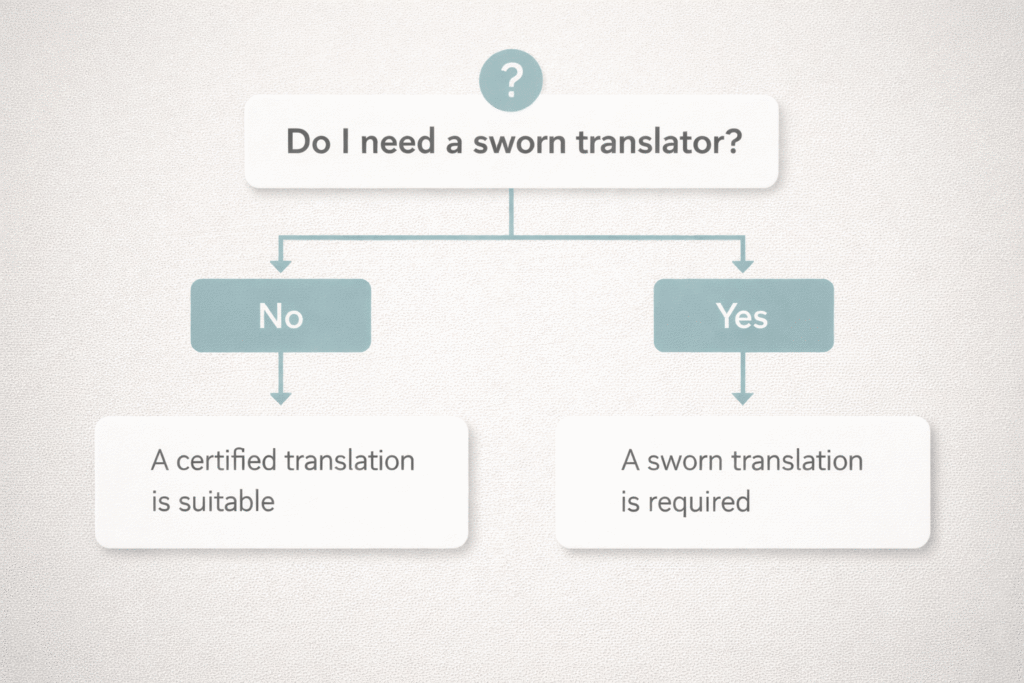
Use this quick logic:
- Where will you submit the translation? (country + authority)
- Do the instructions explicitly say “sworn” (or local equivalent)?
- Yes → you likely need a sworn translator
- No → move to step 3
- Does the country commonly use sworn translators for official filings?
- Often yes in many civil-law jurisdictions
- Is the submission for a legal/court/registry purpose?
- If yes, requirements tend to be stricter (sworn more likely)
- If still unclear: ask the authority or provide the requirement text to your translator for confirmation.
What documents most often require sworn translation?
While requirements vary by country and authority, sworn translation is commonly requested for:
Personal status and civil registry
- Birth certificates
- Marriage certificates
- Divorce decrees
- Death certificates
- Name change documents
Immigration and residency
- Passports / national ID cards (sometimes)
- Police clearance certificates
- Proof of address documents (varies)
- Family relationship evidence (birth/marriage records)
Education
- Diplomas and degree certificates
- Academic transcripts
- Letters of enrolment/graduation confirmations
Legal and court documents
- Court judgments and orders
- Affidavits and witness statements
- Powers of attorney
- Contracts and legal notices
Business and corporate
- Company registration extracts
- Articles of association
- Board resolutions (depending on use)
Tip that prevents rejections: If a document contains stamps, handwritten notes, marginal remarks, or back-page content, the translation often needs to reflect those elements clearly (even if only as labelled notes).
How sworn translation usually works (step-by-step)
Even though formats differ by country, the process is generally:
- You provide a clear scan/photo of the document (all pages, front/back if relevant).
- The sworn translator translates the document in full, preserving meaning and key formatting.
- The translator adds sworn certification wording, signs, and applies the official stamp/seal (and any required pagination/binding).
- You receive the sworn translation in the format the authority accepts (often PDF; sometimes physical copies are preferred).
If you need translation for official submission and want the safest route, start with certified translation services and include the destination country + authority requirements so the correct format can be confirmed from the outset.
Does the sworn translator need to be in the destination country?
Not always — but sometimes, yes.
What matters most is whether the receiving authority recognises the translator’s status and output format. Some authorities want a sworn translator who is:
- authorised in their own country
- listed in a specific official register
- recognised through a consulate or court-approved list
Other authorities are less concerned about physical location and more concerned that the translation was issued by the correct type of authorised professional.
This is another reason not to guess based on general advice alone. A sworn translation accepted in one country is not automatically accepted everywhere.
Country-by-country nuance (why “sworn” isn’t one-size-fits-all)
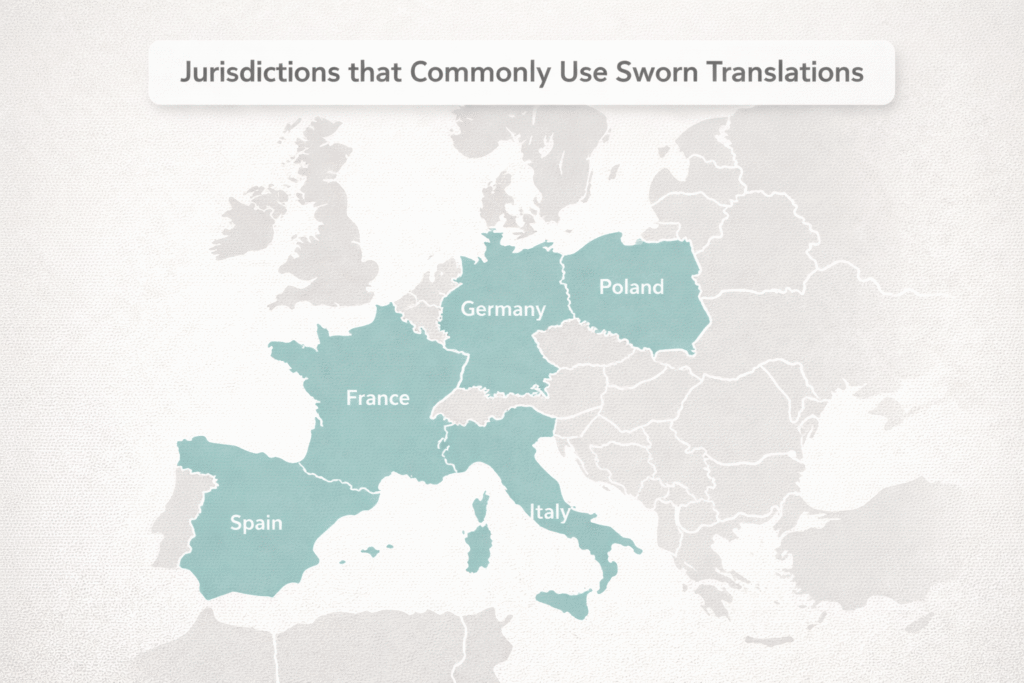
This is where many guides are too vague — and where avoidable rejections happen.
Spain (often strict about sworn translators)
Spain commonly requires official sworn translator output for many administrative uses in Spain. The translator is typically authorised through the relevant Spanish system, and sworn translations are widely recognised for official submissions.
Common scenarios: civil registry, immigration/residency steps, and official education paperwork.
France (court-listed experts)
France often relies on translators who are listed as court-approved experts (“assermenté”) for official purposes. The accepted status is tied to official lists, and the format typically includes a signature and official presentation.
Germany (authorised/sworn translators vary by state)
Germany has systems for officially authorised/sworn translators and interpreters. Requirements can differ by federal state (Länder), and authorities may specify that translations must be done by a translator who is officially authorised/sworn/appointed.
Netherlands (sworn register concept)
The Netherlands uses a sworn interpreter/translator framework with an official register for sworn professionals.
Belgium (national register)
Belgium provides a national register approach for interpreters/translators in certain contexts.
Italy (often “sworn before the court” per translation)
Italy is frequently discussed as a place where a translation may need to be sworn/declared before a court for certain official uses (often described as “asseverazione”). This can mean the “swearing” is tied to the specific translation submission rather than a single global status.
Bottom line: Always match your translation type to the destination authority’s wording, not just the country name.
Can you use a sworn translation from one country to another?
Not necessarily.
A sworn translation that is valid for official use in one country is not automatically treated as sworn in every other country. Some authorities insist on a translator authorised under their own national system, while others may accept foreign sworn translations if additional formalities are completed.
Depending on the destination, you may need:
- a locally sworn translator
- notarisation of the certification
- an apostille
- legalisation
- or a fresh translation prepared in the destination country’s accepted format
The safest rule is this: sworn status is usually jurisdiction-specific.
How to verify a sworn translator (and avoid scams)
If you’ve been told to use a sworn translator, verification matters. Here’s a practical checklist:
- Check that the translator is listed in the official register (where applicable).
- Confirm the language pair the translator is authorised for (some systems authorise specific language combinations).
- Check the output format matches what the authority expects (stamp wording, certification statement, signature placement).
- Avoid “generic stamps” that don’t identify the translator properly.
- Ask for a sample layout (with personal data removed) if you’re dealing with a high-stakes submission.
If you’d rather not navigate this alone, use a provider who can review your destination requirements first and confirm whether sworn or certified is needed. The simplest next step is to contact us with your document and the submission instructions.
Sworn translation vs notarised translation vs apostille (don’t mix these up)
These three are commonly confused — and they solve different problems:
Sworn translation
Confirms the translation is officially certified by an authorised translator (in the destination system).
Notarised translation
A notary verifies the identity/signature of the person signing a declaration (often the translator or an agency representative). Notarisation does not automatically make a translation “sworn”.
Apostille
An apostille authenticates the origin of a public document (or a notarised signature) for international recognition under the Hague Apostille Convention.
Common real-world combinations
- Authority requires sworn translation only → sworn translator output is enough.
- Authority requires certified translation + notarisation → you need notarisation of the certification statement.
- Authority requires apostille → you may need an apostille on the original document (or on a notarised translation package), depending on the destination requirements.
If your instructions mention apostille/legalisation, share them upfront so you don’t order the wrong workflow.
Rejection-proof checklist for sworn translations
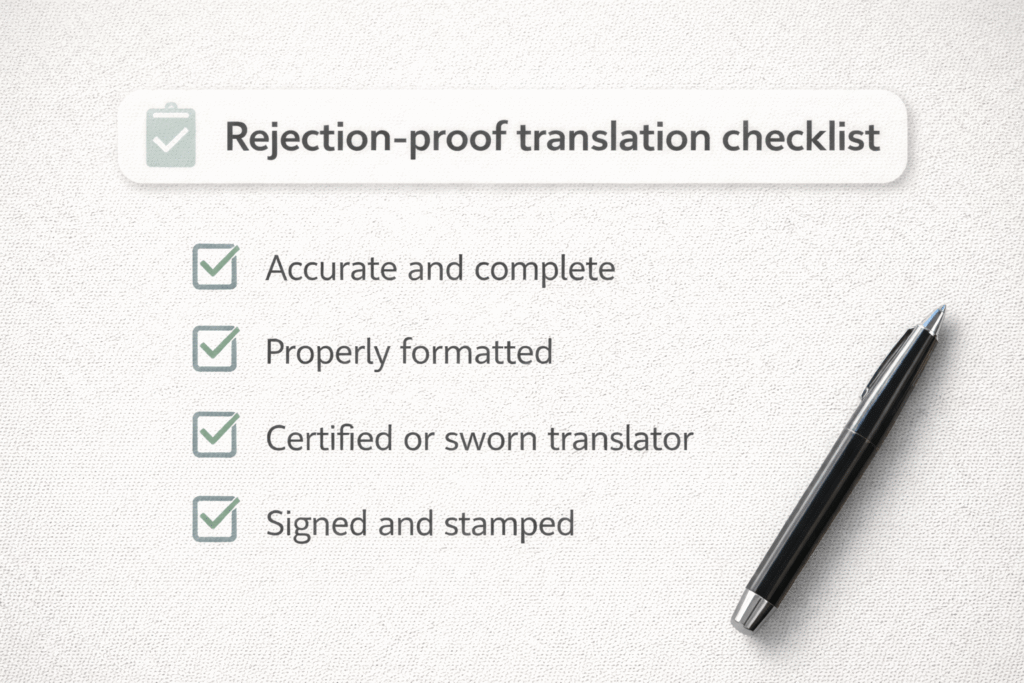
Before you submit, ensure:
- All pages are included (including blank backs if the original is double-sided and that matters to the authority)
- Names match the spelling style required by the authority (especially where diacritics exist)
- Dates are consistent and correctly formatted
- Stamps/seals/handwritten notes are accounted for and clearly labelled in the translation
- The certification statement matches the required wording style
- The translation is legible and professionally presented (no cropped areas, missing margins, or unclear scans)
If you want a quick professional review before you submit, use certified translation services and include your deadline — urgent doesn’t have to mean risky.
Quick examples: when people typically need sworn translators
Example 1: Getting married abroad
You’re registering a marriage in a country that requires sworn translations of civil documents. Your birth certificate translation must be sworn and formatted in the locally accepted style.
Example 2: Submitting documents to a European authority
A university or ministry requests an official translation by a sworn translator. A standard certified translation may be rejected even if it includes a certificate page.
Example 3: Immigration where “sworn” is not required
You’re applying in a country that usually accepts certified translations with a signed certification statement (common for some English-speaking jurisdictions). In this case, a sworn translator may be unnecessary — and more expensive.
Get the right translation type the first time
Sworn translations are high-stakes because they’re used for decisions that matter: visas, residency, courts, education, and civil registry procedures. The biggest risk isn’t “bad translation” — it’s ordering the wrong format for the authority.
If you want the safest path:
- send the document (clear scan),
- tell us where you’re submitting it,
- and include any wording the authority provided.
Start here: contact us.
FAQ Section
What is a sworn translator?
A sworn translator is a translator authorised by a court or government body (in countries that use this system) to produce translations with official legal/administrative validity.
Sworn translator meaning: is it the same in every country?
No. The meaning of a sworn translator depends on the country. Some countries have official registers; others require the translator to swear an oath for each translation submitted. Some countries don’t use sworn translators at all.
Sworn translator vs certified translator: what’s the difference?
A certified translation is typically a translation with a signed certification statement. A sworn translation is issued by an officially authorised translator and usually includes a stamp/seal and sworn certification format recognised by the destination authority.
When do you need a sworn translator?
You need a sworn translator when the receiving authority (often in civil-law jurisdictions) explicitly requires a sworn/official translation or uses local wording that indicates the same requirement.
Can I use a certified translation instead of a sworn translation?
Sometimes — but only if the receiving authority accepts it. If the instructions say “sworn translation” (or local equivalent), submitting only a certified translation may lead to rejection.
Do sworn translations need notarisation or an apostille?
Not always. Notarisation and apostille are separate steps. Whether you need them depends on the destination authority and the purpose of the submission.
Does the UK have sworn translators?
Not in the same way as countries with formal sworn translator registers or court-authorised systems. In the UK, certified translation is commonly used for official submissions, but foreign authorities may still require a sworn translation for documents being submitted abroad.
Can a certified translator provide a sworn translation?
Only if that person also holds the official status required to issue a sworn translation in the relevant jurisdiction. A certified translation and a sworn translation are not automatically the same thing.
Who can issue a sworn translation?
Usually, only a translator who is officially authorised, appointed, registered, or otherwise legally recognised under the destination country’s sworn translation system.
Can I use a sworn translation from one country to another?
Sometimes, but not always. Many authorities treat sworn translations as jurisdiction-specific and may require a local sworn translator or additional formalities such as notarisation or apostille.
Does a sworn translation expire?
The translation itself does not usually “expire” in a universal sense, but the receiving authority may require recently issued documents, recent certifications, or translations prepared within a certain timeframe.
Can I translate my own document and use it as a sworn translation?
Generally no. For official submissions, authorities usually expect an independent professional translator, and where sworn translation is required, one who has the correct official legal status.
Are digital sworn translations accepted?
Sometimes. Some authorities accept digitally issued PDFs, while others want original stamped paper copies. Acceptance depends on the receiving authority’s rules.