Introduction
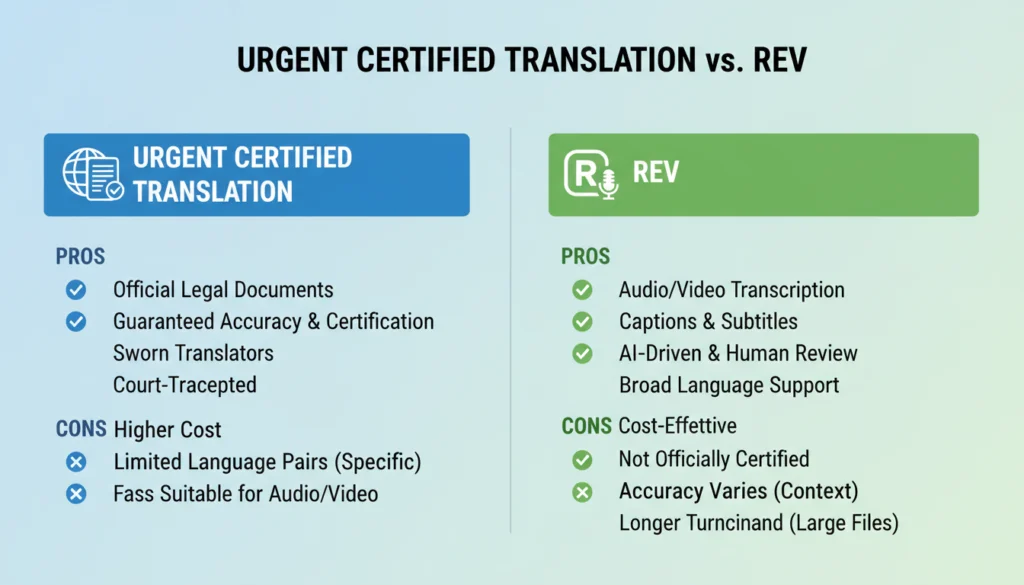
If you are comparing Urgent Certified Translation vs Rev, the right choice depends on what you actually need delivered: a certified document translation for immigration or legal filing, or a speech-to-text workflow for audio/video content.
Here is the short answer:
- If you need a certified translation for USCIS, UKVI, courts, universities, or official paperwork, Urgent Certified Translation is the better fit.
- If you need transcription, captions, or subtitles for audio/video, Rev is often the better fit.
- If you need both (for example, interview audio transcription plus document translation for a filing), you may need two separate services. Rev’s current scope is heavily focused on speech-to-text and subtitles, not certified document translation.
That distinction matters more than price, speed, or branding because using the wrong service type can cause delays, resubmissions, or rejected paperwork.
Quick Answer: Urgent Certified Translation vs Rev by Use Case
If you want the simplest possible comparison, use this rule:
- Choose Urgent Certified Translation for foreign-language documents that must be translated, certified, and submitted to an authority.
- Choose Rev for spoken content that needs to be turned into text, captions, or subtitles.
Do not treat these as interchangeable services, because they solve different problems.
A certified translation provider is typically the right choice for:
- Birth certificates
- Marriage certificates
- Diplomas and transcripts
- Police certificates
- Court papers
- Immigration forms and supporting documents
Rev is typically the right choice for:
- Interviews
- Meetings
- Podcasts
- Webinars
- Depositions
- Video captions and subtitles
This matters because many rejected or delayed filings happen when a user orders a transcript, subtitle, or general language service when the authority actually requires a certified document translation package.
The Key Difference Most People Miss
A lot of people search for a “translation service” when they really need one of these:
- Certified document translation (birth certificate, marriage certificate, diploma, police record, court document)
- Transcription (audio/video to text)
- Subtitling/captioning (video accessibility and multilingual content)
- Interpretation (spoken language support in real time)
Rev is excellent in the audio/video lane. Its public site and pricing pages focus on transcription, captions, subtitles, and legal speech-to-text workflows.
For immigration and official paperwork, the requirement is different: you need a full translated document with a proper translator certification, not just a transcript or subtitle file. USCIS rules specifically require a full English translation and a translator certification of completeness, accuracy, and competence.
Rev Translation Review in One Paragraph
If you are doing a Rev translation review specifically for certified documents, the biggest issue is simple: Rev’s own Help Centre states that it no longer provides document translation (including its former certified/standard document translation offering). Rev says it discontinued document translation on 3 April 2020.
So if your question is:
- “Can Rev handle my USCIS birth certificate?”
- “Can Rev translate my diploma for university admissions?”
- “Can Rev provide a certified document translation for a visa file?”
…then the answer is generally no, because that is not Rev’s current service focus. Rev now positions itself around transcription, captions, subtitles, and legal evidence review workflows.
Can Rev Translate Official Documents for USCIS, UKVI, Courts, or Universities?
For most people asking this question, the practical answer is no. If your document is going to a government department, court, university, immigration authority, or licensing body, the safer choice is a provider that specializes in certified document translation and can supply a translator certification with the translated file.
That means if you are asking questions like:
- “Can Rev translate my birth certificate for USCIS?”
- “Can I use Rev for UKVI documents?”
- “Will Rev handle my diploma translation for admissions?”
- “Can Rev certify a court document translation?”
…you should be thinking in terms of certified document translation, not speech-to-text software or subtitle tools.
A useful rule of thumb is this:
- If the original file is a document image, scan, certificate, record, or form, you probably need a certified document translation provider.
- If the original file is an audio or video recording, Rev may be the better fit.
When Urgent Certified Translation Is the Better Choice
Choose Urgent Certified Translation when your documents are going to be checked by an authority and for format/compliance matters.
You should use Urgent Certified Translation if you need:
- Certified document translation
- Immigration document translation (USCIS, UKVI, consulates, visa offices)
- Academic document translation (degrees, transcripts, diplomas)
- Legal document translation (court orders, affidavits, contracts)
- Notarised translation options (when specifically requested)
- Formatting that mirrors the original document
- Translator certification attached to each translated document
Common documents that usually need certified translation
These are the kinds of documents people often submit to immigration authorities, courts, universities, employers, or regulators and therefore usually need translated with a proper certification attached:
- Birth certificates
- Marriage certificates
- Divorce decrees
- Police clearance certificates
- Passports and ID documents
- Diplomas and degree certificates
- Academic transcripts
- Court orders and affidavits
- Bank statements for visa or legal use
- Adoption records
- Death certificates
- Driving records and civil registry extracts
If your file falls into one of those categories, you should compare providers based on certification, document handling, formatting fidelity, and acceptance requirements, not on subtitle or transcription features.
This is especially important for immigration filings because agencies care about:
- Completeness
- Translator competence
- Certification wording
- Document-level accuracy
USCIS and immigration court rules both explicitly require certified translations for foreign-language documents, not a general summary or partial output.
Practical example
If you are filing:
- A birth certificate
- Marriage certificate
- Police clearance
- Divorce decree
- Degree certificate
You need a provider that treats the file as an official document translation project from start to finish. That means:
- Preserving names, dates, numbers, stamps, and seals
- Clearly marking illegible text
- Attaching a signed certification
When Rev Is the Better Choice
Rev is a strong option when your job is built around audio or video content, not certified documents.
Rev is usually the better fit for:
- Human transcription
- AI transcription
- Captions
- Subtitles
- Speech-to-text for legal/media workflows
- Large volumes of recordings needing searchable text
Rev’s current services and pricing pages clearly centre around transcription, captions, subtitles, and related AI/legal workflow tools.
Rev also publicly states some language limitations that matter:
- Human transcription is currently English-to-English
- Rev does not translate non-English audio into English in its human transcription workflow
- Human translation is available for subtitles (not document translation)
- Rev does not currently offer dubbing/localisation (beyond subtitle translation and third-party support suggestions)
So if your file is:
- A podcast
- Interview
- Webinar
- Deposition recording
- YouTube video
Rev may be a very good fit. If your file is:
- A birth certificate PDF
- Diploma scan
- Marriage certificate
- Court document
Rev is not the right tool for that job.
Side-by-Side Comparison: Certified Translation Comparison That Actually Helps
1) Use case fit
- Urgent Certified Translation: Built for official document translation and certification needs. Better for immigration, legal filings, academic submissions, and government requests.
- Rev: Built for audio/video transcription, captions, and subtitles. Better for media, content teams, legal audio review, and accessibility workflows.
2) Compliance for immigration and official filings
- Urgent Certified Translation: Matches the workflow needed for official documents. Supports certification statements and filing-ready deliverables.
- Rev: Not suitable for certified document translation requests because Rev no longer offers document translation services.
Important: For USCIS, the rule is a full English translation plus translator certification. That is the baseline requirement your provider must meet every time.
3) Turnaround expectations
- Urgent Certified Translation: Better choice for urgent document filings where acceptance and formatting matter. Rush options are useful when deadlines are fixed (appointments, filing dates, hearings).
- Rev: Strong speed for transcription/captions/subtitles. Public pricing/service pages emphasise fast turnarounds for transcription and captions, plus scaled AI workflows.
4) Language workflow
- Urgent Certified Translation: Designed for document language pairs (e.g., Spanish to English, Arabic to English, Romanian to English).
- Rev: Human transcription is English-only (speech to text). Human subtitle translation is available from English into selected languages.
5) Proof of translator competence and trust signals
For certified document translation, clients often want to see:
- Translator credentials
- Acceptance history
- Certification wording
- Document handling standards
ATA is one of the most recognised translator credentials in the U.S., and its guidance is useful for understanding what a proper certified translation package looks like.
For Rev, public trust signals exist (including review platforms), but most of the feedback and categorisation you will see relates to software, transcription, captions, and freelancer experiences rather than certified document translation.
Pricing and Value: Why This Comparison Is Not Like-for-Like
One reason people get confused when comparing Urgent Certified Translation vs Rev is that they are often comparing two different deliverables.
For example:
- A certified translation price usually covers document translation, formatting, quality checks, and a certification statement for official use;
- A transcription or subtitle price usually covers speech-to-text output, caption timing, subtitle formatting, or related workflow tools.
So the real question is not just “Which is cheaper?” but:
- Which service matches the output my authority, court, university, or client actually needs?
- Will the file be accepted the first time?
- Will I need to re-order from another provider if I choose the wrong service?
For official document submissions, better value usually means getting the correct filing-ready translation the first time. For media and audio/video workflows, better value usually means speed, editing tools, subtitle support, and scalable speech-to-text processing.
Original Decision Matrix: Which Service Wins by Task?
This is a practical scoring model you can use before ordering. (Score each service from 1–10 for your exact task.)
If your task is a USCIS/visa/court document (certified translation needed)
Score these criteria more heavily:
- Certified document support (30%)
- Translator certification included (25%)
- Official filing readiness (20%)
- Formatting fidelity (15%)
- Rush delivery (10%)
If your task is a podcast/interview/webinar/deposition audio
Score these criteria more heavily:
- Transcription accuracy (30%)
- Turnaround speed (20%)
- Editor/workflow tools (20%)
- Caption/subtitle options (20%)
- Scalability (10%)
Outcome of the matrix
For official documents, Urgent Certified Translation wins because it matches the required deliverable type. For audio/video speech-to-text, Rev wins because that is its core product lane. This sounds obvious, but it is exactly where buyers lose time: they compare “translation services” as if all translation jobs are the same. They are not.
Best Translation Service for Immigration: What to Check Before You Order
If your goal is immigration approval (USCIS, UKVI, consulate, court, or university), this checklist will save you hassle.
Use this pre-order checklist
- Does the provider offer certified document translation (not just transcription or subtitles)?
- Will each translated document include a signed certification?
- Does the certification state the translation is complete and accurate?
- Does it confirm translator competence?
- Can they reproduce stamps, seals, signatures, and layout notes?
- Can they handle urgent deadlines without cutting quality?
- Do they offer notarisation only when needed (not automatically upsold)?
- Will you receive a filing-ready PDF and, if needed, a Word copy?
ATA’s client guidance aligns closely with what immigration clients should expect in a proper certified translation package.
Common Mistakes People Make When Comparing Rev and Certified Translation Providers
Mistake 1: Assuming “translation” means document translation
A lot of platforms use translation terminology across subtitles, captions, localisation, and speech products. That does not mean they handle official documents. Rev is a clear example: human subtitle translation is available, but document translation is no longer offered.
Mistake 2: Choosing by headline price only
A cheap order is expensive if you need to re-order from a different provider after a rejection or a missing certification page. For immigration and legal use, the cheapest useful service is the one that is:
- Accepted the first time
- Correctly formatted
- Delivered on deadline
Mistake 3: Ignoring document type complexity
A one-page birth certificate and a 20-page court bundle are not the same project. You should check:
- Whether the provider handles handwritten notes
- Stamps and seals
- Multi-column tables
- Supporting attachments
That is where experienced document translators save you time.
Who Should Choose Which Service?
Choose Urgent Certified Translation if you are:
- Filing immigration papers
- Submitting documents to a court
- Applying to a university
- Sending records to a regulator
- Working with certificates, legal paperwork, IDs, transcripts, or official forms
- Under a deadline and need a filing-ready certified translation
Choose Rev if you are:
- Transcribing interviews, meetings, or podcasts
- Adding captions to videos
- Creating subtitles for content distribution
- Running a legal/media workflow with heavy audio evidence
- Using AI transcription and searchable text tools at scale
Rev’s current positioning, product pages, and pricing support that workflow very well.
Final Verdict
For certified document translation, especially for immigration and official filing use, Urgent Certified Translation is the better choice. For transcription, captions, and subtitles, Rev is the better choice.
If your need is “I have a foreign-language document and a submission deadline,” do not treat this as a transcription purchase. Choose a specialist in certified document translation, request a filing-ready package, and confirm that the translator’s certification is included.
If you want a fast answer on your file, upload your document and request a quote with:
- Language pair
- Deadline
- Destination authority (USCIS, UKVI, court, university)
- Whether notarisation is required
That single step usually cuts back and forth by half.
When You Need Both Rev and a Certified Translation Provider
Some projects genuinely need both services. For example:
- You may need Rev to transcribe an interview, hearing, meeting, or recorded statement.
- You may then need a certified translation provider to translate a separate birth certificate, marriage certificate, diploma, court record, or supporting document for filing.
Another example:
- A legal team may use Rev for deposition audio or searchable transcript workflows, while using a certified translation provider for foreign-language documentary evidence that must be submitted in translated form.
If your project includes both recordings and official paperwork, it is often best to separate the work by deliverable:
- Audio/video work to a transcription or subtitle platform
- Official documents to a certified translation provider
FAQs
Does Rev offer certified document translation for USCIS?
Rev’s Help Centre says Rev no longer offers document translation, including its previous certified/standard document translation service. For USCIS document filings, you need a certified document translation provider.
Is Rev good for translation at all?
Yes, for the right type of translation work. Rev supports subtitle translation and is strong in transcription, captions, and speech-to-text workflows. It is not the right choice for certified document translation.
What is the best translation service for immigration documents?
The best translation service for immigration is one that provides certified document translations with a signed translator certification confirming completeness, accuracy, and competence, and can deliver a filing-ready package for your authority. USCIS requirements make this non-negotiable.
Do I need a certified translation or a notarised translation?
For many immigration filings, a certified translation is required. Notarisation may be required in some cases, but not all. The safest approach is to check the receiving authority’s instructions and order notarisation only when specifically requested.
Can Rev translate non-English audio into English?
Rev’s support documentation states its human transcription workflow is English-to-English and that it does not translate non-English audio into English in that service.
How can I compare translation services properly?
Start by matching the provider to the output you need: certified document translation, transcription, subtitles/captions, or interpretation. Then compare compliance, turnaround, formatting, and support for your exact use case rather than general brand popularity.
Is Rev a certified translation service?
Rev is primarily known for transcription, captions, subtitles, and related speech-to-text workflows. If your goal is a certified document translation for an authority or formal submission, you should use a provider that specializes in certified document translation and includes a signed certification with the translated file.
Can I use Rev for a birth certificate or marriage certificate translation?
If the document is being submitted for immigration, court, university, or other official purposes, you should use a certified document translation provider. Birth certificates and marriage certificates are document translation jobs, not transcription jobs.
Can Rev translate scanned PDFs and official documents for filing?
If the file is an official document scan that must be translated and submitted with certification, you need a provider that handles certified document translation, formatting, and document-level compliance.
Which is better for USCIS or UKVI: Urgent Certified Translation or Rev?
For USCIS, UKVI, courts, universities, and similar authorities, Urgent Certified Translation is the better fit because the requirement is typically a certified document translation rather than a transcript, subtitle file, or audio workflow output.
Which is better for subtitles and captions?
Rev is usually the better fit for subtitles, captions, and speech-to-text workflows, especially when the source material is audio or video rather than an official paper document.
Do I need transcription, translation, or both?
You need transcription when the source is spoken audio or video, and you want text, captions, or subtitles. You need a certified translation when the source is a foreign-language document that must be translated for official use. In some projects, you may need both, but they are still separate services.