When a loved one’s will is written in another language, probate can slow down quickly if the translation package is not prepared correctly. The court is not just reviewing words on a page—it is reviewing legal intent, signatures, witnesses, dates, and supporting paperwork. If you need to translate foreign probate documents for a US case, the safest approach is to treat it as both a legal filing task and a language-accuracy task from day one.
This guide walks you through the court-ready process, what to prepare before you order the translation, what probate courts usually expect, and how to avoid the common mistakes that cause delays, objections, or refiling.
Quick answer: if the probate case is in the UK instead of the US
If the probate case is in the UK rather than the United States, the practical steps are similar, but the filing route can be different. In foreign-will matters, you should first confirm which court is handling the estate, whether the matter involves a foreign will only or also a foreign grant or inheritance document, and whether the filing must be made on paper. If the will or related inheritance paperwork is not in English, you should prepare an official English translation before submission.
For readers searching for how to translate a foreign will for probate in the UK, the safest process is usually:
Obtain the correct court, notarial, or certified copy of the will
Gather any codicils, foreign grants, succession certificates, inheritance certificates, or equivalent documents
Arrange a complete English translation that includes signatures, witness wording, seals, stamps, and annexes
Check whether any authentication or apostille is required for the foreign document itself
Submit the probate application in the format required by the court handling the estate
The key point is that the translation should not cover only the body text of the will. It should also account for execution wording, amendments, visible marks, and any supporting paperwork the court may review alongside the will.
What “translating a foreign will for US probate” really means
A probate translation is not simply converting text into English. In practice, it usually means preparing a filing-ready set of documents that may include:
- The will (complete, with all pages and annexes)
- Codicils or amendments
- Death certificate
- Foreign probate grant or court order (if one exists)
- Supporting affidavits
- Authentication or apostille paperwork (when the court or jurisdiction requires it)
The translation also needs to preserve legal meaning and structure. That includes:
- Names exactly as shown on the original
- Dates and number formatting
- Marginal notes, stamps, seals, and handwritten annotations
- Signature labels and witness blocks
- Attachments and schedules referenced in the will
If anything is omitted or unclear, it can affect how the probate court interprets the will.
The biggest mistake families make in foreign will probate cases
The most common issue is ordering a translation too early, before confirming what the specific court wants filed.
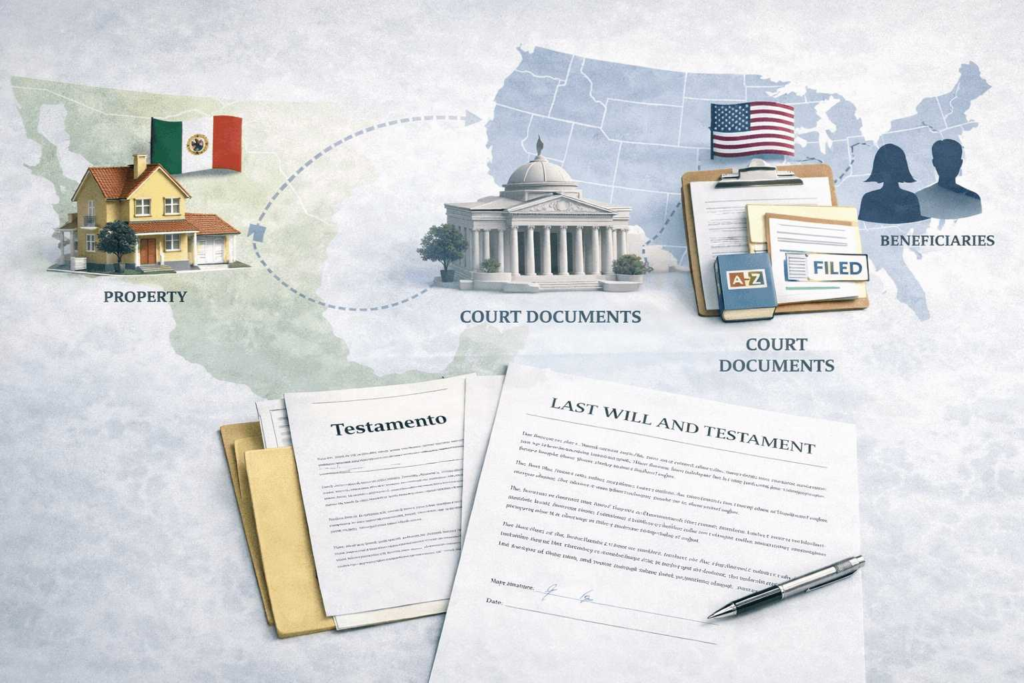
Probate rules vary by state, and local courts may have their own filing expectations. Some matters also involve ancillary probate (for example, when the decedent owned property in a different state), which can add another layer of document requirements.
A better approach is to collect the probate filing instructions first, then build the translation package around them.
If the estate may need probate in both the US and the UK
Some estates involve property, bank accounts, or beneficiaries in more than one country. In those cases, do not assume one translation bundle will satisfy every court automatically.
A US probate court may focus on a complete English translation and a translator’s affidavit suitable for filing. A UK probate office or registry may focus on whether the matter is being filed as a foreign-will application, whether supporting inheritance documents need an official translation, and whether the filing must be made on paper instead of through the standard online route.
The safest approach is to prepare one master document pack and then organise separate filing sets for each jurisdiction. That usually means keeping the underlying translation consistent across all documents while adapting the affidavit, bundle order, and supporting paperwork to the court that will receive it. This reduces delays caused by mismatched names, missing codicils, untranslated exhibits, or filing packages assembled in the wrong order.
Step-by-step process for a court-ready foreign will translation
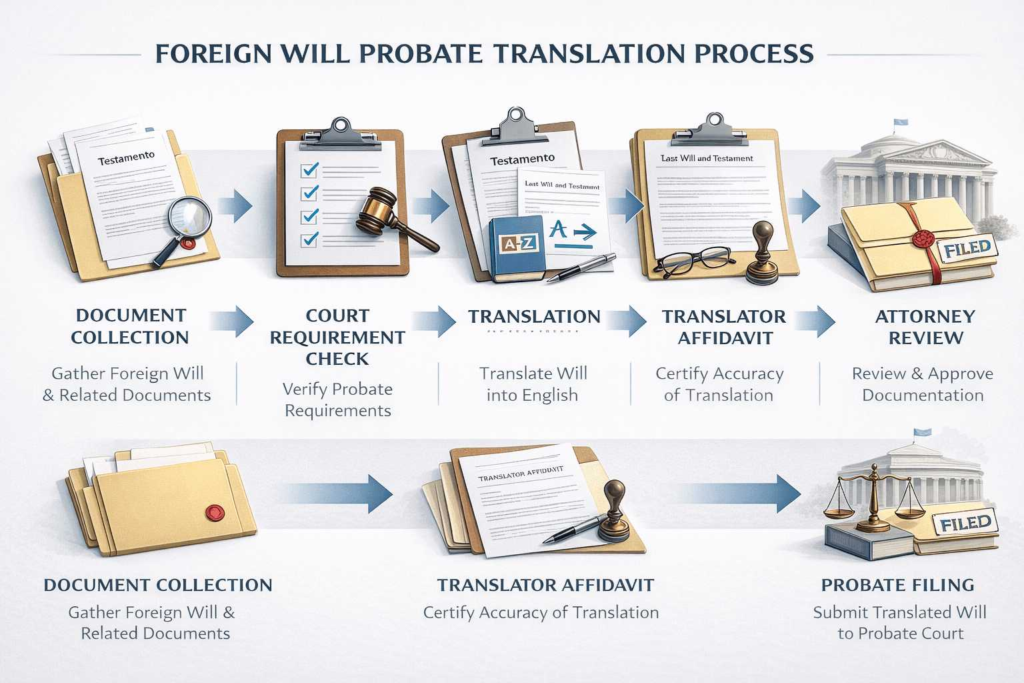
1) Confirm where the probate case will be filed
Before any translation starts, identify:
- The state and county probate court
- Whether this is the main probate case or an ancillary probate
- Whether the court requires originals, certified copies, exemplified copies, or authenticated copies
- Whether a translator’s affidavit is required with the English translation
This single step prevents a lot of wasted time and duplicate work.
2) Gather the full document set, not just the will
For international estates, the will is often only one part of the filing. Courts, attorneys, and clerks may also need:
- Death certificate
- Probate petition or court form attachments
- Foreign court probate order (if probate was already opened abroad)
- ID documents for the personal representative or executor
- Property records for the US state involved
- Any existing legalised/apostilled copies from the originating country
If you only translate the will first, you may end up with inconsistent names or dates when later documents are added.
3) Check whether your court needs a translator affidavit
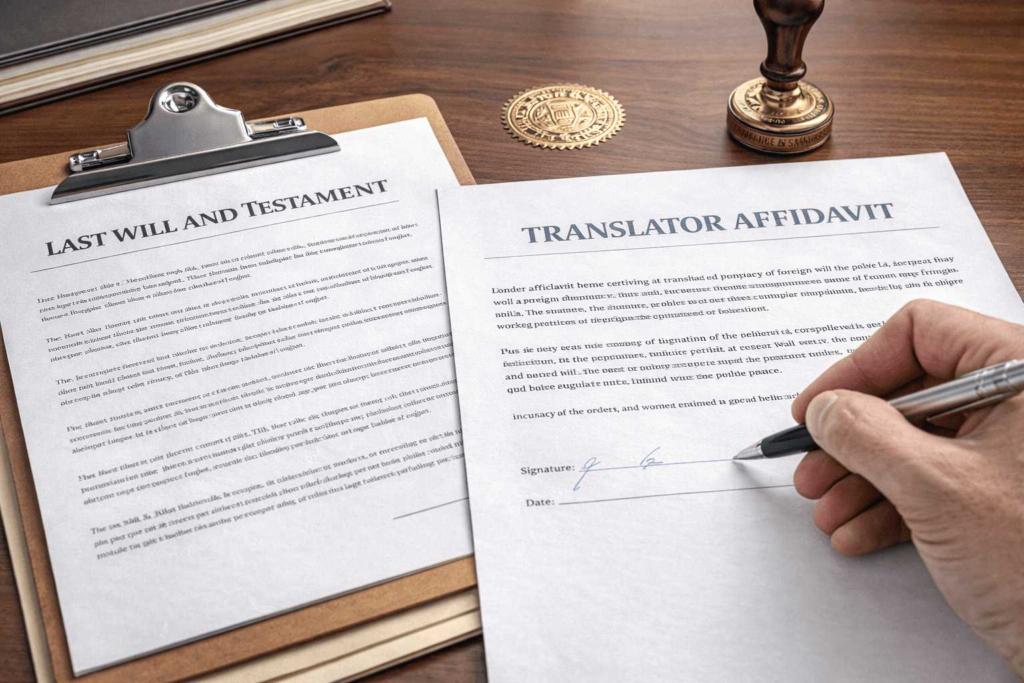
This is critical.
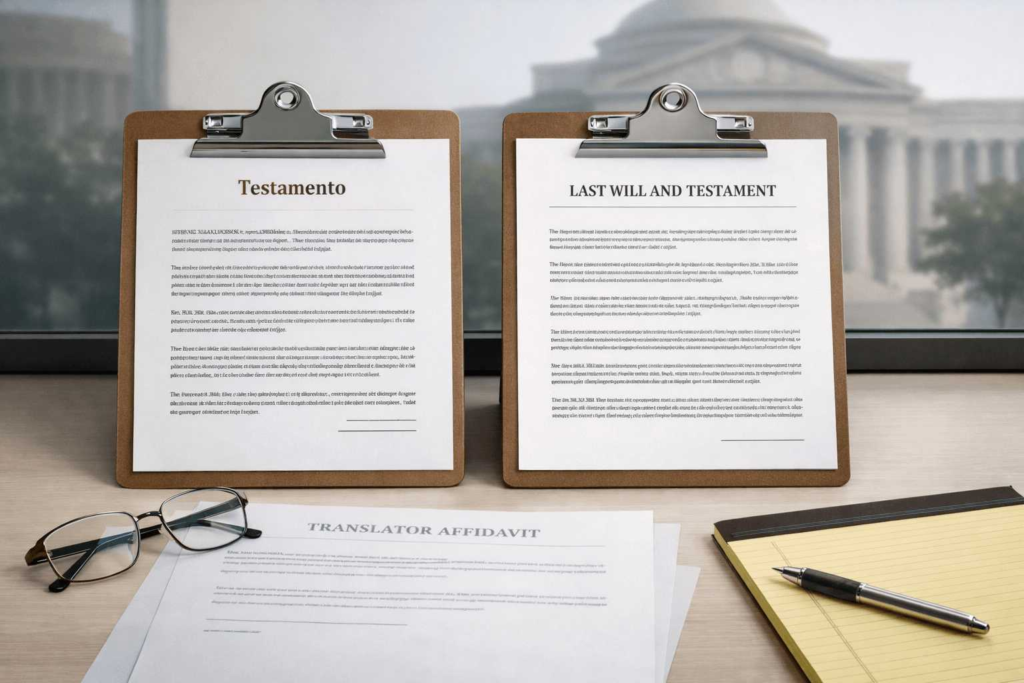
In many US court contexts, non-English documents are not enough on their own. Courts often expect an English translation plus a statement from the translator confirming qualifications and accuracy. For probate filings, this can be a deciding factor in whether the clerk accepts the documents on first submission.
A court-ready translator affidavit typically confirms:
- The translator is competent in both languages
- The translation is true and complete
- The translator’s name and signature
- The date
- Contact details (if required by counsel/court format)
If your probate attorney already has a preferred affidavit format, send it with the files before the translation begins.
4) Use the original document layout as the translation blueprint
Wills are legal documents. Formatting matters.
A strong foreign will translation for probate should mirror the source document structure so the court can compare line-by-line when needed. That means the translated version should clearly show:
- Headings and section numbers
- Article/Clause references
- Signature and witness sections
- Page references and schedules
- Stamps, seals, and handwritten notes (labelled clearly)
This reduces the chance of confusion when the document is reviewed by a clerk, attorney, or judge.
5) Standardise names before finalising the translation
Names often appear differently across documents:
- Passport spelling vs local spelling
- Diacritics are included in one document but not another
- Married names vs maiden names
- Transliteration differences (Arabic, Russian, Chinese, etc.)
Before final delivery, align spellings across:
- Will
- Death certificate
- Property documents
- Court petition
- Executor ID
If there is a mismatch, the translation should preserve the original text but also flag the issue for the filing team. This is a simple step that prevents avoidable objections.
6) Translate legal terms for meaning, not word-for-word appearance
Foreign wills often contain legal terms that do not map neatly to US probate language. A direct literal translation can create ambiguity.
Examples include:
- Executor vs personal representative
- Forced heirship terms
- Community property references
- Notarial acts and civil-law formalities
- Probate grants issued under non-US legal systems
The translation should preserve the original legal meaning and use a clear, neutral English rendering. If a term has no exact US equivalent, a brief bracketed clarification (where appropriate) can help attorneys and court staff understand the function of the term without changing the original intent.
7) Include all visible marks, seals, and annotations
In probate, “minor” marks can become major issues.
Do not ignore:
- Court seals
- Notary seals
- Revenue stamps
- Registry marks
- Handwritten dates
- Handwritten corrections
- Marginal notes
- Seal embossments (if legible from the scan)
These details may be relevant to authenticity, timing, or execution formalities.
8) Build the filing bundle in the order the court will review it
A clean submission package is often what separates a smooth filing from a clerk rejection.
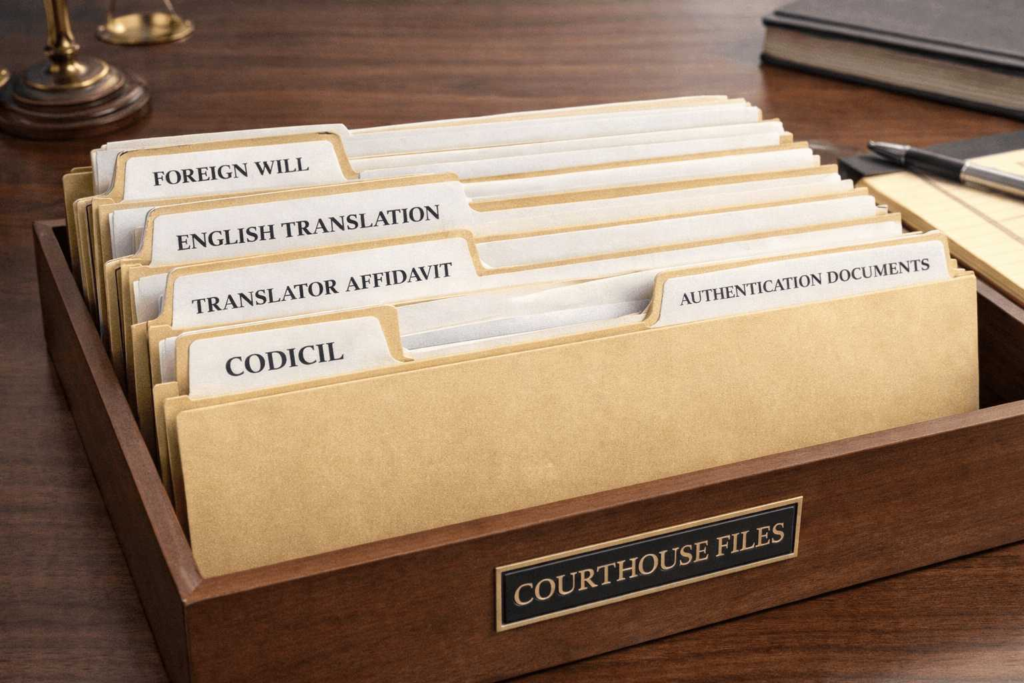
A practical order is:
- Probate petition or attorney cover filing
- Foreign will (copy)
- English translation
- Translator affidavit
- Codicils and their translations
- Death certificate and translation
- Authentication/apostille papers (if applicable)
- Any foreign court orders and translations
This order makes it easier for court staff to follow the file without hunting for matching pages.
9) Ask for a pre-filing legal review if the estate is contested
If the probate is likely to be challenged (capacity, undue influence, competing heirs, multiple wills, property in more than one country), do not treat the translation as an isolated task.
In contested matters, small wording choices can be scrutinised. It is worth having:
- Probate counsel reviews the translated will
- A second legal-linguistic review for sensitive clauses
- Consistent terminology across all translated exhibits
This is especially important in international will translation cases involving more than one jurisdiction.
10) Keep an editable master and a submission PDF
Request two final outputs:
- Editable version (Word format) for attorney markup
- Submission-ready PDF with translation + affidavit
That way, if the court requests a minor formatting change, you can update quickly without redoing the full translation.
What probate courts usually care about most
If you are preparing a last will translation US court filing, most issues fall into four categories:
1) Completeness
The court wants to know if the translation includes the full document, not selected pages.
2) Accuracy
Names, dates, clauses, and legal intent must be faithfully rendered.
3) Translator qualifications
Many courts and attorneys want a clear affidavit confirming qualifications and accuracy.
4) Filing readiness
The translation should be organised and easy to compare against the original.
If you solve those four, you avoid the most common filing delays.
Examples of court rules that make translation mandatory
Readers often search for state-specific probate rules before ordering a translation, and that is a smart step.
For example, some courts and statutes say the requirement very clearly:
Florida: A will written in a foreign language cannot be admitted to probate unless it is accompanied by a true and complete English translation.
California: if the will is in a foreign language, the petitioner must attach an English translation, and once the will is admitted to probate, the certified English translation is filed with it.
New York ancillary probate filings commonly expect foreign-language documents to be filed with an English translation and a translator’s affidavit confirming qualifications and accuracy.
Including a state-specific rule check before translation begins helps families and attorneys order the right package the first time instead of paying for revisions after filing.
Certified translation vs notarisation vs apostille in probate
This is where families often lose time.
Certified translation
A professional English translation with a signed statement confirming it is accurate and complete.
Notarisation
A notary verifies the identity/signature of the person signing a document (often the translator’s affidavit if requested). It does not validate the translation itself.
Apostille/authentication
This is document authentication for international use. It may apply to public documents or court-issued copies, depending on where the document is being used and which country is involved.
For US probate, do not assume every translated document will need notarisation or apostille. The court may require one, both, or neither, depending on the document source and filing context.
Common problems that delay foreign probate filings
Incomplete scans
If the page edges, seals, or signatures are cut off, the translation may be unusable for court filing.
Missing codicils
A will translation without the codicil can create contradictions in beneficiary names or shares.
Inconsistent name spellings
This is one of the most frequent reasons attorneys ask for revisions.
No translator affidavit
Even a strong translation can be rejected if the filing package is missing the affidavit that the court expects.
Literal translation of legal terminology
The document may be “translated” but still unclear to US probate staff and counsel.
Submitting only the will
Many probate matters require supporting translated documents, too, not just the will itself.
A practical example of a smoother probate translation workflow
A family needs to probate a Spanish-language will for property in Florida and a bank account in another state. Instead of translating only the will, they submit a complete file pack for review first: will, codicil, death certificate, and the foreign notarial record. The translator standardises names across all documents, labels seals and signatures clearly, and includes a translator affidavit. The attorney receives an editable version for final review and a PDF bundle for filing.
The result is a cleaner probate submission, fewer follow-up questions, and less risk of refiling due to missing or mismatched information.
What to send when you request a probate will translation
To start your project quickly, send:
- Clear scans/photos of every page (including blank backs if stamped)
- The probate court name and state
- Any filing instructions from your attorney or the court
- Whether this is primary probate or ancillary probate
- Any deadline (hearing date, filing date, objection deadline)
- Your preferred spelling for names (if there are transliteration variations)
If you have the court checklist or attorney filing template, include that too. It helps the translator package the translation correctly the first time.
When timing is urgent
Probate deadlines can move fast, especially when there is a hearing date or an objection window.
If your filing is urgent:
- Send the will and codicils first
- Mark the deadline clearly in the subject line
- Ask for staged delivery (will first, supporting documents next)
- Request an immediate scan review to confirm file quality before work starts
If needed, you can begin with the will and translator affidavit while the remaining supporting documents are being prepared.
Get your foreign will probate translation prepared for filing
If you need help to translate foreign will probate documents, the fastest path is to start with a file review, not a guess. A court-ready translation package should match the original document, preserve legal meaning, include the right affidavit format, and fit the probate court’s filing process.
Send the will, any codicils, and your probate filing instructions, and get a translation package that is ready for attorney review and court submission.
If your matter involves more than one country, multiple heirs, or a contested estate, request a legal-format review at the start so the translation and filing strategy stay aligned.
FAQs
Do I need a certified translation for a foreign will in US probate?
In many probate matters, yes. Courts generally need an English version of the will to review and file the case properly. The translation should be complete, accurate, and prepared in a format that can be submitted with the probate paperwork.
Does a foreign will translation for probate need a translator’s affidavit?
Often, yes. Many courts and attorneys expect an affidavit confirming the translator’s qualifications and that the translation is accurate. This is a common requirement in court filings involving non-English documents.
Can I translate a foreign will myself for probate?
It is not recommended for probate filings. A will is a legal document, and self-translations create risk if the court or opposing party challenges the wording, completeness, or affidavit format.
Do I need notarisation or an apostille for an international will translation?
Not always. Certified translation, notarisation, and apostille are different things. Some probate courts only need the English translation and translator affidavit, while others may also require authenticated or apostilled supporting documents. Always confirm with the probate court or your attorney.
What documents should be translated besides the will?
In many cases, you should also translate codicils, death certificates, foreign probate orders, and any exhibits or supporting documents the court will review. Translating everything together helps keep names and dates consistent.
How long does it take to translate a foreign will for probate?
Timing depends on page count, language, scan quality, and whether supporting documents are included. Many straightforward wills can be translated quickly, but contested estates or complex legal terminology may need additional review.
How do I translate a foreign will for probate in the UK?
If the estate is being handled in the UK, start by confirming which court is dealing with the matter and whether the case involves only the will or also a foreign grant, succession certificate, or inheritance document. Then gather the full document set, obtain the correct copy from the foreign authority, and arrange an official English translation that includes the full will, codicils, signatures, seals, and related paperwork.
Can a foreign will probate case in England and Wales require a paper application?
Yes. Foreign-will cases can fall outside the standard online route, so it is important to check the probate application format before ordering or packaging the translation. This is one reason court-specific filing instructions should be collected first.
Do UK probate filings need an official translation of foreign inheritance documents?
If the supporting document is not in English, an official translation may be needed for the probate application bundle. This can apply not only to the will itself but also to foreign grants, succession certificates, inheritance certificates, or equivalent documents issued abroad.
What if the original foreign will is held by the overseas court or notary?
In that situation, you should obtain the correct certified, notarised, court-issued, or otherwise official copy accepted for filing, and have that version translated together with any codicils or supporting inheritance paperwork. Courts and solicitors usually need a document set they can review consistently, not just an isolated translation of part of the record.
What if the estate has assets in both the United States and the United Kingdom?
Treat the matter as a cross-border filing project. Keep one consistent translation base for the will and related documents, but prepare separate filing bundles for each jurisdiction so that affidavit wording, supporting documents, and submission order match the expectations of the court receiving them.