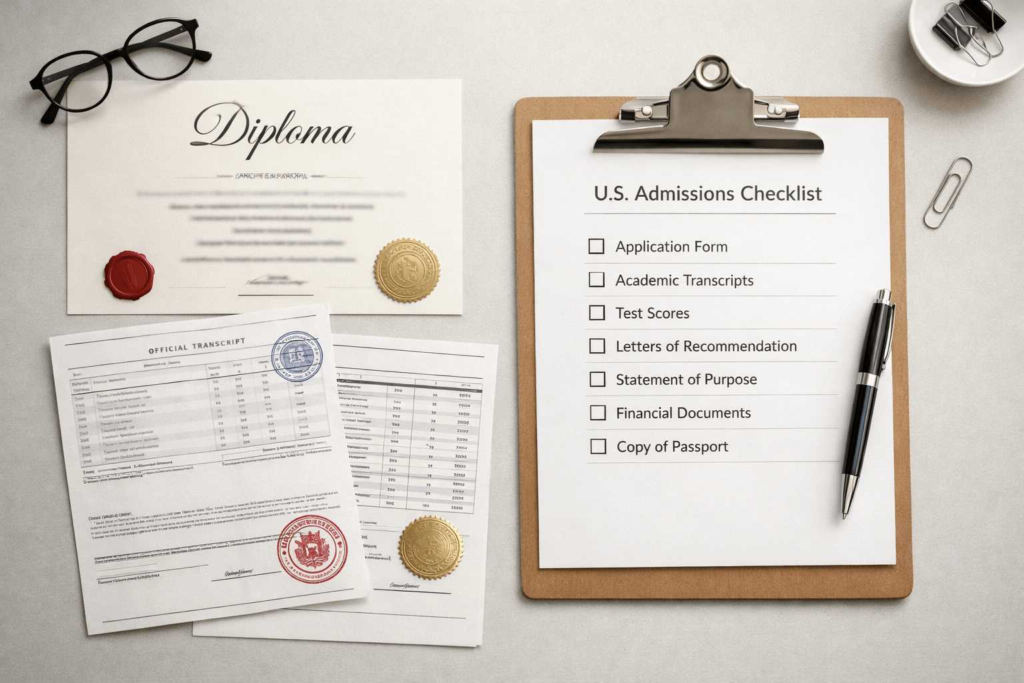
If you need to translate foreign education credentials for the United States, the fastest way to avoid delays is to treat it like a compliance task, not a language task. Universities, credential evaluators, licensing boards, and immigration processes may all accept the same “document” (your diploma or transcript), but they don’t always accept the same format, certification wording, or submission method.
This guide shows you exactly how to translate academic documents in a way that is clear, consistent, and “submission-ready” — whether you’re applying to a U.S. university, validating a foreign degree for work, or preparing paperwork for a formal process.
If you want us to handle this end-to-end, you can upload your documents here: Contact Urgent Certified Translation
If you need to translate foreign education credentials for UK employers
If you are applying for jobs in the UK, the safest approach is to prepare a certified English translation of your education documents first, then check whether the employer also wants a UK qualification comparison. In many cases, UK employers simply want to understand what your diploma, degree certificate, or transcript says in English. In other cases — especially for formal HR checks, public sector roles, or applications that require qualification comparison — you may also be asked for a Statement of Comparability from UK ENIC / Ecctis.
For most UK job applications, the core document set is straightforward:
- degree certificate or diploma
- academic transcript
- grading legend or mark sheet, if applicable
- certified English translation of each document if the originals are not in English
- proof of name changes if your current name does not match your academic records
The practical rule is simple: translation makes the document readable, while comparability explains how the qualification fits into the UK system. If an employer only asks for your documents in English, a properly certified translation may be enough. If they ask what your qualification is equivalent to in the UK, you may need a formal comparability document as well.
If your goal is to avoid delays with UK employers, do not wait until the last stage of recruitment. Get your translations prepared in a clean, submission-ready format and confirm early whether the employer wants translation only, translation plus comparability, or profession-specific recognition.
What does “foreign credential translation” mean in the U.S?

People use the phrase “foreign credential translation” to describe three different steps. Mixing them up is one of the most common reasons applicants get stuck.
1) Translation
A translation converts your diploma, transcript, or letter into English (word-for-word where required), including stamps, seals, signatures, headings, and notes.
2) Credential evaluation
A credential evaluation explains what your education is equivalent to in the U.S. system (for example, whether a qualification is comparable to a U.S. bachelor’s degree, and sometimes how courses/credits align).
Translation and evaluation are not the same service. Many evaluators won’t evaluate anything until the document is in English.
3) Recognition/acceptance
Even after translation and evaluation, the final decision usually sits with the organisation receiving your file:
- a university admissions office,
- an employer,
- a state licensing board,
- or an immigration process.
Key takeaway: Your goal isn’t just “a good translation.” Your goal is a translation that meets the receiving organisation’s acceptance criteria.
Who typically asks you to translate education credentials?
Different recipients ask for different levels of detail. Before you translate anything, identify which bucket you’re in:
University admissions (college, master’s, PhD)
Often requires:
- transcripts (including grading scale notes if they exist),
- degree certificate/diploma,
- and sometimes “course descriptions” or syllabi (varies by programme).
Credential evaluation services (often required by universities and licensing boards)
May require:
- word-for-word translations,
- clean formatting that matches the original,
- specific file types and upload rules.
State licensing boards (nursing, engineering, teaching, etc.)
Often requires:
- a particular evaluator,
- course-by-course evaluation,
- and supporting documents (sometimes work placement hours, clinical hours, or professional certificates).
Employers and background screening
Usually needs:
- a clear English version of the diploma and/or transcript,
- consistency in names and dates.
Immigration-related submissions that include educational evidence
May require:
- a full English translation plus a signed certification statement.
UK employers: when translation is enough and when you may also need UK ENIC
This is where many applicants get confused.
If a UK employer only needs to read your academic documents in English, a certified translation is often the first requirement. That helps the recruiter, hiring manager, or screening team understand your degree title, institution, dates, grades, and any supporting notes.
If the employer wants to know how your qualification compares to the UK education system, they may ask for a formal comparison document in addition to the translation. This is especially common when:
- the role has minimum education thresholds,
- the employer is unfamiliar with the awarding institution,
- a public sector or compliance-driven process is involved,
- or the role sits close to a regulated profession.
A good rule of thumb:
- Use certified translation when the issue is language.
- Use comparability when the issue is UK equivalence.
- Use profession-specific recognition when the issue is legal eligibility to practise.
If you are not sure what the UK employer means, ask one direct question:
“Do you need a certified English translation only, or do you also require a Statement of Comparability / UK qualification comparison?”
That one line can save days of unnecessary back-and-forth.
Start here: choose the correct evaluation type (so you translate the right documents)
If you’re unsure what you need, this quick decision guide will save you time.
Document-by-document evaluation (also called “general”)
Best for:
- employment screening,
- basic degree recognition,
- general comparisons.
Usually needs:
- diploma/degree certificate,
- sometimes transcripts.
Course-by-course evaluation (more detailed)
Best for:
- university admissions requiring credit and GPA mapping,
- professional licensing,
- transfer credit decisions.
Usually needs:
- full transcripts (all pages),
- diploma/degree certificate,
- and occasionally course syllabi (if requested).
Practical tip: If you’re ordering a course-by-course evaluation, assume your transcript translation must be extremely legible, complete, and consistent across every course title and grade.
Step-by-step: how to translate foreign education credentials correctly
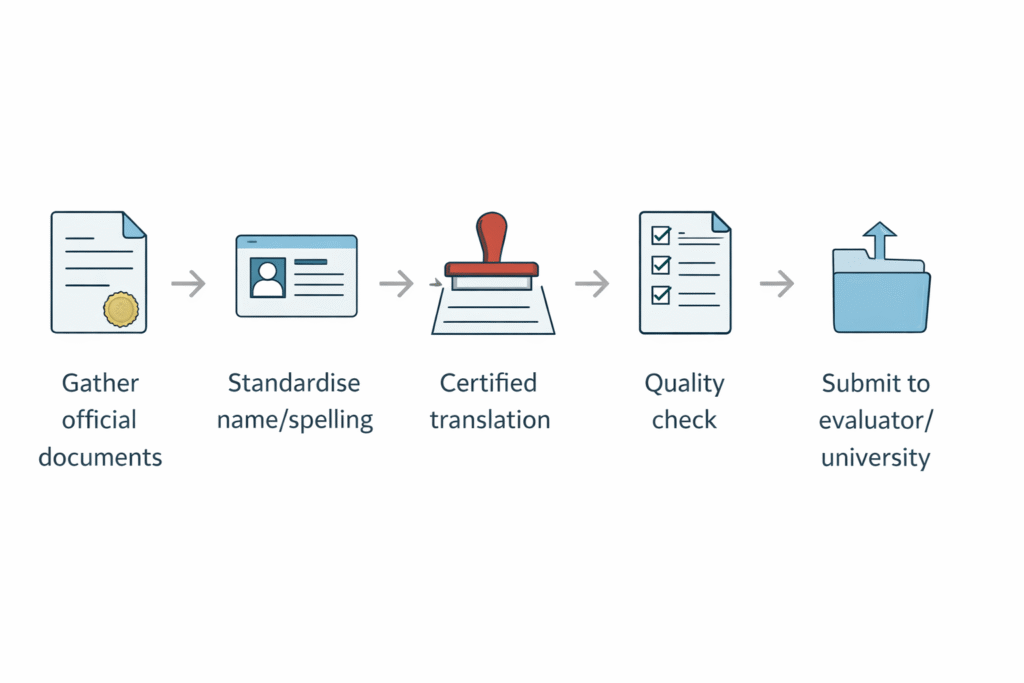
Step 1: Get the receiving requirements in writing (one screenshot is enough)
Before you translate anything, collect:
- the name of the receiving organisation,
- their document list,
- whether they require “certified translation,”
- any upload/post rules (sealed envelopes, portals, file types),
- and deadlines.
If the requirements are buried in a portal, take a screenshot. A single line like “Translation must be complete and certified” changes everything.
Step 2: Gather the right version of your documents
For educational credentials, “official” typically means:
- issued by the institution,
- not edited by the student,
- and complete (all pages, front/back, attachments).
Common documents to include:
- Degree certificate/diploma
- Academic transcript (all pages)
- Diploma supplement (if issued)
- Letter of enrolment/letter of graduation (if used as proof)
- Professional certificate (if tied to licensure)
- Grading key/legend (often printed on the transcript)
Do this now: check for stamps on the back page, embossed seals, small footnotes, and handwritten remarks. These are often where rejections start.
Step 3: Standardise your identity details (so names match everywhere)
A surprising number of credential delays come from name mismatches:
- missing middle names,
- different spellings (especially when transliterating),
- different date formats,
- married vs maiden names.
Create a simple “identity rule” before translation begins:
- Use the name spelling exactly as it appears on your passport (or the document you’ll submit with the application).
- Keep the same order (given name, middle name, surname).
- Choose one date format for the English translation (and apply it consistently).
If your original documents use a different script, the safest approach is to align your English spelling with your passport and keep that spelling consistent across every credential.
Step 4: Choose a translator who can provide a proper certification statement
For official use, the receiving organisation typically expects:
- a complete translation,
- prepared by a competent translator,
- plus a signed certification statement (often called a Certificate of Translation Accuracy).
This is where “DIY translations” often fail: even if the English is fine, the certification and format are often missing or not accepted.
If you want a ready-to-submit option, start here: Certified Translation Services
Step 5: Give your translator a “credential translation brief” (copy/paste)
To reduce back-and-forth, send this short brief with your files:
Credential Translation Brief (copy/paste)
Receiving organisation: [University/evaluator/licensing board/employer]
Purpose: [Admissions/evaluation/licensing/employment/immigration]
Required language: English
Name to use (passport spelling): [Full name exactly]
Date format preference: [e.g., 14 February 2026]
Transliteration note (if applicable): [Any preferred spelling rules]
Must include: stamps/seals/headers/footnotes/handwritten notes
Output needed: submission-ready PDF + signed certification statement
Deadline: [date/time + time zone]
This one step alone prevents the most common mistakes: incomplete pages, inconsistent names, and missing stamps.
Step 6: Translate everything you see (including stamps and “small print”)
Education credentials often include critical details outside the main text:
- transcript legends (“grading system”, “credit hours”, “scale”),
- institutional address lines,
- footnotes about programme language or level,
- “issued on” and “authorised signature” fields,
- verification notes,
- and stamps or embossed seals.
A submission-ready translation should:
- label stamps and seals clearly,
- keep course titles and grades easy to read,
- and preserve the structure so reviewers can compare line-by-line.
Important: Translation is not the same as “conversion.” Your translator typically should not convert grades into GPA or rewrite course credits into U.S. credits unless the receiving organisation explicitly requests an explanatory note. Grade/credit equivalency is usually the evaluator’s job.
Step 7: Use a formatting approach that evaluators can process quickly

Academic translations are reviewed under time pressure. Make it easy.
A strong formatting approach includes:
- headings that mirror the original,
- tables kept readable (especially for course lists),
- consistent labels for repetitive fields (Course Title, Grade, Credits),
- and clear notes when text is illegible or missing.
What tends to get flagged: cramped course tables, merged cells that don’t export well to PDF, and translations that “paraphrase” rather than translate.
Step 8: Quality check with a “no-rejection” checklist
Before you submit, review the translation against the original and confirm:
Submission-ready checklist

- All pages included (including backs and attachments)
- Names match passport spelling exactly
- Dates are consistent and readable
- Every stamp/seal/signature is translated or clearly labelled
- Course titles and grades are legible
- Transcript legends/grading keys are included (if present)
- Document numbers and issuing authority details are included
- The certification statement is signed and dated
- Final output is a clean PDF (and any other file type required)
If you’d like us to run this check for you, you can upload your files here: Contact Urgent Certified Translation
Step 9: Submit the translation the way the recipient expects
This is where many applicants lose days.
Common submission routes:
- Portal upload (PDF/JPEG, sometimes file size limits, usually no password protection)
- Email submission (often for employers)
- Mailed documents (sometimes institutions demand official transcripts separately)
If your institution must send transcripts directly to an evaluator, your translation may still be submitted separately. Follow the recipient’s rules exactly, even if it feels redundant.
Special situations (and how to handle them)
If your transcript is sealed and you can’t open it
Some institutions issue transcripts in sealed envelopes. If you open them, they’re no longer “official” for certain recipients.
What to do:
- ask your institution for a second official set for translation purposes.
- or ask the recipient whether they accept translations based on a separate official copy.
If your documents are in a non-Latin script (Arabic, Cyrillic, Chinese, etc.)
Focus on:
- consistent transliteration,
- matching passport spelling,
- and clearly translating institutional names, programme names, and course titles.
If you need notarisation or an apostille
These are add-ons only when the receiving organisation explicitly requests them. Many education credential translations do not require notarisation, but some processes (or some recipients) may ask for it.
If you’re unsure, don’t guess — obtain the requirement in writing first.
If you plan to work in a regulated profession in the UK
If your end goal is work in the UK, one extra check matters: whether your occupation is regulated.
For general employment, a certified translation and, where needed, a qualification comparison may be enough. But for regulated professions, the professional regulator may have its own rules for overseas qualifications, professional experience, language evidence, and eligibility to practise. In those cases, translation helps the regulator read your documents, but it does not replace the regulator’s own recognition process.
This matters most for applicants in fields such as:
- healthcare
- teaching
- engineering
- architecture
- other licensed or protected-title professions
The safest order is:
- confirm the regulator or employer requirements in writing,
- prepare certified English translations of the exact documents requested,
- obtain any required qualification comparison or profession-specific recognition,
- then submit in the format they specify.
If you are applying both for a job and for professional recognition, do not assume that the employer’s document requirements and the regulator’s document requirements are identical. They often are not.
What affects cost and turnaround?
Pricing for translating foreign education credentials typically depends on:
- number of pages (transcripts can be multi-page),
- document complexity (dense course tables, stamps, handwritten notes),
- language pair,
- urgency,
- and whether certification wording is required.
Turnaround is fastest when you provide:
- clear scans,
- complete pages,
- and your identity brief (name spelling + date format).
If you want a precise quote with a confirmed deadline, upload your files here: Contact Urgent Certified Translation
A quick example (so you can sanity-check your own case)
Scenario: foreign degree recognition for U.S. university admissions
You’re applying for a master’s programme. The university asks for a course-by-course evaluation from a recognised credential evaluator.
A typical “clean” workflow looks like:
- Request official transcripts from your university
- Confirm the evaluator’s document list
- Translate transcripts + diploma into English with a signed certification statement
- Upload translations where allowed
- Institution sends official transcripts where required
- Evaluator issues the report to your university
The win here is simple: your translation is complete, consistent, and formatted so the evaluator can process it without questions.
Additional FAQ: UK employers and qualification recognition
1) Do UK employers need a certified translation or a Statement of Comparability?
It depends on what they are trying to confirm. If they only need to read your diploma or transcript in English, a certified translation may be enough. If they want to understand the UK level of your qualification, they may also ask for a Statement of Comparability or another formal comparison document.
2) Can I apply for jobs in the UK with just my translated degree certificate?
Sometimes, yes — especially for roles where the employer only needs evidence of your degree in English. But many employers will also want your transcript, grading information, or proof of name changes if the records do not match your current identity documents.
3) What documents should I translate for a UK employer?
The safest set usually includes your degree certificate or diploma, full academic transcript, grading legend if applicable, and any supporting academic letters used as proof of completion. If your current name differs from the name on the qualification, include name-change evidence as well.
4) Do UK employers accept applicant-translated academic documents?
Some may not. Even where a translation is technically readable, self-prepared translations often create problems around certification wording, completeness, formatting, and consistency of names and dates.
5) Does a certified translation tell a UK employer what my degree is equivalent to?
No. A certified translation explains what the original document says in English. It does not, by itself, determine the UK academic level or professional standing of the qualification.
6) What if my UK employer is hiring for a regulated profession?
In that case, translation may only be one part of the process. The relevant professional regulator may also require separate recognition, additional checks, or proof that you meet profession-specific entry standards.
FAQ
1) Do I need a certified translation to translate foreign education credentials?
Often, yes — especially when your translation is used for admissions, credential evaluation, licensing, or formal submissions. “Certified” usually means the translation includes a signed statement confirming completeness, accuracy, and translator competence.
2) What’s the difference between credential evaluation and translation?
Translation converts your documents into English. Credential evaluation determines the U.S. equivalency of your education and may assess credits, level, and grading scale alignment. Many people need both.
3) Can I translate my own transcripts or diploma?
Some organisations do not accept applicant-prepared translations for official use. Even when they do, missing certification wording, incomplete pages, and formatting issues frequently cause delays.
4) How do I validate a foreign degree in the U.S.?
There isn’t one single national process. Validation is typically done by the organisation you’re applying to (university, employer, or licensing board), often supported by a credential evaluation from a private evaluation service.
5) Do transcripts have to be translated word-for-word?
Many recipients require an exact translation of all visible text, including course titles, grades, stamps, and legends. When in doubt, treat it as word-for-word and complete.
6) Do I need notarisation or an apostille for an education credential translation?
Only if the receiving organisation explicitly asks for it. Most academic translations are accepted with a proper certification statement, but requirements vary.