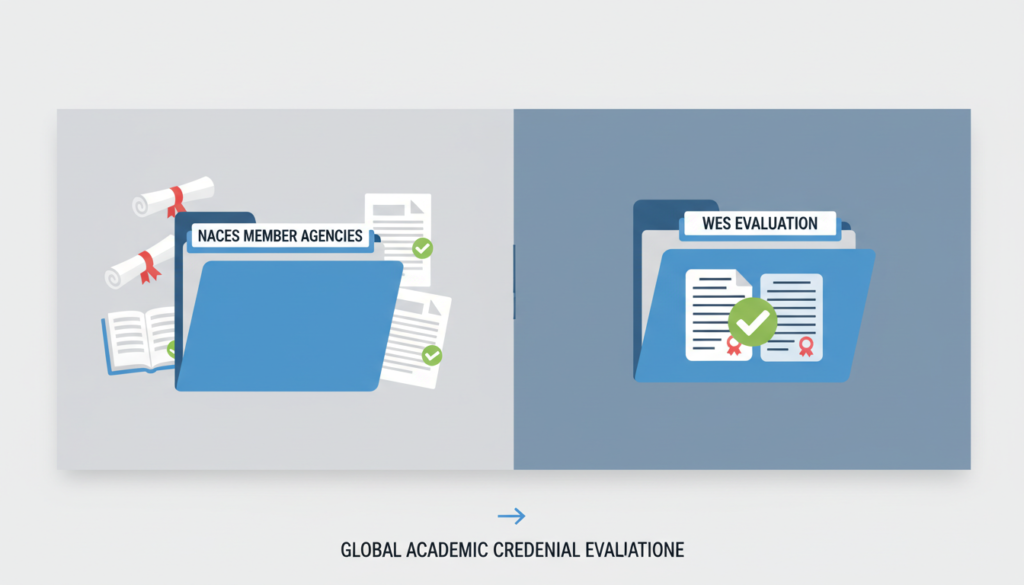
Understanding Credential Evaluation Services
If you’re searching for NACES vs WES, you’re usually trying to answer one urgent question: which credential evaluation service should you use, and what documents do you need to prepare first?
The most important thing to know upfront is this: NACES and WES are not the same kind of thing. NACES is an association of credential evaluation agencies, while WES is one credential evaluation provider (and one of the best-known names in the space). Once you understand that distinction, the rest becomes much easier: choosing the right report, avoiding delays, and making sure your translations are accepted the first time.
This guide walks you through the differences clearly, including NACES evaluation vs WES evaluation, report types, timelines, costs, common mistakes, and how certified translations fit into the process.
Quick Answer: NACES vs WES in Plain English
If you want the shortest accurate answer, it is this:
- NACES is a trade association of independent credential evaluation organisations in the United States, while WES is one individual credential evaluation provider listed among NACES members.
- NACES does not issue evaluation reports itself. Member agencies do.
So if a school says it accepts a “NACES member evaluation,” WES may qualify, but it is not your only option. If the requirement says “WES only,” then you should use WES.
A simple way to remember it
- NACES = association
- WES = evaluation provider
- NACES does not evaluate documents directly
- WES does issue reports directly
- The receiving institution decides what it will accept
The Key Difference Most People Miss
NACES is a network; WES is a provider
A lot of people compare them as if they are direct alternatives. They are not. NACES is a professional association of credential evaluation organisations in the U.S., while WES (World Education Services) is one individual credential evaluation company.
Many universities, employers, and licensing boards ask for an evaluation from a NACES member. That means you may be free to choose WES or another NACES member, depending on the institution’s rules.
Why does this matter for your decision
This single distinction changes how you should choose:
- First, check what your receiving institution accepts.
- If they say “WES only,” use WES.
- If they say “any NACES member,” compare providers by:
Prepare your translations correctly before submitting anything. That is the real NACES vs WES difference in practice.
Who Actually Decides Whether Your Foreign Degree Is Accepted?
This is one of the most misunderstood parts of the process. In the United States, there is no single government agency that universally recognises all foreign degrees for every purpose. In practice, the final decision usually rests with:
- the university
- the employer
- the licensing board
- the immigration authority reviewing your case
That is why the safest rule is: acceptance first, brand second. Always match the evaluator to the written requirement of the organisation receiving your report.
What a Credential Evaluation Actually Does
A credential evaluation compares your non-U.S. education to a U.S. educational framework so that schools, employers, licensing boards, and government bodies can understand your qualifications. It may answer questions like:
- What is your degree equivalent to in the U.S.?
- Are the issuing institutions recognised?
- How many credits/years of study are equivalent?
- What is the GPA equivalent (in some report types)?
- Is a document-by-document or course-by-course report required?
Translation and evaluation are not the same service
This is where many applicants lose time. A certified translation makes your document readable in English, while a credential evaluation interprets the educational value of the document. You often need both. If your diploma or transcript is not in English, your evaluator may require a certified English translation before the evaluation can move forward.
NACES Evaluation vs WES Evaluation
What is a NACES evaluation?
When people say “NACES evaluation,” they usually mean a credential evaluation completed by a member agency of NACES, not an evaluation performed by NACES itself. So, “NACES evaluation” is really a category label.
What NACES membership signals
A NACES member agency is expected to follow professional standards and established practices. For applicants, this usually means:
- a recognised evaluation format
- accepted processes for institutions and regulators
- clearer credibility when an admissions office or licensing board reviews your documents
It does not mean every agency has identical pricing, turnaround times, customer support, or document requirements by country. That is why comparing providers still matters.
What is a WES evaluation?
A WES evaluation is a credential evaluation report issued by World Education Services. WES is widely known because it serves multiple use cases, including:
- higher education admissions
- employment
- licensing boards
- immigration pathways (especially Canada-related ECA use cases)
WES also provides tools that applicants use before they apply, such as:
- document requirement previews
- degree equivalency tools
- report type guidance
Is WES a NACES member?
Yes. WES is listed in the NACES member directory. That is why applicants often see WES and NACES mentioned together. But WES is not “the same as NACES.” WES is one evaluation provider within the wider NACES member network.
Why applicants ask this question
If the requirement says “any NACES member,” you may be able to choose WES or another member. If the requirement says “WES,” another NACES member is not automatically a substitute. If the requirement is unclear, ask before you pay for any report.
Which Credential Evaluation Service Should You Choose?
If you’re asking which credential evaluation service is right for you, use this decision rule:
The Acceptance-First Rule
Choose the provider your receiving institution accepts or prefers — not the one with the strongest brand name. This is the fastest way to avoid rework.
A practical decision framework
Choose WES when:
- your university or licensing body specifically says WES
- you need a WES-only process for your destination
- you want to use WES’s document tools and report ecosystem
- you need a WES-specific immigration or institutional workflow
Choose any NACES member (including WES) when:
- the requirement says “NACES member evaluation accepted”
- you want to compare turnaround and fees across agencies
- you need a provider with country-specific handling experience
- you want a provider with stronger support for your timeline
Pause and confirm before ordering when:
- the institution has not stated whether it wants document-by-document or course-by-course
- you are applying to multiple schools with different requirements
- you are using translated academic records and need to confirm formatting expectations
- you are unsure whether a certified translation alone is enough (it often is not)
WES Evaluation: Report Types, Costs, and Timelines
WES report types (what most applicants choose)

WES offers multiple report types, but the two most common for U.S. academic and professional use are:
1) Document-by-Document (DxD)
Usually used for:
- employment
- some immigration uses
- first-year college entry (in many cases)
It summarises each credential and gives an equivalency.
2) Course-by-Course (CxC)
Usually used for:
- university transfer admissions
- graduate applications
- licensing boards
- any case where course list, credits, grades, and GPA conversion are needed
It is more detailed and is commonly required for academic progression.
3) Other WES reports
WES also offers additional report categories, including:
- Educational Credential Assessment (ECA) for Canadian immigration
- NZQA-related verification reporting
If your destination is not standard U.S. admissions/employment, confirm the exact report required before paying.
WES evaluation fees (what to expect)
WES pricing changes over time, but applicants usually compare these starting points:
- Document-by-Document: lower starting price
- Course-by-Course: higher starting price (because it is more detailed)
- ECA / specialised reports: different pricing structures
Always verify the current fee page before ordering because report fees, add-ons, and delivery options can change.
Does WES cost more than NACES?
This question is slightly misleading, because NACES is not a credential evaluation company and does not have one standard fee. Each NACES member sets its own prices. A more accurate comparison is: Should I use WES, or should I compare WES with other NACES members on price, timing, document rules, and support?
WES processing times (how to avoid delays)
One of the biggest mistakes applicants make is treating the evaluation as one single step. It is actually a sequence:
- Application and payment
- Document submission
- Document review and verification
- Evaluation begins
- Final report delivery
The delay usually happens in step 3, not step 4.
A better way to estimate your timeline
Use this timing method instead of guessing:
- Time to collect documents from your institution
- Time to obtain certified translations
- Time for document review/verification
- Time for the actual evaluation
- Buffer for corrections or extra requests
If you have a hard deadline, start early and submit clean, readable, complete files.
NACES vs WES Comparison by Real-World Use Case
Scenario 1: U.S. university admission (undergraduate)
You may need:
- certified translations of diploma/transcript
- a credential evaluation from a NACES member (sometimes specifically WES)
- document-by-document or course-by-course, depending on school policy
Best move: Ask the admissions office for the exact evaluator and report type before ordering.
Scenario 2: Graduate school or transfer credits
You will often need:
- course-by-course evaluation
- official records sent from the issuing institution
- certified translations for non-English records
Best move: Confirm whether the school wants GPA conversion and whether it accepts all NACES members or only named agencies.
Scenario 3: Professional licensing board
Licensing boards can be strict. They may require:
- course-by-course evaluation
- detailed subject-level analysis
- verified official records
- exact translation formatting
Best move: Request the licensing board’s written requirements and send them with your translation order.
Scenario 4: Immigration-related document prep
This is where confusion is common. Some immigration processes require certified translations, some require credential evaluations, and some require both. Canadian immigration pathways may require a specific type of educational assessment from a designated organisation.
Best move: Treat “translation” and “evaluation” as separate checkboxes and verify both requirements.
The Translation Step That Delays Most Evaluations

A lot of people get stuck because they order the evaluation first and discover later that:
- translations are missing
- translations are not certified
- stamps/seals were not translated
- names do not match passport spelling
- pages are incomplete
- scans are blurred or cropped
- document labels are unclear
What a submission-ready certified translation should include
For academic credential evaluation workflows, your translation should be:
- Complete (every visible text element translated)
- Accurate (names, dates, institutions, grades, document numbers)
- Structured (easy to compare with the original)
- Certified (signed statement of accuracy and translator competence)
- Legible (clean PDF output)
- Consistent (same spelling across transcript, diploma, passport, and application)
Why this matters for WES and other NACES members
Even when the evaluator does not provide translation, your translation quality still affects:
- review speed
- follow-up requests
- acceptance confidence
- resubmission risk
If your documents are already time-sensitive, this is the step to get right first.
Do You Need Translation, Evaluation, or Both?
For many applicants, the answer is both — but they are not the same thing. A translation turns your document into readable English, while a credential evaluation explains how that education compares within the U.S. system.
For WES-related applications, it is helpful to know:
- applicants are responsible for providing required translations
- translations must be exact, clear, and legible
- translations should be completed by a professional translator
- handwritten, applicant-completed, or incomplete translations may not be accepted
- translations may need to be uploaded separately through the applicant account when required
For immigration use cases
Keep one more distinction in mind: USCIS rules require a full English translation with the translator’s certification for foreign-language documents. That rule does not automatically mean USCIS is asking for a WES or NACES evaluation in every case. A credential evaluation, when needed, is a separate requirement tied to the school, licensing, employment, or immigration context involved.
A Simple Checklist Before You Order Any Evaluation

Use this checklist to avoid paying twice.
1) Confirm the receiving institution’s exact requirement
Ask:
- Do you accept WES only or any NACES member?
- Do you require DxD or CxC?
- Do you need original institution-issued documents sent directly?
- Do you require hard copy delivery or digital delivery?
2) Confirm your document set
Typical academic file set:
- diploma/degree certificate
- transcript/mark sheets
- name change document (if applicable)
- passport/ID (for name matching)
- institution-issued records (as required)
3) Prepare certified translations
Make sure your translations include:
- all pages
- seals and stamps
- signatures
- annotations
- certification statement
4) Match names across everything
One spelling mismatch can trigger delays.
5) Start earlier than you think
Credential evaluation timelines are affected by:
- institution response speed
- verification steps
- national holidays
- missing pages
- poor scans
Original Insight: The Right Comparison Is Usually Not “NACES vs WES”
A better question is: “WES vs which other NACES member for my exact goal?” Why is this a stronger question?
- It matches how institutions write their requirements
- It helps you compare actual variables (report type, timing, service)
- It stops you from assuming a brand name guarantees acceptance
- It keeps your decision tied to your destination (school, employer, board)
If your receiving institution says “NACES member required,” you have options. If it says “WES required,” your choice is already made. That one distinction can save days of back-and-forth.
Need Certified Translations Before Your Evaluation?
If your diploma, transcript, or academic records are not in English, get your translations prepared before you submit your evaluation request. Urgent Certified Translation can help you prepare submission-ready certified translations for academic documents, including:
- diplomas
- transcripts
- mark sheets
- enrolment letters
- supporting identity documents
We format translations clearly, include a signed certification statement, and label seals/stamps so your records are easier to review. If you already know which evaluator you are using, send us the requirement page or checklist and we’ll align the translation format accordingly.
“The best decision I’ve made for my documents. The translation service is accurate, dependable, and ensures my paperwork is accepted worldwide.”
Final Takeaway

The NACES vs WES comparison becomes simple once you separate the roles: NACES = the association (a standards-based membership network) and WES = one provider (a well-known NACES member).
Your best next step is not guessing. It is confirmed:
- Which evaluator does your institution accept?
- Which report type do you need?
- Which documents must come from your institution?
- Which documents need a certified translation first?
Once those four points are clear, the process is much faster and far less stressful. If you want to move quickly, start with your translations now so your evaluation application is not delayed later.
FAQ
Is NACES the same as WES?
No. NACES is an association of credential evaluation agencies, while WES is one credential evaluation provider. WES is a member of NACES, but NACES itself does not issue evaluations.
Which is better for credential evaluation: NACES or WES?
This depends on your receiving institution. If they accept “any NACES member,” compare providers by report type, timing, and fees. If they specifically require WES, then WES is the correct choice.
What is the NACES vs WES difference for academic admissions?
The main difference is category vs provider. “NACES” means a recognised member agency network; “WES” is a specific agency. Admissions offices often care more about whether the evaluator is accepted than which brand you prefer.
Do I need certified translation for a WES evaluation?
If your academic documents are not in English, you may need certified translations. Requirements vary by country and document type, so always check the evaluator’s document requirements before submitting.
What is the difference between WES document-by-document and course-by-course reports?
Document-by-document reports summarise each credential and its equivalency. Course-by-course reports include subject-level detail, credits, grades, and often GPA conversion. Many graduate schools and licensing boards prefer course-by-course reports.
Can I use any NACES member instead of WES?
Sometimes yes, sometimes no. Many institutions accept any NACES member, but some specifically name WES or another provider. Always confirm the requirement in writing before ordering.
Is WES part of NACES?
Yes. WES is one of the organisations listed in the NACES member directory. That means WES may satisfy requirements that say “evaluation from a NACES member,” but you should still confirm the receiving institution’s exact wording before ordering.
Does NACES perform credential evaluations itself?
No. NACES does not perform evaluations. Its member agencies do. If you need an actual report, you must order it from a member organisation such as WES or another accepted provider.
Does WES translate documents?
No. Applicants are usually expected to provide any required translations separately.
Do I need WES for USCIS?
Not automatically. USCIS rules require full English translations with translator certification for foreign-language documents. Whether you also need a credential evaluation depends on the specific immigration, licensing, employment, or school requirement involved. A certified translation and a credential evaluation are not the same thing.
Who decides whether my foreign degree is recognised in the U.S.?
Usually the receiving university, employer, licensing board, or immigration authority. There is no single U.S. government agency that recognises all foreign credentials for every purpose.
Do I need a NACES member near me?
No. Applicants usually do not need a local office, because most evaluation processes are handled electronically.
Is WES better than other NACES members?
Not automatically. WES is well known and offers widely used tools and report options, but the best provider is the one your receiving institution accepts for your exact purpose. If the requirement allows any NACES member, compare report type, document rules, fees, processing expectations, and support before choosing.