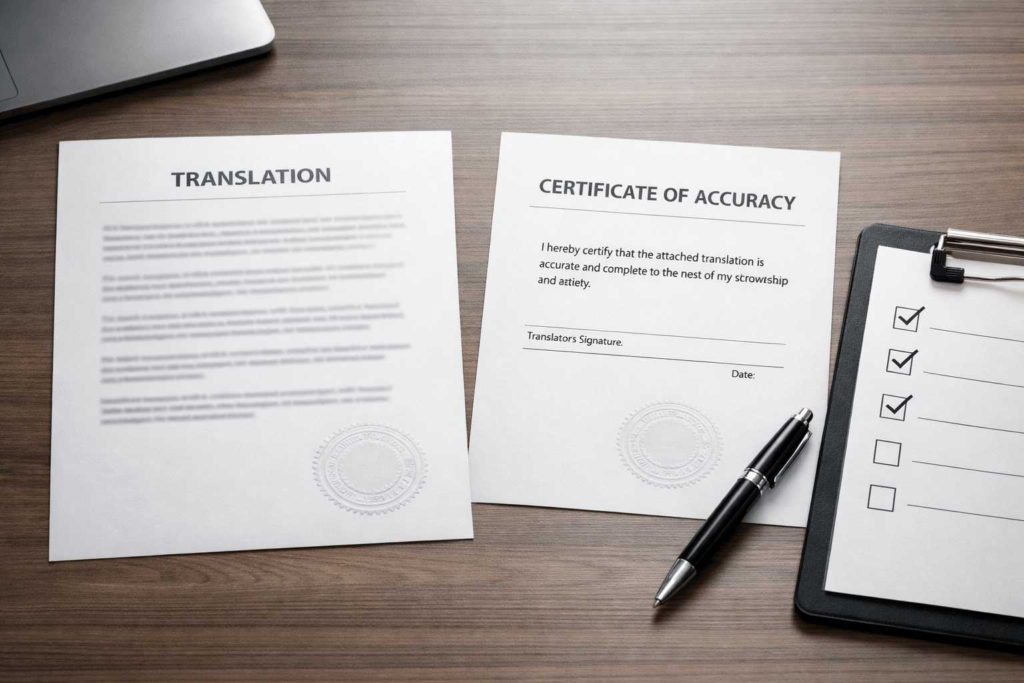
If you’re submitting documents for immigration, court, university, a bank, or a government authority, one question matters more than anything else: how to verify a certified translation before it’s too late.
Because “certified” can mean different things depending on where you’re submitting, a translation can look official and still be rejected. The good news: you can usually spot problems (and confirm legitimacy) in minutes—if you know what to check.
This guide gives you a clear, practical way to verify certified translation: what a real certification looks like, which details must match, what red flags to avoid, and how to confirm a translator’s credentials without guesswork.
Need a quick compliance check? Upload your document, and we’ll confirm the correct certification format for your destination (immigration, court, academic, or corporate).
➡️ Upload your file: /upload/
Quick Answer: How to Verify the Authenticity of a Certified Translation in the UK
If you need the fastest possible answer, verify these six things first:
- It is a full translation, not a summary.
Nothing important should be omitted, including stamps, seals, notes, handwritten annotations, headings, and reference numbers. - It includes a proper certification statement.
The wording should clearly confirm that the translation is true and accurate (or complete and accurate) and that the translator or translation company is taking responsibility for it. - The translator or company is clearly identifiable.
You should be able to see the full name of the translator or company, plus usable contact details. - It is dated and signed.
A certified translation without a date or signature is much more likely to be questioned. - It can be independently verified.
In practice, this means the receiving authority can identify who produced the translation and contact them if needed. - It matches the destination’s rules.
In the UK, a translation is not “more valid” just because it has an impressive-looking stamp. It has to contain the details the receiving authority expects.
For many UK submissions, the safest working rule is this: if the translation does not show a clear statement of accuracy, date, translator full name, signature, and contact details, do not assume it will be accepted.
What “Certified Translation” Actually Means (And Why People Get Confused)
A certified translation is typically a complete translation of a document that includes a signed statement (often called a certificate of accuracy or translator’s certification) confirming:
- the translation is complete and accurate, and
- the translator (or translation company) is competent to translate between the languages
That’s the common core.
Where it gets confusing is that some countries and authorities require extra layers—such as a sworn translator, notarisation, ministry registration, or a stamped affidavit—while others only need a properly worded certification statement.
So when you’re trying to check translation certification, the first step is always:
Step 1: Identify the submitting authority and country requirements
Ask: Where will this translation be submitted?
Examples:
- Immigration (UKVI/Home Office, USCIS, IRCC)
- Courts, solicitors, or police
- Universities / credential evaluation
- Banks, mortgage lenders, corporate compliance
- Embassies / consulates
- Ministries (e.g., Ministry of Justice registers in some countries)
If you’re unsure, the safest move is a format check based on the destination.
➡️ Request a free consultation:/contact/
The 60-Second Test: How to Tell If a Translation Is Certified
Use this quick scan first. A legitimate certified translation will usually include all of the following:
1) A clear certification statement
Look for wording like:
- “I certify that this is a true and accurate translation of the original document…”
- “I am competent to translate from [Language] to [Language]…”
2) Translator or company identity
You should see:
- translator’s full name (or company name)
- contact details (email/phone, address in many cases)
- signature (handwritten or secure digital signature, depending on the destination)
3) Date of certification
A missing date is a common reason documents get questioned.
4) Page integrity
Multi-page documents should be clearly tied together:
- page numbers (“Page 1 of 3”)
- consistent formatting
- no missing sections, stamps, or notes from the original
5) Official stamp or seal (when required)
Some destinations expect a stamp/seal. Others do not. The key is: it must match the requirement, not just “look official”.
If any of these are missing, pause and verify before submitting.
What “Independently Verifiable” Means in Practice
A lot of people ask this because authorities sometimes say a translation must be “independently verifiable” without explaining what that means.
In practical terms, it usually means the translation itself should contain enough information for the receiving organisation to verify who produced it and how to contact them. That normally includes:
- translator name or company name
- signature
- date
- email address and/or phone number
- consistent branding or letterhead where relevant
It does not usually mean the translation needs a QR code, barcode, tracking code, or government serial number.
So if you are trying to check whether a certified translation is genuine, ask this simple question:
Could the receiving authority identify the provider from the translation itself and contact them without guessing?
If the answer is no, the document is more likely to be challenged.
The Legitimate Certified Translation Checklist (Print-Friendly)
Use this as your definitive “yes/no” checklist to verify certified translation legitimacy.
A. Certification & accountability
- The certification statement is present and readable
- Statement confirms complete and accurate translation
- Statement confirms translator competence in both languages
- Statement is signed (and signed name matches printed name)
- Certification date is included
B. Identity & traceability
- Translator/company full name is shown
- Contact details are included (at minimum email or phone; often address too)
- Any membership or credential numbers (if shown) look consistent and verifiable
- If the destination requires a sworn/registered translator, this is stated clearly
C. Document completeness
- Every visible element is translated: stamps, seals, headings, handwritten notes, annotations
- Names, dates, numbers, and reference numbers match the source exactly
- No pages are missing
- Page count and numbering are consistent
D. Format & submission readiness
- Layout is clear and professional (especially for official documents)
- Translator notes are used appropriately (e.g., “[illegible]”, “[stamp]”)
- Output matches the authority’s required format (PDF/hard copy, certification placement, etc.)
Want a second set of eyes?
➡️ Start your project: /get-a-quote/
What a Proper Certification Statement Should Look Like (Examples)
Different authorities have different preferences, but legitimate certificates usually include the same core pieces. Here are safe, commonly accepted formats.
Example 1: General certified translation certificate (common worldwide)
Certificate of Accuracy
I, [Full Name], certify that I am fluent in [Source Language] and [Target Language], and that the attached translation is a true and accurate translation of the original document.
Name: [Full Name]
Signature: ___________________
Date: [DD Month YYYY]
Contact details: [Email / Phone / Address]
Example 2: Immigration-style certificate (often accepted where competence + accuracy are required)
I certify that this translation is complete and accurate, and that I am competent to translate from [Source Language] into [Target Language].
Name: [Full Name]
Signature: ___________________
Date: [DD Month YYYY]
Contact details: [Email / Phone / Address]
Example 3: When a company certifies (agency letterhead)
On company letterhead:
We certify that the translation provided is a true and accurate translation of the original document. The translator assigned is competent to translate from [Source Language] to [Target Language].
Authorised signatory: [Name + Role]
Signature + Date + Contact details
If your translation has vague wording (“looks accurate”, “best effort”, “verified”) instead of a clear certification, treat it as a red flag.
The “Genuine vs Questionable” Table (Fast Spotting)
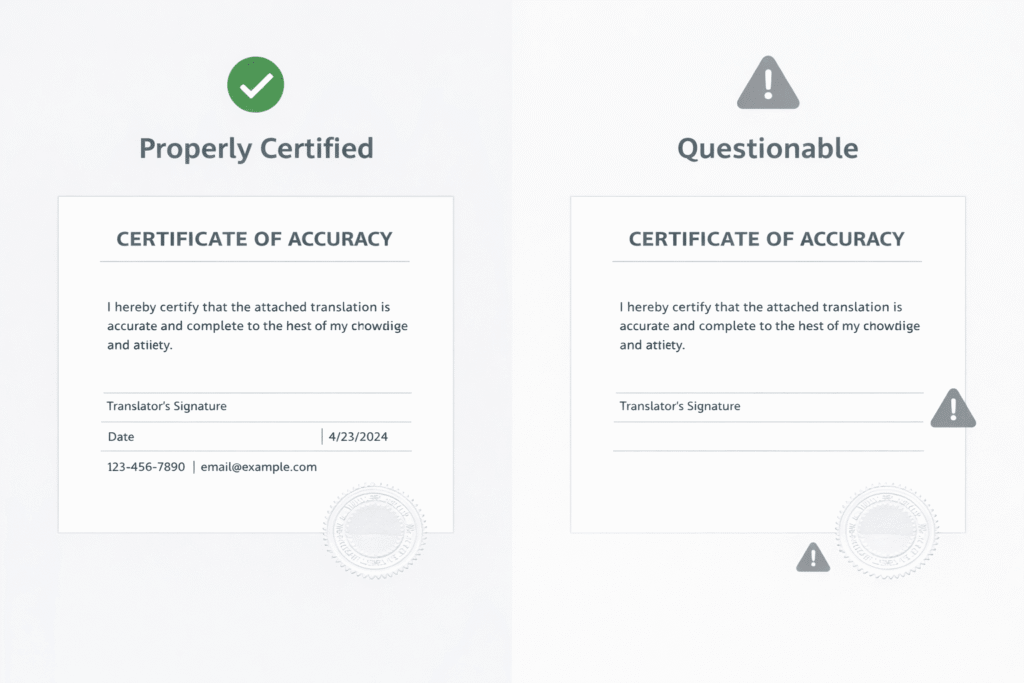
| What you see | Usually legitimate | Usually questionable |
| Certification statement | Clear, specific: accurate + competent | Vague, missing competence or accuracy |
| Identity | Full name + contact details | Only a first name, no contact info |
| Signature | Present and consistent | Missing, typed only, or mismatched name |
| Dates | Date included | No date |
| Completeness | Stamps/notes translated, no gaps | Missing stamps, missing sections, “summarised” |
| Numbers & names | Match source exactly | Spelling differences, changed dates, rounded numbers |
| Format | Page numbering, consistent layout | Pages look stitched together, inconsistent formatting |
How to Verify the Translator or Company (Without Awkward Emails)
If you’re wondering how to tell if translation is certified beyond the page itself, verification is about traceability. Your goal is to confirm: a real person or organisation is accountable for this document.
1) Ask for a verification-ready PDF
A legitimate provider can supply a clean, final PDF that includes:
- the translated document
- the certification statement
- any required stamp/seal
- consistent page numbering
➡️ If you need a reissued verification-ready copy, request it here: /contact/
2) Confirm professional membership (when claimed)
If the certificate references a professional body (e.g., national translator association, chartered institute, recognised translation company membership), check that:
- the name matches the membership listing
- the membership status is active (or at least credible and consistent)
Tip: Membership isn’t always required for a certified translation—but if it’s claimed, it must be verifiable.
3) Validate “sworn/official translator” status when required
In some countries, only sworn/official translators can produce legally valid translations for certain submissions. If your destination requires this:
- confirm the translator is authorised in that jurisdiction
- verify any registration number if shown
4) Verify contact details are real and consistent
Quick checks:
- does the company have a real address and a reachable phone?
- do email domain and branding match?
- does the certificate show a consistent identity (not multiple unrelated names)?
5) Ask the receiving authority what they actually check
Some authorities verify by:
- confirming the certification wording
- checking the translator’s contact details
- requesting the translator’s details on letterhead
- requiring a sworn affidavit or notarisation (in specific cases)
If an authority says “we need it independently verifiable,” that usually means the translator’s identity and contact details must be clear and reachable.
Can You Verify a Certified Translation Online in the UK?
Sometimes yes—but not through one single official government database.
In the UK, there is no universal public register where every certified translation can be checked by document number. Verification is usually done in one of three ways:
- Check the translation itself
Confirm it includes the certification statement, signature, date, full identity details, and contact information. - Check the provider’s public presence
Look for a real website, business identity, matching email domain, phone number, address, and consistent company branding. - Check any claimed professional affiliation
If the translator or company says they belong to a recognised professional body or association, verify that claim through the relevant public directory.
Important: Professional membership can strengthen credibility, but the key issue is whether the translation is properly certified for the authority you are dealing with.
If a provider claims membership, accreditation, sworn status, or official registration and you cannot verify any of it, treat that as a warning sign.
Common Red Flags That Get Certified Translations Rejected
If you see any of the following, don’t submit yet:
- No certification statement (or it’s separated from the translation with no link to the document)
- Missing signature or a signature that doesn’t match the named translator
- No date
- No contact details
- The translator certifies a language they clearly don’t know (e.g., wrong language names, mismatched language pair)
- Partial translation (“key parts only”, “summary translation”, omitted stamps/notes)
- Altered names/dates/numbers (even small changes can trigger rejection)
- Suspicious stamps (generic “CERTIFIED” stamp with no identity behind it)
- No page numbering for multi-page documents
- Inconsistent formatting, suggesting pages were assembled from different files
If you’re on a deadline, the fastest fix is often a compliant re-translation with correct certification.
➡️ Get a quote:/get-a-quote/
Country and Authority Quick Checks (Because Requirements Vary)
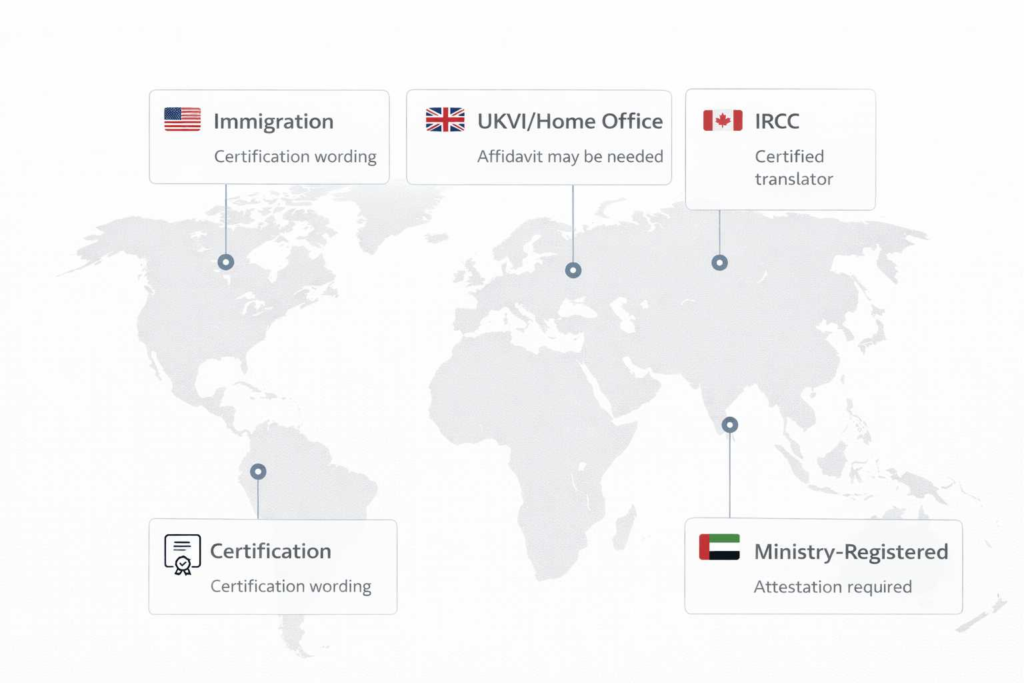
Use this section when you’re verifying a translation for a specific destination.
United States (Immigration and USCIS-style submissions)
Typically expects:
- full English translation
- certification confirming completeness/accuracy + translator competence
Notarisation is usually not required unless specifically requested by another body.
United Kingdom (Home Office / UKVI-style submissions)
Typically expects the translation to include:
- confirmation it’s a true and accurate translation
- date of translation
- translator’s full name and signature
- translator contact details
Some cases also expect the translator’s credentials (or the company’s) to be clearly stated.
Canada (Immigration-style submissions)
Often expects:
- English or French translation
- if not completed by a certified translator, an affidavit may be required (varies by situation)
UAE and other Ministry-registered jurisdictions
Often requires:
- translator/company approved by the relevant ministry
- official stamp and registration details
- strict formatting expectations
Key point: A translation can be “certified” in one country’s sense and still be unacceptable in another. Verifying legitimacy includes verifying fit for purpose.
If You Need to Confirm Legitimacy With Confidence: The 7-Step Verification Flow
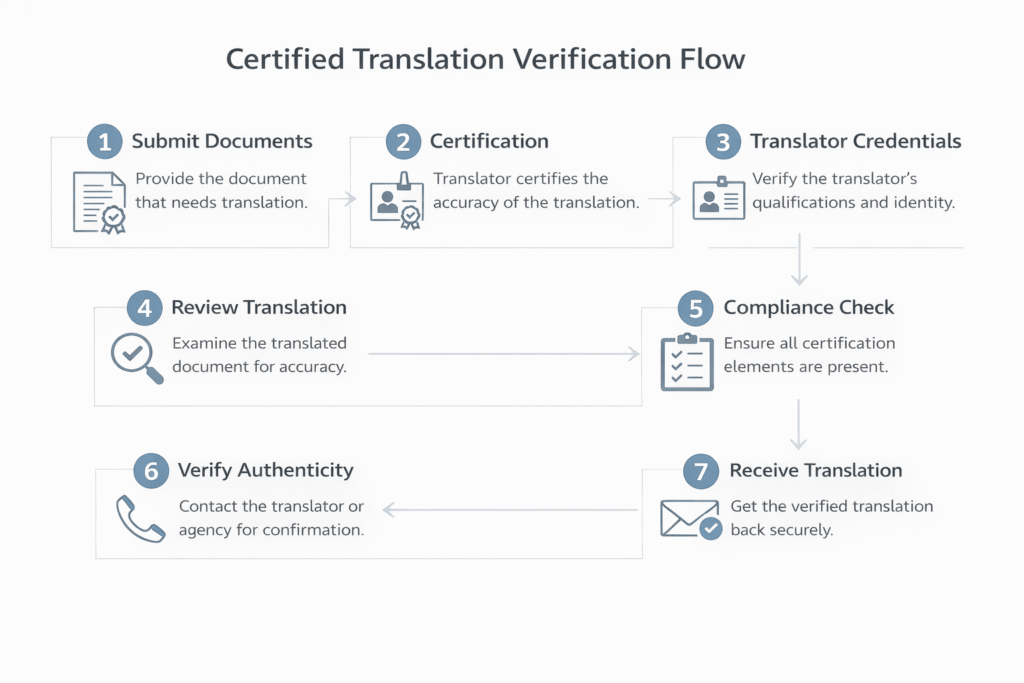
Use this step-by-step process when the stakes are high (immigration deadlines, court filings, credential evaluations).
- Confirm destination requirements (authority + country)
- Check the certificate wording (accurate + competent)
- Confirm identity details (name, signature, date, contact info)
- Check completeness (stamps, seals, notes, all pages)
- Cross-check names/dates/numbers against the original
- Confirm the provider’s credibility (membership claims, address, reachable contact)
- Match delivery format (PDF/hard copy, certification placement, any additional steps like notarisation)
If you’d like us to run this check for your documents, we’ll confirm the correct certification format and reissue if needed.
➡️ Upload your file:/upload/
Real-World “What Went Wrong” Examples (And How to Avoid Them)
Example 1: “It looked certified, but the date was missing.”
A client submitted a translation with a signature and stamp, but no certification date. The receiving office requested a reissued certificate.
Fix: Reissue the certification with a date and consistent page numbering.
Example 2: “The translation skipped stamps and handwritten notes.”
The main text was translated, but the original document’s stamp and handwritten note were omitted. The authority treated it as incomplete.
Fix: Translate all visible elements and add clear translator notes where needed.
Example 3: “The provider claimed accreditation, but it wasn’t verifiable.”
A certificate listed an impressive credential, but the translator’s name didn’t match any listing, and the certificate lacked contact details.
Fix: Use a provider whose identity is clear and verifiable, and ensure the certificate contains traceable details.
A Simple Way to Protect Yourself Before You Pay
If you’re hiring a translator or agency, ask these three questions upfront:
- “Can you confirm the certification format for my destination authority?”
- “Will the translation include a signed certification with your full contact details?”
- “Will you translate stamps, seals, handwritten notes, and all pages—no omissions?”
A legitimate provider will answer clearly and in writing.
Ready to get it done the first time properly?
➡️ Start your project: /get-a-quote/
FAQs
How do I verify a certified translation is legitimate?
Check for a clear certification statement, the translator’s full name and contact details, a signature, a date, and a complete translation (including stamps and notes). Then confirm the format matches your destination authority.
What should a certified translation include?
A certified translation usually includes the full translation plus a signed certificate stating it is complete and accurate and that the translator is competent in both languages. Many authorities also expect the date and contact details.
How to tell if a translation is certified if it has a stamp?
A stamp alone doesn’t prove certification. Look for the certification statement, signature, date, and traceable identity details. A stamp helps only when it matches the authority’s requirements and is linked to a real translator or company.
Can I check the translation certification with the receiving authority?
Sometimes. Many authorities verify by checking the certification wording and whether the translator/company can be independently contacted. If in doubt, ask what they require on the certification statement.
What are the biggest red flags in certified translation verification?
Missing certification statement, no signature or date, no contact details, incomplete translation (omitted stamps/notes), and inconsistencies in names/dates/numbers compared with the original.
Do I need notarisation to verify a certified translation?
Not always. Notarisation usually verifies the signer’s identity, not the translation’s accuracy. Some destinations require notarisation or an affidavit, but many accept a proper certification statement alone.
How can I verify the authenticity of a certified translation in the UK?
Check that it is a full translation and that it includes a proper certification statement, the translator or company’s full name, signature, date, and contact details. Then make sure the document can be independently verified and that the format matches the authority you are submitting to.
Is there an official UK database to check certified translations online?
No single universal database covers every certified translation in the UK. In most cases, verification is done by reviewing the certification details on the document, checking the provider’s public business identity, and confirming any claimed professional membership through the relevant directory.
What does “independently verifiable” mean on a certified translation?
It means the receiving authority should be able to identify who produced the translation and contact them if needed. In practice, that usually requires a clear name, signature, date, and contact details on the certified translation.
Is a stamp enough to prove a translation is genuine?
No. A stamp on its own is not enough. A certified translation should also include the certification wording, date, signature, and traceable identity details. A stamp helps only when it supports a properly certified document.
Does notarisation prove a translation is accurate?
Not usually. Notarisation commonly verifies the identity of the person signing the certification, not the linguistic accuracy of the translation itself. Whether notarisation is needed depends on the destination authority.
Can a translation company certify a translation, or does it have to be an individual translator?
A translation company can certify a translation if the certification is properly presented and the provider takes responsibility for the document. What matters is that the certification is clear, traceable, and acceptable to the receiving authority.
Do UK authorities require a sworn translator?
Usually no. The UK does not have a domestic sworn translator system in the same way some civil-law countries do. UK authorities typically look for a properly certified translation rather than a “sworn” one.