What a certified translation actually means
A certified translation is not just a translated document. It is a translated document plus a signed certification statement confirming the translation is complete and accurate and that the translator is competent for the language pair.
That is what makes it suitable for official use in many situations, including:
- Immigration applications
- Court and legal filings
- Academic admissions and credential evaluations
- Employment and licensing
- Banking and compliance checks
- Medical or insurance submissions
In the UK, this commonly includes submissions for the Home Office, universities, qualification recognition services, courts, employers, banks, insurers, and professional bodies. Different organisations can ask for slightly different formats, so it is always best to match the translation package to the submission requirement.
What a certified translation is not
A lot of confusion comes from terms that sound similar. Here is the quick distinction:
- Certified translation = translation + certification statement
- Notarised translation = certified translation where a notary verifies the signature (only when requested)
- Sworn translation = a jurisdiction-specific legal format used in some countries by authorised/sworn translators
If you are unsure which one you need, always check the receiving organisation first. The destination (USCIS, court, university, embassy, employer, etc.) decides the requirement.
UK-Specific Point That Causes Confusion
In the UK, the usual official format is a certified translation, not a sworn translation. The UK does not operate a general sworn-translator system in the way some other countries do. That is why a UK authority will usually ask for a certified translation, while a foreign authority may ask for a sworn translation completed by a translator authorised in that country.
Who Can Certify a Translation in the UK
In the UK, there is no single government-issued title called “official translator.” In practice, a certified translation is usually prepared by a qualified professional translator or by a reputable translation company that can identify who completed the work and stand behind the certification statement.
What matters most is that the translation is complete, accurate, and capable of being independently verified by the receiving authority if needed. That is why clients usually choose a provider with experience in official-document translation and a clear certification process, instead of relying on an informal bilingual contact or an unverified online translation.
What UK Authorities Usually Expect to See on a Certified Translation
If a document is being submitted in the UK and it is not in English or Welsh, the receiving authority will usually expect a full translation rather than a summary. In many cases, the certified translation should include:
- A statement confirming that the translation is true and accurate
- The date of translation or certification
- The full name of the translator, or the responsible representative of the translation company
- A signature where required
- Contact details for the translator or translation company
- A complete translation of the visible content, including stamps, seals, notes, and handwritten elements if legible
This is one of the most important parts of the whole process. Even when the translation itself is accurate, missing certificate details can still cause delays, follow-up questions, or rejection. In the UK, this commonly applies to submissions for the Home Office, universities, qualification recognition services, courts, employers, banks, insurers, and other organisations handling official records.
How certified translation works step by step
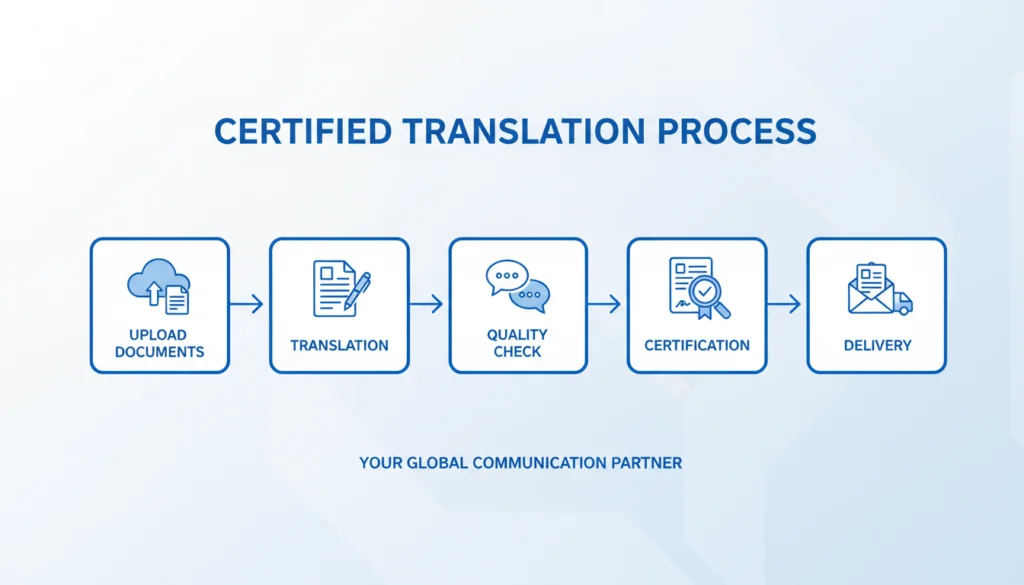
Below is the full process from upload to delivery, explained in plain language.
1) Upload your document
The process starts when you send a scan or a clear photo of the document. You usually do not need to post the original document to begin. In most cases, a readable digital copy is enough for quoting and translation.
What to upload for a faster start
- Full page images (no cropped edges)
- Front and back (if there is any text, stamp, or note on the reverse)
- Clear photos with no shadows or glare
- All pages in the correct order
- Any instructions from the authority requesting the translation
Practical tip: If the document has seals, stamps, handwritten notes, or marginal notes, make sure they are visible. These are often the details that get missed in weak translations and later cause questions.
2) Quote and turnaround confirmation
Once your file is reviewed, you receive a quote and delivery estimate. A proper quote is usually based on:
- Language pair
- Number of pages/word count
- Document complexity
- Image quality (clear vs difficult scan)
- Deadline (standard vs urgent)
This is also the stage where the provider should confirm:
- Whether certified translation is enough
- Whether notarisation is needed
- Whether hard copies are required
- Whether the formatting needs to mirror the original closely
What to expect from a good quote
A good quote should be clear, not vague. It should tell you:
- Price
- Turnaround time
- Delivery format (PDF, hard copy, both)
- Any add-ons (notarisation, postage, apostille support)
- Anything missing from your upload
If something is unreadable, a strong provider tells you before work starts, not after delivery.
3) File check and project setup
Before translation begins, the project is prepared properly. This stage is often invisible to the client, but it matters a lot. It is where mistakes are prevented.
What happens in project setup
- Pages are checked for completeness
- Document type is identified (birth certificate, court order, diploma, etc.)
- Names and date formats are noted
- Special elements are flagged (stamps, seals, signatures, handwriting)
- Submission context is noted (USCIS, court, university, employer, etc.)
This is where a professional team reduces risk. The translation itself is important, but the setup determines whether the final package will be submission-ready.
4) Translator assignment
The file is assigned to a qualified translator for the language pair and document type. This matters because certified translation is not just about language fluency. The translator also needs to understand official-document conventions, formatting, and terminology.
For example:
- A birth certificate translation requires exact handling of fields, seals, and registry notes
- A court document requires precise legal terminology
- A transcript or diploma needs consistent academic terminology
- A medical file needs accurate terminology and legible labelling
A reliable process matches the translator to the document, instead of treating every file the same way.
5) Translation and formatting
This is the main production stage. The translator prepares the English version (or other target language if required), keeping the content complete and faithful to the source document.
What “complete” really means
A complete certified translation should include more than the main body text. It should also account for visible elements such as:
- Stamps
- Seals
- Headings
- Signatures (labelled)
- Handwritten notes (if legible)
- Annotations
- Official marks and numbers
It should also be formatted so the reviewer can compare it with the original easily.
Good formatting makes acceptance easier
A well-formatted translation helps the receiving officer, caseworker, or administrator review it quickly. That usually means:
- Clear headings
- Logical field-by-field layout
- Labels for stamps/seals/signatures
- Readable spacing
- Consistent names and date styles
Quick insight: Many delays are not caused by “wrong translation” in the dramatic sense. They are caused by avoidable issues like missing page backs, inconsistent name spellings, or poorly labelled stamps.
6) Quality check and review
This is the stage that separates a basic translation from a professional certified translation process. Before certification is added, the file should be reviewed for accuracy, completeness, and usability.
A strong review checklist usually covers
- Names (spelling and order)
- Dates and date format consistency
- Document numbers and reference IDs
- Issuing authority names
- Missing lines, notes, or stamps
- Terminology consistency
- Formatting clarity
- Legibility of the final output
If anything is unclear in the source file, this is the point where the client should be contacted for a better image or clarification.
7) Certification statement preparation
After the translation passes review, the certification statement is prepared and signed. This is the part that makes the translation “certified” for official use.
A proper certification statement typically confirms:
- The translation is complete and accurate
- The translator is competent to translate the document
- The relevant language pair
- Date of certification
- Signature (and contact details, where required)
When notarisation is added
Not every certified translation needs notarisation. Notarisation is an extra authentication step and is only required when the receiving authority specifically asks for it. If the requirement is unclear, confirm it before paying for add-ons.
8) Delivery (PDF and, if needed, hard copies)
Once everything is complete, the final package is delivered. In many cases, delivery includes a professional PDF containing:
- The translated document
- The certification statement
- Signature/date
- Clear file naming for easy submission
If you need paper copies, notarisation, or courier delivery, those are arranged at this stage.
Final delivery checklist
Before you submit, make sure you have:
- The complete translated document
- The certification statement attached
- The correct file format (usually PDF)
- Any required hard copy (if requested by the authority)
- Any required notarisation (only if explicitly requested)
Can a Certified Translation Be Digital or Does It Need to Be Printed?
Many certified translations are now delivered and submitted as PDFs, and many organisations accept digital copies. However, acceptance still depends on the authority receiving the document.
Some submissions are straightforward with a digital file, while others may still require a printed hard copy, a wet-ink signature, notarisation, or a couriered set. If the document is for court, probate, powers of attorney, or another sensitive legal process, it is always worth confirming the required format before ordering.
A simple rule is this: if the authority has not asked for a hard copy, a professional PDF is often enough to start the process. If they have asked for a physical original, build that into the order from the beginning so there is no delay later.
What affects turnaround time
One of the biggest questions in “what to expect from certified translation” is timing. Turnaround depends on more than page count. The biggest factors are:
- Document length (single-page certificate vs multi-page legal file)
- Language pair (common vs rare languages)
- Document complexity (simple form fields vs dense legal/medical text)
- Scan quality (clear scan vs blurred phone photo)
- Urgency (standard vs same-day/rush)
- Add-ons (notarisation, hard copy delivery, courier)
Typical timeline expectations
- Simple personal documents: often faster
- Multi-page legal/technical documents: longer review and QA cycle
- Urgent requests: possible, but only if the source file is clear and complete
If you are on a deadline, send the document early and include the submission date in your first message. That helps the team plan properly and avoid last-minute issues.
Common mistakes that cause delays or rejections
If you want the fastest route from upload to delivery, avoid these:
1) Cropped or blurry uploads
A translation can only be as accurate as the file provided.
2) Missing pages (especially the back side)
Back-page notes, stamps, and registry entries are often required.
3) Name mismatch across documents
If your passport spelling differs from another record, flag your preferred spelling at the start.
4) Assuming notarisation is always required
It is not. Confirm before adding cost and time.
5) Sending documents one by one
If you submit all required documents together, terminology and names can be standardised across the full package.
6) Waiting until the last day
Rush requests are possible, but clear scans and early submission always improve outcomes.
What a “submission-ready” certified translation package looks like
A strong certified translation process does not stop at translation. It ends with a package that is easy for the receiving authority to review. A submission-ready package should be:
- Complete (all visible content translated)
- Accurate (names, dates, numbers, terminology)
- Clearly formatted (easy to compare with source)
- Properly certified (signed statement included)
- Delivered in the right format (usually PDF, plus hard copy if needed)
This is the difference between “translated” and “ready to submit.”
A smarter way to order certified translation the first time
If you want the process to go smoothly, send these five things in your first message:
- The document(s)
- The target language
- Where you are submitting it (USCIS, court, university, employer, etc.)
- Your deadline
- Whether you need digital copies only or printed copies too
That simple message usually cuts back and forth and gets you a clear quote faster.
From upload to delivery: what you should expect from Urgent Certified Translation
When you order from a professional provider, the experience should feel clear from the start:
- You upload your file
- You get a clear quote and turnaround
- The document is translated and reviewed
- A proper certification statement is added
- You receive a clean, submission-ready final file
If you are working to a deadline or you are not sure whether you need certified, notarised, or sworn translation, the safest next step is to send the file and the submission requirement together so the correct format can be confirmed before work begins.
If you want to get started now, upload your document and request a quote with your deadline. If you have a complex case (multiple documents, court filing, or urgent submission), request a free consultation so the process is set up correctly from day one.
FAQs
How does certified translation work if I only have a phone photo?
Certified translation can usually start from a phone photo as long as the image is clear, complete, and readable. Make sure all corners are visible, and there is no glare, shadow, or blur over names, dates, stamps, or handwritten notes.
What should I expect from certified translation after I upload my file?
You should expect a file review, a clear quote, a confirmed turnaround time, translation and quality checking, a signed certification statement, and final delivery as a professional PDF (plus hard copies if requested).
Does the certified translation process explained here include notarisation?
Not automatically. Notarisation is a separate step and is only added when the receiving organisation specifically asks for it. Many certified translations are accepted without notarisation.
How long does the translation process, step by step, usually take?
It depends on the language pair, page count, complexity, scan quality, and deadline. Simple personal documents are often completed faster than multi-page legal or technical files. Urgent options may be available if the files are clear and complete.
Can I upload multiple documents in one order?
Yes, and it is often better to do so. Sending all required documents together helps keep names, dates, and terminology consistent across your full application or submission.
What if I do not know whether I need a certified, notarised, or sworn translation?
Send the document and the authority’s requirement (or screenshot of the instruction) when you request a quote. The correct format can be confirmed before work starts, which saves time and prevents unnecessary add-ons.
Who can certify a translation in the UK?
In the UK, certified translations are usually prepared and certified by a qualified professional translator or by a translation company. What matters is that the certification clearly identifies who is responsible for the translation and provides the details needed for the receiving authority to verify it if necessary.
What must a certified translation include in the UK?
A UK-ready certified translation normally includes the full translation, a certification statement confirming accuracy, the date, the name and signature of the translator or company representative where required, and contact details.
Can I translate my own documents and certify them myself?
Do not assume self-translation will be accepted for official use. Many authorities want the translation to be independently verifiable, which is why a professionally certified translation is usually the safer option.
Is there a sworn translator system in the UK?
Usually, no. In the UK, the standard format for official submissions is a certified translation. Sworn translation is a different legal framework used in some other countries.
Will a PDF-certified translation be accepted?
Often yes, but it depends on the authority. Many organisations accept digitally certified translations, while others still want a printed hard copy or additional formalities. Always check the submission requirements first.