The short answer
In general, a foreign marriage can be recognized in the United States when:
- The marriage was legally performed under the laws of the country where it took place.
- You can provide an official foreign marriage certificate (or a certified copy).
- The document is translated into English if required by the agency.
- You meet any additional rules of the agency or state where you are submitting it.
That is the core framework behind most foreign marriage legal recognition questions.
How can I verify if my foreign marriage is legally recognised in the USA?
If you want a practical answer before you submit anything, verify your case in this order:
- Confirm the marriage was legally valid in the country where it took place.
- Get the official civil marriage certificate, or a certified copy from the correct issuing authority.
- Check that the certificate is complete, readable, and consistent with your passports, IDs, and any prior marriage records.
- Get a full English translation if the document is not in English.
- Ask the U.S. office handling your case whether they require anything extra, such as a certified copy, apostille, authentication, proof that earlier marriages ended, or supporting identity documents.
- If your question is about state-level use, ask the relevant state office for its checklist before you file.
In practice, this is how most people verify recognition. You are usually not asking one national office to “approve” the marriage. You are proving the marriage to the specific U.S. agency, court, or state office that needs to rely on it.
If your use is state-specific, such as a name change, DMV update, or court filing, get the document checklist in writing before you submit. That one step often prevents avoidable rejections.
What “recognised” actually means in the U.S.
A lot of people search for “how to validate foreign marriage in USA” when what they really need is one of these:
- Immigration recognition (USCIS, consular processing, green card cases)
- State-level use (name change, DMV, court filings, benefits)
- Federal/administrative use (Social Security, tax, insurance, employer records)
- Proof for banks, schools, or legal matters
There is no single federal office where you “register” every foreign marriage in the U.S. Instead, you usually prove the marriage to the agency that needs to see it.
A simple way to think about it
Use this four-part checklist:
- Validity – Was the marriage legal where it happened?
- Evidence – Do you have the correct marriage certificate?
- Translation – Is it fully translated into English when required?
- Acceptance – Does the receiving agency need anything extra (apostille, notarisation, certified copy, identity documents)?
This is the fastest way to avoid confusion between “recognition” and “paperwork acceptance”.
Do you need to register a foreign marriage in the U.S.?
In most cases, no. The United States does not usually require a separate nationwide registration step for a marriage that was legally performed abroad. Instead, recognition is usually handled when you present the foreign marriage certificate to the office that needs it, such as USCIS, a state agency, Social Security, a court, an employer, or another receiving office.
That means the real question is usually not: “Do I need to register my marriage in the U.S.?” It is: “Do I have the right certificate, translation, and supporting documents for the office reviewing my case?” That distinction is worth making clearly because many people assume there is a single approval step when there usually is not.
When a foreign marriage is usually accepted in the U.S.
Most U.S. agencies and institutions start with the same practical question: Was the marriage legally valid in the place it was celebrated? If the answer is yes, your next job is proving it with the right documents.
Situations that often go smoothly
A foreign marriage certificate is generally easier to use when:
- It was issued by a recognised civil authority
- Names and dates are clear and consistent
- The certificate is complete (not cropped or partially scanned)
- The document is in good condition and readable
- You provide a proper English translation if needed
Situations that often cause extra checks
Even if a marriage was valid abroad, extra scrutiny can happen when:
- One or both spouses were not physically present at the ceremony
- The document is handwritten, faded, or hard to read
- The country issues multiple versions of marriage records
- There are differences in name spellings across passports, IDs, and certificates
- The receiving agency has state-specific or case-specific requirements
This is where people lose time — not because the marriage is invalid, but because the evidence package is weak.
When a foreign marriage may need deeper legal review
Some cases need more than routine document preparation. Extra care is sensible when:
- The marriage was by proxy or online/virtual
- The only record you have is a religious or ceremonial document, but the country normally issues a civil marriage certificate
- Either spouse had a previous marriage that may not have been fully terminated
- The marriage could conflict with state law or public policy
- There are unusual facts around age, consent, coercion, or identity
In higher-risk cases, do not assume a translation alone will solve the problem. Confirm the receiving office’s requirements in writing before filing, and where necessary get case-specific legal advice.
Step-by-step: How to validate a foreign marriage in the USA
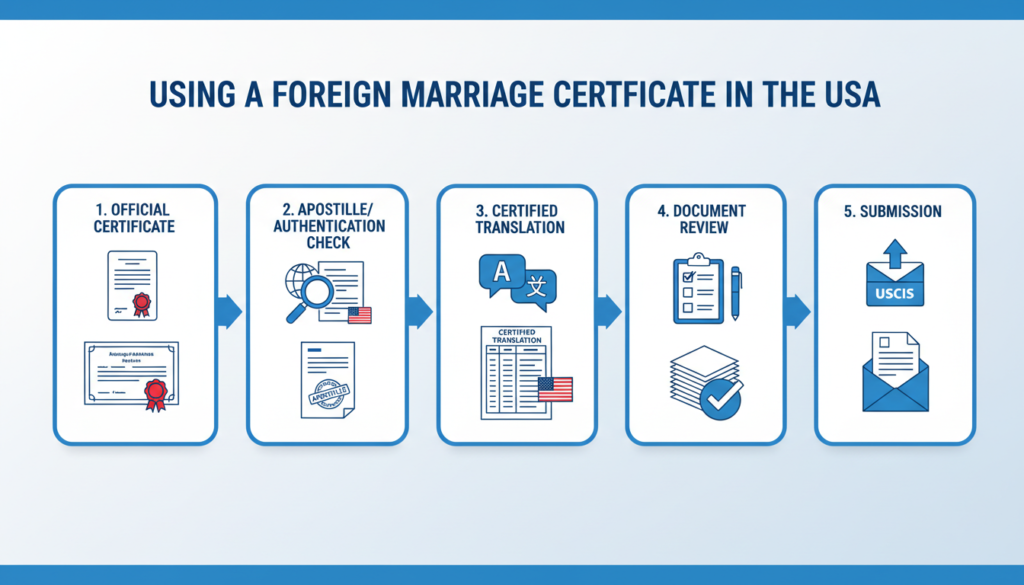
1) Get the correct foreign marriage certificate
Start with the official marriage record issued by the relevant authority in the country where the marriage took place. This matters because many people submit:
- A ceremonial certificate
- A church/mosque/temple certificate
- A wedding invitation
- A translated summary
- A scanned photo of an unofficial copy
Those documents may be useful in some cases, but they are often not enough on their own.
What to request
Ask for the version that is:
- Officially issued by the civil registry or authorised government office
- A certified copy (if the original is not available)
- Complete and legible
- The most recent version if multiple formats exist
If you are unsure which version is correct, get the document reviewed before you submit anything.
How to confirm you have the right version for U.S. use
If your country issues multiple marriage records, do not guess. For U.S. immigration and consular use, the safest approach is to confirm which authority issues the accepted marriage certificate and whether certified copies are available. If there are different formats, extracts, registry books, court copies, or religious certificates, check which one is treated as the official civil record for U.S. purposes before you order or translate the wrong document.
This directly answers a very common question: “How do I know if I have the correct marriage certificate?”
2) Check whether you need an apostille or authentication
This step is often misunderstood. You do not always need an apostille just because the document is foreign. You may need one when the receiving agency specifically asks for proof that the foreign public document is officially authenticated for cross-border use.
Quick rule of thumb
Apostille is usually used when the document will be used between countries that are part of the Hague Apostille system. Authentication/legalisation may be required instead when the country is not in that system. If you are submitting a foreign marriage certificate in the U.S., ask the receiving agency exactly what they require before paying for extra legalisation work. In many immigration and administrative cases, the agency may only need the certificate plus a compliant English translation.
3) Translate the marriage certificate for U.S. use
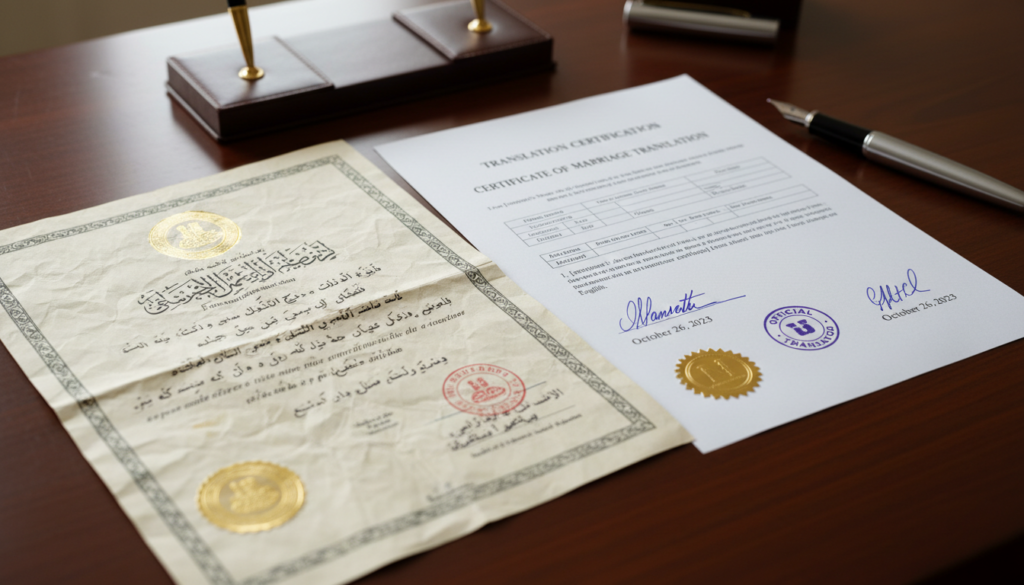
If your marriage certificate is not in English, you will usually need a full English translation for U.S. immigration and many official uses. This is the step people mean when they search “translate marriage certificate for US”.
What a submission-ready translation should include
A strong translation package should include:
- A full translation of the document (not a summary)
- Names, dates, places, document numbers, and notes translated clearly
- Stamps, seals, signatures, and annotations labelled where visible
- A signed certificate stating the translation is complete and accurate
- A statement confirming translator competence
What to avoid
Do not submit:
- Partial translations
- AI-only output with no human certification
- A translation with missing seals or handwritten notes
- A translation that changes name order or date format without care
- A low-quality scan that makes the translation unreliable
If you need a proper certified translation with clear formatting and a signed certificate, start your project here.
4) Match names and dates before you submit
A very common issue in foreign marriage recognition USA cases is inconsistency across documents. For example:
- Passport says Mohamed
- Marriage certificate says Muhammad
- Birth certificate says Mohamad
That does not always cause rejection, but it can trigger questions.
Before submitting, check:
- Spelling of both spouses’ names
- Date of marriage
- Place of marriage
- Passport numbers (if shown)
- Previous surnames / maiden names
- Transliteration differences
If there is a mismatch, do not hide it. Prepare a clear explanation and supporting documents where needed.
5) Submit to the right U.S. agency with the right supporting documents
Your marriage is not “validated” the same way everywhere. The required package depends on where you are submitting.
Common use cases
Immigration (USCIS / visa process)
Usually requires:
- Foreign marriage certificate
- Full English translation
- Supporting identity and relationship evidence (depending on the case)
Social Security / benefits
May require:
- Marriage certificate
- Translation
- Identity documents
- Additional proof depending on status and the state/legal context
State-level use (name change, records, court filings)
May require:
- Certified copy
- Translation
- Apostille/authentication (sometimes)
- Local filing forms
Employer, insurance, banking, or school records
Often require:
- Marriage certificate
- English translation
- Sometimes a notarised copy, depending on internal policy
If you are not sure what your receiving office needs, ask them for a checklist in writing before submitting.
The most common reasons foreign marriage documents get delayed
Even valid marriages can run into paperwork delays. Here are the most common causes:
1) Wrong document type
People submit a commemorative certificate instead of the official civil record.
2) Incomplete translation
A seal, stamp, margin note, or handwritten entry is skipped.
3) Poor scan quality
Blurred text, cut-off edges, shadows, or folded pages make the record unusable.
4) Name inconsistencies
Different spellings appear across passport, visa records, and marriage certificate.
5) Extra legalisation done too early
People pay for apostille/notarisation before confirming whether the receiving agency actually requires it.
6) No document review before submission
A quick check by an experienced team often catches issues that cost weeks later.
A smarter approach: build a “submission-ready” package first
Instead of treating translation as a standalone task, prepare your document set as one package.
Submission-ready package checklist
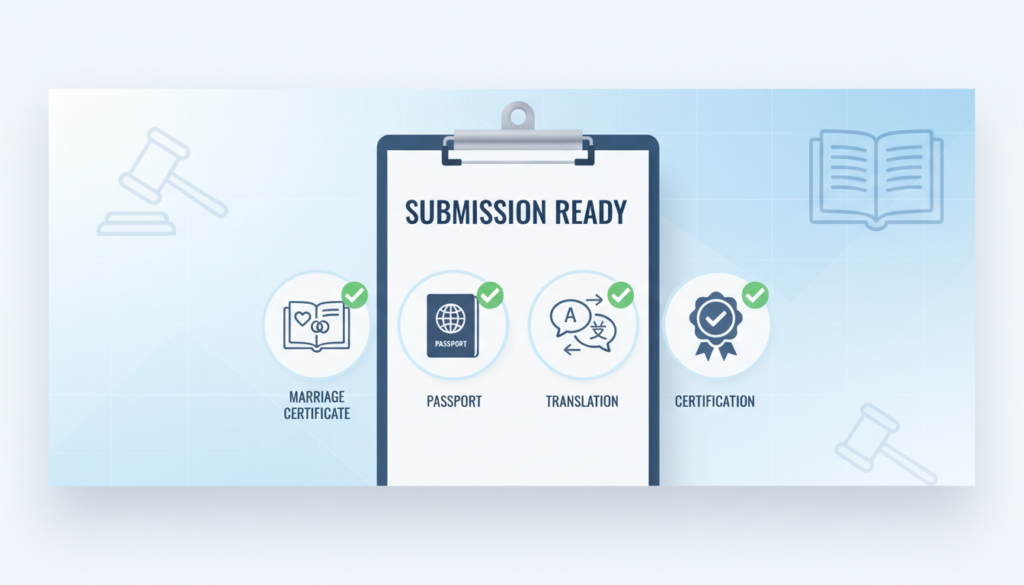
- Clear scan of the full marriage certificate (all pages)
- Certified copy if the original is not available
- Full English translation
- Signed translation certification
- ID copies (if your agency requests them)
- Supporting relationship records (if required for your case)
- Apostille/authentication only if specifically required
- File names organised clearly (for online uploads)
This is exactly where a specialist translation service helps most: not just translating words, but reducing submission risk. Keep the original marriage certificate or a certified copy available even if you submit scans first. Some offices may ask to inspect the original later.
Example scenarios
Example 1: Marriage abroad for a U.S. immigration filing
A couple married outside the U.S. and needed to file a family-based immigration case. The marriage certificate was valid, but the scan was of low quality, and the certificate had handwritten notes and stamps.
What fixed the issue:
- New high-resolution scan
- Full English translation
- Clear labelling of seals and handwritten entries
- Consistent name formatting across documents
Result: the case package was easier for the officer to review, with fewer chances of follow-up requests.
Example 2: Name change and benefits update in the U.S.
A spouse needed to update records after a marriage abroad. The main problem was not the marriage itself — it was the mismatched spellings between the passport and the translated certificate.
What fixed the issue:
- Clean re-translation using the passport-preferred spelling consistently
- Supporting ID included in the submission set
- Short written note explaining transliteration differences
Result: smoother processing and less back-and-forth.
Example 3: Foreign marriage certificate for court or legal use
A family needed a marriage record for a legal matter in the U.S. They assumed a simple translated copy would be enough, but the receiving office requested a specific level of authentication.
What fixed the issue:
- Confirming requirements with the receiving office first
- Getting the correct certified copy
- Completing translation and then the required authentication step in the right order
Result: no repeated submissions and no duplicate fees.
Foreign marriage legal recognition vs. document acceptance
This is the key distinction most blogs miss. A marriage can be legally valid, but the document can still be rejected for administrative reasons. That is why the best question is not only: “Is my marriage recognised?” It is also: “Is my document package ready for the agency that needs it?” That one shift saves people time, money, and stress.
Why do people use a specialist translation service for marriage documents
Marriage certificates look simple, but they often contain details that matter a lot:
- Marginal notes
- Registry references
- Stamps and seals
- Multiple surnames
- Old spellings
- Handwritten fields
- Local terminology that does not translate literally
A general translator may translate the words. A specialist service prepares the document for real-world submission. At Urgent Certified Translation, the certified translation workflow is built around document acceptance — with full translations, clear formatting, and a signed Certificate of Translation Accuracy for official use.
If you want your marriage certificate checked before submission, upload your file and request a review.
What to do next
If you need to use a foreign marriage certificate in the U.S., do this first:
- Confirm which agency you are submitting to
- Confirm whether they need translation only or translation plus authentication
- Get the correct certificate version
- Prepare a clean, certified English translation
- Submit a complete, organised package
If you want help with the translation step, start your project with Urgent Certified Translation and include your deadline so the team can confirm turnaround.
FAQst
Is a foreign marriage automatically recognised in the USA?
Often yes, if it was legally valid where it took place. The issue is usually proving it properly with the correct foreign marriage certificate and any required translation or authentication.
How do I validate a foreign marriage in the USA for immigration?
For most immigration cases, you usually need the official marriage certificate plus a full English translation if the original is not in English. You may also need supporting identity or relationship documents, depending on the filing type.
Do I need to translate my marriage certificate for U.S. use?
If the marriage certificate is not in English, yes, in many official situations, especially immigration-related submissions. The translation should be complete, accurate, and include a signed certification.
Is notarisation required for a marriage certificate translation in the U.S.?
Not always. Many agencies accept a certified translation without notarisation. Notarisation is usually only needed when the receiving office explicitly asks for it.
What is the difference between an apostille and authentication for a foreign marriage certificate?
An apostille is typically used for countries in the Hague Apostille system. Authentication (sometimes called legalisation) is used for countries outside that system. Always confirm with the receiving agency before paying for either one.
Can a proxy marriage be recognised for U.S. immigration purposes?
Proxy marriages can trigger extra immigration rules. If one or both spouses were not physically present at the ceremony, the case may require additional proof and should be reviewed carefully before filing.
How can I verify if my foreign marriage is legally recognised in the USA?
The safest way is to verify four things: that the marriage was legally valid where it took place, that you have the correct official marriage certificate, that the document is translated properly if needed, and that the U.S. office using it does not require extra supporting documents. In practice, recognition is usually checked by the agency or state office reviewing your paperwork, not by a single national registry.
Do I need to register my foreign marriage in the United States?
Usually no. In most cases, you do not separately register the marriage nationwide. You prove the marriage when you submit the foreign marriage certificate to the agency, court, or state office that needs it.
Who should I contact to check if my state will accept my foreign marriage?
If your issue is state-level, such as a name change, court filing, or local records update, contact the office handling your case and ask for a written document checklist before submitting. For state-law questions, it is also sensible to check with the relevant state authority before filing anything.
Will a religious marriage certificate be enough for U.S. use?
Sometimes, but not always. If the country where you married normally issues an official civil marriage certificate, that civil record is usually the safer document to use. A religious or ceremonial certificate may not be enough on its own.
Do I need an apostille for a foreign marriage certificate in the USA?
Not always. Many people assume apostille is automatic, but it depends on the receiving office and the purpose of the submission. Ask first, because in many cases the office may only require the official certificate and a proper English translation.
Can an online or virtual marriage be recognised in the U.S.?
It can require extra review. These cases should be checked carefully because some U.S. immigration uses apply special rules to proxy or virtual marriages. If your ceremony was online, remote, or conducted without both spouses physically present, confirm the exact requirements before filing.