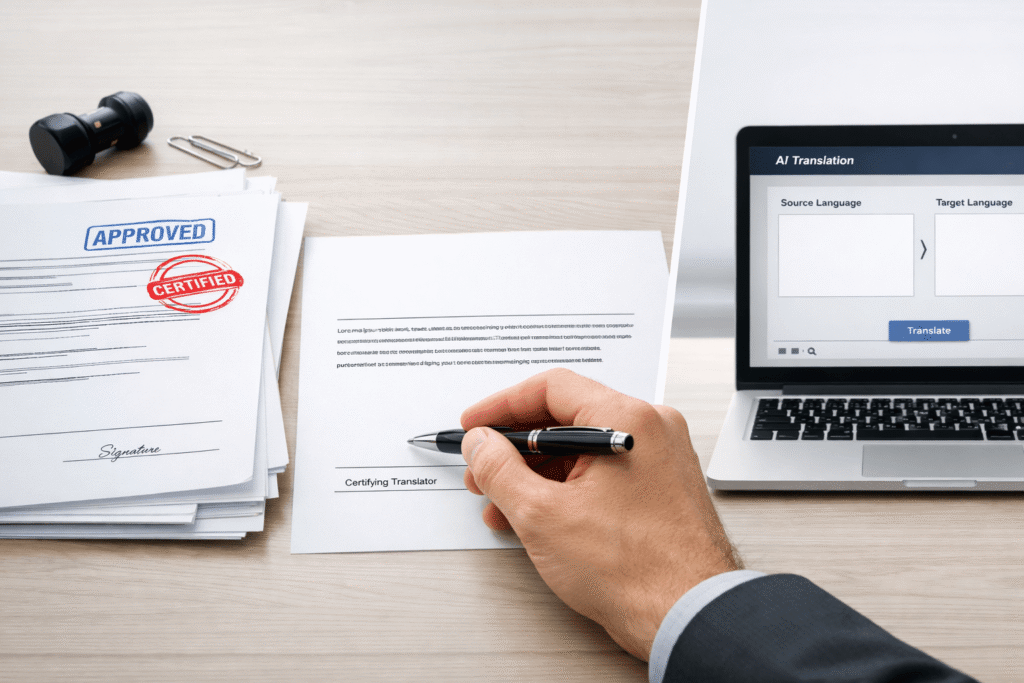
If you’re translating something important, the real question isn’t “Which is better?” — it’s what happens if it’s wrong.
Machine translation (like Google Translate, DeepL, or AI chat tools) can be brilliant for speed and understanding. But certified translation exists for a different reason: it’s designed to be submission-ready for authorities that require a signed statement of accuracy and translator competence.
This guide helps you choose the right option in minutes, avoid common rejection triggers, and use both approaches smartly (without taking unnecessary risks).
The Main Difference Between Certified Translation and Machine Translation
The main difference between certified translation and machine translation is that certified translation is completed and signed off by a qualified human translator for official use, while machine translation is generated automatically by software for speed and convenience.
Certified translation is intended for authorities, courts, universities, embassies, and regulated organisations that need a complete and accurate translation with a signed certification statement. Machine translation is useful for quick understanding, internal reading, and early drafts, but it does not provide legal accountability, a certificate of accuracy, or reliable handling of names, dates, numbers, seals, handwritten notes, and official formatting.
If the document is being submitted to an authority or used in a high-stakes decision, certified translation is usually the safer and more appropriate option. If the document is only being read for convenience and no official reliance will be placed on it, machine translation may be enough.
The 60-Second Decision

Choose certified translation if any of these are true:
It’s for immigration, visas, residency, citizenship, asylum
It’s for court, tribunals, solicitors, legal filings, and evidence bundles
It’s for government, embassies, consulates, and official registries
It’s for universities, licensing bodies, and professional regulators
You’ve been asked for a certification statement, “certified translation”, “sworn translation”, or “notarised translation”
The document includes stamps, seals, handwritten notes, or formatting that must be mirrored
Choose machine translation if all of these are true:
It’s only for internal understanding
No one outside your team will rely on it as an official record
A small error won’t cause delays, rejection, or legal/financial fallout
You’re not sharing sensitive personal data in a public tool
If you’re still unsure: treat it as high-stakes and go certified. It’s usually cheaper than repeating a process after a rejection.
The Main Differences at a Glance
If someone asks, “What are the main differences between certified translation and machine translation?”, the clearest answer is this:
- Certified translation is human-produced, checked, and signed for official use.
- Machine translation is software-generated and usually intended for understanding, not formal submission.
- Certified translation includes accountability because a translator or provider stands behind the work.
- Machine translation has no certifier, no signed statement, and no official responsibility.
- Certified translation is built for exactness in names, dates, document numbers, seals, stamps, handwritten notes, and formatting.
- Machine translation can be helpful for speed, but it may simplify, omit, or misread these details.
- Certified translation is commonly used for immigration, legal, academic, and government documents.
- Machine translation is better suited to drafts, summaries, internal use, and low-risk communication.
What “Certified Translation” Actually Means
A certified translation is a human translation delivered with a signed certificate confirming, in plain terms:
The translation is complete and accurate, and
The translator is competent in the language pair.
That certificate is what makes the translation “officially usable” for many authorities. Machine tools can’t issue (or take responsibility for) a certification statement — and that’s often the deal-breaker.
Why Authorities Ask for Certified Translation Instead of AI Output
Authorities do not just want words converted from one language into another. They often want a translation that can be relied on as part of a formal decision. That usually means:
- a competent human translator has reviewed the full document
- the translation is complete, not partial or selective
- key details such as names, dates, places, document numbers, and official titles have been checked
- the translator or provider is willing to certify the result in writing
This is why certified translation is often required even when machine translation appears readable. Readable is not the same as submission-ready.
What Machine Translation Is (and Isn’t)
Machine translation uses AI models trained on large volumes of bilingual text to generate fast translations.
It’s strong at:
speed (seconds, not days)
common phrases and everyday language
getting the gist of emails, messages, articles, and basic documents
It’s weaker at:
legal meaning and formal tone
names, dates, document numbers, and official terminology
handling ambiguity (it may “choose” the wrong meaning confidently)
formatting and completeness (stamps, seals, marginal notes, handwritten text)
accountability (there’s no liable translator behind the output)
Modern AI is better than ever — but high-stakes translation is still about risk management, not just fluency.
Can ChatGPT, Google Translate, or DeepL Replace Certified Translation?
For quick understanding, they can be useful. For official use, they usually cannot replace certified translation.
Tools such as ChatGPT, Google Translate, and DeepL can help you understand the rough meaning of a foreign-language document, compare phrases, or decide what needs professional attention. But if the document is being filed with immigration authorities, a court, a university, an embassy, or a regulator, a machine-translated output on its own is normally not enough.
The missing pieces are certification, human accountability, and careful checking of layout-sensitive details. Even strong AI output still needs a qualified human translator to review, correct, complete, and certify the final version.
Certified Translation vs Machine Translation (Side-by-Side)
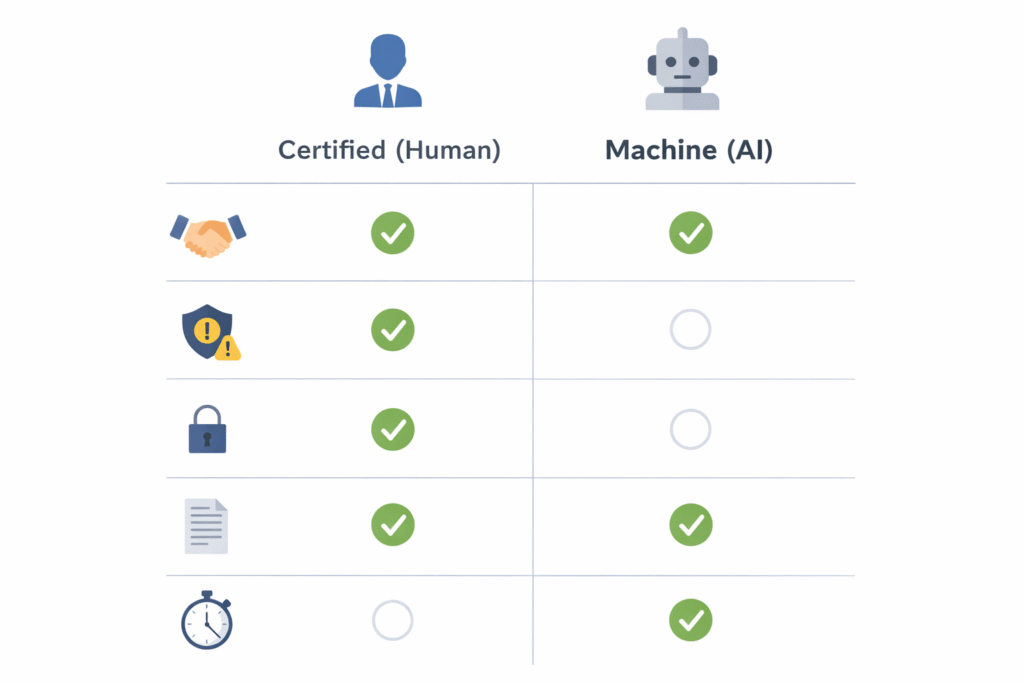
Factor
Certified (Human) Translation
Machine Translation
Official acceptance
Designed for submission and compliance
Often rejected for official use
Accountability
Translator signs a certificate and stands behind accuracy
No certification, no responsibility
Accuracy under pressure
Checked for names, dates, numbers, legal meaning
Can miss context or “guess” incorrectly
Formatting & completeness
Can mirror layout; labels stamps/seals/notes
May strip formatting or omit elements
Confidentiality
Can be handled under NDA and secure upload
Public tools may store or process data externally
Turnaround
Hours to days (rush available)
Seconds
Cost
Higher, but defensible
Usually free/low-cost
Best for
Immigration, courts, legal, government, official submissions
Internal understanding, drafts, quick gisting
Google Translate vs Certified Translation (Real-World Differences)
Here’s what typically goes wrong when people use Google Translate (or similar) on official documents:
Names get “normalised” (diacritics removed, order changed, spelling altered)
Dates flip (day/month confusion)
Official terms become generic (e.g., legal roles, issuing authorities, registries)
Numbers and identifiers drift (especially when formatting is messy)
Stamps/handwritten notes disappear (or are ignored)
The result looks unprofessional (which invites scrutiny even when the meaning is close)
The issue isn’t that machine translation is always bad. It’s that official processes often require precision, completeness, and a certifier — not just readable text.
Why Machine Translation Gets Rejected Even When It Looks “Mostly Right”
A machine-translated document can look convincing at first glance and still fail an official check. That is because many rejections are caused by small but critical issues:
- a personal name is transliterated differently from the passport
- a registry term is translated too generally
- a seal or handwritten notation is omitted
- a date format creates ambiguity
- a number, case reference, or certificate number is altered or misplaced
- the output has no certification statement attached
For official submissions, “mostly right” is often not good enough. The threshold is usually completeness, clarity, and accountability.
When to Use Certified Translation
Use certified translation when the outcome has a “yes/no” gate, such as:
Immigration and visa submissions
Birth certificates, marriage certificates, divorce decrees, police certificates, passports, residence cards, affidavits, and employment letters.
Courts and legal proceedings
Evidence, witness statements, court orders, contracts, POAs, affidavits, and legal correspondence.
Education and licensing
Diplomas, transcripts, professional certificates, membership letters, and academic references.
Business and compliance (high-stakes)
Incorporation documents, tax letters, financial statements, and regulatory filings.
Rule of thumb: if a rejection causes delay, cost, or legal risk, certified translation is the safer choice.
When Machine Translation Is a Smart Choice
Machine translation is excellent for:
understanding foreign documents before deciding what you need professionally translated
internal summaries and note-taking
early drafts of content that will later be rewritten by humans
multilingual customer-support triage (with human review before publishing externally)
translating non-critical communications quickly (messages, scheduling, casual emails)
A practical workflow: use machine translation to triage, then certify what actually needs to be submitted.
Documents You Should Not Rely on Machine Translation Alone For
Machine translation should not be the final version for documents such as:
- birth, marriage, divorce, and death certificates
- passports, ID cards, residence permits, and police certificates
- court orders, affidavits, contracts, powers of attorney, and legal evidence
- academic transcripts, diplomas, and licensing records
- medical reports, discharge summaries, and insurance or regulatory paperwork
- financial statements, tax records, incorporation papers, and compliance documents
These documents carry identity, legal, financial, academic, or regulatory consequences. That makes human review and certification the safer standard.
The Hidden Risk: Privacy and Sensitive Information
Official documents usually contain personal data: passport numbers, addresses, health information, and financial details.
Before you paste that into a free tool, ask:
Who can access the data?
Is it stored, logged, or used to train models?
Can you prove confidentiality if challenged?
For sensitive documents, professional workflows typically use secure upload, restricted access, and confidentiality agreements.
Cost, Speed, and Risk: The Practical Trade-Off
People often compare certified translation and machine translation in terms of price and speed alone. A better comparison is price, speed, and consequence.
Machine translation is faster and cheaper at the start.
Certified translation takes longer and costs more because it includes human expertise, checking, formatting, and certification.
But if a machine-translated document is rejected, delayed, challenged, or resubmitted, the “cheap” option can become the more expensive one.
For low-risk reading, machine translation saves time.
For high-stakes filing, certified translation often saves the process.
The “Submission-Ready” Checklist (What Pros Verify)

If you’re ordering a certified translation, a reliable provider should check things that commonly trigger requests for resubmission:
all pages included (front/back where relevant)
stamps, seals, watermarks, and annotations accounted for
names match the spelling you use on your passport/ID
dates and document numbers are consistent and legible
terminology matches the document context (legal, medical, academic)
the certification statement is signed and dated
the final PDF is clean, readable, and clearly labelled
This is the difference between “a translation” and a translation that survives scrutiny.
How Officials Often Assess a Translation
Many authorities do not need to compare every line against the original to identify risk. They often start by checking practical markers:
- Does the translation clearly identify the source document?
- Is the certification statement included, signed, and dated?
- Do names, dates, and numbers appear consistent?
- Are stamps, seals, annotations, and handwritten elements accounted for?
- Does the translation look complete, professional, and suitable for filing?
That is why presentation and completeness matter. A translation can be linguistically decent and still raise concerns if it looks incomplete or uncertified.
Can You Combine AI Translation and Certified Translation?

Yes — but only in the right order.
A safe hybrid model looks like this:
AI for first-pass speed (optional, internal only)
Human translator produces the final version
Quality review (names, numbers, completeness, formatting)
Certification signed by the translator
What you don’t want: AI output pasted into a template and “certified” without proper human responsibility and verification. That defeats the purpose of certification.
Quick Examples (So You Can Choose with Confidence)
Example 1: Birth certificate for immigration
Best choice: Certified translation
Why: names, dates, and registry terms must be exact, plus certification is commonly required.
Example 2: Reviewing a foreign-language contract before you decide
Best choice: Machine translation (for understanding), then human legal translation if needed
Why: machine translation helps you triage quickly, but don’t rely on it for signing decisions.
Example 3: University application transcripts
Best choice: Certified translation
Why: formatting, grades, course titles, and institutional language must be consistent.
Example 4: Internal team update from a foreign partner
Best choice: Machine translation
Why: low-stakes and speed matter.
What to Do Next (Without Overthinking It)
If your document is for an authority, you’ll usually save time by getting it done the first time properly.
If it’s for submission, request a certified translation and include any instructions you were given by the authority.
If it’s for understanding: use machine translation to triage, then upgrade only the documents that need to be filed.
Ready to move forward? Upload your document and deadline, and we’ll confirm the right format (certified, sworn, notarised, apostilled) and the fastest, safest turnaround.
A Few Words from Clients
“Fast turnaround and the formatting looked professional. Exactly what we needed for submission.”
“Clear communication, no surprises, and the certificate was included correctly.”
“We tried translating it ourselves first — then realised certified was the only sensible option.”
FAQs
What is the main difference between certified translation and machine translation?
Certified translation is produced and checked by a human translator and supplied with a signed certification statement for official use. Machine translation is produced automatically by software and is mainly suitable for internal understanding, drafts, and low-risk content.
Is certified translation more accurate than machine translation?
Certified translation is usually more reliable for official use because it’s completed and checked by a qualified human translator and delivered with a signed certification of accuracy.
Can I use Google Translate for immigration documents?
For internal understanding, yes. For submissions, it’s risky — immigration processes often require a certified translation with a signed certificate and complete, verifiable formatting.
What’s the difference between AI translation and professional translation?
AI translation is automated and fast, but may miss context, legal meaning, and formatting. Professional translation is human-led, reviewed, and accountable — and can be certified for official purposes.
When should I use machine translation instead of certified translation?
Use machine translation for low-stakes, internal content: quick understanding, drafts, summaries, and informal communication where errors won’t cause rejection or legal issues.
Do certified translations need notarisation?
Not always. Notarisation is typically only needed when a receiving organisation explicitly asks for it. If you’re unsure, provide the requirement, and we’ll advise the safest option.
Can a machine-translated document be certified?
A translation can only be certified when a human translator takes responsibility for the accuracy and completeness and signs a certification statement. Machine output on its own can’t do that.
Can ChatGPT, DeepL, or Google Translate be accepted for official documents?
They may help with understanding a document, but on their own, they are usually not acceptable where a certified translation is required. Official bodies typically want a human-reviewed translation with a signed statement of accuracy.
Why do authorities reject machine-translated documents?
They are often rejected because they lack certification, human accountability, complete formatting, and careful handling of names, dates, numbers, stamps, seals, and handwritten annotations.
Is machine translation cheaper than certified translation?
Usually, yes at the start, because many machine tools are free or low-cost. But if the output is rejected or causes delays, the overall cost can become higher than using certified translation from the beginning.
Which documents should always use certified translation instead of machine translation?
Documents for immigration, court proceedings, government filings, universities, regulators, and formal compliance purposes should usually use certified translation rather than machine translation alone.
Can I use machine translation first and then order certified translation later?
Yes. That is often a sensible workflow. You can use machine translation for initial understanding, then instruct a qualified human translator to prepare the final certified version for submission.