If you’re applying for Social Security benefits (or updating your record) and your documents aren’t in English, the fastest path is simple: provide a certified translation for social security that’s clear, complete, and easy for an SSA reviewer to match against the original. Done right, it reduces follow-ups, prevents avoidable delays, and keeps your claim moving.
This guide breaks down what Social Security typically needs, which documents usually require translation, what a “submission-ready” certified translation looks like, and the mistakes that most often trigger requests for more information.
If you’d like help, you can start with our Certified Translation Services or reach out via Contact.
Where can I get certified translation for social security documents in the UK?
If you are in the UK and need a certified translation for social security documents, the safest option is to use a professional translation provider that prepares complete English translations with a signed certificate of accuracy for official use. This is especially important for documents such as birth certificates, marriage records, death certificates, passports, national ID cards, pension letters, foreign benefit records, and medical evidence.
If your documents are being submitted to the U.S. Social Security Administration (SSA), the translation should be clear, complete, and easy for the reviewer to match against the original. If you are in the UK but handling a benefits, pension, or entitlement matter that involves foreign-language documents, the same principle applies: use a provider that includes all names, dates, document numbers, stamps, seals, marginal notes, and handwritten entries.
At Urgent Certified Translation, clients across the UK can order certified translations remotely by sending a scan or clear photo of the document. This is often the easiest route if you want a fast, submission-ready translation without needing to visit a local office.
When you might need a certified translation for Social Security
You may need translations when you’re:
- Applying for benefits (retirement, survivors, disability/SSI) and your supporting documents were issued abroad
- Requesting a Social Security Number (SSN) or replacing a card and your identity documents aren’t in English
- Updating your record (name change after marriage/divorce, date of birth correction, citizenship/lawful status updates)
- Using international records for work history or eligibility (including situations involving foreign pensions and cross-border documentation)
Even if the agency can arrange translation in some scenarios, providing a high-quality certified translation upfront often helps avoid extra handling time and back-and-forth.
A quick clarification for UK-based applicants
People often use the phrase “social security documents” in different ways. Some mean documents for the U.S. Social Security Administration. Others mean supporting paperwork for benefits, pensions, identity updates, family status, or entitlement checks that they are managing from within the UK.
If you are based in the UK, the practical question is usually not just “Do I need a translation?” but also “What kind of translation will be accepted without causing delays?” In most cases, the safest approach is to order a full certified translation rather than a summary or informal translation. That means the English version should reproduce the important evidence in the original document, including official markings and notes, and should be accompanied by a signed certification statement.
This matters whether you are:
applying from the UK using foreign-issued civil documents,
sending paperwork to a U.S. authority from the UK,
supporting a pension or survivor-related claim with overseas records, or
submitting identity or family-status documents that are not in English.
What “certified translation” means in practice
A certified translation is:
- A complete and accurate English translation of your document, and
- A signed certification statement confirming:
- the translator is competent in both languages, and
- the translation is accurate and complete to the best of their knowledge.
It is not:
- a self-translation signed by the applicant (risky and often discouraged), or
- a machine translation printout (not reliable for official review), or
- a summary that leaves out stamps, marginal notes, handwritten entries, or back-page text.
The SSA-style “submission-ready” standard (what reviewers need to see quickly)
Social Security reviewers aren’t only checking the words—they’re checking whether the translation preserves the evidence. A submission-ready translation makes it easy to verify:
- Who the document is about (names, aliases, parents/spouse, identifiers)
- What the document is (type, issuing authority, registration numbers)
- When/where it was issued (dates, places, municipality/registry details)
- Whether anything looks altered (corrections, overwriting, annotations)
Your translation should clearly include:
- Document type (e.g., Birth Certificate, Marriage Record, Court Order)
- Issuing authority and location (registry office, municipality, court)
- All names exactly as shown (including diacritics), plus consistent Romanisation if relevant
- Dates written clearly (and unambiguous date format)
- Document/registration numbers, file references, stamp numbers
- Stamps, seals, signatures and handwritten notes (translated or described when not legible)
- Any marginal notes, amendments, “remarks”, and back-page content (where present)
Documents that commonly need translation for Social Security
Different cases require different proof, but these are frequent “translation triggers”.
Identity and civil status documents
- Birth certificate / birth registration extract
- Marriage certificate / marriage registration
- Divorce decree / dissolution certificate
- Death certificate (survivors claims)
- Adoption decree / guardianship order
- Name change court order or deed documentation (where applicable)
Immigration and nationality-related proofs (depending on your situation)
- Passport bio page (if not in English)
- National ID card
- Citizenship/naturalisation evidence issued abroad
- Residency documents issued outside the US (case-dependent)
Disability/medical evidence (disability/SSI cases)
- Hospital letters, medical records, test results, specialist reports (when relied upon as evidence)
Work and entitlement documentation (case-dependent)
- Foreign employment records, contribution statements, pension letters
- Letters from foreign institutions that show entitlement, coverage periods, or status
Tip: If you’re unsure what must be translated, gather your SSA request letter (or the list of requested evidence) and translate every non-English document referenced in that checklist.
What can go wrong (and how to prevent it)
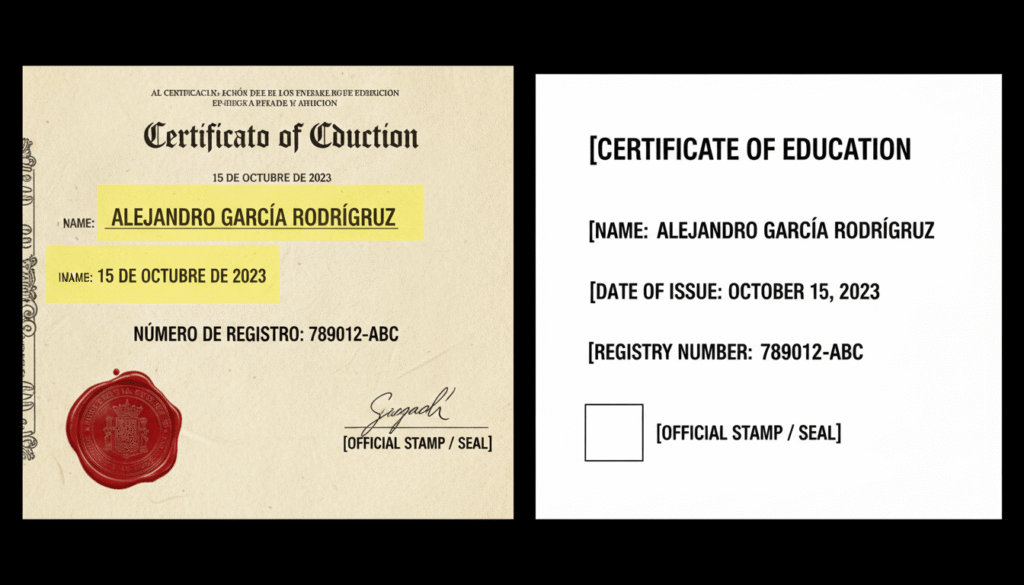
These are the issues that most often create delays:
1) Names don’t match across documents
Example: “María-José” appears as “Maria Jose” on another record, or surname order flips between cultures.
Fix: Keep names exactly as written on the document, and add a translator note only when necessary for clarity (without changing the underlying text).
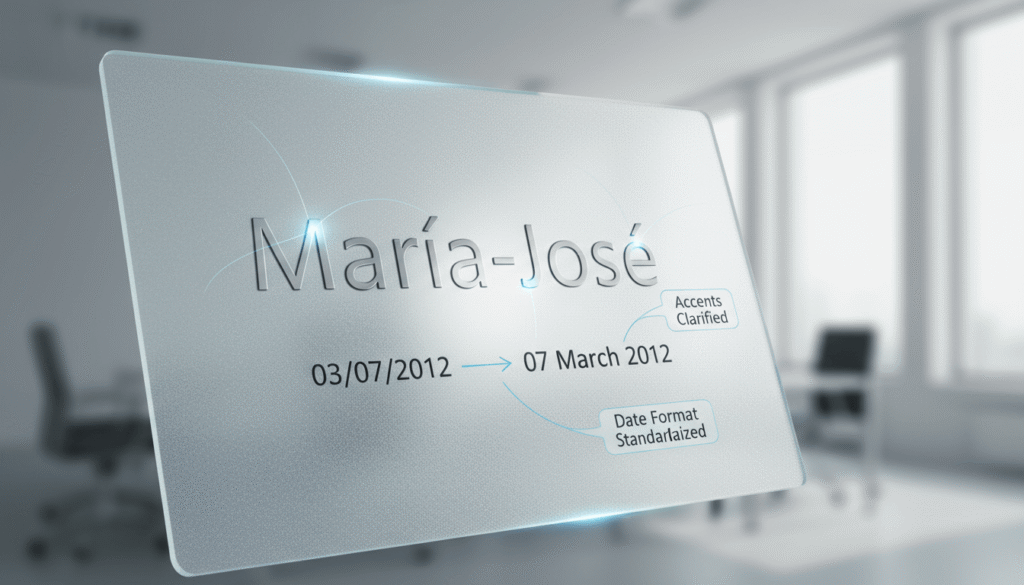
2) Date formats are ambiguous
Example: 03/07/2012 could be 3 July or 7 March.
Fix: Write dates in a clear format in the translation (e.g., “07 March 2012”) while preserving what the original shows.
3) Stamps, seals, and marginal notes are omitted
Fix: Include them as bracketed entries like: [Stamp: Civil Registry of …], [Seal: …], [Marginal note: …].
4) “Partial translation” leaves out the part SSA cares about
Fix: Translate the entire document or, at minimum, all substantive content plus identifiers and official markings. If you’re not sure, default to full translation.
5) Certification wording is missing or weak
Fix: Attach a proper certificate with signature and date (sample below).
The certified translation certificate (copy-ready example)
You can use this format (adjusted to your provider’s details):
Certificate of Translation Accuracy
I, [Translator Name], certify that I am competent to translate from [Source Language] into English, and that the attached translation is a true, complete, and accurate translation of the original document to the best of my knowledge and ability.
Translator Name: [Name]
Signature: ____________________
Date: [DD Month YYYY]
Contact: [Email / Phone]
Address (optional): [City, State/Country]
Practical note: Some institutions prefer the certificate on the same page as the translation or immediately following it. Either approach works as long as it’s clearly attached to the translated document set.
How to prepare your documents before you translate (so you don’t pay twice)
Before you upload anything, do this quick check:
- Capture all pages, including the back (many civil registry stamps appear on the reverse)
- Ensure the scan/photo is:
- well-lit
- not cropped
- readable at 100% zoom (especially registration numbers and handwritten notes)
- If the document has multiple stamps or faint seals, take:
- one normal scan, and
- one close-up of the stamp area
If you can’t get a perfect scan, send what you have—just be prepared to provide a clearer image if a key line is unreadable.
A simple “SSA submission-ready” checklist you can use
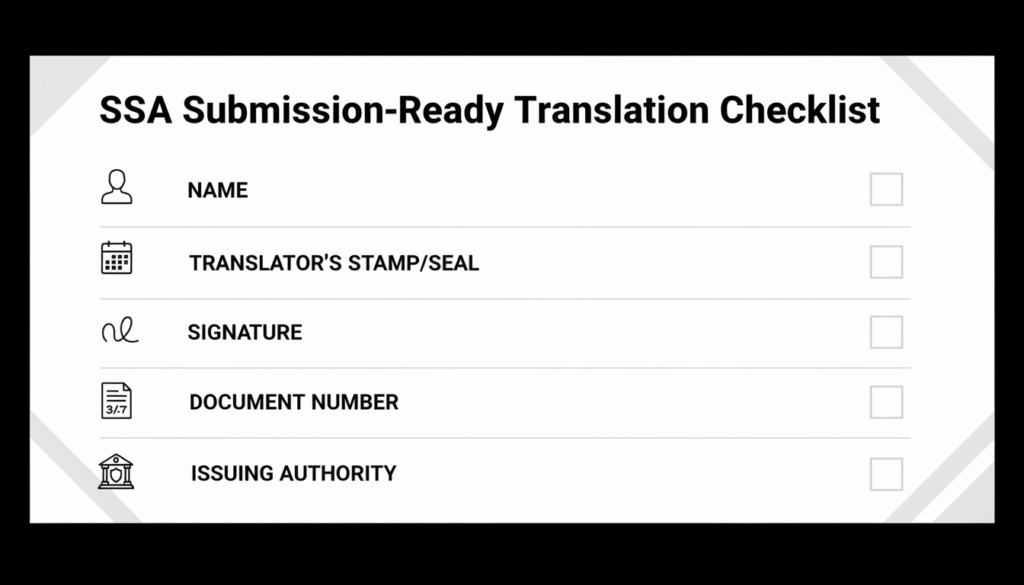
Use this to review any translation (even if you didn’t order it from us):
- Document type stated exactly (not guessed)
- Issuing authority included (registry/court/municipality)
- All names match original spelling (including accents/diacritics)
- Dates are unambiguous in English
- Registration numbers and reference IDs included
- Stamps/seals/signatures included and labelled
- Handwritten notes included or flagged as illegible (never silently omitted)
- All pages included (front/back where relevant)
- Certificate of accuracy is signed and dated
Timelines: why good translations speed up claims
When foreign-language evidence is involved, additional handling is common—especially if multiple documents need review. A clear certified translation helps by:
- reducing clarification requests
- preventing “please resubmit” scenarios
- allowing the reviewer to verify key facts quickly (identity, relationships, dates, status)
If your case is time-sensitive (travel, benefit start date, Medicare enrolment window, survivor claim deadlines), getting translations right the first time is one of the easiest ways to protect your timeline.
How we help (without making it complicated)
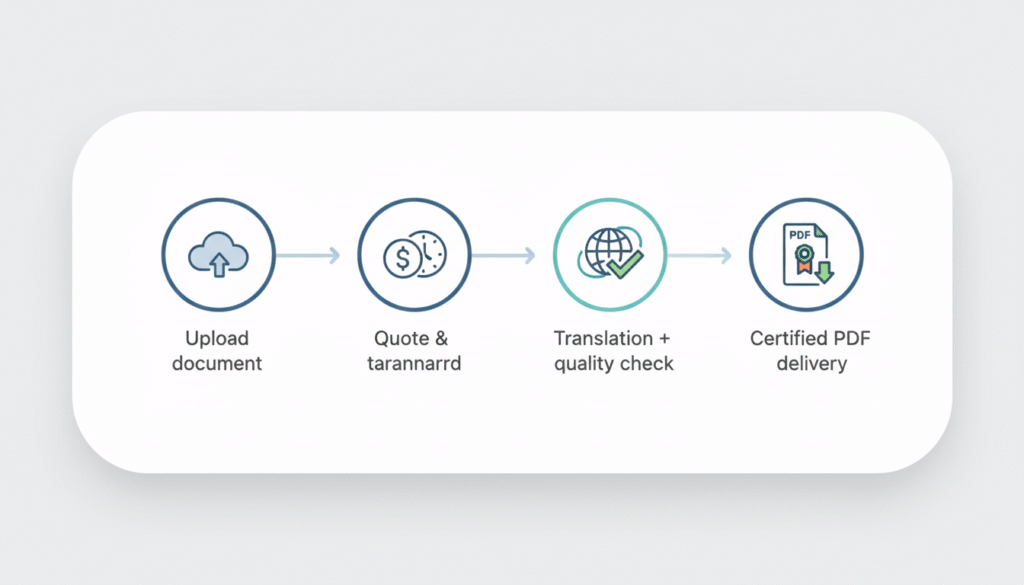
At Urgent Certified Translation, our process is designed around “submission-ready” output:
- You send a scan or clear photo
- We confirm price and turnaround
- Translation + quality check (names, dates, identifiers, stamps, completeness)
- Delivery as a clean, professional PDF with certification
We also help clients throughout the UK who need certified translations for Social Security-related paperwork but are unsure whether they need a local office, an online service, or a U.S.-style certified translation. In most cases, a clear scan and the right certification wording are far more important than your location. That means you can usually order remotely from anywhere in the UK and receive a clean, submission-ready certified PDF.
Start here: Certified Translation Services
Questions or special requirements? Contact us here
FAQ
Do I need a certified translation for Social Security?
If you’re submitting documents that are not in English as part of a Social Security application or record update, a certified translation is typically the safest, most submission-ready option.
What are SSA translation requirements?
SSA translation requirements generally focus on accuracy, completeness, and the ability to verify key evidence (names, dates, issuing authority, document numbers, stamps/seals, and notes). A signed certification statement from the translator is strongly recommended for official use.
Can I translate documents for Social Security myself?
Self-translation can create avoidable risk—especially when formatting, completeness, or certification wording is not handled correctly. For official submissions, a third-party certified translation is usually the better option.
Does an SSA certified translation need notarisation?
Not usually. Notarisation is typically only needed if the receiving office explicitly requests it. If you’re unsure, ask the office handling your case or share the instruction with your translator before work begins.
What documents should I translate for Social Security benefits?
Common items include birth certificates, marriage/divorce records, death certificates (survivor claims), passports/IDs (if not in English), and medical evidence for disability claims—plus any foreign-language documents listed in an SSA request letter.
How long does social security document translation take?
Turnaround depends on language, length, and complexity. Many personal documents can be translated quickly, but unclear scans or heavy handwritten content may add time.
Where can I get certified translation for social security documents in the UK?
You can get certified translation for social security documents in the UK from a professional translation provider that prepares official-use certified translations with a signed certificate of accuracy. If your paperwork includes foreign-language birth certificates, marriage records, death certificates, passports, ID cards, pension letters, or benefit documents, it is usually best to use a service experienced with official document formatting and certification.
Do I need a translator near me in the UK?
Not usually. Most certified social security document translations can be arranged online. If your scans or photos are clear and complete, you can normally send them digitally, approve the quote, and receive the certified translation electronically.
I am in the UK but my documents are for the U.S. Social Security Administration. Can I still order from a UK-based service?
Yes—many applicants arrange certified translations remotely while they are in the UK. The key point is that the translation should be complete, accurate, and properly certified, with names, dates, document numbers, stamps, seals, and notes clearly reflected.
What social security-related documents are most commonly translated by UK-based applicants?
The most common documents include birth certificates, marriage certificates, divorce decrees, death certificates, passports, national ID cards, foreign pension letters, benefit statements, work history records, and medical evidence used in disability-related claims.
Do stamps, seals, handwritten notes, and back-page entries need to be translated?
Yes, where they form part of the document evidence. Omitting official markings, annotations, remarks, or reverse-side content can create avoidable questions during review.
Can I send multiple documents together for one social security case?
Yes. In many cases, applicants need a small document set rather than a single item—for example, a birth certificate, marriage certificate, passport, and pension letter together. It is often better to have the full set reviewed at the start so names, dates, and identifiers stay consistent across the translations.