
A property deal is already paperwork-heavy. Add a second language and the risk multiplies fast. Certified translation for real estate keeps your transaction moving by making sure buyers, sellers, lenders, notaries, land registries, and solicitors can rely on the documents you submit—without misunderstandings, rejections, or last-minute scrambling.
This real estate document translation guide walks you through what needs translating, what “certified” actually means in a property context, and how to avoid the most common mistakes that derail completions.
Ready to get started? Upload your documents here: Upload your documents
Certified translation services for real estate documents in the UK
If you need certified translation services for real estate documents in the UK, the documents most commonly translated include title deeds, sale and purchase agreements, lease agreements, mortgage documents, land registry extracts, proof of funds papers, powers of attorney, probate papers, company documents, tenancy contracts, and compliance certificates.
For UK property transactions, the translation usually needs to be complete, accurate, and accompanied by a signed certificate of accuracy so it can be relied on by solicitors, conveyancers, lenders, notaries, estate agents, developers, and compliance teams.
In many UK property matters, certified translation is the correct level. Notarisation, sworn translation, or apostille is usually only needed where a specific lender, notary, court, foreign land registry, or overseas authority asks for it. For cross-border property deals, the correct format depends on where the documents will be submitted and whether the receiving institution has its own wording or hard-copy requirements.
We support buyers, sellers, investors, landlords, developers, and legal teams with certified translation for real estate documents in the UK and for cross-border transactions. If you are unsure what level you need, send the full pack and the receiving authority’s request, and we will confirm the correct format before translation begins.
Why certified translation matters in property deals
Real estate documents are not “general” documents. A single word can change a financial obligation, a boundary, or the right to transfer ownership.
Here’s what certified translation protects you from:
- Rejected filings because the translation format or certification statement is missing
- Delayed mortgage approvals when lender compliance teams can’t verify foreign-language documents
- Closing day surprises when a clause is interpreted differently in the target language
- Costly rework when names, addresses, plot numbers, or dates don’t match across documents
In real estate, translation isn’t just about understanding the document. It’s about making it acceptable to the institution that must rely on it.
If you’re not sure what level you need, start with our certified translation services and we’ll confirm the correct format for your receiving authority.
What “certified translation” means for real estate
A certified translation is typically a complete, accurate translation of the entire document, accompanied by a signed statement confirming accuracy and completeness.
Depending on where the property is and who is requesting the translation, you may also need:
Certified vs notarised vs sworn vs legalised (what to choose)
- Certified translation
Best for: lenders, solicitors, agents, standard filings, and most administrative checks.
Includes: translation + signed certificate of accuracy. - Notarised translation
Best for: situations where a notary must verify the translator’s identity/signature.
Includes: certified translation + notary verification.
See notarised translation. - Sworn translation
Best for: many civil-law countries where only court-authorised/sworn translators are accepted for property procedures.
Includes: translation by an authorised translator (rules vary by country). - Apostille/legalisation (for the original, the translation, or both)
Best for: cross-border use of official documents where proof of authenticity is required.
Includes: official legalisation process (requirements vary).
See apostille and legalisation.
What UK solicitors, conveyancers, and lenders usually expect
For UK property matters, the most common requirement is a full certified translation that can be checked against the source document. In practice, reviewers usually expect:
the complete document, not extracts only
a signed certificate of accuracy
clear rendering of names, addresses, dates, figures, plot or title references, and signatures
translation of visible stamps, seals, annotations, and handwritten amendments
annexes, plans, schedules, and attachments translated where they form part of the document pack
If the file is for a lender or compliance team, they may also want the translation delivered as a clear PDF first, followed by a signed hard copy if the matter progresses to completion. If a UK notary or foreign land registry is involved, ask whether they want notarisation, sworn translation, or apostille before the file is finalised.
If you’re dealing with contracts, deeds, powers of attorney, or dispute papers, you may also require legal translation to match formal requirements and preserve legal effect.
When a certified translation for real estate is usually required
You’ll commonly need certified translation in these scenarios:
1) Buying property abroad
If you’re purchasing outside your home country, you may need a certified or sworn translation for:
- the purchase contract or deed of sale
- notary documents
- local tax forms
- bank and mortgage documentation
2) Selling property to an overseas buyer
Overseas buyers often need translations for:
- title documents and searches
- building compliance certificates
- tenancy details and rent schedules (if sold with tenants)
- management company/HOA information
3) Mortgage and refinancing
Lenders may request certified translations for:
- foreign income evidence
- overseas bank statements
- foreign property ownership documents
- gifted deposit letters in another language
- existing mortgage documents for cross-border checks
4) Power of attorney for a property transaction
If you can’t be present to sign, your agent may need a POA that is translated and properly certified (and sometimes notarised/legalised).
5) Probate, inheritance, or divorce-related transfers
These cases often involve court orders, death certificates, wills, and registry extracts—usually requiring a higher level of formality.
Who usually requests certified translation in UK property transactions
In UK practice, the request may come from a conveyancing solicitor, mortgage lender, compliance or AML team, notary, probate practitioner, estate management company, or the overseas authority handling the other side of the transaction. The key point is that the translation is not ordered for convenience alone; it is usually needed so another party can verify identity, ownership, source of funds, authority to sign, or the legal effect of the document.
If the matter involves a foreign property being reviewed in the UK, the translation is often needed for lender assessment, tax advice, probate, divorce settlement, corporate acquisition, or source-of-wealth checks. If the matter involves a UK property with overseas parties or foreign-language paperwork, translations are often needed before exchange, completion, refinancing, inheritance transfer, or compliance review.
Real estate documents that often need translation (complete checklist)
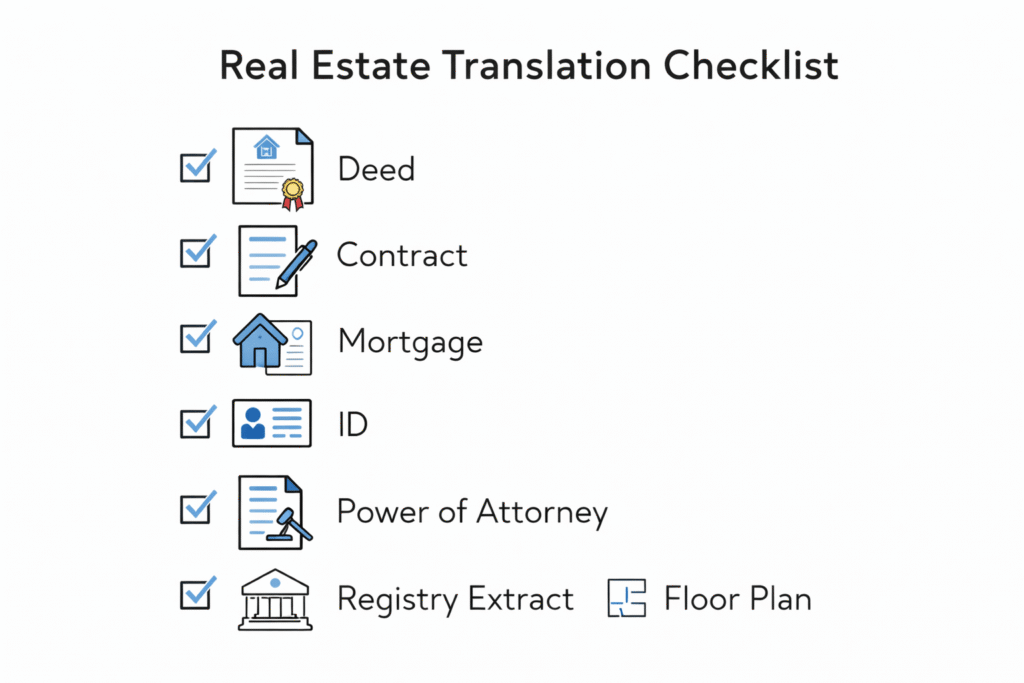
Use this as your “no-missed-documents” checklist.
Ownership and title
- Title deed/property deed/deed of transfer
- Land registry extracts
- Boundary plans, plot maps, and cadastral references
- Title searches and encumbrance reports
Contracts and transaction papers
- Sale and purchase agreement (SPA) / purchase contract
- Reservation agreements and addendums
- Disclosure forms
- Completion statements/closing statements
- Escrow agreements
Mortgage and finance
- Mortgage deed/loan agreement
- Valuation reports
- Bank letters, source of funds documentation
- Proof of income (employment letters, payslips, tax filings)
Compliance and property condition
- Energy certificates (where relevant)
- Building permits, completion certificates
- Surveyor reports
- Fire safety or building compliance statements
- Tenancy contracts and rent schedules (for investment property)
Identity and authority
- Passports / IDs (if requested by the authority)
- Marriage certificates (commonly requested for joint ownership in some jurisdictions)
- Corporate documents for company-owned property: articles, board resolutions, shareholder registers
- Power of attorney
Fast-track option: If your completion date is close, start here: Upload your documents and mark your deadline.
Property deed translation requirements (what makes deeds different)
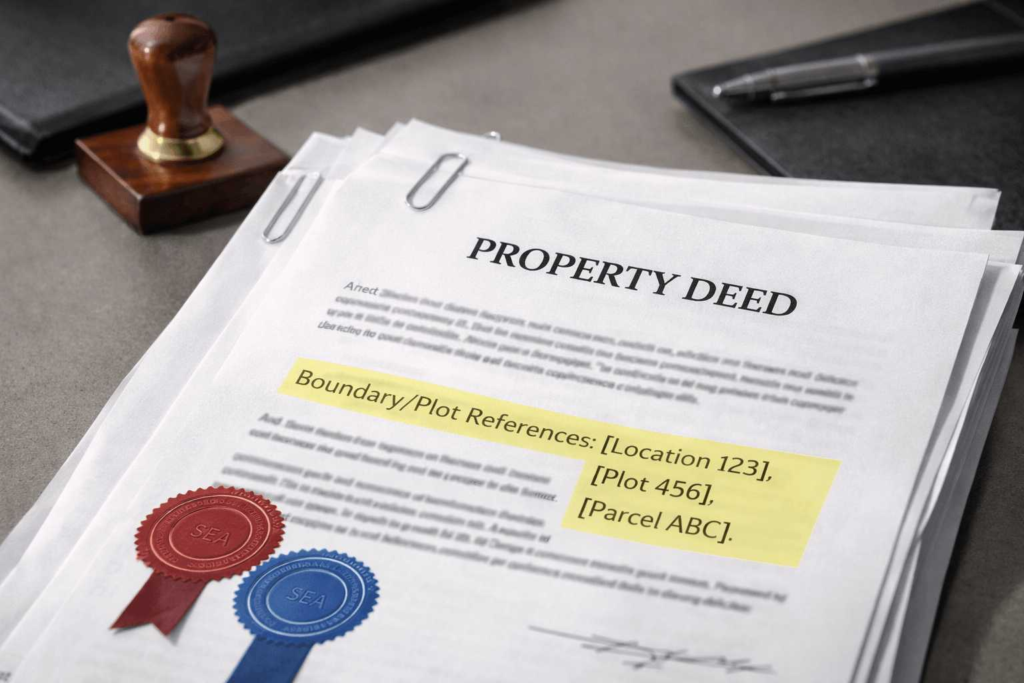
A deed is a high-risk document because it directly affects ownership rights. Accurate translation must preserve:
- Legal capacity and parties (exact names, legal forms, and identification details)
- Property description (plot number, boundaries, units, and references)
- Consideration/price and payment terms (numbers, currency, instalments)
- Restrictions and rights (easements, covenants, liens, charges, usufruct/life interest)
- Execution language (signatures, witnessing, notarial clauses)
- Attachments (maps, schedules, annexes)
The deed “do-not-guess” list
Any of these elements must be translated consistently, not “interpreted”:
- Names (including transliteration rules where needed)
- Registry numbers, parcel IDs, and file references
- Dates (especially where two formats exist)
- Units (sqm vs sq ft, local land measures)
- Legal terms that don’t map 1:1 between legal systems
Formatting matters more than people think
Many rejections happen because:
- pages are missing
- stamps and handwritten notes are ignored
- annexes aren’t translated
- the certification statement isn’t attached
- the translator’s details aren’t included
If your deed includes stamps, seals, or handwritten additions, ask for a format that mirrors the original layout so reviewers can cross-check quickly.
Requirements vary by jurisdiction (what to expect in practice)
Real estate translation isn’t “one standard worldwide”. Requirements depend on:
- the country and local land registry/notary rules
- the lender’s compliance requirements
- whether the document is considered official/public
- whether you’re in a system that uses sworn/court translators
A simple way to confirm what you need
Before you order, answer these three questions:
- Where will the translation be submitted? (lender, solicitor, notary, land registry, court)
- Does the authority require a sworn/notarised/legalised translation?
- Do they need a physical hard copy, or is a PDF accepted?
If you don’t know, send the request email or checklist from the authority, and we’ll match the format.
Start here: Contact our team
Step-by-step: the safest process for real estate document translation
Step 1: Gather the full document set
Include annexes, schedules, maps, and any stamped pages. Partial documents are a common reason for rework.
Step 2: Confirm the receiving authority’s rules
Ask them (or your solicitor/agent) if they require:
- certified translation only
- notarised translation
- sworn translation
- apostille/legalisation
Step 3: Decide what must be translated word-for-word
For property, assume everything unless the authority explicitly says otherwise. Summaries are risky.
Step 4: Translate with a property-aware linguist
Real estate documents have specialist terminology. A general translator can miss legal nuance.
Step 5: Quality check for “closing-critical” details
A proper QA pass checks:
- names match IDs exactly (including middle names and initials)
- numbers match the source document
- plot numbers and registration references match
- dates and addresses are consistent across the pack
Step 6: Certification (and notarisation/legalisation if required)
Your translation is finalised with the required certification statement and signatures.
Step 7: Delivery in the format your transaction needs
Typical options:
- digital certified PDF for quick submission
- printed and signed hard copy for in-person completion
- courier delivery for tight timelines
If your deadline is urgent, choose the fastest path here: Upload your documents
Common pitfalls that delay completions (and how to prevent them)
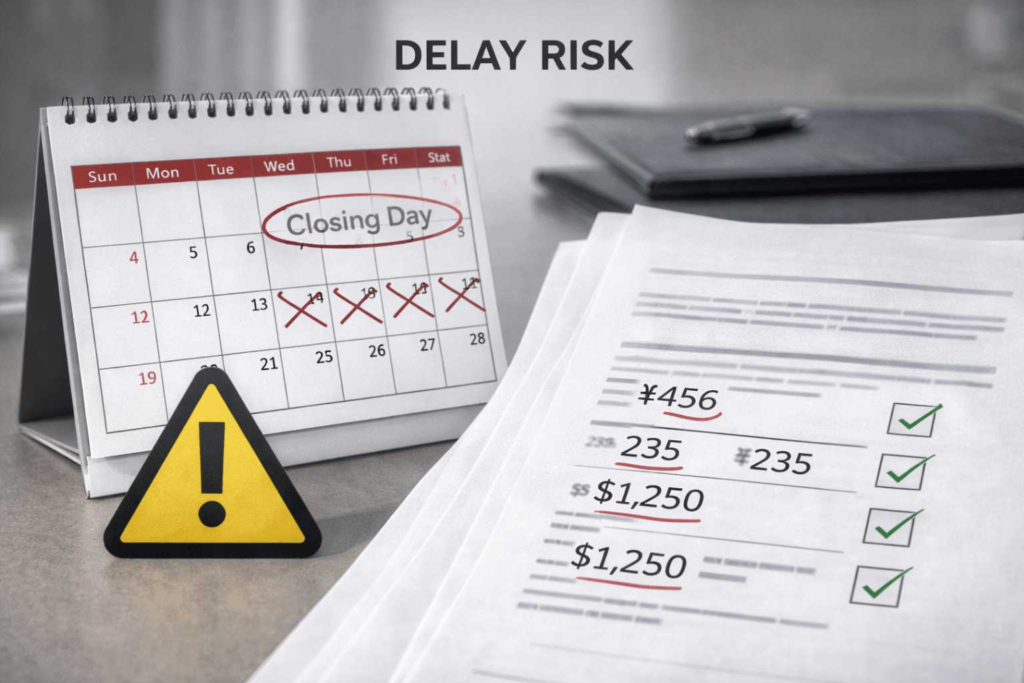
Pitfall 1: Name mismatches across documents
Real estate workflows are strict about identity checks. One letter difference can trigger additional verification.
Fix: Provide passports/IDs (if permitted) and keep a single spelling standard for transliteration.
Pitfall 2: Missing annexes, maps, or stamped pages
Authorities often treat attachments as part of the legal instrument.
Fix: Translate the entire bundle, including appended pages and exhibits.
Pitfall 3: Untranslated handwritten notes
Handwritten notes can contain key amendments, authorisations, or registry references.
Fix: Ensure handwritten additions are translated and clearly marked.
Pitfall 4: “Near enough” legal terminology
Real estate law varies. A literal translation can be wrong if the legal concept doesn’t exist in the target system.
Fix: Use a translator experienced in cross-border property language, with explanatory translator notes where appropriate.
Pitfall 5: Wrong certification level
A certified translation may not be accepted where a sworn or notarised translation is required.
Fix: Confirm upfront. If unsure, we’ll help you choose: Contact our team
How much does certified translation for real estate cost?
Real estate translation pricing typically depends on:
- Document length (pages/words)
- Complexity (deeds and notary clauses take longer)
- Language pair (rarer pairs may require specialist availability)
- Urgency (rush completion or same-day processing)
- Formatting requirements (mirroring layout, tables, stamps, annexes)
- Extra steps (notarisation, sworn translation, apostille/legalisation)
A helpful budgeting rule
- Routine supporting documents (simple certificates, standard letters) are usually straightforward.
- Transaction-critical documents (deeds, SPAs, mortgage deeds, POAs) should be treated as specialist work with enhanced QA.
For a precise quote, it’s fastest to upload the full pack and your completion date: Upload your documents
How to choose a real estate translation provider (quick vetting checklist)
Use these questions before you commit:
- Do they translate deeds, contracts, and mortgage documents regularly?
- Will they provide a certificate of accuracy that meets your authority’s format?
- Can they handle notarised, sworn, or legalised requirements if needed?
- Do they preserve tables, formatting, stamps, and annexes?
- Do they run a two-person review (translator + independent checker) for high-stakes files?
- Do they offer confidential handling and an NDA if required?
If you want the “lowest-friction” route, send your document pack and the receiving authority’s requirements—our team will confirm the exact format before work begins. Contact our team
Real-world scenarios (what this looks like in practice)
Scenario A: UK buyer purchasing abroad
A UK buyer needs the purchase contract and deed translated into English for a lender review, plus a certified translation of the seller’s registry extract. The deal stays on track because all annexes and stamped pages are included from day one.
Scenario B: Overseas buyer purchasing in the UK
A buyer needs translated proof-of-funds documents for solicitor checks. The key is consistent name spelling across bank statements, IDs, and the purchase file.
Scenario C: Power of attorney for remote completion
A seller overseas signs a POA. The receiving notary requires a specific certification format and verification. The POA is translated, certified, and then notarised to meet the formal submission requirements.
Frequently asked questions
Do I need a certified translation for real estate, or is a regular translation enough?
If the translation will be submitted to a solicitor, lender, notary, land registry, or any official authority, a certified translation for real estate is usually required. A regular translation often lacks the signed certification statement that institutions rely on.
What are the property deed translation requirements?
Property deed translation requirements commonly include a complete translation, consistent rendering of legal terms, accurate numbers and registry references, and a certificate of accuracy. Many authorities also expect annexes, plans, stamps, and handwritten notes to be translated as part of the deed pack.
Can I use a translated deed in another country without legalisation?
Sometimes yes, sometimes no. For cross-border use, you may need an apostille/legalisation for the original document, the translation, or both—depending on the receiving country and authority. When in doubt, confirm with the notary, solicitor, or registry handling the transaction.
How fast can you deliver certified translation for a property closing?
Timelines depend on length, language, and whether notarisation/legalisation is needed. If you have a closing date, upload the pack, and we’ll prioritise the completion of critical documents first. Upload your documents
Do lenders accept digitally certified translations?
Many do, especially for initial review, but some may request a signed hard copy for final completion. Always check your lender’s document policy. We can provide both digital and printed options when needed.
What if my real estate documents include stamps, seals, or handwritten amendments?
These should be translated and clearly referenced in the final file. Omitting them can cause delays because reviewers cannot reconcile the translated text with the original.
Do UK solicitors and conveyancers accept certified translations for real estate documents?
In many cases, yes. A certified translation is commonly used where a solicitor, conveyancer, lender, or compliance team needs to understand and rely on a foreign-language property document. The exact format can still vary, so it is best to check whether they need a certified translation only or a notarised, sworn, or legalised version.
Which real estate documents most often need certified translation in the UK?
The most common examples are title deeds, sale and purchase agreements, lease agreements, mortgage papers, land registry extracts, proof of funds documents, powers of attorney, probate papers, tenancy agreements, rent schedules, and company documents used for corporate ownership or purchase.
Do I need a notarised or sworn translation for a UK property transaction?
Not always. In many UK property matters, certified translation is enough. Notarised or sworn translation is usually only needed when a notary, overseas authority, foreign court, or land registry specifically requires that higher level of formality.
Can proof of funds and overseas bank documents be translated for a UK property purchase?
Yes. Buyers are often asked to provide translated proof of funds documents, overseas bank letters, income evidence, gifted deposit letters, or source-of-wealth papers so the solicitor or lender can complete compliance checks.
Can lease agreements, tenancy agreements, and rent schedules be certified for property transactions?
Yes. These documents are commonly translated for investment property purchases, due diligence reviews, disputes, refinancing, and portfolio acquisitions, especially where rental income or tenant obligations need to be assessed.
Can you work from scans or PDF copies of real estate documents?
Yes, in most cases, a clear scan or PDF is enough to start. Make sure every page is included, especially annexes, plans, signatures, stamps, and handwritten amendments. If a receiving authority later needs a printed and signed hard copy, that can be arranged separately.
Next step: get your real estate translation accepted the first time
The fastest way to avoid delays is to translate the complete document bundle, confirm the required certification level, and run a strict QA pass focused on names, numbers, and registry references.
Upload your pack and your completion date: Upload your documents
Prefer to speak first? Contact our team