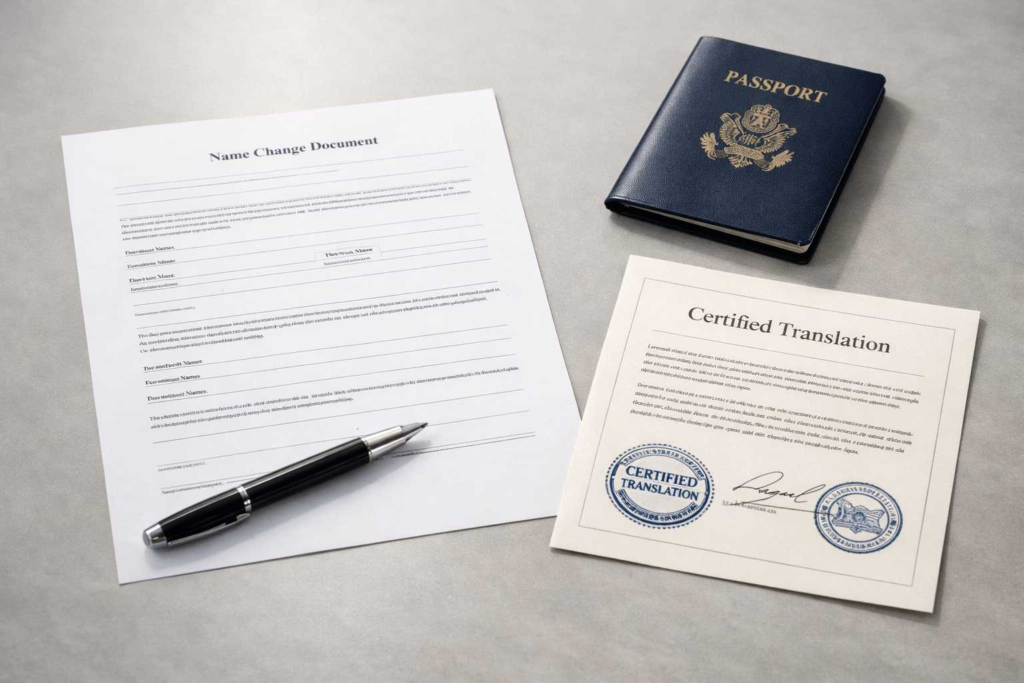
If you’re changing your name for official purposes, a single missing piece can slow everything down. Courts, passport offices, banks, employers, universities, and immigration authorities often require certified translation for name change documents when any part of your evidence is in a foreign language.
This guide explains what “certified translation” means in practice, which documents usually need translating, what authorities look for, and how to avoid the most common reasons applications get delayed or rejected.
Not legal advice: Requirements vary by country and organisation. Use this as a practical checklist and always follow the instructions from the authority you’re submitting to.
Direct answer: How to get a certified translation for a name change certificate in the UK
If your name change certificate or supporting documents are not in English or Welsh, the safest route is to send a clear copy to a professional translator or translation company and request a full certified translation for official use.
A straightforward process usually looks like this:
- send a clear scan of every page, including backs, stamps, and attachments
- confirm the authority you are submitting to, such as HM Passport Office, the Home Office, a bank, a university, a court, or an employer
- confirm the spelling you want used in English if the original document is in a non-Latin script
- request a full translation plus a signed certification statement with the translator’s name, signature, date, and contact details
- check whether the receiving authority wants a certified translation only, or also wants notarisation, sworn translation, or legalisation
This type of direct, complete submission reduces the risk of delays caused by missing pages, inconsistent name spellings, or incomplete certification.
Why name change cases are different (and why translations get scrutinised)
Name change workflows are all about identity continuity. The receiving organisation needs to see a clear chain from:
- your old name (as shown on previous records), to
- your legal basis for the change (deed poll, court order, marriage/divorce/adoption documents, etc.), to
- your new name (as you want it to appear on updated records)
When documents are in a different language, the authority can’t verify that chain unless the translation is complete, consistent, and properly certified.
What “certified translation” means for a name change
A certified translation is typically:
- a complete translation of the document (not a summary)
- prepared by a competent translator
- accompanied by a signed certification statement confirming accuracy and completeness
- formatted so an officer can easily compare it with the original (including stamps/seals/notes)
Many organisations don’t require a translator to be “government-approved” for a certified translation, but they do require the certification statement to include key details (translator competence, signature, date, and contact details). Some countries and courts have stricter rules (for example, requiring a sworn translator or licensed legal translator).
If you want a safe, submission-ready format, start here: Certified translation services.
What UK authorities usually expect to see on the certification
For UK-facing submissions, a strong certification package usually includes:
- confirmation that the translation is a true, accurate, and complete translation of the original
- the date of translation
- the translator’s full name and signature
- the translator’s contact details
- a clear link between the translated document and the source document
This matters because many authorities are not looking for decorative formatting. They are looking for a translation they can independently verify and match to the original quickly.
Which name change documents typically need certified translation?
You’ll usually need a certified translation for a name change if any of these are not in the required language of the authority:
1) The “legal basis” document (the document that proves the change)
Common examples:
- Deed poll/change of name deed
- Court order approving the name change
- Change of name certificate (issued by a government registry)
- Statutory declaration/affidavit confirming the change
2) Supporting identity and civil status documents
Often required to prove identity continuity:
- Birth certificate
- Marriage certificate (common for surname changes)
- Divorce decree/dissolution order (especially if reverting)
- Adoption order
- Naturalisation/citizenship certificate
- National ID card, family book, household registry, resident card
3) Records that must match the new name
Depending on what you’re updating:
- bank letters and statements
- payslips and tax letters
- educational transcripts or diplomas
- employment letters
Practical rule: If you’re submitting it as evidence to explain or justify the name change, translate it.
Where can you get a certified translation for a name change in the UK?
You can usually obtain a certified translation for a name change document from:
- a professional translation company that handles official documents
- an individual professional translator who provides certified translations
- a provider affiliated with recognised UK professional bodies or directories
When comparing providers, ask:
- Do you translate every page, stamp, seal, annotation, and handwritten note?
- Will the certification statement include the translator’s name, signature, date, and contact details?
- Can you format the translation so it is easy to compare with the original?
- Can you handle related documents in the same order, such as birth certificates, marriage certificates, court orders, or registry extracts?
Choosing a provider that regularly handles official submissions can make a significant difference in name change cases, where consistency across several documents matters as much as the translation itself.
Name change translation requirements: what authorities usually check
Organisations rarely “grade” a translation. They check whether it’s usable. Here’s what typically matters most.
Completeness (no missing content)
Your translation should include:
- every page (front/back where relevant)
- handwritten notes and marginal stamps (when legible)
- seals, stamps, headings, footers, reference numbers
- signature lines and signatory titles (even if signatures themselves aren’t “translated”)
Name accuracy and consistency
Name change files are where small differences cause big delays.
Authorities often compare:
- spelling (including middle names)
- order of names (given name/surname order can vary)
- hyphens, spacing, apostrophes
- diacritics (é, ñ, ü) and transliteration (Arabic/Cyrillic/Chinese to Latin)
Best practice: Decide on a single official Latin spelling for the new name (matching your passport preference where possible) and keep it consistent across every translation.
Dates, places, and document numbers
Translation should preserve:
- the date as written and (where helpful) standardise the format consistently (without changing meaning)
- registration numbers, certificate numbers, court file numbers
- issuing authority names (translated clearly)
Proper certification statement
A strong certification statement usually confirms:
- the translation is accurate and complete
- the translator is competent in both languages
- the translator’s name, signature, and date
- contact details (and often address)
Formatting that makes comparison easy
For name change documents, “pretty” matters less than “matchable”. Clear layout helps an officer verify details quickly:
- sensible line breaks
- labels for stamps/seals
- table formatting where the original uses tables
- clear page numbering
To keep the process simple, use a provider that formats translations specifically for official submission: USCIS-ready certified translation services.
Certified translation vs certifying a copy: not the same thing
These are two different steps.
Certifying a copy means a professional person confirms that a photocopy is a true copy of an original document.
Certifying a translation means the translator or translation company confirms that the translation is accurate and complete.
Some authorities ask for one of these steps. Some ask for both. If an authority asks for notarisation or legalisation as well, that is an extra requirement on top of the translation itself.
A submission-ready checklist (save this before you file)
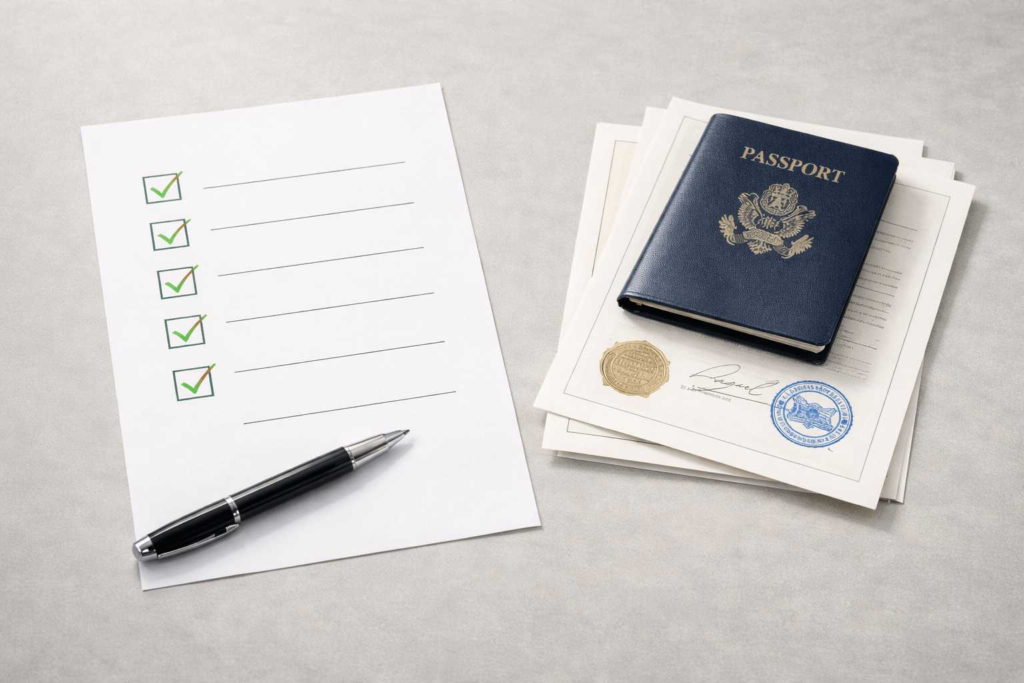
Use this checklist to reduce follow-up requests and rejections:
- Original scan/photo is readable (no blur, no cropped edges)
- All pages included (front/back, attachments, annexes)
- Stamps/seals/handwritten notes visible (or flagged if illegible)
- Names are consistent across all translated documents
- Transliteration/spelling choice is confirmed (especially for non-Latin scripts)
- Dates and document numbers are preserved accurately
- Translation includes a signed certification statement
- Output is delivered as a clean PDF suitable for submission
- You’ve checked whether you need notarisation or an apostille (only if requested)
Ready to move forward? Upload your file and you’ll receive a clear confirmation of requirements, price, and turnaround.
Step-by-step: how to get a certified translation for a name change
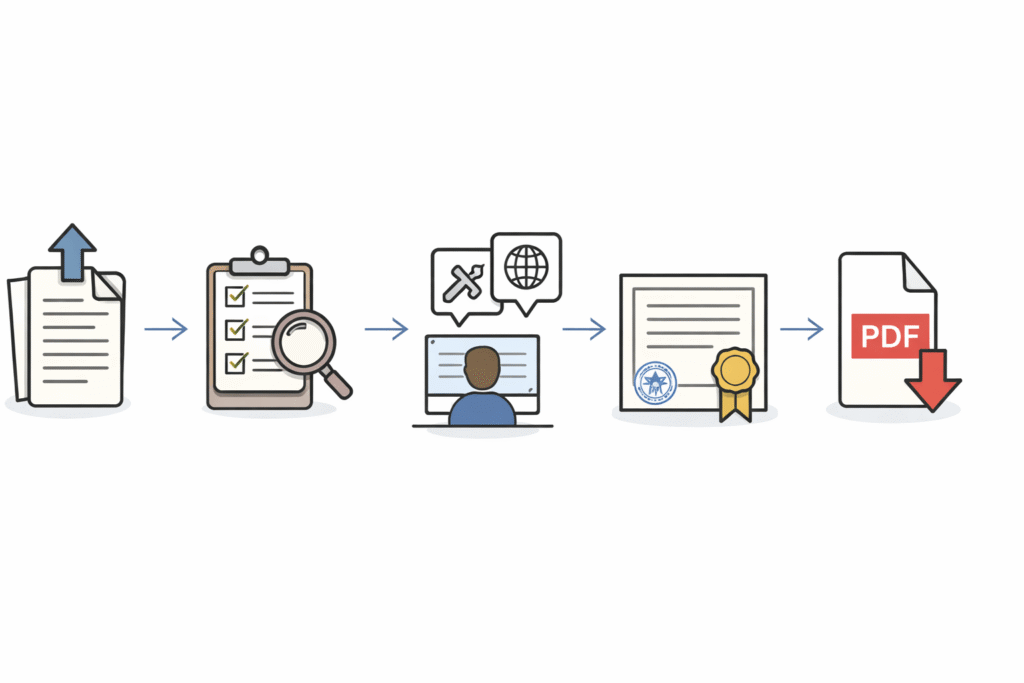
Step 1: Identify the receiving authority (and their language requirement)
Before you translate, confirm:
- which organisation you’re submitting to (court, passport office, immigration authority, bank, employer)
- required language (English, Arabic, French, etc.)
- whether they specify a certified, sworn, or notarised translation
If you’re not sure what they mean by “certified”, send their instructions along with your document when you submit.
Step 2: Gather the full “chain of name” evidence
If your name change touches multiple documents, include:
- the name change document itself (deed poll/court order/etc.)
- a primary identity document (passport or national ID)
- any civil status document that explains the change (marriage/divorce/adoption)
Tip: If you’re updating immigration records, include both the “old name” and “new name” documents in the same order so the chain is obvious.
Step 3: Confirm your preferred spelling (especially for transliteration)
If your original document uses a non-Latin script, the translation must choose a spelling in Latin letters.
Provide:
- your preferred spelling exactly as you want it used
- a reference document showing that spelling (passport bio page is ideal)
This one step can prevent the most common delay: “names do not match”.
Step 4: Translate everything on the document (not just the body text)
Name change documents often contain:
- legal declarations
- issuing authority references
- certification or registration stamps
- witness details
These must be translated clearly, even if they look “administrative”.
Step 5: Add the certification statement and final quality check
A name change translation should be reviewed specifically for:
- spelling consistency across pages
- date accuracy
- completeness of seals/stamps/annotations
- correct naming of the issuing authority
If you want a provider that follows a submission-ready checklist, start here: Certified translation services.
What to send when requesting a quote or placing an order
To avoid back-and-forth and reduce turnaround delays, send:
- a clear scan or photo of every page
- all backs, annexes, and attachments
- any instructions from the authority you are submitting to
- one reference document showing your preferred spelling in English, if relevant
- a short note explaining whether the translation is for HM Passport Office, the Home Office, a deed poll application, an employer, a bank, a university, or overseas use
This allows the translator to quote accurately, spot missing pages early, and flag whether you may need certified only, or certified plus notarisation or apostille.
Common scenarios (and what to translate in each)
Name change for immigration applications
Usually required:
- the name change instrument (court order/deed poll/certificate)
- birth certificate (if used to establish identity)
- marriage/divorce documents (if they explain the change)
- any supporting registry extracts that show both names
What trips people up:
- different spellings across documents
- missing pages or missing registration details
- certification statement that’s too vague or unsigned
Name change for passports and travel documents
Usually required:
- legal name change proof (varies by country)
- supporting evidence showing identity continuity
What trips people up:
- transliteration differences (especially when old passport used one spelling)
- inconsistent order of names (e.g., patronymic systems)
Name change for banks, employers, and universities
Often required:
- the legal name change document
- supporting ID
- sometimes proof of address in the new name
What trips people up:
- partial translations or “unofficial” translations without certification
- missing stamp/seal translations (organisations rely on them to verify authenticity)
UK-specific situations, people often ask about
HM Passport Office
Name change cases for passports are especially sensitive to previous names, name alignment, and supporting evidence. If the spelling, order, or formatting of the name differs across documents, that can cause delays even where the translation itself is accurate.
Home Office and UKVI
If a supporting document is not in English or Welsh, the translation normally needs to be full and independently verifiable, with the translator’s confirmation of accuracy, the date, the translator’s full name and signature, and contact details.
Enrolling a deed poll with the court
If the supporting documents for the application are not in English or Welsh, certified translations are required.
Using the document abroad
If a foreign authority asks for legalisation, apostille, or a notarised translation, that requirement is separate from the translation itself and should be confirmed before you order.
Certified vs notarised vs sworn: which one do you need?
Certified translation
Most common requirement for:
- immigration filings
- bank updates
- general official submissions
Notarised translation
Usually needed only if:
- the receiving organisation explicitly requests notarisation, or
- you must provide wet-ink signed documents and they want notarised certification
Sworn translation
Sometimes required for:
- certain courts
- civil registries in specific countries
- jurisdictions where only sworn/authorised translators can produce legally valid translations
Decision rule: If the authority doesn’t explicitly ask for notarisation or sworn status, a properly prepared certified translation is often sufficient.
If you’re unsure, upload your file with the destination requirements, and you’ll be guided to the correct option.
The biggest “silent” risk: name matching across languages
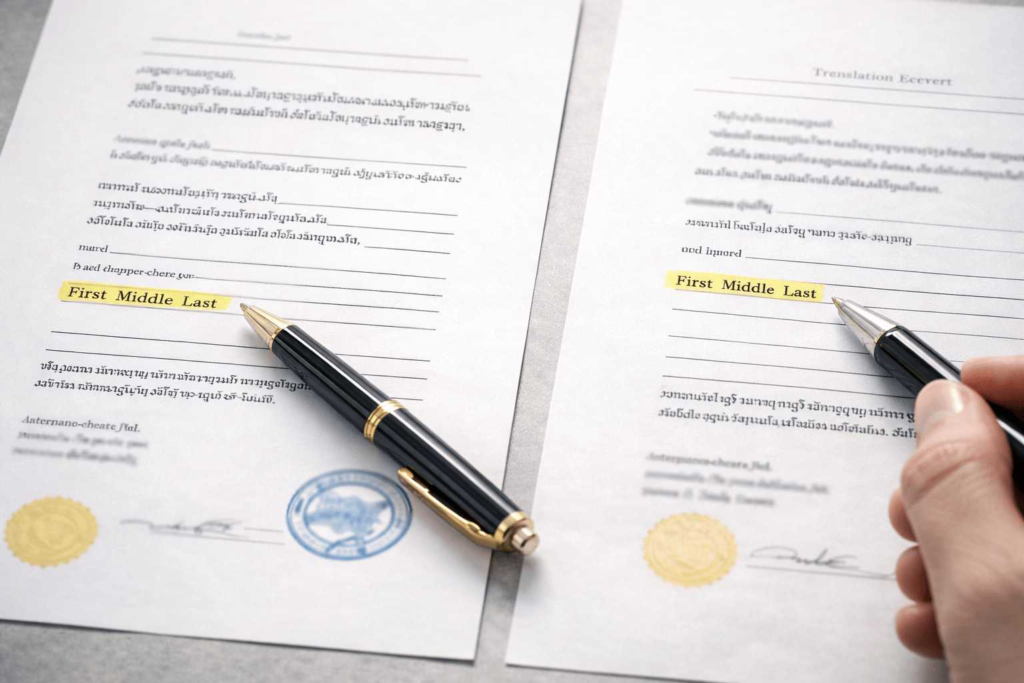
Name change files are frequently delayed because two documents are “technically correct” but don’t match.
Mini “name matching” plan (use this before you translate)
Create a one-line plan and stick to it:
- Old name (as on prior records): e.g., Maria I. García López
- New name (as requested): e.g., Maria I. Garcia
- Rule you’ll apply in translations: keep surnames and order consistent; remove diacritics only if required by the receiving authority; ensure spelling matches passport preference.
If you have multiple scripts (Arabic/Russian/Chinese), choose one transliteration and apply it everywhere.
Example: what a strong certification statement typically includes
Below is an example of the type of wording many organisations accept. The exact format can vary.
Certificate of Translation Accuracy
I, [Translator’s Name], certify that I am fluent in [Source Language] and English, and that the attached translation of the [Document Name] is a true, complete, and accurate translation of the original document to the best of my knowledge and ability.
Signature: ____________________
Date: ________________________
Contact details: ______________________
What to send (so you don’t pay twice)
Before you order, make sure your scan is:
- flat (no fingers covering text)
- complete (all edges visible)
- readable (good lighting, no glare)
- includes all pages and backs
If your document has stamps on the reverse, include the reverse even if it “looks blank”.
Ready to translate your name change document?
If you want a translation that’s clear, certified, and formatted for official submission, you can start immediately:
- Upload your file to receive a confirmation of requirements, price, and turnaround
- Or view what’s included with our certified translation services
FAQ Section
Do I need a certified translation for name change documents?
If your name change evidence is not in the required language of the organisation you’re submitting to, you will usually need a certified translation so they can verify your identity and the legal basis for the change.
What documents should I translate for a legal name change?
Most people translate the name change instrument (deed poll/court order/certificate) plus supporting identity documents used to prove continuity, such as birth certificate, marriage/divorce documents, and registry extracts.
Will a certified translation be accepted without notarisation?
Often, yes—many organisations accept certified translations without notarisation unless they explicitly request notarised or sworn translations. Always follow the receiving authority’s instructions.
Can I translate my own name change document?
Some organisations allow it, but it creates avoidable risk in name change cases where spelling and formatting are heavily scrutinised. A certified translation prepared by a competent translator, with a proper certification statement, is less likely to trigger delays.
How fast can I get a certified translation for a name change?
Turnaround depends on length, language, and complexity. Many single-page name change documents can be completed quickly if the scan is clear and all pages are included.
What causes name change translations to be rejected or questioned?
The most common issues are missing pages, untranslated stamps/seals, inconsistent spelling/transliteration across documents, and a certification statement that’s unsigned or missing key details.
How can I get a certified translation for a name change certificate in the UK?
Send a clear copy of the certificate and any related supporting documents to a professional translator or translation company, confirm the receiving authority, confirm your preferred English spelling if relevant, and request a full certified translation with a signed certification statement.
Where can I get a certified translation in the UK?
You can usually get one from a professional translation company or an individual professional translator who provides certified translations for official use. For extra reassurance, many people choose providers linked to recognised UK professional bodies or directories.
Is certifying a copy the same as certifying a translation?
No. Certifying a copy means confirming that a photocopy matches the original document. Certifying a translation means confirming that the translation is accurate and complete. Depending on the authority, you may need one or both.
Do I need to translate only the name change certificate?
Not always. If you are also relying on birth, marriage, divorce, adoption, registry, passport, or ID documents to show the chain from your old name to your new name, those may also need translating.
What do the HM Passport Office or the Home Office usually look for?
They typically need a full, usable translation that supports identity continuity. For foreign-language supporting documents, missing pages, inconsistent spellings, or incomplete certification details can all create delays.
Do I need an apostille as well as a certified translation?
Only if the receiving authority specifically asks for legalisation or an apostille. That is a separate step from translating the document and should be confirmed before you order.
Can I use any translator, or should I choose a qualified provider?
A qualified provider reduces risk in official submissions because name change translations often involve multiple linked documents, precise name matching, and formal certification requirements.