Military families deal with paperwork most people never see: service records, overseas civil documents, VA forms, immigration filings, marriage and birth certificates, and country-specific evidence that has to be reviewed quickly and correctly. When any part of that paperwork is in another language, a proper certified translation can make the difference between a smooth submission and a stressful delay.
This is especially true when you are handling two timelines at once, such as a VA-related claim and an immigration case for a spouse, child, or parent. The standards are strict, the documents are often sensitive, and the deadlines can be tied to PCS moves, deployment schedules, appointments, or benefit deadlines. That is why military families need a translation process built for official use, not a casual word-for-word rewrite.
If you are preparing a military-related document packet, the safest approach is to translate everything that must be reviewed in English, keep the formatting clear, and submit a complete, certified packet the first time.
Quick answer: Do military documents need certified translation?
If you are in the UK and submitting military-related paperwork to USCIS, VA, a court, an embassy, or a consulate, the key question is not where you live but where the documents are being filed. If any supporting document is in a foreign language, the safest route is usually a full English translation with a signed certification statement confirming the translation is complete and accurate.
Not every military document needs translation. A standard U.S. DD-214 is already in English, so it usually does not need translation for U.S. use. What normally needs translation are the supporting records around the military case, such as foreign marriage certificates, birth certificates, police certificates, court papers, school records, and overseas medical documents.
For military families, the most common problem is not the main service document. It is the mixed packet around it. That is why a page like this should answer the question clearly: military families usually need certified translation for foreign-language supporting evidence, not automatically for every military document in the file.
What “certified translation” means in military-related cases
For military families, certified translation usually comes up in two situations:
- Immigration filings (service member, spouse, child, parent, or survivor-related cases)
- Benefits and claims paperwork (including overseas treatment or reimbursement records)
A certified translation is not just a translated page. It is a submission-ready document set that should include:
- A full English translation of the foreign-language document
- A signed certification statement confirming completeness and accuracy
- The translator’s statement of competence
- Clean formatting that matches the source document clearly (names, dates, stamps, seals, notes)
This matters because military paperwork often gets reviewed by multiple offices. A document that is technically translated but poorly formatted, incomplete, or missing certification can trigger follow-up requests and slow everything down.
Official rules military families should know before filing
USCIS and other immigration filings
If a supporting document is in a foreign language, it should be translated in full into English and accompanied by the correct certification statement. That means the translation must be complete, not partial, and the certification must clearly confirm accuracy.
VA overseas claims
For VA-related overseas medical paperwork, language handling can affect speed. Even when the underlying treatment is eligible, a claim can move more slowly if the documents arrive in another language and have to be reviewed or translated later.
Free support may exist, but format still matters
Military families may have access to support resources for document translation in some situations. That can be helpful for routine family administration and relocation paperwork. But when the packet is being filed to a government authority, court, or formal reviewer, the final translation still needs to match the receiving authority’s requirement.
The documents military families most often need translated
Even when the main military document is already in English, the supporting evidence often is not. That is where most delays happen.
Immigration-related documents for service members and families
These are the most common documents we see in military family immigration packets:
- Marriage certificates
- Birth certificates
- Divorce decrees
- Police clearance certificates
- Passports and ID documents
- Household registration records
- Adoption paperwork
- Court judgments and custody orders
- Foreign military or government records
- Financial records used as supporting evidence
VA and overseas care documents
For veterans and military families living abroad or receiving overseas support, translation may be needed for:
- Medical invoices and receipts
- Hospital discharge summaries
- Diagnosis reports
- Pharmacy documents
- Treatment notes
- Supporting letters from clinics or doctors
- Claim attachments and correspondence
Education and family transition documents
During relocations, school placement and dependent paperwork can also require translation, including:
- School transcripts
- Immunisation records
- Academic certificates
- Guardianship documents
Which military documents usually do and do not need translation?
Documents that usually do need translation
In military-related cases, translation is usually needed for foreign-language supporting evidence such as:
Marriage and birth certificates issued abroad
Police and court records
Adoption and custody documents
Household registers and civil status records
School and vaccination records
Overseas medical records, invoices, and prescriptions
Foreign military or government documents included in the case file
Documents that usually do not need translation
Translation is usually not needed for documents that are already issued in clear English, such as:
A standard U.S. DD-214
English-language VA forms
English-language USCIS forms
English-language service records and correspondence
Why this distinction matters
Many users search broadly for “military document translation” when the real issue is only part of the packet. A strong page should state this clearly so the user knows whether they need translation for the entire file or just the non-English supporting records.
DD-214 translation and military service records
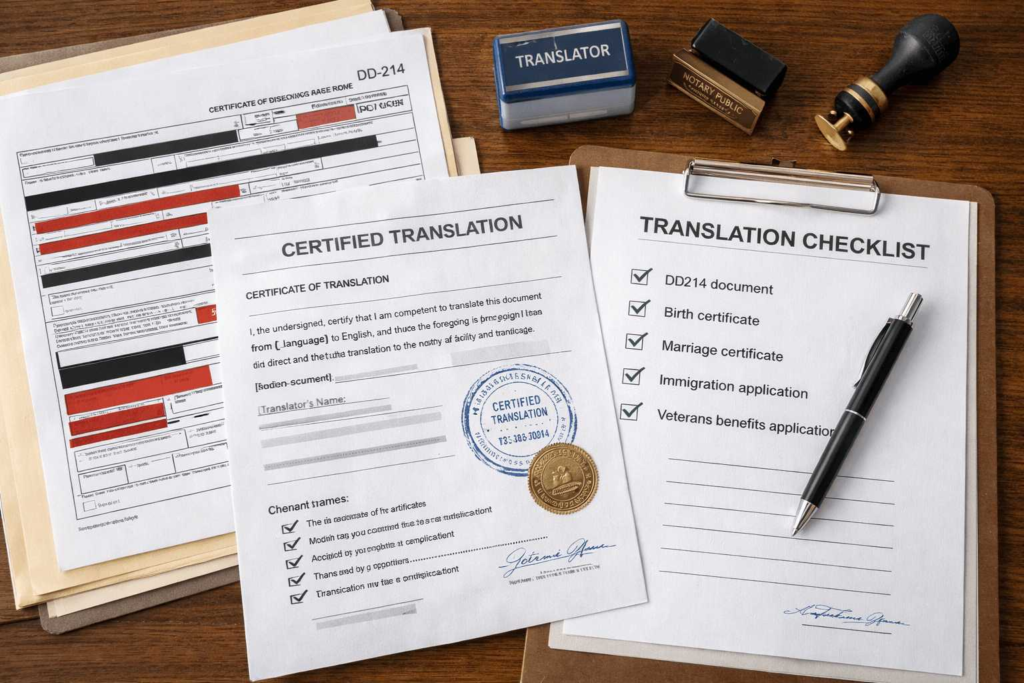
The DD Form 214 is one of the most important military documents a veteran will ever use. It is commonly needed to verify service for benefits, retirement, employment, and other official purposes.
Important point most pages get wrong
A standard U.S. DD-214 is already in English, so for USCIS or VA use, the DD-214 itself usually does not need translation.
Where translation becomes necessary is when the DD-214 is submitted alongside foreign-language documents, or when a family is dealing with:
- Foreign civil records (marriage, birth, police records)
- Non-English medical records
- Foreign military records
- Overseas legal documents
- Supporting documents for a spouse or child’s immigration case
When people still search for “DD-214 translation”
This usually happens because they are really trying to solve one of these problems:
- They need a complete military/immigration packet and are unsure which documents need translating.
- They need a replacement DD-214 and also need translations for related non-English records.
- They are submitting documents to a foreign authority and need certified English-to-foreign-language translation (or vice versa).
If your DD-214 is missing
Do not wait until your filing deadline. Order the replacement first, then organise the translation work for the rest of the packet so both are ready together. This avoids last-minute submissions with missing evidence.
If you are in the UK but filing to a U.S. authority
This is a common point of confusion. Being based in the UK does not remove the translation requirement for a U.S. filing. If the receiving authority is USCIS, VA, or another U.S. office, the document packet still has to meet that authority’s evidence standard.
In practice, this means a UK-based military spouse, veteran, or dependent may still need certified English translations for foreign-language civil records, medical records, school records, or court documents, even though the family is living outside the United States.
VA claims and overseas treatment: where translation delays happen

Military families and veterans living abroad often assume the difficult part is the medical paperwork itself. In practice, the delay often comes from language handling.
The common problem
A claim packet may include valid invoices and treatment records, but if they are not in English (or not translated clearly), the reviewer has to pause and request clarification. That can create avoidable delays.
What to translate for a cleaner VA submission
For overseas claims and reimbursements, translate the parts a reviewer needs to understand quickly:
- Provider name and clinic details
- Patient name
- Dates of service
- Diagnosis/treatment description
- Charges and currency
- Prescription details (if relevant)
- Supporting notes attached to the claim
Best practice for military families abroad
Send a neat packet with:
- Original document copy (scan or PDF)
- Certified English translation
- Certification statement
- Clear file naming (for example: Invoice-ClinicA-12Jan2026-English-Translation.pdf)
- A simple cover note listing all attachments
This makes the review process easier and reduces back-and-forth.
Will the VA translate non-English documents for you?
VA-related overseas claims can involve documents in another language, and those documents may still be processed. But if the packet has to be translated after submission, that can slow the claim down.
For that reason, many veterans and military families prefer to send a clean English packet from the start, especially when the claim includes multiple invoices, prescriptions, discharge summaries, treatment notes, or provider letters from more than one clinic. A pre-prepared certified packet is often the easier route when speed and clarity matter.
Military family immigration cases need a “packet” mindset
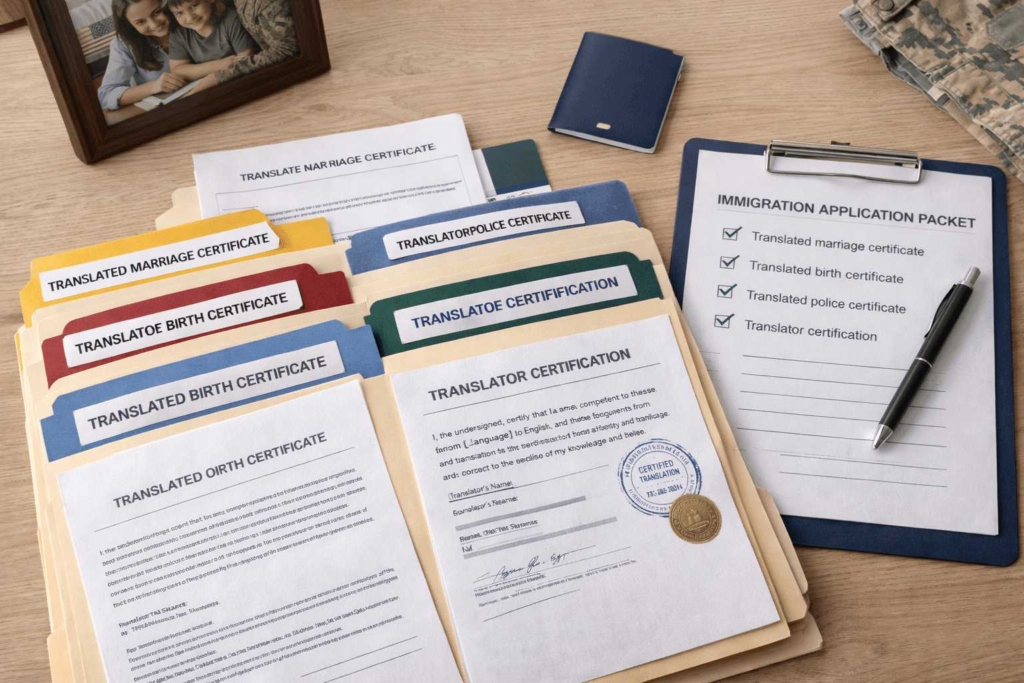
The biggest mistake military families make is translating documents one by one, only after receiving a follow-up request. That almost always costs more time.
A better approach is to prepare the whole packet at once.
Example 1: Spouse immigration while stationed overseas
A service member’s spouse may need:
- Marriage certificate translation
- Birth certificate translation
- Police certificate translation
- Household registry translation
- Court or divorce record translation (if applicable)
If only the marriage certificate is translated first, the case often stalls when the next document is requested. It is faster and cleaner to prepare the full set in one go.
Example 2: Child citizenship or family evidence
Military family cases often require proof of relationship and legal status. That may include:
- Child birth certificate
- Parent marriage certificate
- Custody orders
- Adoption paperwork
- Name change records
These documents must be consistent across names, dates, and spellings. A professional translator will keep the formatting and naming conventions aligned across the packet.
Example 3: Veteran + family + benefits timeline overlap
A veteran may be handling:
- VA paperwork abroad
- Immigration support for a spouse or parent
- Employment or licensing paperwork requiring service proof
This is where a translation team that can manage multiple document types under one order becomes a real advantage.
Certified vs notarised for military documents
This causes confusion in almost every military family case.
What you usually need
For most U.S. immigration filings, you need a certified translation.
When notarisation may be requested
Notarisation (notarization) may be required when:
- A specific court, consulate, or foreign authority requests it
- You are submitting documents abroad
- An attorney asks for a notarised certification statement for a local filing
Do not assume notarisation is always needed
Many families pay extra for notarisation when it is not required. The right step is to confirm the receiving authority’s requirement first.
If you are unsure, send the document list and destination authority together (USCIS, VA, court, embassy, consulate, etc.) so the translation team can advise the correct format before work starts.
Mistakes that cause delays in military translation cases
1) Partial translations
A common issue is translating only the “main text” and skipping:
- Seals
- Stamps
- Notes in the margin
- Handwritten entries
- Back-page information
Official reviewers may treat that as incomplete.
2) Inconsistent names across family documents
Military family cases often involve:
- Different surname formats
- Diacritics
- Double surnames
- Transliteration differences
If the names are not handled consistently, you may trigger a request for clarification.
3) Low-quality scans from older records
Military families often rely on scanned copies from older files, archives, or overseas offices. If the scan is cut off, blurred, or shadowed, translation accuracy drops and turnaround slows down.
4) Using a friend or family member for official packets
Even if they speak the language well, they may not know how to format the translation, preserve document structure, or prepare the certification correctly.
5) Ordering too late during PCS or deployment windows
Military timelines change quickly. Translation should be one of the first tasks, not the last.
How to prepare your documents for faster turnaround
Use this checklist before you upload anything:
Document prep checklist
- Scan the full page, including edges
- Include front and back (if anything appears on the reverse)
- Keep all stamps, seals, logos, and handwritten notes visible
- Send multi-page documents in the correct order
- Group related family documents together
- Tell us where the translations will be used (USCIS, VA, court, embassy, employer, etc.)
- Flag any urgent date (interview, filing, appointment, PCS move, hearing)
What to include in your message
To speed up quoting and production, include:
- Target language pair (for example, Arabic to English)
- Number of pages
- Country of issue (important for formatting conventions)
- Whether you need certified only or certified + notarised
- Deadline
- Whether hard copies are needed
What a strong military-family translation service should provide
Military cases are not just “urgent”; they are often sensitive, high-stakes, and multi-agency. You need a service that can handle official formatting and practical case flow.
Look for a provider that offers:
- Certified translations for official submissions
- Clear turnaround options (standard and rush)
- Secure document handling
- Experience with immigration and legal-style documents
- Formatting that preserves names, seals, and stamps
- Support for multi-document family packets
- Clear communication if a page is unclear or incomplete
You should also receive a final packet that is easy to forward to:
- Attorneys
- Caseworkers
- Government portals
- VA claims support
- Family members coordinating the case from another country
Military families often have free support options too — use them strategically
Some military families can access support services for interpretation and document translation through military resources. That can be very helpful, especially for routine family paperwork and transition support.
But if you are submitting a high-stakes packet to an immigration authority, court, or benefits office, make sure the final translation format matches the exact submission requirement. In many cases, the safest route is still a dedicated certified translation packet prepared for official review.
A practical approach is:
- Use free support services for guidance and routine assistance
- Use certified translation for official filings and evidence packets
- Keep one organised folder for all translated family documents so future filings are faster
Can free military support services replace a private certified translation service?
Sometimes they can help, but not always.
A free or internal support option may be perfectly suitable for routine family administration, school paperwork, relocation support, or early case preparation. But for USCIS, VA, court, embassy, or consular filings, you should confirm three things before relying on it:
The certification wording matches the authority’s requirement
The turnaround fits your deadline
The final files will be delivered in the format you need for submission
If the answer to any of those is unclear, a dedicated certified translation service is usually the safer option for the final filing packet.
A better way to handle military translation requests
Instead of ordering one translation at a time, send the full packet and ask for a document review first.
That lets us:
- Identify which pages actually need translation
- Flag missing pages before translation starts
- Keep names and dates consistent across the family file
- Recommend certified vs certified + notarised format
- Prioritise urgent pages first if you are close to a deadline
If you are working with a lawyer, VA support contact, or military legal office, we can also align the final file naming and delivery format so your packet is easier to submit.
Ready to submit your military family documents without delays?

If you are handling a military immigration case, overseas VA claim, or a family document packet tied to service records, start with the documents you already have. We will review the file set, confirm what needs translation, and prepare a certified packet that is clear, complete, and ready for official use.
Upload your files today and get a fast, document-by-document quote with the right format from the start.
If your deadline is close, include the date in your message and we will prioritise the urgent pages first.
Frequently Asked Questions
Do military families need certified translation for immigration documents?
Yes. If a document is not in English and you are submitting it for a U.S. immigration matter, you will generally need a full English translation with a signed certification from the translator.
Does a DD-214 need to be translated for USCIS or VA?
A standard U.S. DD-214 is already in English, so it usually does not need translation. The translation usually applies to supporting foreign-language documents in the same packet, such as marriage, birth, police, court, or medical records.
Can I translate military family documents myself?
It is not recommended for official filings. Even if you are fluent, self-prepared translations often cause issues with formatting, completeness, or certification. For official use, a professionally prepared certified translation is the safer option.
Do I need a notarised translation for military immigration cases?
Usually, you need certified translation, not notarised translation. Notarisation may be required by a specific court, consulate, or foreign authority. Always check the destination requirement before paying for extras.
What military-related documents can be translated urgently?
Most common documents can be handled on a rush basis, including marriage certificates, birth certificates, police certificates, service-related records, and supporting medical documents. The key factor is scan quality and page count.
Can you help with a mixed packet for VA and immigration?
Yes. Many families submit a combination of records for different purposes. It is best to send the full packet together so the translations can be prepared consistently and prioritised correctly.
Do I need certified translation if I live in the UK but my filing is for USCIS or VA?
Yes, in many cases. If the receiving authority is U.S.-based and a supporting document is not in English, the packet will usually still need a full English translation with the correct certification. Your location in the UK does not remove the filing requirement.
Will the VA translate overseas medical records for me?
VA-related foreign-language documents may still be processed, but translation after submission can add time. For a cleaner and often faster submission, many veterans provide certified English translations of key invoices, discharge summaries, prescriptions, and treatment notes from the start.
Can Military OneSource help with document translation?
In some cases, yes. Eligible military families may be able to access translation support for certain family and relocation-related documents. It is still important to confirm that the final format suits your USCIS, VA, court, or consular submission.
Which military documents usually do not need translation?
Documents already issued in clear English usually do not need translation. A standard U.S. DD-214 is the most common example. The translation need usually applies to foreign-language supporting evidence attached to the military-related case.
What if my DD-214 is missing and my deadline is close?
Request the replacement immediately and organise the rest of the packet at the same time. That way, the supporting foreign-language documents can be translated while you are waiting for the DD-214 copy.
Can one order include military, civil, and medical documents together?
Yes. In fact, mixed packets are often easier to manage when they are translated together, because names, dates, seals, and file naming can be kept consistent across the entire submission.