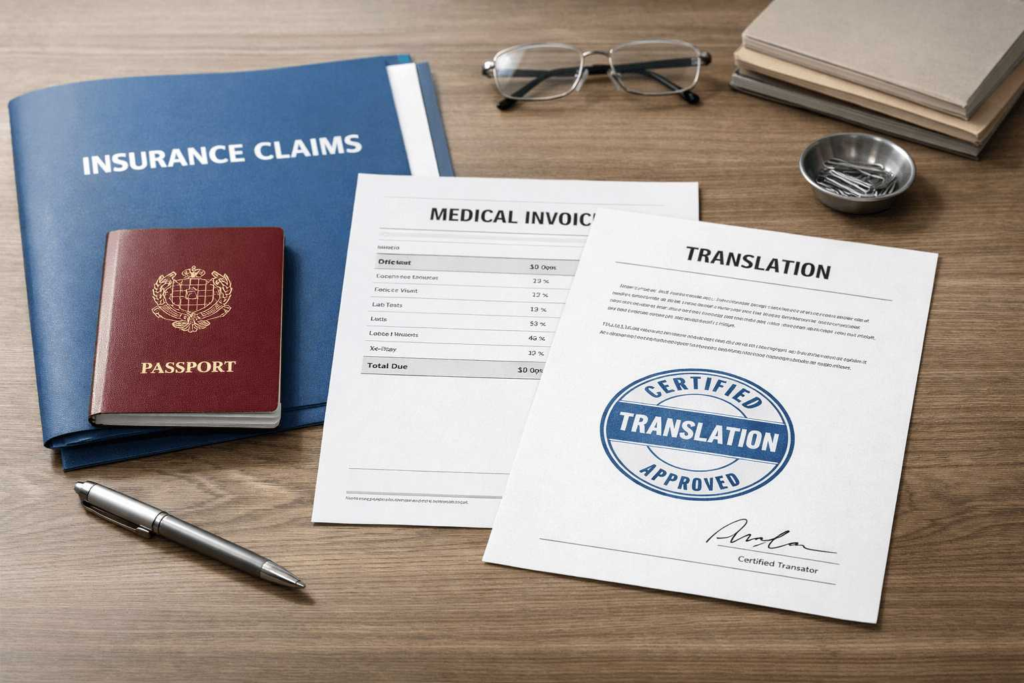
An insurance claim can be stressful enough without a preventable delay: “We can’t process this yet because the documents aren’t in the right language.” If you’ve received treatment abroad, filed a travel claim after an incident overseas, or you’re submitting foreign documents to support a payout, a certified translation for insurance can be the difference between a smooth claim and weeks of back-and-forth.
This guide explains when insurers typically ask for certified translations, what “certified” actually means in practice, and how to submit translations that are easy for claims teams, adjusters, and (if needed) legal teams to verify quickly.
If you already have your documents ready, you can start here: Certified Translation Services.
Where can you get certified translation services for insurance documents in the UK?
If you are asking, “Where can I get certified translation services for insurance documents in the UK?”, the safest option is a professional translation provider that can supply:
A full human translation of the entire document
A signed Certificate of Translation Accuracy
Translator or agency contact details
A clear PDF that claims handlers can review easily
Optional notarisation or sworn translation support if an insurer specifically asks for it
At Urgent Certified Translation, you can request a certified translation for insurance documents online from anywhere in the UK. This is commonly used for medical reports, hospital invoices, police reports, repair estimates, death certificates, marriage certificates, travel claim evidence, and other official records submitted to support an insurance claim.
The key is not just speed. It is providing a translation package that is complete, legible, and easy for insurers, adjusters, or legal reviewers to verify.
When do you need a certified translation for insurance?
Not every claim needs certification. But insurers are far more likely to request a certified translation for insurance when the document is being used to prove eligibility, validate loss, or justify payment.
You’ll usually need a certified translation when:
- The insurer explicitly requires it (often stated on claim forms or in instructions).
- Documents are official: hospital discharge summaries, police reports, court documents, death certificates, marriage certificates, medical invoices with provider details, or formal repair estimates.
- The claim value is significant, and the insurer needs a clear audit trail.
- There’s a dispute, complaint, or escalation (for example, the claim is denied and you’re challenging the decision).
- The claim crosses borders: treatment abroad, incident abroad, foreign providers, foreign authorities.
- The document includes legal or medical terminology where small translation errors create large financial consequences.
You may not need certification when:
- You’re submitting informal supporting evidence (simple emails, basic receipts), and the insurer has told you a standard professional translation is sufficient.
- The insurer accepts documents in the original language (some do for common languages, but don’t assume).
Rule of thumb: if the document is decisive evidence (it affects whether you get paid), treat it as certification-worthy unless the insurer confirms otherwise.
What is a “certified translation” in insurance?
A certified translation is more than “a good translation.” It is a translation that comes with a formal certification statement confirming the translation is complete and accurate, and that the translator is competent in the language pair.
For insurance use, a proper certification typically includes:
- A Certificate of Translation Accuracy (or similarly titled statement)
- Translator’s name and signature
- Date
- Confirmation that the translation is complete and accurate
- Confirmation that the translator is qualified/competent
- Contact details (often included)
Some insurers also ask for:
- Company letterhead
- A stamp/seal (depending on jurisdiction or internal policy)
- Notarisation (less common, but sometimes requested)
Certified vs notarised vs sworn: what’s the difference?
- Certified translation: translator/agency certifies accuracy and completeness.
- Notarised translation: a notary verifies the identity of the signer (not the translation quality).
- Sworn translation: produced by a translator authorised under a specific legal system (common in parts of Europe and some other jurisdictions).
If you’re unsure which one you need, ask your insurer a single clarifying question:
“Do you require a certified translation with a certificate of accuracy, and do you also require notarisation or a sworn translator?”
Certified translation requirements for insurance documents in the UK
In the UK, insurers do not all follow one identical language policy, but the practical requirement is usually the same: if a foreign-language document affects claim approval, liability, medical evidence, identity, or payout, the insurer needs a translation that is clear, complete, and formally attributable to a qualified translator or agency.
For most UK insurance cases, the safest submission includes:
The full translation of every relevant page
A signed certificate of accuracy
The date of certification
The translator or agency name and contact details
Clear treatment of stamps, seals, handwritten notes, and official annotations
If the claim later moves beyond routine handling, such as a complaint, ombudsman review, fraud check, legal dispute, or cross-border verification, the importance of a properly certified translation usually increases.
Insurance document translation requirements (the claim-ready checklist)
If insurers had a universal “reject reasons” list, it would look a lot like this. Use the checklist below before you submit anything.
The 12-point “claim-ready translation” checklist
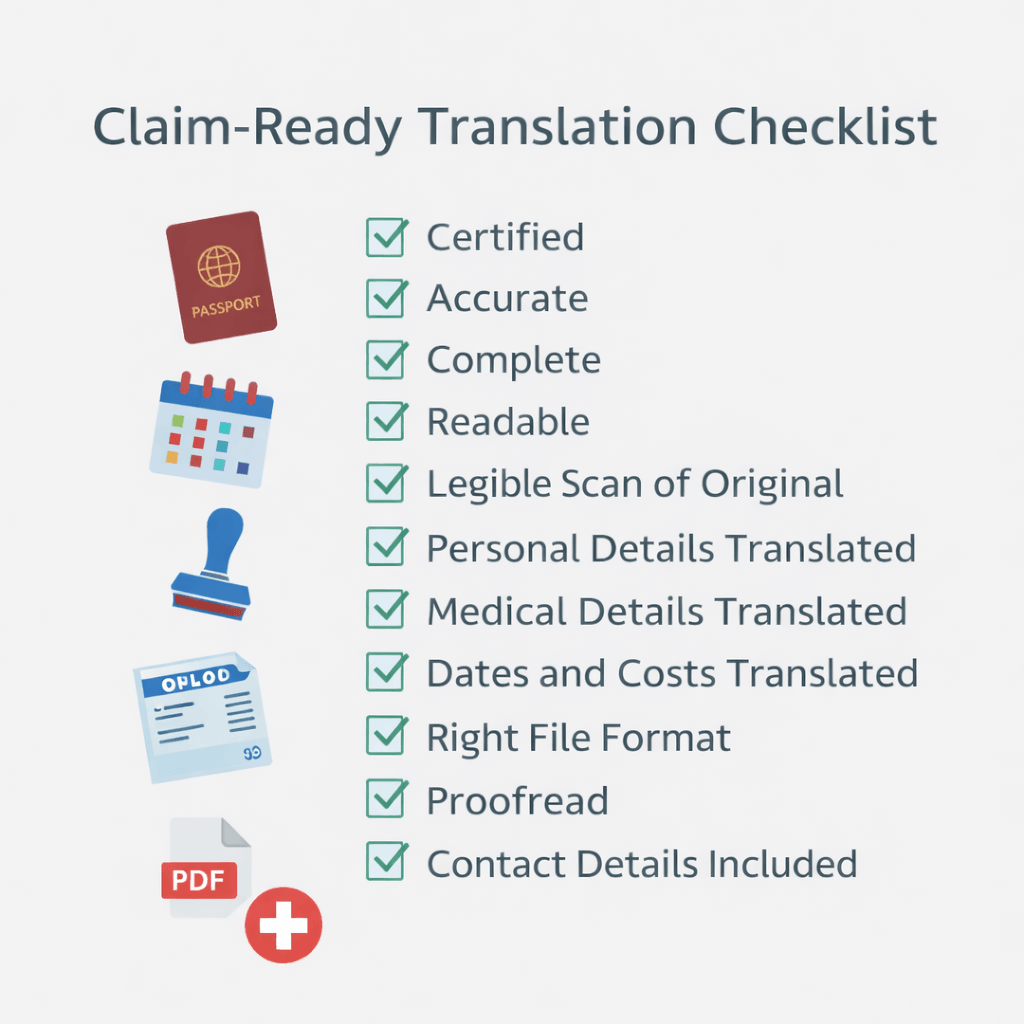
- Every page is included (front and back, including blank stamped pages if they exist).
- Stamps, seals, and annotations are accounted for (and clearly labelled in the translation).
- Names match the spelling on your passport/ID (including middle names, order, diacritics).
- Dates are consistent (especially where different countries use different formats).
- Document numbers and policy references are copied exactly (no “close enough”).
- Currency and units are preserved (and clarified where needed: EUR vs USD, mg vs ml, kilometres vs miles).
- Medical terminology is precise (diagnoses, procedures, medications, dosages).
- Handwritten notes are translated when legible (and marked as “handwritten” in the translation).
- No missing attachments (lab results, itemised invoices, prescriptions, discharge summaries, photos, witness statements).
- Formatting is easy to cross-check (headings and sections are clear; tables stay readable).
- The certification statement is included, signed, and dated.
- The output is delivered as a clean, readable PDF suitable for uploading.
If you want an extra layer of safety, request a “submission-ready” review before delivery. On our side, that’s part of the process described here: Certified Translation Services.
What insurance documents are most commonly translated?
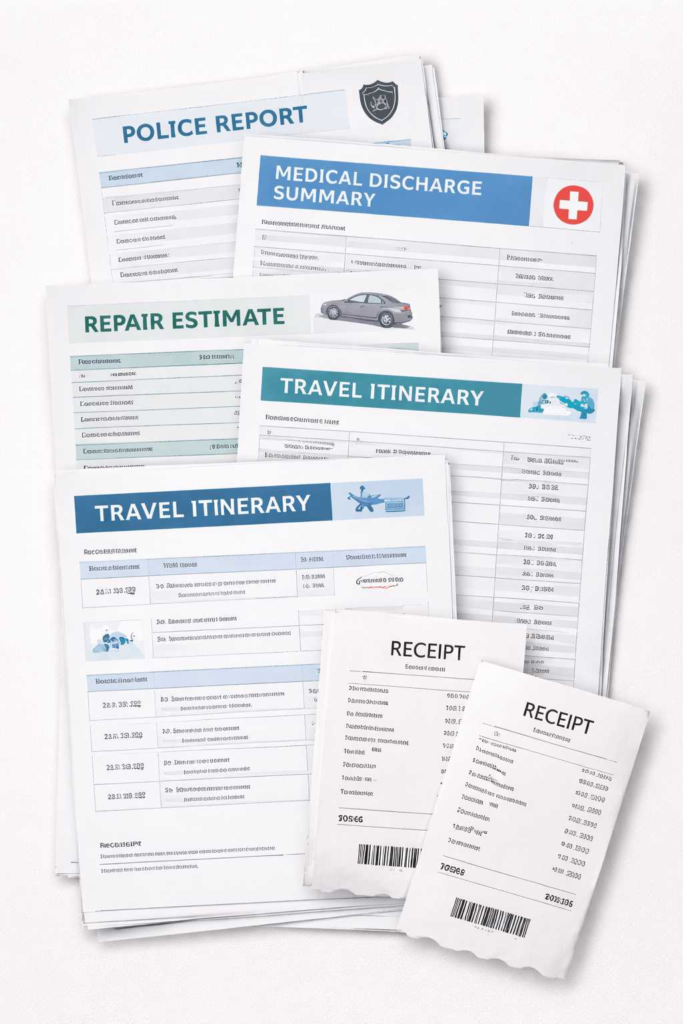
Insurance claims don’t come in one shape. Here are the documents that most frequently trigger translation requests.
Medical and health-related claims
- Hospital discharge summaries
- Medical reports and diagnoses
- Itemised invoices (with provider details)
- Lab results and imaging reports
- Prescriptions and pharmacy receipts
- Medical certificates and treatment plans
Where translation matters most: procedure names, diagnosis codes/descriptions, dates of treatment, and itemised charges.
Travel insurance claims
- Police reports (theft, assault, accident)
- Airline delay/cancellation letters
- Proof of travel (boarding passes, itineraries)
- Hotel incident reports
- Receipts for replacement items or emergency costs
Where translation matters most: incident description, time/date, location, and official references.
Motor and accident-related claims
- Police accident reports
- Witness statements
- Repair estimates and invoices
- Medical assessments linked to injury claims
Where translation matters most: vehicle details, liability language, injury descriptions, and repair line items.
Life insurance and beneficiary claims
- Death certificates
- Marriage certificates/proof of relationship
- Probate or court documents (where applicable)
- Bank documents for payout routing (sometimes requested)
Where translation matters most: identity details, cause-of-death wording, legal declarations, and issuing authority information.
Property and home claims
- Damage reports from local authorities
- Contractor estimates
- Proof of ownership documents (in cross-border scenarios)
- Photos with translated annotations (if requested)
Where translation matters most: scope of damage, dates, addresses, and valuation language.
How to choose a certified translation service for insurance documents
If you are comparing providers, look for features that directly reduce the risk of claim delays:
Experience with insurance, medical, and legal terminology
Certification included as standard
Ability to translate complete document packs, not just isolated pages
Fast turnaround options for urgent claims
Delivery in submission-ready PDF format
Support for notarisation if requested
Clear communication about names, dates, policy numbers, and formatting
A good provider should also tell you early if scan quality is too poor, if pages are missing, or if a document needs specialist handling. That kind of pre-check often prevents resubmission later.
How to prepare documents for insurance claim translation
A translator can only translate what’s visible. Most avoidable delays happen before translation begins.
Do this before you upload anything
- Scan or photograph in good light (flat, no glare, no fingers covering text).
- Capture full page edges (cropping is a common cause of “missing information”).
- Include the front and back of the cards and certificates.
- Keep multi-page files in order, preferably as a single PDF per document type.
- If the insurer gave you instructions, upload those too (even a screenshot is helpful).
Organise your documents like a claims handler
Instead of uploading 18 random photos, group by category:
- Medical (reports, invoices, prescriptions)
- Incident evidence (police report, witness statement)
- Financial proof (receipts, bank confirmations if required)
- Travel proof (tickets, booking confirmations)
This simple structure can reduce processing time because it matches how claims teams triage evidence.
Step-by-step: how to get certified translation for insurance
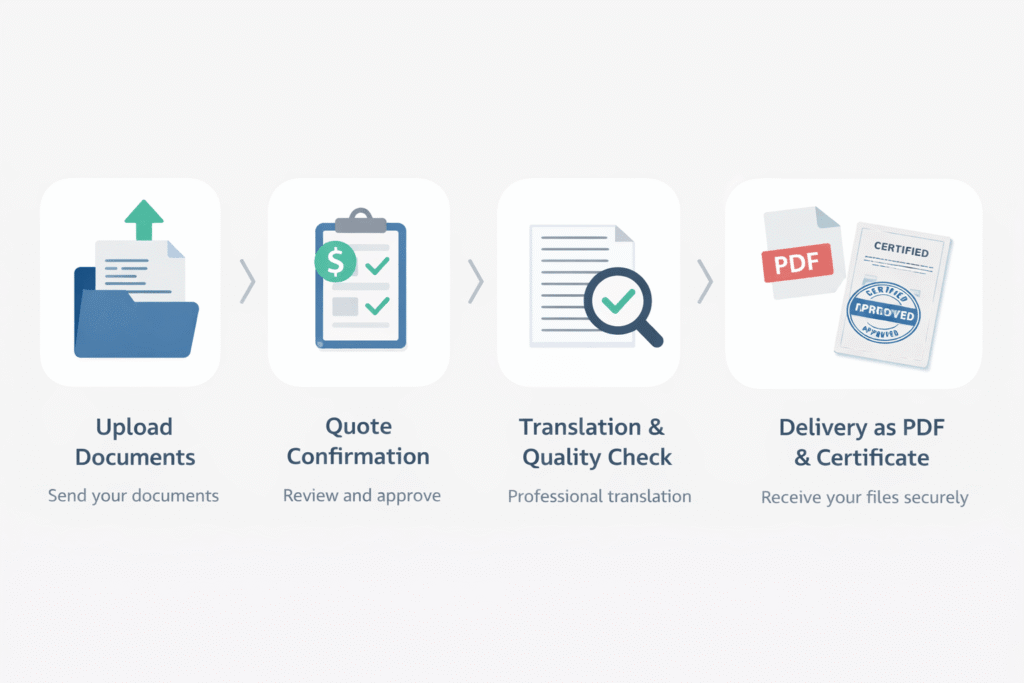
Step 1: Confirm what the insurer wants (one email can save weeks)
Ask:
- Which documents must be translated?
- Do they require certified translation?
- Do they also require notarisation or sworn translation?
- Do they require a specific language variant (e.g., US English vs UK English)?
Step 2: Choose a service that can produce claim-ready certification
For insurance, you want:
- Clear, complete translation
- A proper certification statement
- Formatting that’s easy to compare to the original
- Fast turnaround options when deadlines are tight
You can start your request here: Contact us.
Step 3: Provide context that improves accuracy
Include:
- Your policy number (if you want it referenced)
- The claim type (travel, medical, motor, life, property)
- Any insurer-specific phrases or templates they require
- Your preferred name spelling (matching passport/ID)
Step 4: Review the “high-risk details” before submission
Even professional translations can be delayed if a name is inconsistent with your ID, or a date format looks wrong.
Check:
- Names (order, spelling)
- Dates (day/month vs month/day)
- Currency
- Document numbers
- Provider names and addresses (medical invoices, especially)
Step 5: Submit in the format the insurer prefers
Most insurers accept:
- A single PDF with translation + certification statement
- Separate PDFs per document category
If your insurer uses a portal with upload limits, ask for split PDFs by category.
Common mistakes that slow down insurance claims (and how to avoid them)
1) “Partial translations”
Translating only the “important bits” is a fast route to a request for resubmission. Insurance claims rely on context.
Fix: translate the full document, including stamps, headers, and footnotes.
2) Missing pages or missing backs of documents
Many official certificates have critical information on the reverse.
Fix: always include front and back, even if one side looks blank.
3) Machine translation for medical/legal content
Machine translation can be useful for the gist. It is not designed for claim-critical accuracy.
Fix: Use professional human translation for anything that affects eligibility or payout.
4) Name and date mismatches
One small inconsistency can trigger a verification pause.
Fix: tell the translator the exact spelling you need (matching passport/ID) and confirm date formats.
5) Unreadable scans
Claims teams can’t verify what they can’t see.
Fix: retake photos before translation begins. A clear scan saves time and money.
Cost and turnaround: what actually affects your quote?
Insurance translation pricing varies because documents vary. The main factors are:
- Language pair (rarer pairs can cost more)
- Length (pages/word count)
- Complexity (medical and legal terminology requires specialist handling)
- Certification requirements (certified vs standard)
- Urgency (same-day/next-day options)
- Extra services (notarisation, hard copies, apostille if required for related legal steps)
If you’re working to a deadline, upload the document and the deadline in one go. It’s easier to confirm the fastest viable turnaround than to guess.
Start here: Certified Translation Services.
Real-world examples: how certified translation prevents claim delays
Example 1: Travel medical claim after treatment abroad
A traveller submits hospital invoices and a discharge summary in a foreign language. The insurer asks for “official translation,” but doesn’t specify what that means. The claim pauses until the traveller provides a certified translation with a signed certificate of accuracy.
What changed: the insurer could verify the translation formally and proceed with the assessment.
Example 2: Motor claim with a police report from overseas
A police report includes a diagram, stamped statements, and handwritten notes. The claimant submits a translation that ignores stamps and handwritten lines. The insurer requests a re-translation, delaying repairs.
What changed: a complete, certified translation that includes stamps and handwritten notes reduces follow-up questions.
Example 3: Life insurance payout involving foreign civil documents
A beneficiary submits relationship documents (marriage certificate) and an official death certificate from abroad. The insurer requests certified translations to validate the payout decision.
What changed: certified translation provides the documentation integrity needed for approval.
What you can expect from Urgent Certified Translation
Insurance claims move faster when your documents are easy to verify. Our certified translation process is built around the practical details that most often trigger re-requests:
- Complete translations (including stamps, seals, and visible notes)
- A signed Certificate of Translation Accuracy
- Clear formatting that makes the translation easy to compare against the original
- A quality check focused on names, dates, document numbers, and completeness
If you want to avoid back-and-forth, the quickest path is to submit your documents in one pack with your deadline and insurer instructions.
Upload your files and get a clear quote: Contact us.
FAQ Section
Do I need a certified translation for insurance claims?
Often, yes—especially for official documents (medical reports, police reports, certificates) or when the insurer specifically requests certified translation for insurance.
What does “certified translation” mean for insurance?
It means the translation is accompanied by a signed statement confirming the translation is complete and accurate, and the translator is competent in the language pair.
Can I translate insurance documents myself?
Some insurers may accept it for low-stakes documents, but it can create delays if they require certification or if there are errors in names, dates, or terminology. For decisive claim evidence, professional certified translation is the safer route.
Do insurance translations need to be notarised?
Not always. Notarisation is typically only needed if the insurer explicitly asks for it. If they do, it’s best to confirm whether they need notarisation, sworn translation, or just certified translation.
Which insurance documents most commonly need translation?
Medical reports, itemised invoices, police reports, repair estimates, death certificates, marriage certificates (for beneficiary claims), and official correspondence supporting eligibility or payout decisions.
How fast can I get a certified translation for insurance?
Turnaround depends on language pair, document length, and complexity. Many personal documents can be completed quickly, and urgent options are often available when you have a deadline.
Where can I get certified translation services for insurance documents in the UK?
You can use a professional certified translation provider in the UK that supplies a signed certificate of accuracy, full-document translation, and clear PDF delivery. This is commonly used for medical reports, police reports, repair estimates, certificates, and claim-supporting evidence submitted to insurers.
Will UK insurers accept online certified translations?
Many insurers accept digitally delivered certified translations, especially when the translation includes a signed certificate of accuracy and all pages are clearly presented. If your insurer has a portal or hard-copy requirement, confirm whether they want one combined PDF, separate files, or posted originals.
What should I send for a quote for insurance document translation?
Send clear scans or photos of every page, your deadline, the target language, and any insurer instructions. It also helps to mention the claim type—medical, travel, motor, life, or property—so the translator can prepare the document in the most suitable format.
Can certified translation be used for insurance complaints or ombudsman cases?
Often, yes. If the translated document is part of a complaint, appeal, or dispute, certified translation is usually the safer option because it gives the reviewer a formal statement of accuracy and helps preserve the evidential value of the document.