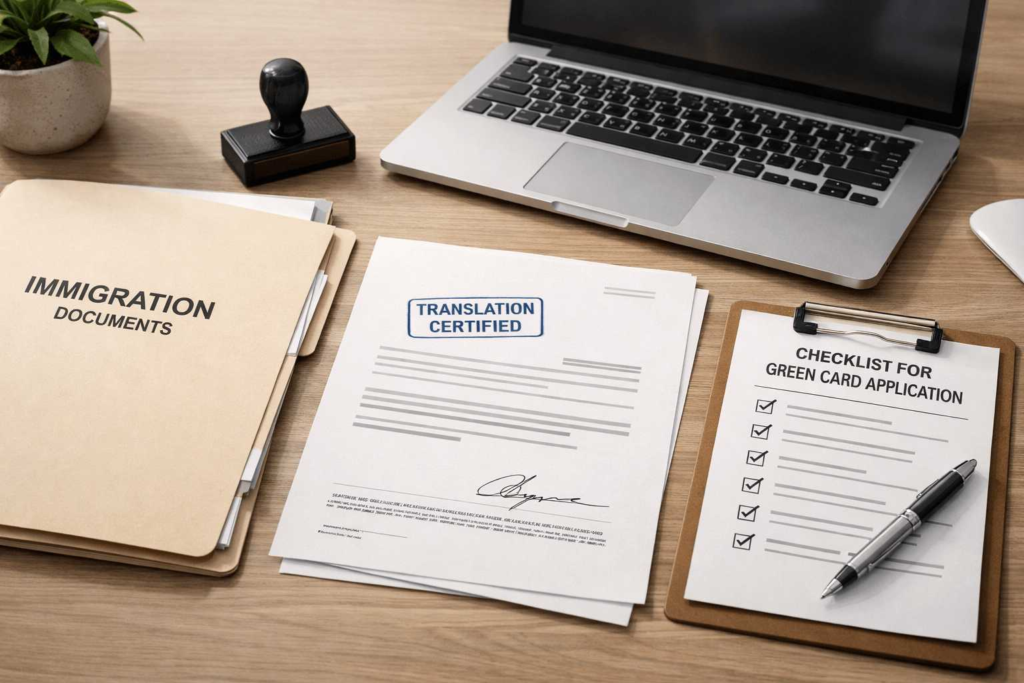
If you are filing for a green card, one of the quickest ways to create avoidable delays is to submit foreign-language documents that have not been translated properly. A strong application can still run into problems if the supporting documents are incomplete, unclear, or missing the correct certification.
This guide explains what certified translation means in the context of a green card application, which documents commonly need translation, and how to avoid the small mistakes that can cause major disruption.
In a rush? Here is the simple rule
If you are submitting a document that is not in English, the safest assumption is that you will need:
- a full English translation, and
- a proper certification statement
Together, these make the document submission-ready.
If you want to remove the guesswork, start with our Certified Translation Services page and upload your document when you are ready.
How do I get a certified translation for my green card application?
For most applicants, the process is straightforward.
- Identify every non-English document you are actually submitting with your green card case.
- Scan every relevant page clearly, including stamps, seals, handwritten notes, and any back pages where content appears.
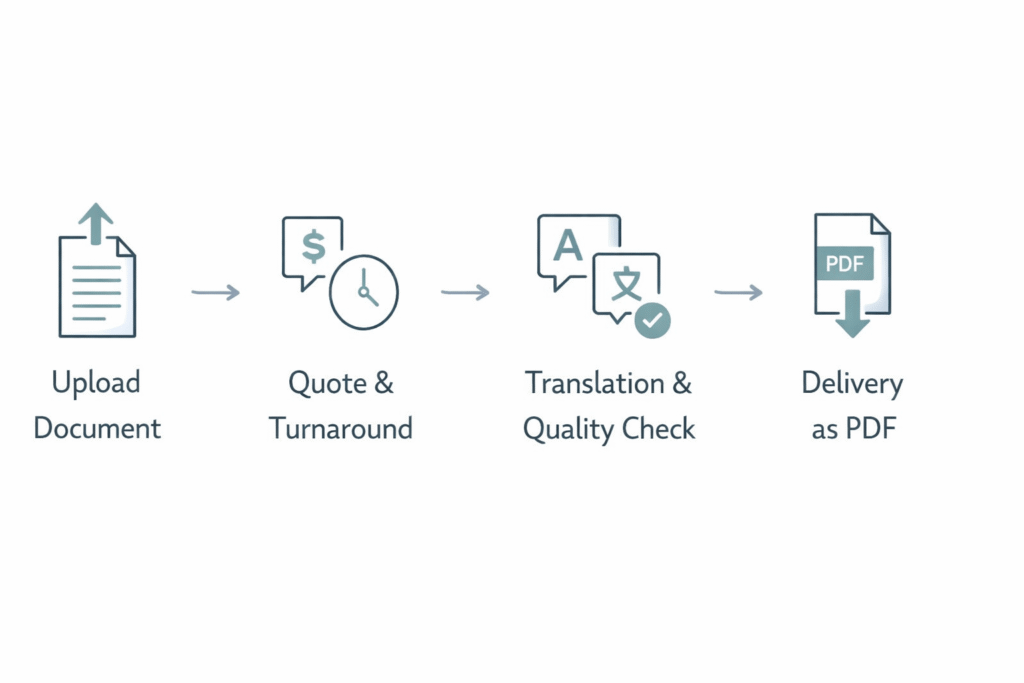
- Send the files to a professional translation provider and request a full English translation with a signed certification statement.
- Check that names, dates, places, and document numbers are consistent with your passport and supporting records.
- Receive the final certified translation in a submission-ready format, usually as a PDF with the certification attached.
- Submit the original-language document together with the English translation, and keep a copy of the full set for your own records.
The practical rule is simple: if the document you are filing is in another language, treat the translation and the certification as part of the document package, not as an optional extra.
What “certified translation” means for a green card case
A certified translation is not a special government stamp, and it is not a separate licence issued by USCIS.
In practice, a certified translation is:
- a complete English translation of the document, not a summary, and
- a signed certification statement from the translator or translation company representative confirming:
- the translation is complete and accurate, and
- the translator is competent to translate the language pair
- the translation is complete and accurate, and
That certification statement is the part many applicants overlook. It is also the part that makes the translation feel official and usable from an immigration filing point of view.
The USCIS rule in plain English
The safest way to understand the requirement is this:
- the translation should be full, not partial
- the translation should be complete and accurate
- the translator should sign a certification confirming competence in the language pair
That means a green card-ready translation is more than just English text on a page. It should cover the whole document you are submitting, reflect visible content such as notes and stamps where relevant, and include the certification statement so the file can be reviewed without unnecessary follow-up.
The green card translation trap: it is not just what you translate, but what you forget
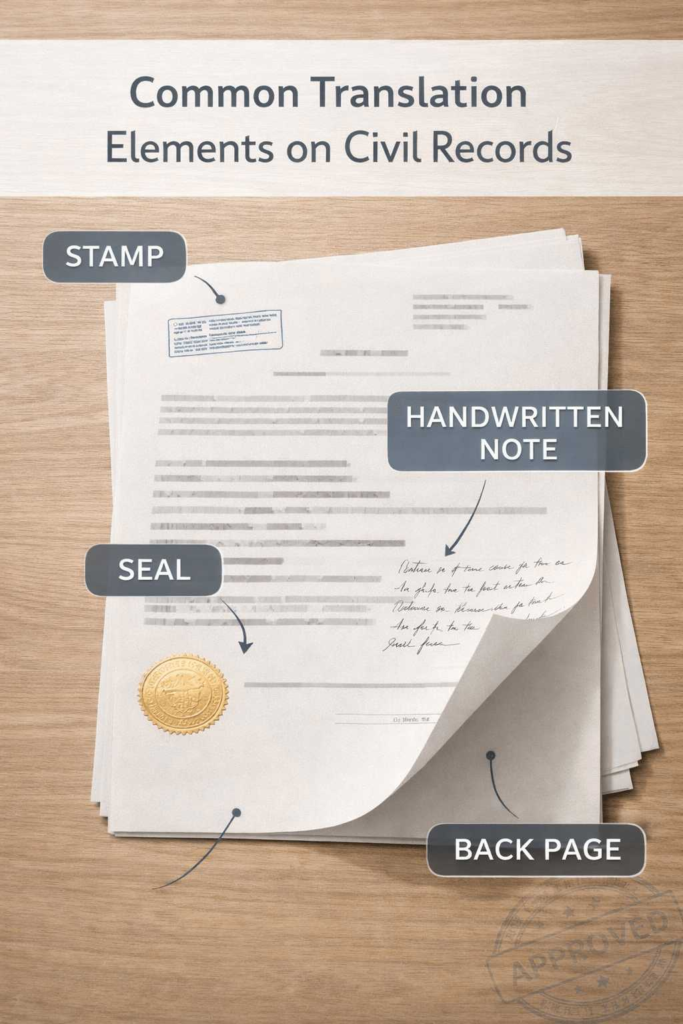
Most translation issues in green card applications do not come from poor English. They come from missing details.
Applicants commonly forget to include:
- stamps, seals, and watermarks
- handwritten notes
- back pages, especially on civil records
- marginal notes
- corrections, amendments, and annotations
- numbering and reference codes that help USCIS match records
A useful rule of thumb is this: if an officer can see it on the original document, they will usually expect to see it represented in the translation, either translated or clearly labelled.
Green card translation checklist: what documents usually need translation
There is no single universal list because green card cases vary. Family-based, employment-based, asylum-related, adjustment of status, and consular processing cases can all involve different paperwork.
However, the same document categories appear repeatedly.
Identity and civil status documents
These are among the most commonly translated documents:
- birth certificate
- marriage certificate
- divorce decree or divorce certificate
- death certificate, where relevant
- adoption records, if applicable
- name change documents
Immigration history and status evidence
Depending on your case, this may include:
- entry and exit stamps, if submitted as evidence
- prior immigration approvals or denials, if not in English
- police certificates or clearance letters, where requested
- court records, if relevant to admissibility
Family and relationship evidence
Many applicants translate the main certificate but overlook supporting records. Common examples include:
- household register or family register
- civil registry extracts showing parents or spouse
- relationship certificates issued by local authorities
Education and employment evidence
These are common in work-based filings or supporting evidence packages:
- diplomas and degree certificates
- academic transcripts
- professional licences
- employment letters, if not in English
Financial and household documents
These may be needed in some cases and can include:
- tax documents
- bank letters or statements, if submitted and not in English
- property or tenancy documents, if used as evidence
- affidavits from third parties, if not in English
Practical shortcut
Translate what you are actually submitting. If you are not including the document in your filing, you do not need to translate it.
Why this comes up in different green card routes
When people refer to a green card application, they may be talking about adjustment of status inside the United States, consular processing outside the United States, or a case supported by family, employment, or other civil documentation.
The exact document set may differ, but the translation principle remains the same: if the document you are submitting is not in English, it should be prepared with a full English translation and a proper certification statement.
Do you need to translate your passport for a green card application?
Usually, no. You do not normally need to translate the entire passport.
However, translation may be needed if:
- the submitted copy contains non-English biographical details
- there are annotations that matter, such as status notes or endorsements
- your supporting evidence relies on non-English entry or exit stamps and you are including them
If you are unsure, the safest approach is to translate the relevant page or pages you are submitting, together with any non-English notations that may affect interpretation.
Do you submit the original-language document with the translation?
In practice, yes. The English translation should travel with the foreign-language document it relates to.
Best practice
- Keep the original-language document and the English translation together as one document set.
- If you are uploading files, place the original-language pages first and the English translation after them.
- Keep your own copy of the same combined set for reference.
This makes it easier for a reviewer to compare the source document and the translation quickly, and it reduces the risk of the file being treated as incomplete.
What a correct certification statement should include
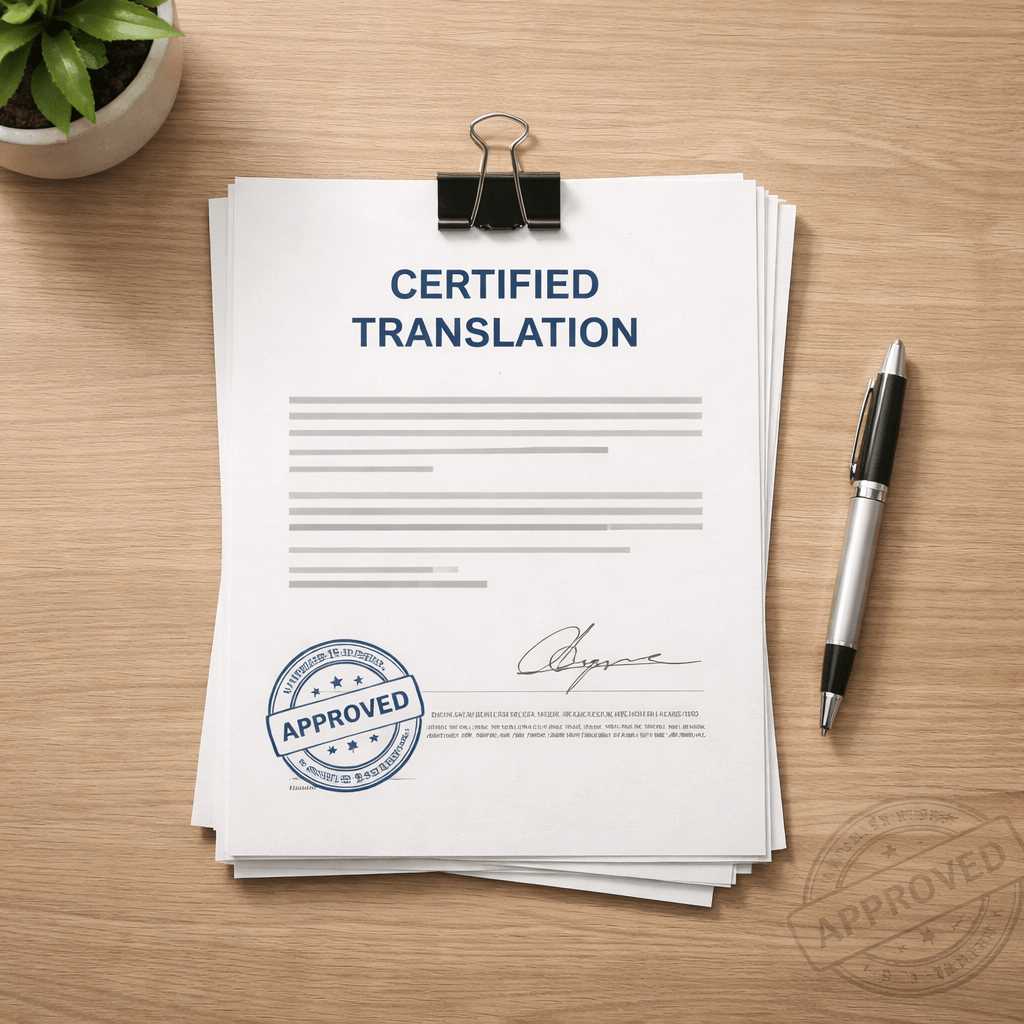
A strong certification statement should be short, clear, and complete.
It should include:
- translator’s full name
- statement of competence in the language pair
- statement of accuracy and completeness
- signature
- date
- contact details, ideally
- if issued by a company, the company name and the signatory’s role, such as Project Manager or Authorised Representative
Sample certification statement template
I, [Full Name], certify that I am competent to translate from [Language] into English and that the attached translation is a true, accurate, and complete translation of the original document.
Signature: ____________________
Date: ________________________
Contact (email/phone): ____________________
Address (optional): ________________________
If you want a ready-to-submit format with the certificate included, start with our Certified Translation Services page.
What you should receive from a professional translation provider
A proper green card translation package usually includes:
- a full English translation of the document being submitted
- a signed certification statement attached to the translation
- clear identification of the source document the translation relates to
- delivery in a practical filing format, usually PDF
- an optional printed copy, if you want a hard-copy set for your records
If a provider sends only plain translated text without a certificate, the document may not yet be submission-ready.
Certified vs notarised vs sworn: what you actually need for a green card
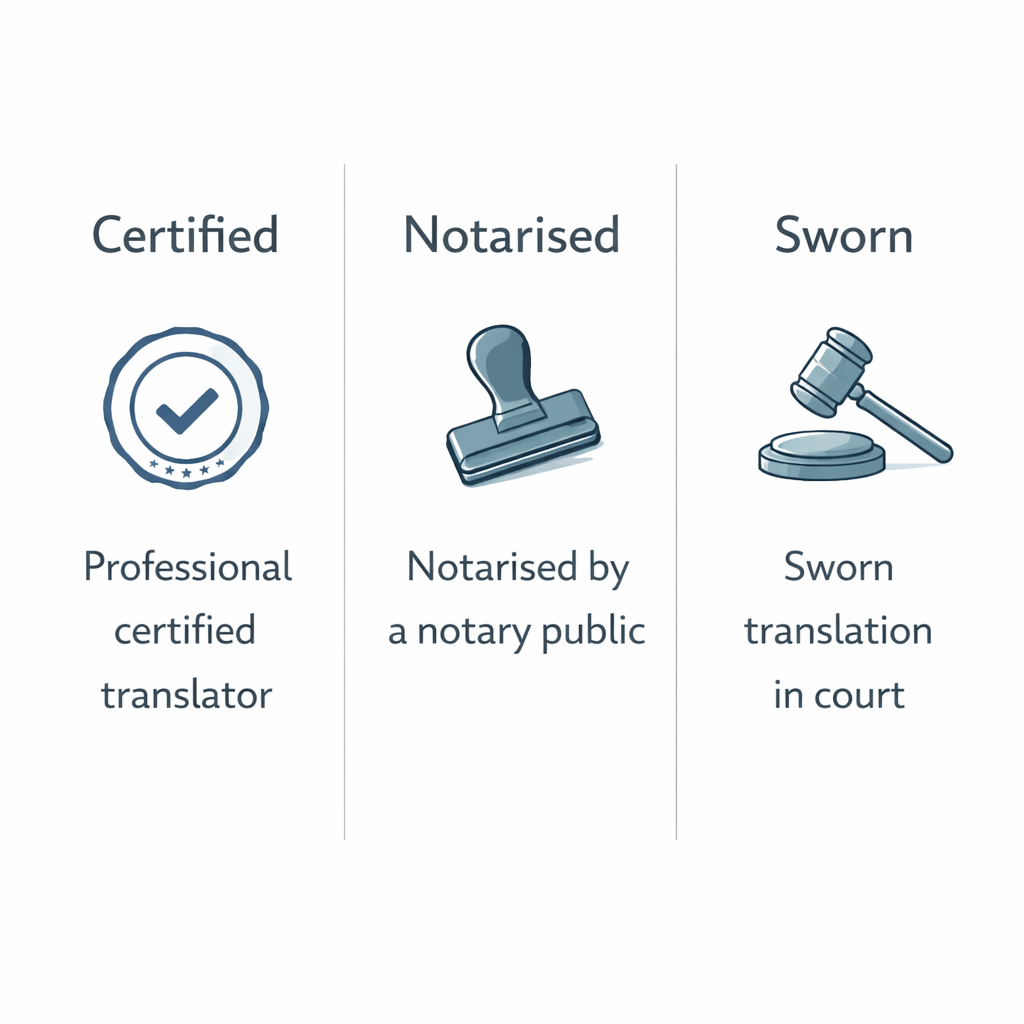
This is one of the most common points of confusion.
Certified translation
This is the most common requirement for immigration filing. It focuses on the translator’s statement of accuracy and competence.
Notarised translation
A notary confirms the identity of the person signing the certification. A notary does not verify the quality of the translation itself.
This is only needed if a specific authority expressly requests it.
Sworn translation
Sworn translation is required in some countries for local legal procedures. It is not automatically better or more acceptable for USCIS than a properly certified translation.
Rule of thumb
For green card submissions, start with certified translation. Only add notarisation if you have been specifically told to do so.
Can a UK translation company prepare a certified translation for USCIS?
Yes, in many cases it can.
What matters most is not whether the provider is based in the UK or the United States, but whether the translation is:
- in English
- complete
- accurate
- accompanied by a proper certification statement from a competent translator
For applicants living in the UK, this can be especially practical, as it allows the translation to be arranged locally while still preparing a document set suitable for U.S. immigration filing.
How to prepare your documents so your translation does not get rejected
Before sending anything for translation, carry out a quick quality check.
- Make sure every page is included, including front and back.
- Ensure all text is legible.
- Zoom in on stamps and seals if needed.
- Confirm names appear clearly, especially where accents or diacritics are used.
- If the document is double-sided, scan both sides.
- If a seal obscures text, capture it as clearly as possible.
- Keep the file format simple. PDF or clear photos are usually fine.
One simple upgrade
If your document has faint stamps, take two photos: one normal and one with slightly increased contrast. Most phone cameras can do this well enough to improve legibility.
The name-matching strategy that prevents avoidable delays
Immigration officers often compare documents quickly. Many preventable issues come from mismatched names.
Common problems include:
- different spellings across documents
- diacritics dropped inconsistently
- multiple surnames used differently across records
- transliteration variations from languages such as Arabic, Russian, Ukrainian, or Chinese
What to do
- Use the spelling shown on the passport as your reference spelling.
- Keep original spellings visible where appropriate, especially on civil extracts.
- Add a translator note where a document clearly uses a different spelling.
Example translator note
“Surname appears as ‘[Variant]’ on the original record; this corresponds to ‘[Passport Spelling]’ on the applicant’s passport.”
Mini case examples: what “complete” looks like in practice
Example 1: Marriage certificate with stamps and marginal notes
A marriage certificate may look short, but the legally important content is often found in:
- the registration stamp
- the registry seal
- a margin note referring to an amendment or re-issue
A clean-looking translation that leaves out those elements is one of the most common reasons the document gets questioned.
Example 2: Police certificate with multiple issuing references
Police certificates often include:
- reference numbers
- issuing authority lines
- validity statements
Leaving out even one reference number may not sound serious, but it can make the record harder to match or authenticate.
How long certified translations take and how to plan ahead
Turnaround times vary depending on:
- the language pair
- document length and complexity
- handwriting, stamps, or poor scan quality
- whether formatting replication is needed
Planning tip
Translate your core civil documents first, such as:
- birth certificate
- marriage certificate
- divorce record
- police certificate, if required
These are the documents most likely to be reused across filings.
If you are working to a deadline, start with our Certified Translation Services page.
How much certified translation for green card documents usually costs
Pricing usually depends on:
- number of pages
- document density and word count
- language pair
- urgency
- whether there are stamps, seals, notes, or back pages requiring extra care
- whether you need certified PDF delivery only or additional hard copies
The more useful question is not simply, “What is the cheapest price?” but, “What is included?”
A low headline price is not helpful if it does not include the certification statement or a complete translation of all visible document content.
How to choose a translation provider for a green card application
Use this checklist before committing to a provider:
- Do they provide a signed certification statement with every document?
- Do they translate stamps, seals, and notes, not just the main body text?
- Do they have a quality review step?
- Can they keep names consistent with the passport?
- Can they deliver in the format you need, usually PDF?
- Do they clearly explain what you will receive?
A good provider makes the process feel simple: clear, consistent, and submission-ready.
Red flags to watch for when choosing a provider
Be cautious if a provider:
- promises approval rather than accurate and complete translation work
- does not mention the certification statement at all
- quotes without checking whether the document contains stamps, notes, or back pages
- offers to summarise the document instead of translating it fully
- cannot explain who signs the certification or what the final package includes
Frequently asked questions
What is the certified translation requirement for a green card application?
If you submit a document that is not in English, you will generally need a complete English translation plus a signed certification statement confirming accuracy and translator competence.
How do I get a certified translation for my green card application?
Start by identifying every non-English document you plan to submit. Then send clear scans of those documents to a translation provider and request a full English translation with a signed certification statement. Review the final version for names, dates, and document numbers, then submit the original-language document together with the certified English translation.
What documents need translation for a green card?
Common examples include birth certificates, marriage certificates, divorce records, police certificates where requested, civil registry extracts, and any other supporting evidence you submit that is not in English.
Can I translate my own documents for a green card application?
Some applicants do, but it adds risk. Certification wording, completeness, and perceived neutrality all matter. A third-party certified translation is usually the safer option.
Can I use a UK translation company for USCIS?
Usually, yes. What matters is whether the provider produces a full English translation and includes a proper certification statement from a competent translator. The provider’s location is typically less important than whether the translation is complete and submission-ready.
Do green card translations need to be notarised?
Not usually. Notarisation is typically only required if the receiving authority specifically asks for it.
Do I need to translate every page, including the back?
If the page contains text, stamps, seals, annotations, reference numbers, or handwriting that forms part of the submitted record, it should be included in the translation set. Back pages are often overlooked, especially on civil documents.
Should I submit the original-language document with the translation?
Yes. The translation should be submitted together with the foreign-language document it relates to. Keeping them as one document set makes review easier and reduces the chance of confusion.
What should I receive from a translation provider?
At a minimum, you should receive the full English translation and a signed certification statement. Ideally, you should also receive a clean, submission-ready PDF and a clear indication of which original document the translation relates to.
What should a green card translation checklist include?
At minimum, it should cover every page, front and back, as well as stamps, seals, notes, correct names and dates, and a signed certification statement for each translated document.
How much does certified translation for green card documents usually cost?
Cost depends on the document type, page count, language pair, urgency, and whether extra elements such as handwritten notes, seals, and back pages need special handling. The key question is whether the quote includes a proper certification statement and a complete translation, not just raw translated text.
What happens if my certified translation is missing stamps or notes?
It can lead to delays or a request for additional evidence because the translation may be treated as incomplete.