
Applying to a college or university abroad is exciting — until the checklist hits: official records, transcripts, stamps, and translations. If any part of that bundle is unclear, admissions teams may pause your file, request resubmission, or route you to credential evaluation.
This guide explains how certified translation for college admission works, which documents typically require translation, and what “certified” usually means in an admissions context — so you can submit once, confidently, and on time.
If you already have a deadline, you can start here: upload your documents for a quick review and a clear turnaround via our contact page or learn what’s included in our certified translation services.
How to get a certified translation for college admission in the UK
If you need the short answer, first check the exact wording used by the university, UCAS portal, or credential evaluator. Then send clear scans of your academic documents to a professional translator or translation company, request a full certified translation (not a summary), and make sure the final file includes a signed certificate of accuracy with the translator or agency details.
For UK college or university admission, the safest format is usually a complete translation of the original document plus a certification statement confirming accuracy. If the same documents may later be used for a UK Student visa application, the translation should also include the translation date, the full name and signature of the translator or authorised company representative, and contact details.
Why do colleges ask for certified translations?
Admissions teams are assessing eligibility and academic readiness using documents created in a system they may not recognise (different grading scales, course titles, credit structures, and institutional formatting). A certified translation helps by:
Making every detail readable in the target language
Preserving structure so reviewers can match translation to the original
Providing a signed certification statement that confirms accuracy and translator competence
Reducing back-and-forth requests that slow your decision timeline
In short: a certified translation helps your application get reviewed for your achievements — not held up by paperwork.
What does “certified translation” mean for university admission translation
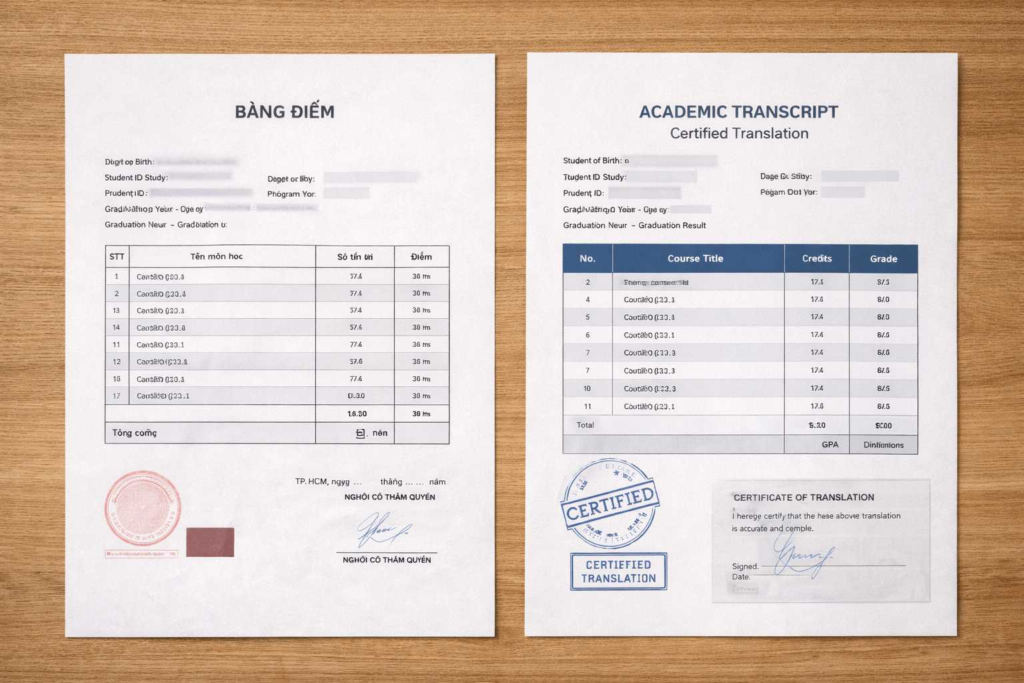
A certified translation is typically a complete, accurate translation of your document accompanied by a signed certificate confirming it is a true and correct translation.
For college application translation, “certified” usually means the translation includes:
A complete translation of all text (not a summary)
Clear formatting that matches the original layout, where practical
A certification statement, signed and dated
Translator or agency details (commonly name and contact information)
Certified vs notarised vs sworn vs “ATA certified”
These terms are often mixed up. Here’s the practical difference for applicants:
Certified translation: Translation + signed certificate of accuracy (commonly requested for admissions)
Notarised translation: A notary verifies the identity of the signer (often requested only if the institution explicitly asks)
Sworn translation: Completed by a translator officially authorised in certain countries (requirements vary by jurisdiction)
ATA-certified translator/membership: A credential that may be requested in some cases, but is not always required for admissions
The safest move: follow the exact wording on your admissions portal or credential evaluator instructions. If the requirement is vague (“official translation”), a certified translation is usually the most widely accepted format.
Who can certify a translation in the UK?
In the UK, there is no single government licence that every admissions office calls a “certified translator.” In practice, universities and other institutions usually expect a qualified professional translator or translation company that can provide a signed certification statement and verifiable contact details.
A strong option is to use a translator or company affiliated with recognised professional bodies such as the Institute of Translation and Interpreting (ITI), the Chartered Institute of Linguists (CIOL), or the Association of Translation Companies (ATC). This helps reduce the risk of your translation being questioned for lack of professional credentials.
Which academic documents typically need a certified translation for college admission
Requirements vary, but these are the most common documents requested for academic document translation for admission:
Core academic records
Academic transcripts/grade reports/mark sheets
Diplomas, degree certificates, certificates of completion
School leaving certificates
Academic standing letters (where issued)
Supporting admission documents
Letters of recommendation (if submitted in the original language)
Personal statements or writing samples (occasionally requested in English, depending on programme)
Proof of enrolment or attendance letters
Course descriptions or syllabi (sometimes required for transfer credit)
Identity and compliance documents (sometimes requested)
Passport or national ID (especially for enrolment or visa stages)
Change-of-name documents (if names don’t match across documents)
Financial documents (programme-dependent)
Bank letters or financial support statements
Sponsor letters
If you’re applying to multiple universities, translate once — but ensure the format is “submission-ready” for each destination. Different portals may have different file and naming rules.
A simple rule admissions teams love: “One-to-one and easy to verify”
When someone reviews your file, they’re often doing a quick cross-check:
Does the translated name match the passport spelling?
Do dates and document numbers match?
Is every stamp, seal, note, and handwritten annotation accounted for?
Can they line up the translation with the original without guessing?
That’s why a strong certified translation is more than correct words — it’s a verifiable document package.
Transcript translation for college: the details that cause the most delays
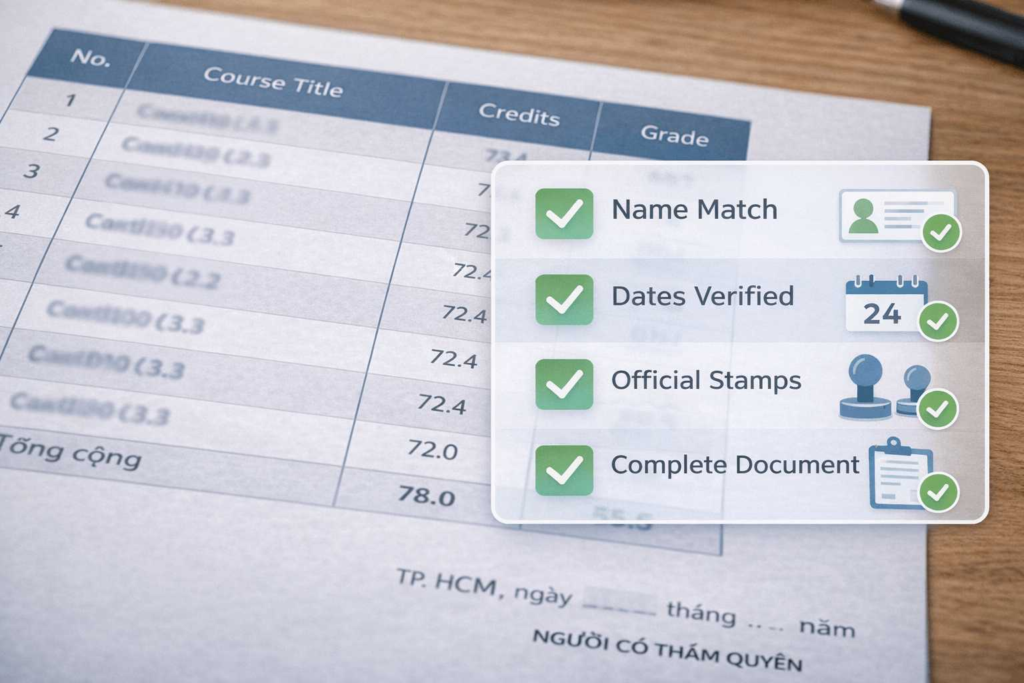
Transcripts are where small inconsistencies become big problems. Watch for these common delay triggers:
1) Name mismatches across documents
Different spellings, order changes, missing middle names, or diacritics can create confusion.
Best practice: Use your passport spelling as the reference and keep it consistent across every translated file.
2) Missing stamps, seals, or institutional notes
Admissions reviewers may treat stamps and notes as part of the official record.
Best practice: Translate visible stamps/seals and label them clearly.
3) Summaries instead of full translations
Admissions and evaluators typically need full text, not a condensed version.
Best practice: Translate everything on the page, even boilerplate.
4) Formatting that breaks readability
If a transcript is a table, the translation should stay easy to follow (course title, grade, credit hours, term).
Best practice: Keep a clean table structure and consistent terminology across pages.
5) Grade scale “interpretation”
A translator should translate the document, not reinterpret grades or convert scales, unless specifically instructed by the receiving institution.
Best practice: Translate labels accurately and leave evaluation to credential evaluators where required.
Do you also need a credential evaluation?
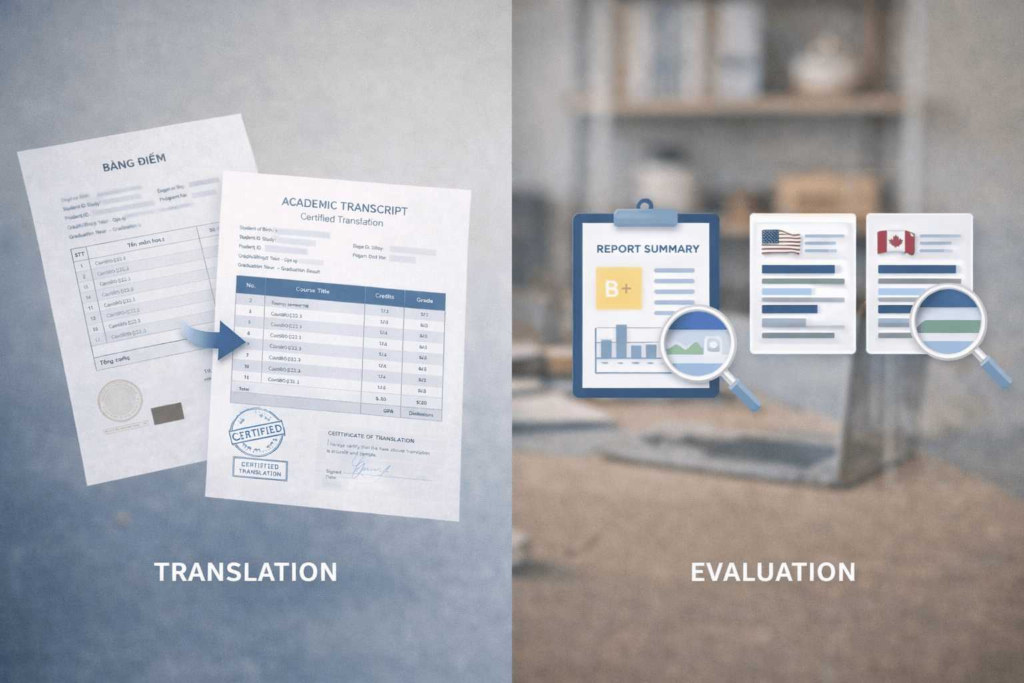
Sometimes, a certified translation is only step one. Some institutions (especially for international applicants) may require an independent credential evaluation (for example, a course-by-course report). That’s separate from translation.
A helpful way to think about it:
Translation makes your documents readable in the new language
Evaluation explains how those credentials compare in the new education system
If a school requests an evaluation, they may also specify how translations must be prepared and how documents must be submitted (for example, directly from the awarding institution or via a specific evaluation service).
Can you use the same certified translation for UCAS, university applications, and a Student visa?
Sometimes yes — but only if the translation meets the requirements of each destination.
UCAS allows applicants to upload translated qualifications and transcripts as part of supporting evidence. For Student route applications, documents that are not in English or Welsh must be accompanied by a translation, and that translation must contain specific certification details. Universities and credential evaluation services may also impose their own file, format, or source requirements, so the safest approach is to prepare one high-quality certified translation package and then check each portal’s submission rules before uploading.
Can I translate my own academic documents?
It is usually better not to. Even if you are fluent, self-translation can create doubt about independence and accuracy, and some institutions or evaluators may reject it.
For admissions, the lower-risk option is to use an independent professional translator or translation company that can certify the translation formally. This is even more important if your documents may also be used for credential evaluation, because some evaluation providers specifically do not accept translations completed by applicants themselves.
Step-by-step: how to get certified translation for college admission done right
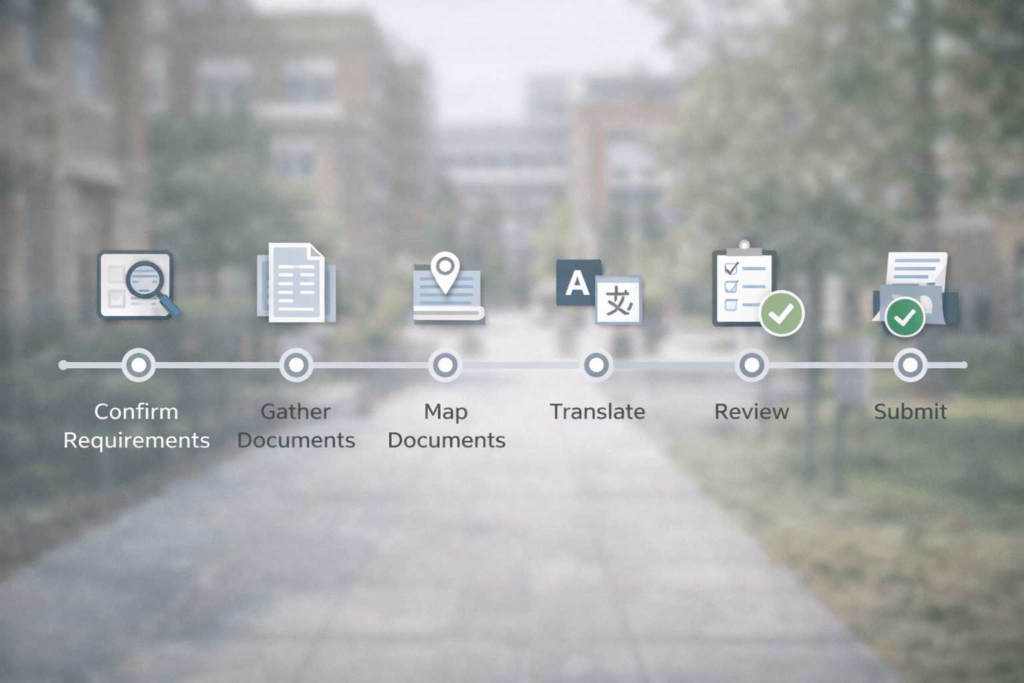
Step 1: Confirm the requirement (and where you’re submitting)
Before ordering, check:
Do they say “certified”, “official”, “sworn”, or “notarised”?
Is translation needed for all documents or only academic records?
Are there file format rules (PDF only, max size, naming conventions)?
Do they require separate uploads for original + translation?
If the instruction is unclear, ask admissions: “Do you accept certified translations with a signed certificate of accuracy? Do you need notarisation?”
Step 2: Gather the best version of each document
Use:
Clear scans or high-resolution photos
Full pages (including back pages, margins, stamps)
All pages in a multi-page record
If anything is cropped or blurred, it’s better to re-scan than risk a rejected translation.
Step 3: Build a “document map”
Create a simple list:
Document name (e.g., “Bachelor transcript — Year 1–3”)
Number of pages
Destination (University A, University B, evaluator)
Deadline
This prevents last-minute surprises and helps you order the correct set.
Step 4: Choose a provider experienced in university admission translation
Look for:
Academic formatting experience (tables, course lists, credit columns)
Clear certification statement included
Quality checks for names, dates, and completeness
Ability to deliver a clean PDF package suitable for portals
You can review what our process includes on our certified translation services page.
Step 5: Review a draft like an admissions reviewer would
When you receive the translation, check:
Names match passport spelling
Dates match the original
Every stamp/seal/note is included
Page count matches exactly
Course titles repeat consistently across pages and years
Step 6: Submit as a complete package
Unless the portal says otherwise, submit:
Original document (scan)
Certified translation (PDF)
Any required supporting file (cover letter, evaluator form, etc.)
If you are submitting to multiple institutions, keep a final folder with the exact files you uploaded (it saves time when portals request resubmission).
When notarisation or sworn translation might be required
Most admissions offices do not require notarisation, but it can be requested when:
A specific university policy states “notarised translation”
A government or embassy-related step is involved
The destination country requires sworn translators for official submissions
If you see the word sworn, check what country the requirement refers to — sworn translation rules vary widely.
What does a certified translation for college admission cost?
Pricing varies by language pair, urgency, and complexity. Here’s what typically affects cost:
Length: per page or per word (transcripts are often priced per page because of formatting)
Complexity: tables, handwriting, multiple stamps
Turnaround: urgent delivery costs more
Certification type: standard certification vs notarisation vs sworn (where applicable)
Volume: multiple documents can sometimes be bundled efficiently
If you want a precise figure fast, the simplest approach is to upload your documents and deadline and request a clear quote via our contact page.
A “submission-ready” checklist you can use today
Before you click submit, confirm:
All pages included (front/back where relevant)
Original + translation are both prepared in a readable PDF format
Names match passport spelling across every document
Dates and document numbers match the originals
Stamps, seals, signatures, and notes are translated and clearly labelled
The certification statement is signed and dated
File names are clear (e.g., “Transcript_UniversityName_English.pdf”)
You’ve kept a copy of exactly what you uploaded
If you’d like us to verify your scan quality before translation, upload your documents, and we’ll flag any issues that could affect acceptance.
Mini case-style insights: what “good” looks like in real applications
Scenario 1: Multi-university application with one transcript set
A student applied to four universities with the same academic record. The winning approach was one consistent translation package (same name format, same course title translations, same table structure), reused across portals to avoid inconsistencies.
Scenario 2: Tight deadline with stamps and handwritten notes
The risk wasn’t the language — it was missing details. Translating every stamp and note prevented a common follow-up request: “Please resubmit with a complete translation of the page annotations.”
Scenario 3: Credential evaluation required
The student separated tasks:
Certified translation for readability
Credential evaluation for equivalency
That avoided “double work” and kept submission aligned with evaluator instructions.
FAQs
Do I need a certified translation for college admission?
Many universities require certified translations for any academic documents not issued in the programme language, especially transcripts and diplomas.
What documents should I translate for a college application?
Most applicants translate transcripts, diplomas/degree certificates, and any supporting academic records. Some programmes also request translated recommendation letters or course descriptions.
Can I translate my own transcript for university admission?
Even if you’re fluent, self-translation is often treated as higher risk and may be rejected. A certified translation with a signed accuracy statement is typically safer for admissions review.
Do universities require notarised translations for admission?
Not always. Notarisation is usually only needed when a university explicitly requests it. If the requirement says “certified translation,” notarisation may be unnecessary.
How long does transcript translation for college take?
Turnaround depends on length, language, and complexity. If you have a deadline, submit your files and date early so any scan issues can be corrected before translation.
What makes an academic document translation “acceptable” for admission?
Completeness, accuracy, and consistency — plus a signed certification statement. Admissions reviewers should be able to match the translation to the original without guessing.
How do I get a certified translation for college admission in the UK?
Check the university, UCAS, or evaluator requirements first. Then send clear scans to a professional translator or translation company and request a full certified translation with a signed certificate of accuracy.
Who can certify a translation in the UK?
Usually, a qualified professional translator or translation company can provide a signed certification statement, date, and contact details. Using a provider linked to recognised bodies such as ITI, CIOL, or ATC is often the safest choice.
Will UCAS accept translated qualifications and transcripts?
UCAS allows applicants to upload translated qualifications and transcripts as supporting documents. You should still make sure your files are clear, complete, and named correctly for submission.
Can I use the same certified translation for university admission and a Student visa?
Sometimes, yes. But you should confirm that the translation includes everything needed for each use case, especially if your visa application requires specific certification details.
What should a certified translation include for a UK Student visa application?
If the documents are not in English or Welsh, the translation should include confirmation that it is an accurate translation of the original, the date of translation, the full name and signature of the translator or authorised company representative, and the translator or company contact details.