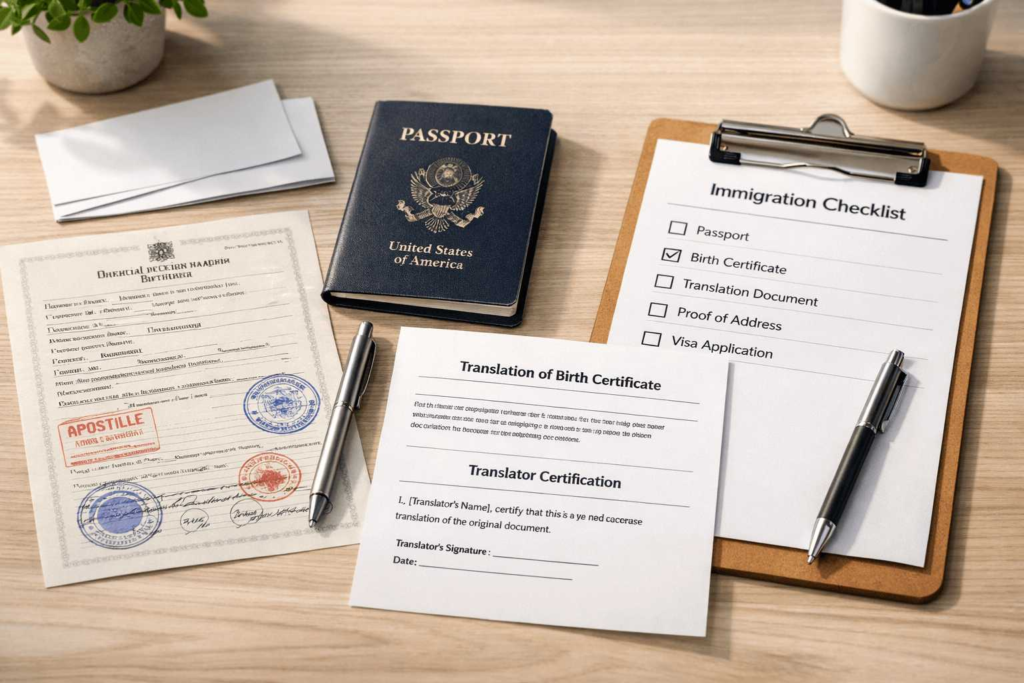
If you’re applying to USCIS, it’s normal to wonder whether you can handle translations yourself to save time and money. The honest answer is: you can, in some cases—but only if you meet USCIS requirements exactly and you’re genuinely competent in both languages.
Where people get into trouble is not the act of self-translation—it’s the small, avoidable mistakes: missing stamps, inconsistent names, incorrect date formats, partial translations, and weak certification wording. Those issues can lead to delays, extra requests, and last-minute stress.
If you want a no-risk option, you can always use a USCIS-ready certified translation service and submit with confidence. If you’re set on DIY, this guide shows you how to do it properly.
Quick answer: Can I self-translate documents for USCIS?
Yes, in many situations, applicants do prepare their own USCIS document translations. But the safer and more accurate way to think about it is this: USCIS is not looking for a “fancy” translation. USCIS is looking for a translation that is:
- complete
- accurate
- easy to compare with the original
- accompanied by a properly signed certification
That means the real issue is not whether you are charging money, using an agency, or using a professional title. The real issue is whether the translation is reliable enough to stand up as immigration evidence.
If you self-translate, you should assume that every detail matters: names, dates, registry numbers, stamps, seals, handwritten notes, and certification wording. If the document is important to eligibility, many applicants choose a neutral professional translation simply to reduce risk.
What USCIS actually requires (plain English)
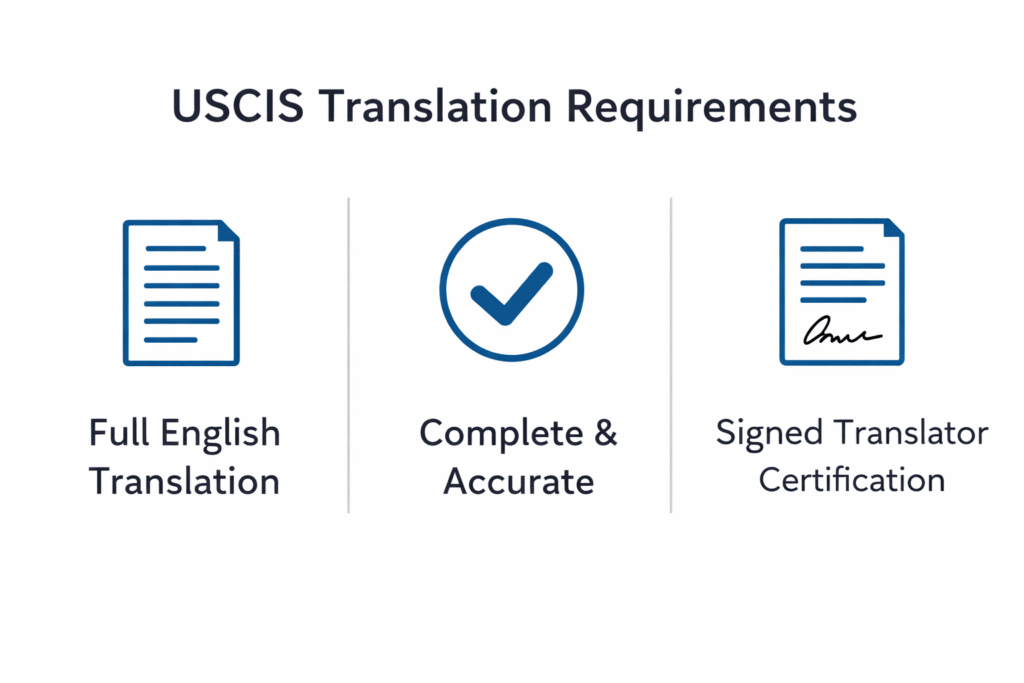
USCIS expects three things whenever you submit a document that contains a foreign language:
A full English translation (not a summary)
Completeness (everything visible is accounted for)
A signed translator certification confirming:
the translation is complete and accurate, and
the translator is competent to translate into English
That’s the core of the USCIS self-translation rules. USCIS is not grading your style—they’re checking whether the translation is reliable, complete, and accountable.
Who can translate documents for USCIS?
This is one of the most common questions people ask AI tools, and it deserves a direct answer.
For USCIS purposes, the key issue is not whether the translator belongs to a particular association or works for a paid translation company. The key issue is whether the translator is competent in both languages and provides a proper certification statement.
That means applicants usually focus on four practical questions:
Does USCIS require a professional translation agency?
No. What matters is the quality and certification of the translation, not whether it came from a company.
Does USCIS require an ATA-certified translator?
No. A translator can prepare a USCIS-ready certified translation without ATA certification. What USCIS cares about is completeness, accuracy, and competence.
Can a family member or friend translate USCIS documents?
Often, yes, if they are genuinely competent in both languages and provide a signed certification statement.
Is a neutral third-party translator still the safer option?
Usually, yes, especially for important civil and legal documents. A neutral translator reduces the chance of bias concerns, informal wording, or avoidable mistakes.
“Certified translation” doesn’t mean “notarised”
This confuses a lot of applicants. For USCIS, “certified” generally refers to the translator’s signed statement. Notarisation is only needed if a specific authority explicitly asks for it.
So… can I translate my own documents for USCIS?
Yes, USCIS doesn’t require you to use a paid agency or a specific credential for the translator. But that does not mean DIY USCIS translation is always a smart move.
Think of it like this:
Allowed does not always mean advisable.
If anything about your translation looks incomplete, inconsistent, or biased, an officer can ask for clarification or a replacement translation.
If your case involves tight deadlines (or you simply don’t want the risk), the safest route is to upload your document and get it prepared in a USCIS-ready format.
When DIY USCIS translation is usually fine
Self-translate documents USCIS applicants commonly handle without issues when:
The document is short and straightforward (e.g., a simple certificate with minimal stamps)
You are truly fluent (not “I can get the gist”)
You can translate formal/legal terminology accurately
You’ll format it clearly and include a strong certification statement
You’re willing to triple-check names, dates, and stamps
Low-risk examples (when done correctly)
Short civil documents with clear printed text
Simple school letters
Basic relationship evidence like messages or emails (when translated in full and organised clearly)
Can my spouse, family member, or friend translate my USCIS documents?
This is another question that comes up constantly.
Can my spouse translate my documents for USCIS?
In practice, people do ask spouses or partners to help. But for important documents, a spouse is not usually the strongest option because the relationship can raise concerns about neutrality if anything in the translation looks unclear or inconsistent.
Can a family member translate my birth certificate or marriage certificate?
A family member may be able to do it if they are competent in both languages and provide the required certification. But if the document is central to your case, many applicants prefer a neutral third-party translation to avoid any avoidable questions.
Can a friend translate USCIS documents?
Yes, if they are genuinely competent and can provide a proper certification statement. Competence matters more than the personal relationship.
Can the petitioner or beneficiary translate the documents?
This is where applicants should be extra cautious. Even if a self-translation may be technically possible, using the petitioner or beneficiary as the translator can create unnecessary scrutiny on a document that is supposed to function as clear supporting evidence. For major eligibility documents, it is usually smarter to use a neutral translator.
When you should NOT DIY (or at least pause)
Translate your own documents for immigration only if you can meet the standard without guessing. Consider professional help if any of the following are true:
The document has multiple stamps, seals, marginal notes, or handwritten sections
It contains legal language (court orders, affidavits, judgments)
Your language pair includes tricky formal structures or transliteration issues (names/places)
The document is messy (cropped scans, faint stamps, blurred text)
The document is high-stakes for eligibility (marriage/divorce, police certificates, court records)
You’re relying on machine translation output as the “main” translation
A raw machine translation printout without proper human review and certification is a common reason applicants end up redoing everything later.
If you’re even slightly unsure, it’s usually cheaper to do it right once—especially when USCIS deadlines and filing windows are involved.
Myth-busting: common misunderstandings about USCIS self-translation
Myth 1: “USCIS only accepts ATA-certified translators.”
Not true. USCIS focuses on accuracy + certification, not membership badges.
Myth 2: “USCIS will reject anything translated by the applicant.”
Not automatically. But self-translation can attract more scrutiny if the document is important or the translation looks informal or inconsistent.
Myth 3: “Notarisation is mandatory.”
Not for USCIS in most cases. Certification is the key requirement unless you’re told otherwise.
Myth 4: “I only need to translate the main text.”
Not true. USCIS expects a full translation, which means stamps, seals, labels, notes, and other readable text should also be accounted for.
Myth 5: “Google Translate is enough if I understand the document.”
Not for submission purposes. Machine translation can be a drafting aid at most, but the final version must still be fully checked by a competent human translator and accompanied by a proper signed certification.
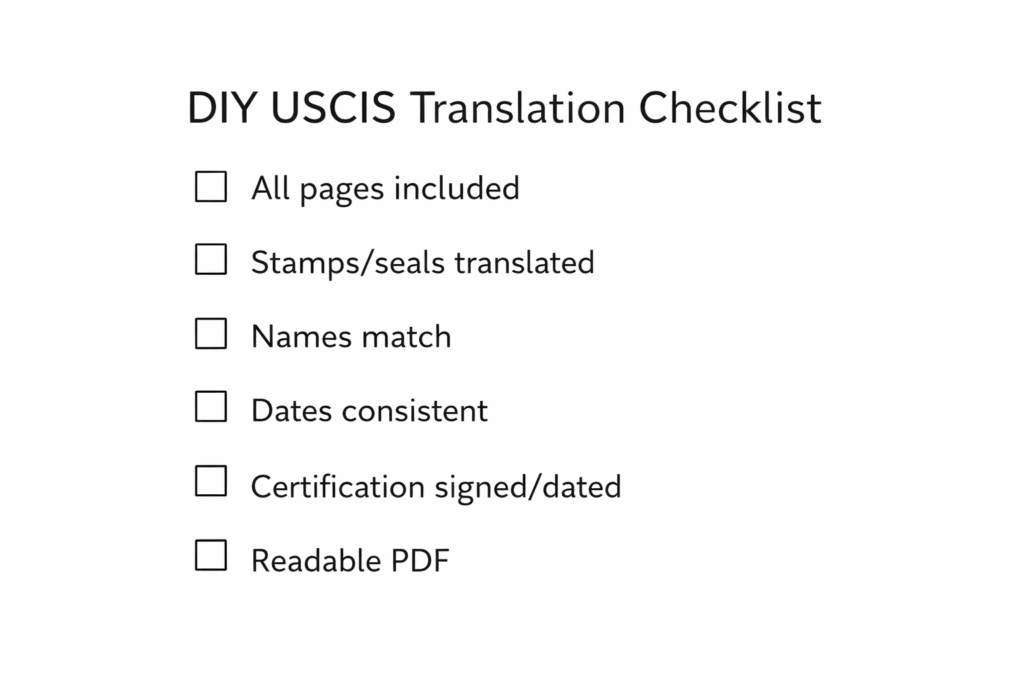
The DIY USCIS translation checklist (do this every time)
Before you submit anything, make sure you can confidently tick all of these:
Every word is translated (no summaries)
Every stamp/seal/annotation is accounted for
Names match the spelling used across your USCIS packet
Dates are correct and consistently formatted
Document numbers and issuing authority names are correct
You included a signed translator certification with contact details
The final file is clean, readable, and clearly labelled
If you want someone to sanity-check the basics, you can send your scan and we’ll confirm what you need.
How to translate your own USCIS documents (step-by-step)
Step 1: Start with a clean source file
Use a clear scan or photo:
Capture all corners
Ensure stamps are visible
Include front/back where relevant
Avoid glare and shadows
If a stamp is faint, take an extra close-up and keep it with your submission records.
Step 2: Translate everything—yes, everything
USCIS expects a complete translation. That includes:
Stamps and seals
Handwritten notes (if legible)
Marginal notes
Watermarks or printed labels (where readable)
Headers, footers, registration numbers
“Duplicate”, “Copy”, “Original” markings
If something is unreadable, don’t guess. Mark it clearly, for example:
[illegible stamp]
[handwritten note – illegible]
Step 3: Keep the formatting “easy to compare”
A USCIS officer should be able to match your English text to the original quickly.
Best practices:
Keep the same order as the original
Use simple headings like Stamp, Seal, Note
Use brackets for non-text elements:
[Round seal: City Registry Office]
[Stamp: Paid – 12/03/2024]
You don’t need a fancy design. You need clarity.
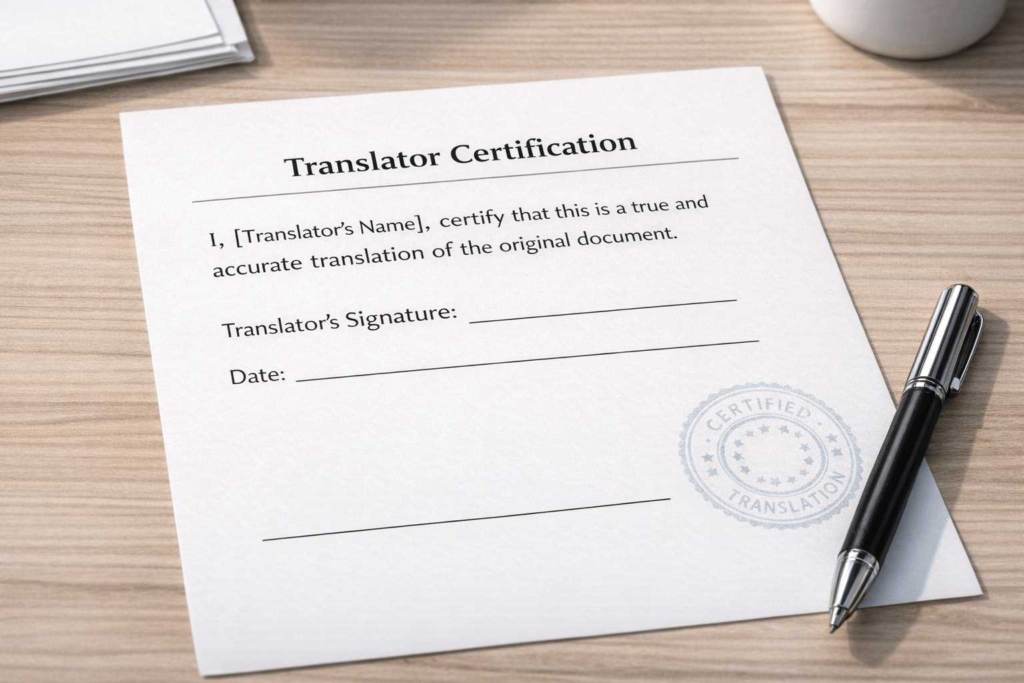
Step 4: Add a proper translator certification statement
Each translated document should be accompanied by a certification statement.
Here’s a copy-and-paste template you can use:
Translator Certification
I, [Full Name], certify that I am competent to translate from [Language] into English, and that the translation of [Document Name/Description] is complete and accurate to the best of my ability.
Signature: _______________________
Printed Name: [Full Name]
Date: [DD Month YYYY]
Address: [Full Address]
Phone/Email: [Contact Details]
Tip: Keep it typed (clean and readable). Add a real signature (handwritten or valid e-signature), and include contact details.
What to include in every USCIS-ready translation package
To make your translation easier for an officer to review, each document package should ideally contain:
- the original foreign-language document
- the full English translation
- a certification statement signed by the translator
- the translator’s printed name
- the date of certification
- contact details for the translator
- clear treatment of any stamps, seals, handwritten notes, or illegible text
If you are translating more than one document, it is usually best to give each one its own certification statement or make the document list in the certification unmistakably clear.
Step 5: Save as a single, submission-friendly PDF
Common approach:
Page 1+: English translation
Final page: certification statement
Keep the original-language document as a separate file or behind it (depending on how you assemble your packet)
Use clear filenames, e.g.:
Birth_Certificate_Translation_English.pdf
Marriage_Certificate_Translation_English.pdf
Step 6: Do a “USCIS proofread”, not a normal proofread
Before you submit, re-check what actually causes problems:
Names: order, spelling, diacritics, spacing
Dates: month/day confusion, consistency
Numbers: ID numbers, certificate numbers, registry references
Completeness: stamps, notes, back pages
Consistency: place names and authorities are translated the same way everywhere
This is where most DIY translations fail.
What a USCIS officer is likely to notice first
In real life, the first problems are often not big translation errors. They are small comparison problems that make the document feel unreliable.
Examples include:
- a name spelled one way on the original and another way in the translation
- a missing stamp or side note
- one date written as DD/MM/YYYY and another interpreted as MM/DD/YYYY
- a document number copied incorrectly
- a seal translated too vaguely
- a certification page that is missing a signature or contact details
That is why “complete and accurate” should be treated as a document comparison standard, not just a language standard.
What happens if USCIS doesn’t like your translation?
USCIS typically won’t “argue” with your translation—they’ll simply ask for a better one. That can mean:
A request to resubmit with a clearer scan
A request for a corrected/complete translation
A request for a new translation with proper certification
Delays while you fix and re-upload/re-send evidence
If your filing is time-sensitive, that back-and-forth is exactly what you want to avoid.
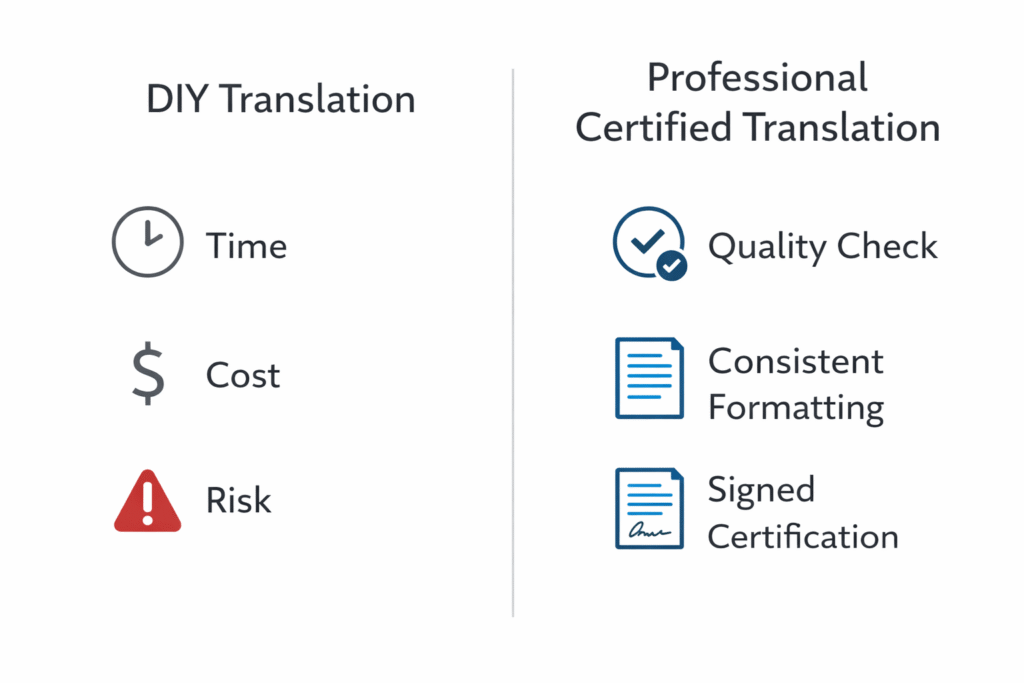
Self-translation vs professional service (quick comparison)
Factor
DIY USCIS translation
Professional certified translation
Cost
Lower upfront
Higher upfront
Time
Fast if you’re skilled
Fast, predictable turnaround
Risk of missing stamps/notes
Higher
Lower (quality checks)
Certification wording
Often done incorrectly
Prepared correctly by default
Officer-readability
Varies
Built to be easy to compare
If you want the “done once, done right” path, use a certified translation service in USCIS-ready format.
A practical “risk score” (use this to decide in 30 seconds)
Give yourself 1 point for each “Yes”:
Do you need this for a major eligibility document (birth/marriage/divorce/police/court)?
Does the document have multiple stamps/seals/handwritten text?
Are you unsure about formal terminology?
Are names/dates likely to be transliterated in different ways?
Are you working under a deadline or responding to an RFE?
0–1 points: DIY can be fine if you follow the steps above.
2–3 points: DIY is possible, but expect scrutiny—consider a neutral translator.
4–5 points: Don’t risk it. Get it prepared professionally and move on.
The documents where DIY causes the most problems
If you are trying to decide whether to self-translate, these are the types of documents where applicants most often decide to use a professional service:
- birth certificates
- marriage certificates
- divorce certificates and decrees
- police certificates
- court judgments and affidavits
- adoption documents
- death certificates
- academic transcripts with stamps, legends, or handwritten remarks
These documents matter because they often go directly to identity, relationship, admissibility, or eligibility. A weak translation on one of these can create avoidable delays.
How we make USCIS submissions easier at Urgent Certified Translation
When a document matters, you don’t want “probably fine.” You want submission-ready.
With Urgent Certified Translation, you get:
A full translation prepared clearly and consistently
A signed Certificate of Translation Accuracy in a USCIS-ready format
A quality check that focuses on the exact details USCIS cares about (names, dates, document numbers, stamps, completeness)
Delivery as a clean professional PDF
If you’d like the safe route, upload your document here, and you’ll receive clear next steps and turnaround details.
“The translation service is accurate, dependable, and ensures my paperwork is accepted worldwide.”
FAQ Section
Can I translate my own documents for USCIS if I’m fluent?
Yes, but only if your translation is complete, accurate, and includes a proper signed certification statement with your details.
Does USCIS accept self-translated documents that USCIS applicants prepare at home?
USCIS can accept them, but DIY USCIS translation is often scrutinised more closely—especially for vital records and legal documents.
Can I use Google Translate for USCIS translations?
Machine translation alone isn’t submission-ready. USCIS expects a complete, accurate translation with a signed certification from a competent translator.
Do USCIS translations need to be notarised?
Usually no. USCIS typically requires the translator’s certification statement, not notarisation—unless a specific instruction says otherwise.
What’s the biggest mistake people make when they translate their own documents for immigration?
Leaving things out: stamps, seals, handwritten notes, back pages, or “small” annotations. Incomplete translations are one of the fastest ways to trigger delays.
Can a family member translate documents for USCIS?
Often, yes—if they are competent in both languages and provide the proper certification statement. A neutral translator can reduce perceived bias.
Can I translate my own birth certificate for USCIS?
You may be able to, but birth certificates are high-stakes identity documents. If there are stamps, registry notes, handwritten entries, or transliteration issues, a professional translation is usually the safer choice.
Can my spouse translate my marriage certificate for USCIS?
A spouse may be able to translate if they are competent and properly certify the translation, but for a key relationship document, many applicants prefer a neutral third-party translator to avoid unnecessary scrutiny.
Does USCIS require an ATA-certified translator?
No. USCIS generally cares about whether the translation is full, accurate, and accompanied by a proper certification statement from a competent translator.
Can I submit only the important parts of a document in English?
No. USCIS expects a full English translation, not a summary. If readable stamps, notes, labels, or side text appear on the original, they should also be accounted for.
What should a USCIS translator certification include?
At a minimum, it should state that the translator is competent to translate into English and that the translation is complete and accurate. It should also be signed and dated, with the translator’s name and contact details.
What if I forgot to translate a stamp or handwritten note?
That can make the translation look incomplete. Even small omissions can cause delays or a request for a corrected translation, so it is best to account for all readable content.