Moving to the United States as a nurse, therapist, physician assistant, lab professional, or other healthcare worker usually means you are handling more than one process at the same time: immigration paperwork, credential checks, license verification, and employer onboarding. That is exactly where document translation can either keep everything moving or slow everything down.
If your documents are in another language, you need a clean, complete English translation package that can be used confidently across these stages. A rushed or incomplete file often causes repeat requests, delays, or extra fees. The goal is not just “translation.” The goal is a translation set that is ready for immigration, credentialing, and hiring.
If you are preparing your file now, start your project with a certified translation package designed for healthcare migration so you can submit once, clearly, and with confidence.
If you are a healthcare worker in the UK, this page still applies
Many people search for certified translation services for healthcare workers in the UK when what they actually need is a UK-based provider that can prepare certified English translations for use in the United States.
If you are living or working in the UK but your diploma, transcript, licence, civil documents, or supporting letters were issued in another language, you may still need certified English translations for U.S. immigration, credentialing, licensing, or employer review.
In practice, the important question is not where you are based. The important question is where your documents are being submitted and whether the receiving organisation expects a full English translation with a proper translator certification. For many healthcare workers, one organised translation pack can then support more than one stage of the process.
Quick answer: When healthcare workers usually need certified translation
Healthcare workers commonly need certified translation when:
- they are submitting foreign-language supporting documents as part of a U.S. immigration file
- they need English versions of diplomas, transcripts, licences, or registration records for credential review
- a licensing body, recruiter, or employer asks for readable English copies of non-English records
- their passport, degree, and professional licence show different name formats and the file needs to be easy to follow
- supporting documents such as marriage certificates, good standing letters, reference letters, or police certificates are not in English
What does “certified translation” mean in this context
A certified translation is a full English translation of your original document, accompanied by a signed certification confirming the translation is complete, accurate, and prepared by a competent translator.
For healthcare workers, this matters because your documents are often reviewed by multiple parties, including:
- Immigration authorities
- Credentialing organisations
- Licensing boards
- Recruiters or employers
- Hospitals and staffing agencies
- Education evaluators (when requested)
A professional healthcare worker document translation package should be prepared so the same file can be reused where appropriate, without confusion about names, dates, qualifications, or issuing authorities.
Why healthcare workers need a more careful translation process
General document translation is not enough for most medical professionals relocating to the USA. Healthcare files often contain:
- Technical qualification names
- Clinical training records
- Multi-page transcripts
- Licence or registration cards
- Internship and placement certificates
- Name variations across passports, diplomas, and licences
- Stamps, seals, signatures, handwritten notes, and marginal comments
This is where many applicants run into problems. The translation may be “correct” linguistically, but still fail operationally because:
- The layout does not clearly match the original
- Issuer names are inconsistent across documents
- The translator certification is missing or incomplete
- Pages are translated selectively instead of fully
- The applicant submits a translation before confirming which body needs direct-source records
A better approach is to build your file in the order the U.S. process actually works.
The four-track system every healthcare worker should understand
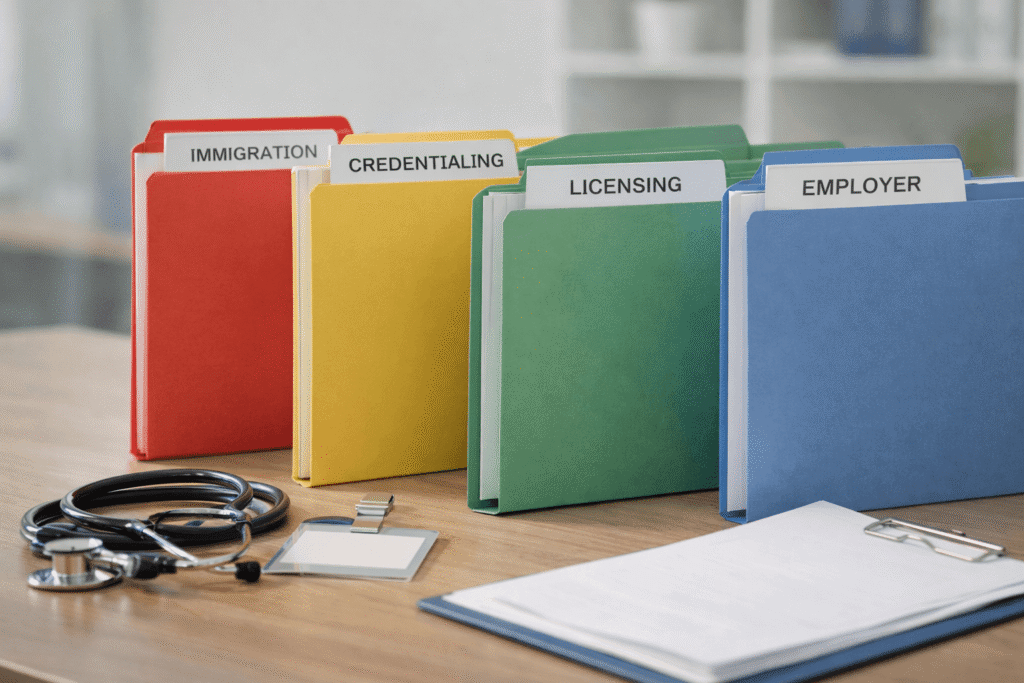
One of the biggest mistakes is assuming everything goes to one place. In reality, you may be dealing with four separate tracks at once.
1) Immigration track
This includes visa or status paperwork and supporting documents. Any foreign-language documents submitted for immigration must be translated properly into English.
2) Credentialing track
This is where your education, licence, and professional standing are checked by the relevant organisation for your profession.
3) Licensing track
Your state board or professional regulator may require verification, exam records, transcripts, or additional documentation.
4) Employer track
Hospitals, clinics, or recruiters may request translated copies for hiring, onboarding, compliance, or HR records.
Why this matters:
A document that works for one track may not be enough for another. For example, a translated diploma may be acceptable for employer review, but a credentialing body may still require transcripts sent directly by your university.
That is why a strong nurse credential translation or medical professional immigration translation plan starts with a document map, not just a price quote.
Which U.S. organisations may review your translated documents?
Depending on your profession and route, your translated documents may be reviewed by more than one type of organisation.
Immigration reviewers may need certified English translations of civil and supporting documents included in a filing.
Credentialing bodies may review your education, registration, training, and professional standing documents as part of a broader assessment process.
Licensing boards may ask for translated records as part of an application, while still requiring direct-source or primary-source documents from the issuing institution.
Employers, recruiters, and onboarding teams may request English copies so they can review qualifications, employment history, and supporting records more efficiently.
Some healthcare workers also encounter profession-specific pathways involving nursing screening, physician credential review, physical therapy credentialing, or state-specific licensure steps. That is why your translation package should be planned around the full workflow, not just around one document at a time.
Documents that healthcare workers commonly need to be translated
Below is a practical list of documents commonly translated for healthcare workers moving to the USA.
Identity and civil documents
- Passport bio page (if requested in your process)
- Birth certificate
- Marriage certificate (especially if your surname changed)
- Divorce decree (if name history affects records)
- Police clearance certificate (when part of immigration or licensing steps)
Education documents
- Degree certificate
- Diploma certificate
- Academic transcripts
- Internship completion certificate
- Clinical training records
- Course completion certificates
- Professional training certificates
Professional and licensing documents
- Nursing licence/registration
- Professional membership certificates
- Good standing certificate
- Licence renewal records
- Specialist certification documents
- Work experience letters from hospitals/clinics
Employment and immigration support documents
- Employment letters
- Offer letters
- Reference letters
- CV/resume attachments (if formally requested)
- Immigration forms with supporting attachments
- Name-change affidavits or declarations (if applicable)
Profession-specific notes for healthcare workers
Nurses (RN, LPN/LVN)
Nurses usually have the heaviest document load because they often need:
- Nursing diploma/degree
- Academic transcripts
- Nursing licence/registration
- Validation documents
- Identity documents matching all records
- Possible exam-related evidence, depending on the path used
A foreign nursing degree translation should be prepared with extra care around:
- Course names
- Clinical hours terminology
- Issuing school names
- Licence numbers
- Date formats (DD/MM/YYYY vs MM/DD/YYYY)
- Maiden/married name alignment
Practical tip:
Before translating everything, confirm which records must be sent directly by the school or licensing body and which ones can be submitted as translated copies. This prevents duplicate work and extra costs.
Physical therapists and occupational therapists
PT and OT applicants often need precise terminology in:
- Degree titles
- Clinical placement descriptions
- Internship records
- Professional registration documents
These files are often reviewed by credentialing bodies and state-level authorities, so consistency matters more than literal word-for-word conversion. The translation should preserve meaning while staying faithful to the original record.
Speech-language pathologists, audiologists, physician assistants, and lab professionals
These professions often involve:
- Mixed academic and clinical documentation
- Licence/registration evidence from multiple countries or regions
- Specialist training records
- Employer-issued competency letters
For these files, the translation package should clearly label each document and maintain consistent formatting across the full set so reviewers can move through the documents quickly.
Physicians
Physicians are a special case. Even when a healthcare worker certification is not the main issue for your pathway, you may still need certified English translations for immigration filing, credential verification, and education records. Many doctors also need primary-source verification workflows, so your translation strategy should be coordinated with your credentialing timeline.
Certified translation vs credential evaluation vs licence verification
This is the most common point of confusion, so it helps to separate the three clearly.
Certified translation
A certified translation converts your foreign-language document into English and includes the translator’s certification.
Credential evaluation
A credential evaluation compares your foreign education to U.S. standards (for example, degree equivalency or coursework review). This is not the same as a translation.
Licence verification
Licence verification confirms your professional registration or standing with the issuing authority. This may require direct communication between authorities and may be separate from translation.
Simple rule:
Translation makes the document readable in English.
Evaluation judges equivalency.
Verification confirms authenticity and status.
You may need all three.
What reviewers usually expect from a healthcare translation package
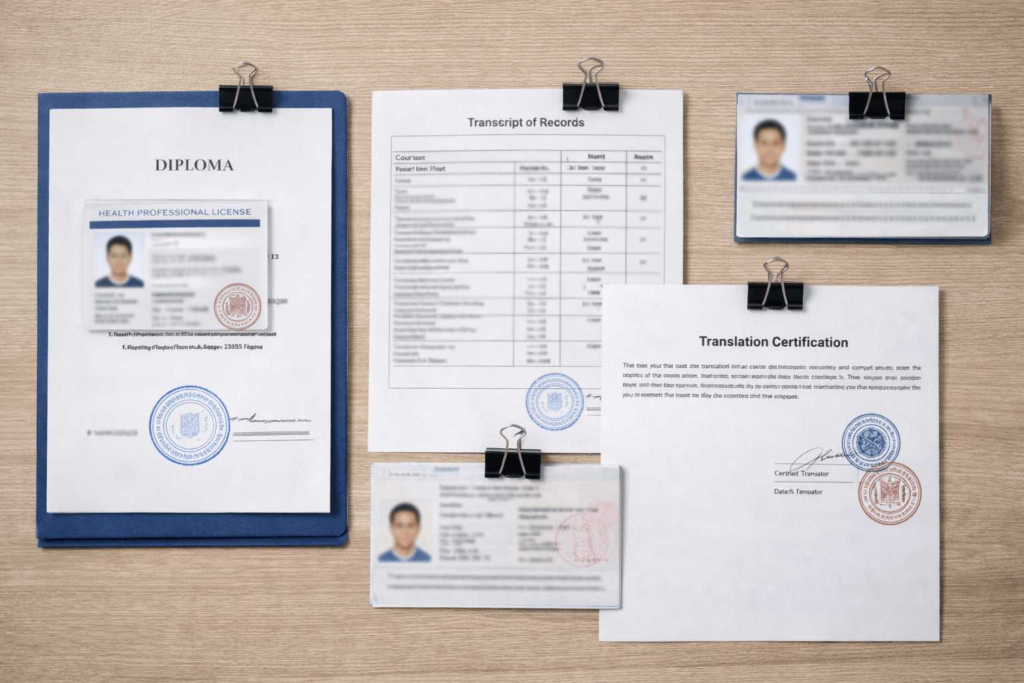
A strong healthcare translation package is not just about converting words from one language into another. It should also make the file easier to review.
In practical terms, reviewers usually expect:
- a full translation rather than a summary or partial extract
- all relevant pages included, not just the main body text
- stamps, seals, signatures, handwritten notes, and marginal comments reflected where needed
- clear file labels so each document is easy to identify
- consistent rendering of names, dates, institutions, and qualification titles across the whole pack
- a translator certification attached to the translated documents
- clean source scans so the translation can be prepared accurately
- awareness that some organisations may still require direct-source or primary-source records separately
This is why healthcare worker document translation should be planned as a coordinated file set rather than as isolated one-page jobs.
How to prepare a healthcare translation file that gets accepted faster
Step 1: Build a document checklist before ordering translation
Create one list with these columns:
- Document name
- Issuing country
- Language
- Number of pages
- Who needs it (immigration/credentialing/licensing/employer)
- Original available? (yes/no)
- Scan quality (good/needs re-scan)
- Name variation issue? (yes/no)
This avoids missing a page later.
Step 2: Scan clearly and completely
Poor scans cause preventable delays. Submit:
- Full-page scans (not cropped)
- Colour scans for stamped or sealed documents
- Flat, straight images
- All pages, including blank backs if they contain seals or stamps
- Clear close-ups if handwriting is faint
Step 3: Flag name mismatches early
Healthcare worker files often include different name versions across documents. Tell your translator up front if you have:
- Maiden and married names
- Different transliterations
- Abbreviated middle names
- Passport renewals with updated spelling
This allows the translation package to stay consistent and prevents confusion during review.
Step 4: Translate in logical batches
Instead of translating everything randomly, organise your order into batches:
Batch A (immigration core):
- Civil documents
- Identity documents
- Key education documents
Batch B (credentialing):
- Transcripts
- Degree certificates
- Licence/registration records
- Good standing letters
Batch C (employment/onboarding):
- Experience letters
- Training certificates
- HR-related documents
This helps you submit the right documents at the right time without paying to rush everything.
Step 5: Use a translator familiar with healthcare and immigration files
Healthcare records include technical terms, abbreviations, and institution-specific phrasing. A translator experienced in nurse credential translation or healthcare worker document translation is less likely to produce wording that creates follow-up questions.
Common mistakes that delay healthcare worker immigration files
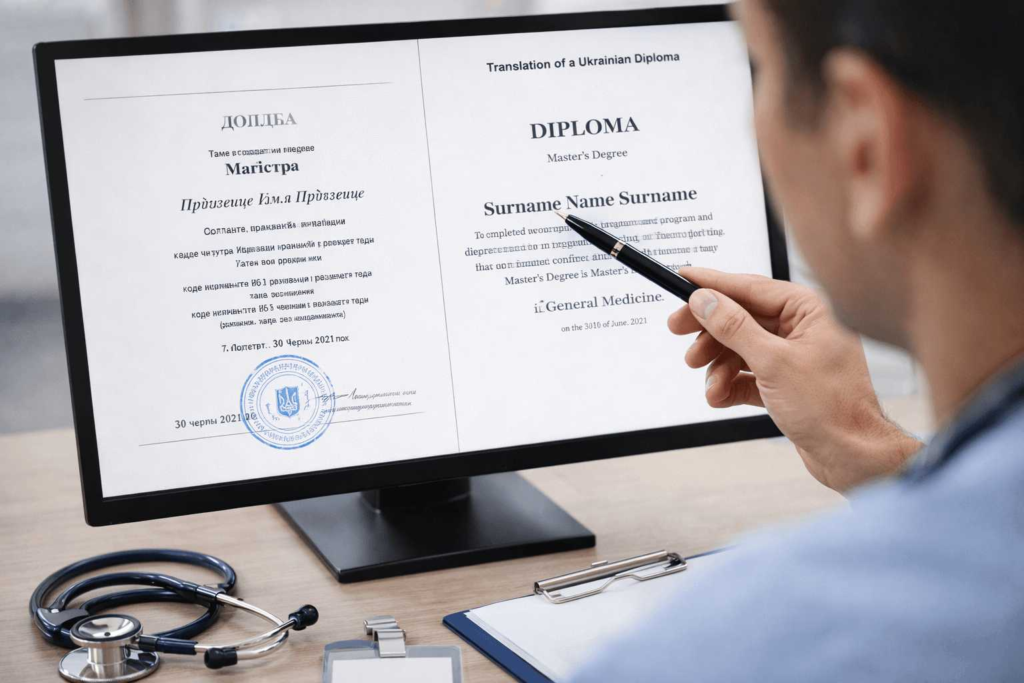
Translating only part of a document
Applicants sometimes translate only the “main text” and leave out stamps, notes, or back pages. Reviewers may treat the file as incomplete.
Ignoring transcript formatting
A transcript translation should preserve structure so the reviewer can match:
- Course titles
- Grades
- Dates/semesters
- Credit units
- Institutional headers
Using inconsistent terminology
If one document says “Registered Nurse” and another is translated as “State Nurse Practitioner” (incorrectly), the file can look inconsistent even if the source documents are valid.
Submitting low-quality scans
Even a perfect translation cannot fix an unreadable source text.
Ordering translation before checking direct-source requirements
Some organisations require documents directly from the issuing institution. Translating first is still useful in many cases, but the order should be planned.
What a strong healthcare translation package should include
When you order certified translation for healthcare workers, ask for a package that includes:
- Full English translation of every required page
- Clear document labels (so each file is easy to identify)
- Translation formatting that mirrors the original structure
- A signed translator certification
- Consistent names and terminology across all files
- Editable format (when useful) plus PDF delivery
- Support for multi-document projects with staged deadlines
If you are under a visa or licensing deadline, ask for a staged delivery plan (for example, “immigration set first, credentialing set next”) instead of a single final deadline. This is often faster and more practical.
Real-world workflow examples
Example 1: Nurse relocating with a surname change
A registered nurse has:
- Degree and transcript in maiden name
- Passport in married name
- Licence in abbreviated middle-name format
The best approach is to translate the documents fully, keep each original name exactly as shown in the source, and maintain consistent formatting while making the records easy to match. This prevents confusion when the file is reviewed by multiple bodies.
Example 2: Physical therapist with multiple licences
A physical therapist may have:
- Degree from one country
- Internship certificate from another institution
- Current registration in a third jurisdiction
A clean translation pack groups these by category (education, training, registration) and uses consistent terminology for institutions and credentials. This makes credential review much smoother.
Example 3: Physician assistant with mixed-language records
Some applicants have partly bilingual documents and partly non-English records. In these cases, a document-by-document review is essential so only the necessary pages are translated while still keeping the submission complete.
When you may not need every document translated immediately
Not every document must be translated at the same time. A smarter approach is to prioritise:
Translate first
- Documents needed for your next filing deadline
- Any foreign-language document you will submit to immigration
- Core education and licence documents requested by the credentialing body
Translate later (if not immediately requested)
- Older training certificates
- Secondary supporting documents
- Employer HR documents not yet requested
This staged approach reduces cost pressure and speeds up your first submission.
When translation may not be needed
If a document is already fully in English and accepted by the receiving organisation, an extra translation is usually not needed.
Many healthcare workers only need translation for documents issued in another language, while English-language documents can remain in the pack as originals or supporting copies.
However, do not assume that a partly bilingual page removes the need for translation. If part of the document is still in another language, if stamps or notes remain untranslated, or if the English wording is incomplete, a full certified English version may still be the safer option.
Can a UK-based translation provider prepare documents for U.S. use?
Yes, many healthcare workers in the UK use a UK-based provider to prepare certified English translations for U.S. immigration, credentialing, licensing, and employer review.
What matters most is not the country where the translator is located, but whether the translation package is complete, clearly formatted, and properly certified for the receiving workflow.
For applicants with multi-document files, using one provider for the full set can also reduce inconsistent terminology across diplomas, transcripts, licences, civil records, and work history letters.
Choosing the right translation provider for healthcare migration
When comparing providers, ask these questions:
- Do you provide certified translations suitable for U.S. immigration filings?
- Can you handle healthcare documents (diplomas, transcripts, licences, clinical records)?
- Do you preserve seals, stamps, signatures, and handwritten notes in the translation?
- Can you deliver multi-document projects in batches?
- Can you maintain consistent terminology across all my files?
- Do you support an urgent turnaround if a regulator or employer requests a missing document?
- Can you help me organise the files before translation begins?
A provider who can answer these clearly is usually far better than a generic low-cost translation option.
Get your healthcare migration documents ready without delays
If you are a nurse, therapist, physician assistant, lab professional, or another healthcare worker moving to the USA, the fastest way to avoid delays is to organise your documents early and translate them properly the first time.
Urgent Certified Translation can help you build a healthcare-focused certified translation package for immigration, credentialing, and licensing workflows — with clear formatting, accurate terminology, and a translator certification ready for submission.
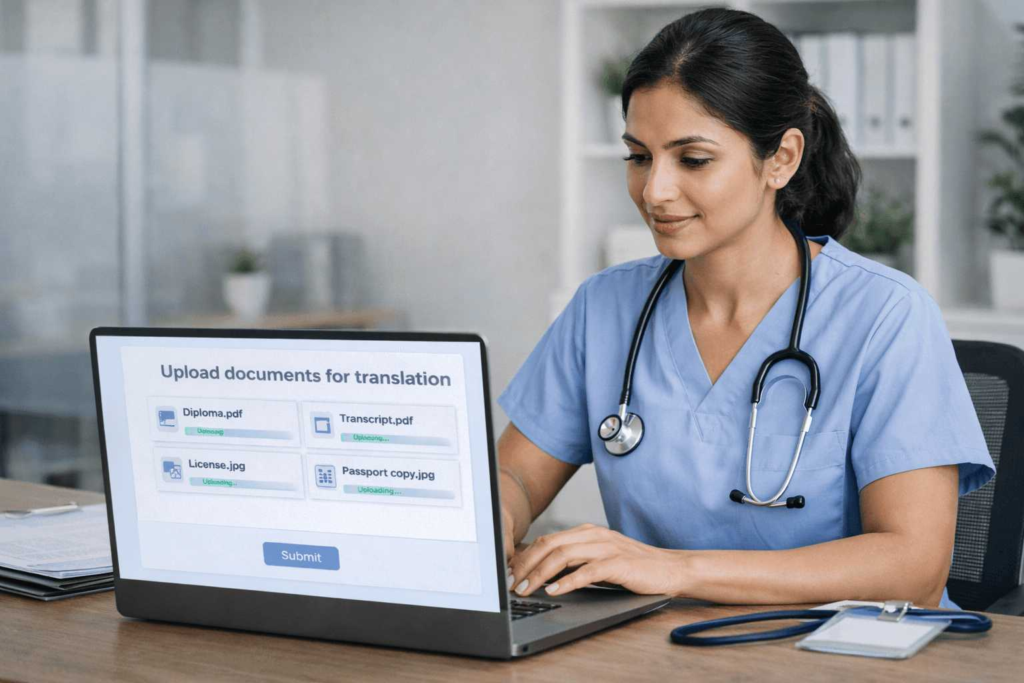
Start your project today and send your documents for review. If you are not sure what to translate first, request a quick file check, and we will help you prioritise the right documents.
FAQs
Do healthcare workers need certified translation for U.S. immigration?
Yes. If you submit foreign-language documents as part of a U.S. immigration filing, they should be translated into English with a proper translator certification. This applies to healthcare workers just as it does to other applicants.
Is nurse credential translation the same as a credential evaluation?
No. Nurse credential translation converts the document into English. A credential evaluation is a separate process that compares your education or training to U.S. standards.
What documents should I translate first as a healthcare worker moving to the USA?
Start with the documents required for your next deadline: usually identity/civil documents (if applicable), core education records, and professional licence documents. Then translate the remaining documents in batches.
Can I translate my own nursing or medical documents?
It is safer to use a professional translator. Immigration and credentialing bodies expect a competent translator’s certification, and self-translations often create avoidable problems with formatting and consistency.
Do I need to translate my transcript if the school sends records directly?
Sometimes yes, sometimes no. Some organisations require direct-source records and may have their own translation rules, while others still need a certified English translation for review. Check the specific requirement before ordering.
What if my diploma and passport names are different?
That is common. A good translation package preserves the names exactly as they appear on each original document while keeping the file organised and easy to match across all submissions.
Do healthcare workers in the UK need certified translation when applying to work in the USA?
Yes, if any of the documents you are submitting were issued in a language other than English. Many healthcare workers search from the UK because they want a UK-based provider, but the real requirement depends on the U.S. process they are entering and the language of their documents.
Can a UK-based translation provider prepare certified translations for USCIS, credentialing, and licensing use?
Yes. A UK-based provider can prepare the translation package as long as the translation is complete, accurate, properly certified, and organised for the receiving workflow. The key issue is submission readiness, not the translator’s country.
Do all healthcare workers need the same documents translated?
No. The required documents vary by profession, pathway, and deadline. A nurse, physician, physical therapist, or lab professional may each need a different mix of civil documents, academic records, licence evidence, and employment documents.
Do I need to translate documents that are already in English?
Usually no. If the document is already fully in English and accepted by the receiving organisation, it typically does not need to be translated again. The documents that usually need translation are the ones issued in another language.
If my document is partly bilingual, should I still order a certified translation?
Often yes. If the English content is incomplete, if important notes remain in another language, or if seals, stamps, or handwritten entries are not covered clearly, a full certified English translation is the safer option.
Can I send all of my healthcare documents in one project?
Yes, and that is often the better approach. A single coordinated project helps keep names, dates, institution names, and professional terminology consistent across your diploma, transcript, licence, civil documents, and work history letters.
What is the difference between a healthcare translation package and a normal certified translation order?
A healthcare translation package is usually more structured. It often involves multiple document types, technical terminology, name-history issues, staged deadlines, and the need to keep the full set consistent for immigration, credentialing, licensing, and employer review.
Should I translate everything before I know my licensing route?
Not always. It is often smarter to translate the documents needed for your next filing stage first, then translate the remaining records in batches. This reduces avoidable cost and helps you sequence your file more efficiently.