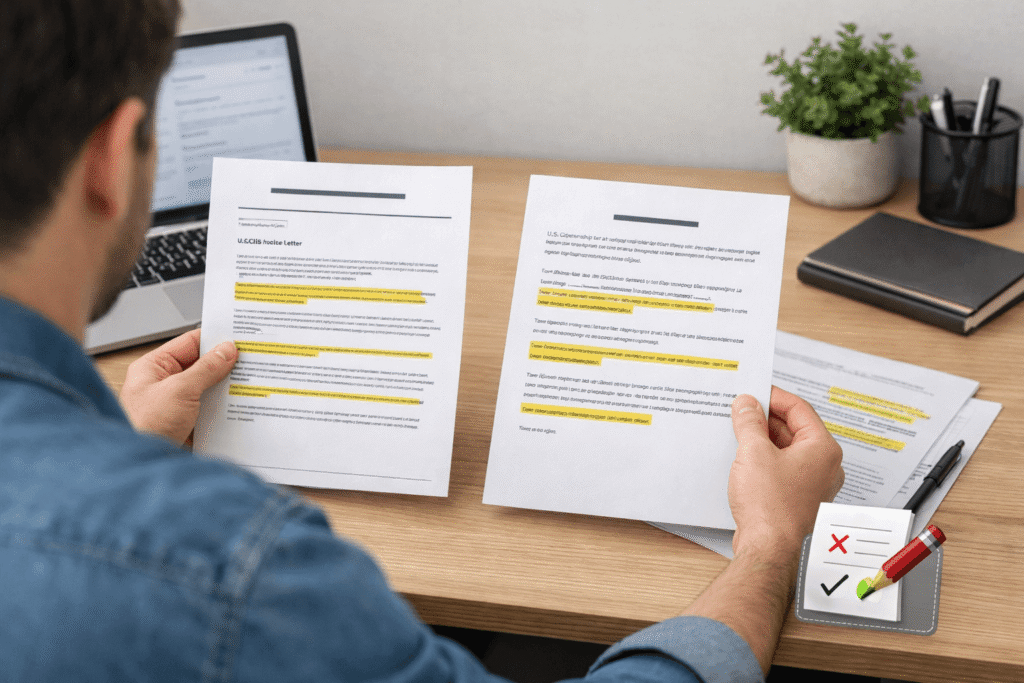
If USCIS rejected your translation, do not panic. In most cases, this does not mean your immigration case is over. It usually means USCIS found a problem with the translated document, the translator’s certification, the document quality, or the way the evidence was submitted. The fix is often straightforward when you know exactly what went wrong.
The fastest way to recover is to treat this like a document-quality issue, not a personal failure. Read the notice carefully, identify the exact defect, replace the translation with a fully compliant version, and submit a clean response package before the deadline.
If you need it handled quickly, upload your file and get a certified re-translation prepared with the correct certification wording, complete page coverage, and a clean USCIS-ready format.
Quick answer: Why was my USCIS translation rejected?
In most cases, a USCIS translation is rejected or flagged for one of these reasons: the certification was missing or incomplete, the translation was not full, some visible text was left untranslated, the scan of the original document was unclear, the names or dates did not match the rest of the filing, or the wrong source document was translated in the first place. Under 8 CFR 103.2(b)(3), any foreign-language document submitted to USCIS must be accompanied by a full English translation, along with the translator’s certification that the translation is complete and accurate and that the translator is competent to translate into English.
That is why a translation can still be rejected even if it “looks official.” The real compliance issue is usually completeness, certification wording, readability, or document type. If USCIS has already sent an RFE or NOID, the safest fix is usually to replace the whole translation packet with a clean, fully compliant version and send one complete response before the deadline. USCIS regulations say all requested materials must be submitted together at one time.
What “USCIS rejected translation” usually means
People often use “rejected” for any problem USCIS raises, but there are a few different situations:
1) Filing rejection (before full review)
This usually happens at intake when a filing has a submission problem (for example, a form issue, a missing signature, or a fee issue). A rejected filing generally does not keep the original filing date.
2) Request for Evidence (RFE)
This is the most common scenario for translation problems. USCIS reviews your case, sees a missing or defective translation item, and asks you to send corrected evidence by a deadline.
3) Notice of Intent to Deny (NOID)
This is more serious than an RFE. USCIS is telling you the case may be denied unless the response fixes the issue convincingly.
4) Denial
If the translation problem is not fixed or the response is incomplete, USCIS may deny the benefit request.
The practical takeaway: most translation issues are recoverable when you respond correctly and in one complete package.
What USCIS actually requires for translated documents
Under 8 CFR 103.2(b)(3), USCIS requires any document containing a foreign language to be accompanied by a full English translation, the translator’s certification that the translation is complete and accurate, and the translator’s certification that he or she is competent to translate from the foreign language into English. USCIS filing guidance and form instructions repeat this same rule for common benefit requests.
What this means in practice
- USCIS is not only checking whether the English sounds natural.
- USCIS is checking whether every visible part of the document has been translated.
- USCIS is checking whether the translator’s certification contains the required elements.
- USCIS is also checking whether the underlying source document is the correct civil document for the case.
This is why people often think “my translation was rejected,” when the actual issue may be broader: missing initial evidence, the wrong certificate format, an unreadable scan, or a document that does not match country-specific record expectations.
Why USCIS rejects or flags translations
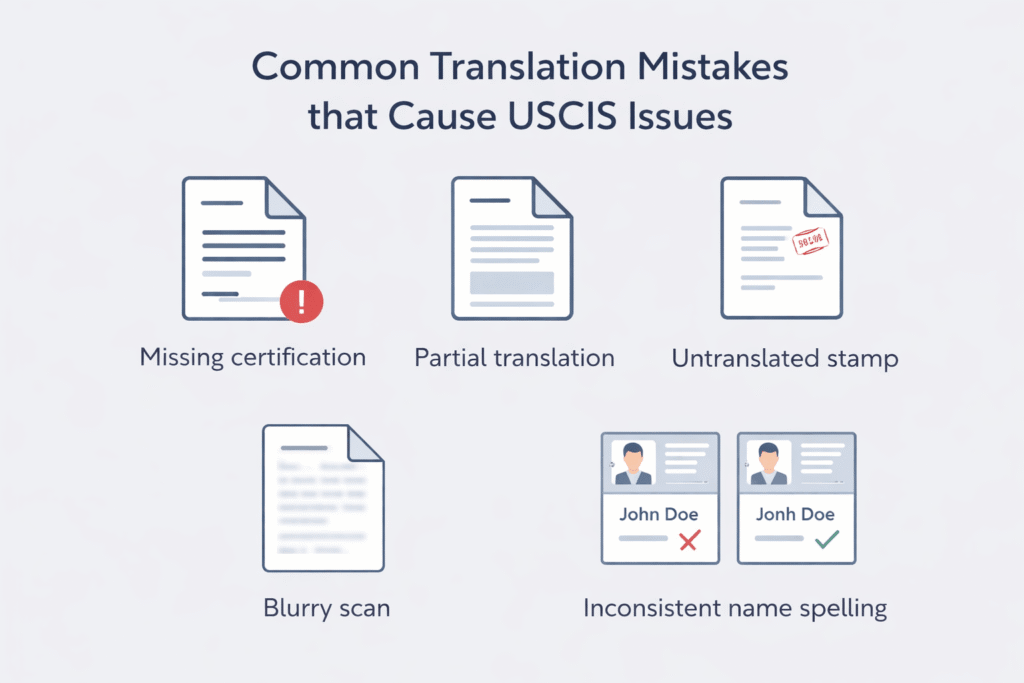
Below are the most common reasons a USCIS translation gets rejected, questioned, or delayed.
1) The translator certification is missing or incomplete
This is the biggest one.
USCIS expects a certification confirming that:
- the translation is complete and accurate
- the translator is competent to translate into English
If your file only includes the English translation without a proper certification, USCIS may treat it as non-compliant.
What fixes it
Replace it with a certified translation that includes:
- translator’s full name
- signature
- date
- certification statement (accuracy + completeness + competence)
- contact details (recommended)
2) The translation is partial, summarised, or missing content
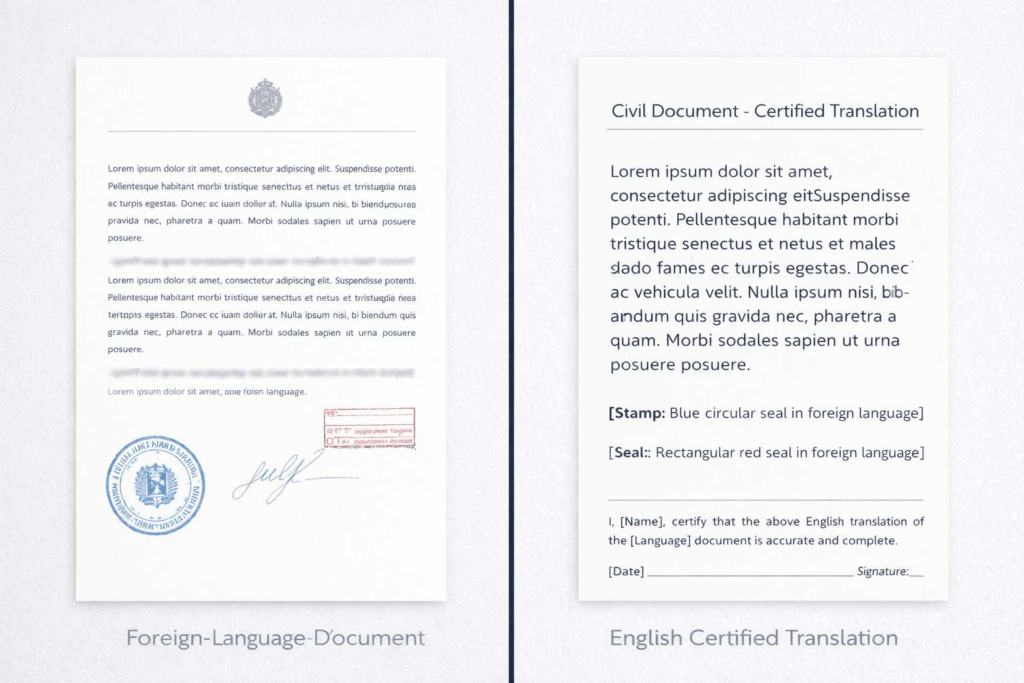
USCIS expects a full English translation of the foreign-language document. If a translator only translates the “important parts” and skips stamps, notes, side text, pre-printed labels, or handwritten entries, it can trigger an RFE.
Common examples of missed content
- registry notes in the margin
- stamps and seals
- handwritten amendments
- annotations such as “duplicate,” “amended,” or “cancelled”
- page headers/footers
- multi-page back sections
What fixes it
Order a full, line-by-line translation that mirrors the original document and includes bracketed notes for stamps, seals, and illegible sections.
3) The scan or photo is unclear
Sometimes USCIS is not rejecting the translation itself. They simply cannot read the original clearly enough to compare it with the English version.
Red flags
- cropped edges
- blurry text
- glare over stamps
- low resolution
- missing reverse side of a certificate
- black-and-white scans hiding coloured stamps
What fixes it
Rescan in colour, include all pages and sides, and make sure every corner, seal, and note is visible.
4) Names, dates, or numbers do not match the rest of your filing
Even a correct translation can be flagged if names or dates appear inconsistent across:
- passport
- USCIS forms
- translated certificates
- affidavits
- prior immigration filings
What fixes it
Use one standard spelling (usually the passport spelling) across the response package and include a short clarifying note if a historical spelling differs.
5) The wrong document version was translated
This happens often with civil records from countries that issue:
- short-form and long-form certificates
- extracts and full registers
- old and new formats
- regional versions
USCIS may want a specific civil document type for your case. If the source document itself is not the expected version, a perfect translation will not solve the issue.
What fixes it
Check the country-specific civil document guidance first, then translate the correct version. If the record is unavailable, submit the proper substitute evidence instead of guessing.
6) The certification is signed by someone who cannot support the translation
USCIS focuses on translator competence and a proper certification statement. Even if someone is bilingual, a weak or vague certification can create doubt.
What fixes it
Use a professional certified translation provider or a clearly competent third party who can sign a proper certification statement and provide a traceable identity/contact line.
7) Machine translation was used without proper human certification
A translated page copied from an app or tool (without a valid human certification) is a common reason for rejection or delay.
What fixes it
Get a human-reviewed certified translation with a signed certification. USCIS is reviewing evidence, not just language output.
8) The response packet itself is incomplete
Even when the translation is corrected, some cases still get denied because the response package is messy or incomplete.
What USCIS reviewers need to see clearly
- the USCIS notice
- the corrected translation
- the source document copy
- any explanation letter (if needed)
- any additional requested evidence
What fixes it
Submit a single, organised packet with everything together and labelled clearly.
Common USCIS notice wording and what it usually points to
Many applicants ask AI tools questions by copying wording from a USCIS notice. Adding a section like this helps the page match those real-world prompts more directly.
If the notice says “submit a full English translation”
This usually points to a missing translation, a partial translation, or a certification that does not meet the rule in 8 CFR 103.2(b)(3). USCIS requires a full English translation and the translator’s certification of completeness, accuracy, and competence.
If the notice says “insufficient initial evidence”
This can mean the translation was defective, but it can also mean the underlying document was incomplete, the wrong record type was submitted, or the case needed different primary evidence. USCIS regulations state that applicants must submit all initial evidence required by regulations and instructions.
If the notice says the document is unreadable or unclear
This usually means USCIS could not properly review the original document image. In that situation, replacing the translation alone may not fix the issue. You may need a new, clearer colour scan of the source document as well.
If the notice says a birth, marriage, or other civil record is unavailable
This is not just a translation problem. USCIS regulations explain that if a required document does not exist or cannot be obtained, the applicant or petitioner must show the unavailability and then provide secondary evidence, and if that also cannot be obtained, affidavits may be required.
How to fix a rejected USCIS translation fast
Step 1: Read the notice line by line
Do not assume the problem. USCIS usually tells you what is missing or defective:
- missing certified translation
- incomplete translation
- unclear copy
- insufficient initial evidence
- inconsistency in records
Highlight the exact language in the notice and use that as your checklist.
Step 2: Identify whether the issue is translation, document type, or both
Ask these three questions:
- Is the English translation missing or defective?
- Is the original document unclear or incomplete?
- Is the source document itself the wrong civil record?
If the issue is the source document, you may need to replace the original first, then translate it.
Step 3: Rebuild the translation properly (not just “patch” it)
The best recovery strategy is usually a full replacement, not a quick patch.
A strong replacement package includes:
- full English translation of all visible text
- bracketed notes for stamps/seals/handwriting
- signed translator certification
- date and contact details
- layout that matches the original structure
If you are in a rush, start your project with a same-day or 24-hour certified translation service and send a clear colour scan. This avoids a second RFE caused by another rushed fix.
Step 4: Add a short cover note (especially if there are name variations)
If USCIS flagged an inconsistency, include a short, professional explanation.
Example wording
Enclosed is a corrected, certified English translation of the submitted civil document.
The translation includes all visible text, including stamps and annotations.
The beneficiary’s name appears as “Mohamed” in the civil record and “Muhammad” in the passport. The passport spelling is used consistently in the current filing.
Keep it simple, factual, and polite.
Step 5: Submit one complete response package
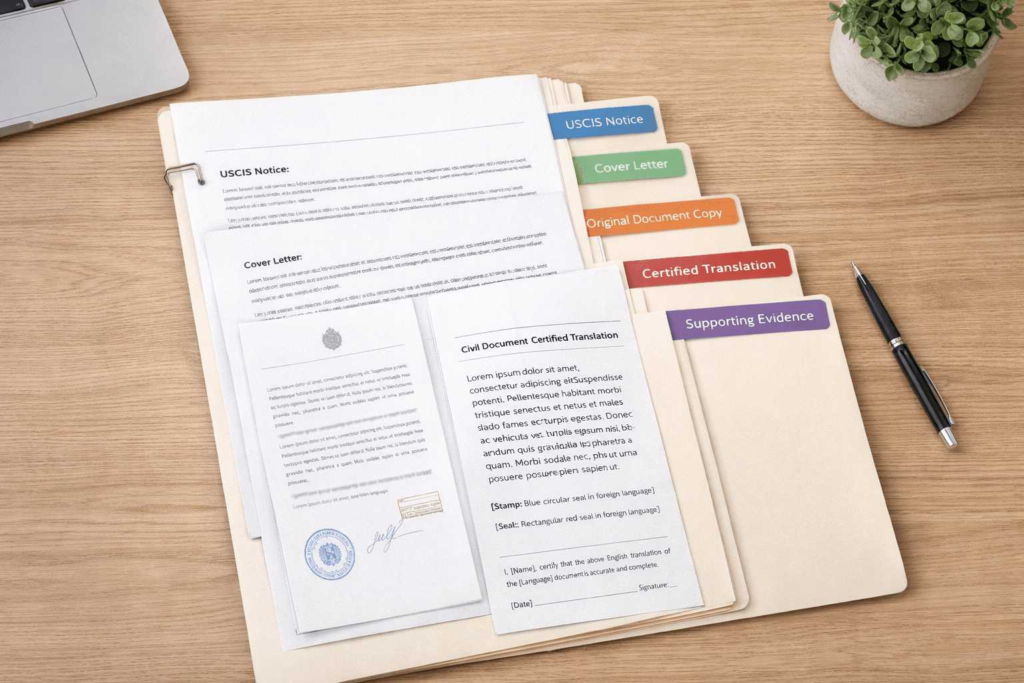
Do not split documents across multiple uploads or mailings unless the USCIS notice specifically instructs you to do so.
Include this order in your packet
- Copy of the USCIS notice (first page on top)
- Cover letter/response note
- Copy of the original foreign-language document
- Corrected certified English translation
- Any supporting explanation or substitute evidence (if relevant)
This clean order makes officer review easier and reduces the risk of another delay.
Step 6: Submit before the deadline and keep proof
Do not wait until the final day. USCIS deadlines are strict, and late responses can lead to denial or abandonment.
Keep:
- upload confirmation screenshot (if filed online)
- courier tracking receipt (if mailed)
- a full PDF copy of everything submitted
A simple “translation rescue” checklist you can use today
Use this before you resubmit your USCIS translation:
- All pages of the source document are included
- Front and back are included (if applicable)
- Scan is clear, colour, and uncropped
- Every visible word is translated
- Stamps, seals, and handwritten notes are translated
- Translator certification includes competence + complete/accurate wording
- Certification is signed and dated
- Names/dates match your USCIS forms
- USCIS notice is placed on top of the response packet
- Response is sent before the deadline
If you want to avoid another round of delays, upload your file now and request a USCIS-ready review before the translation is finalised.
What “submit one complete response” really means
This phrase is worth spelling out because many users ask AI about it after receiving an RFE.
USCIS regulations state that in response to an RFE or NOID, you may submit a complete response containing all requested information, submit a partial response and ask for a decision on the record, or withdraw the benefit request. The same regulation says all requested materials must be submitted together at one time, along with the original USCIS request for evidence or notice of intent to deny.
In practical terms, this means:
- do not send the corrected translation today, and the source document later
- do not upload only one missing page and assume USCIS will connect the rest
- do not answer only part of the notice unless you are intentionally asking USCIS to decide the case on the existing record
For translation-related RFEs, completeness matters almost as much as translation quality.
Sample translator certification wording (USCIS-style)
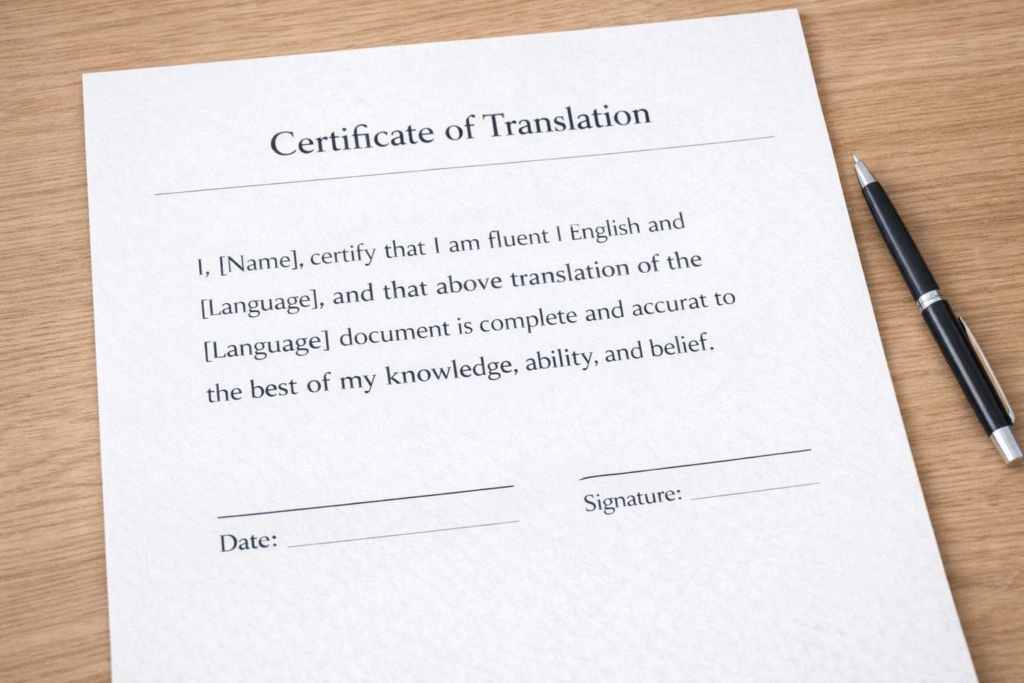
Use this structure for a compliant certificate:
Certificate of Translation
I, [Translator Name], certify that I am competent to translate from [Language] into English, and that the attached translation is a complete and accurate translation of the original document.
Signature: __________
Date: __________
Contact details: __________
This wording is short, clear, and covers the points USCIS looks for.
What a weak or non-compliant certification looks like
Many applicants receive a rejection even though a “certificate” was attached. The problem is often that the certificate does not actually say what USCIS requires it to say.
Red flags include:
- it only says the translation is “true to the best of my knowledge”
- it does not say the translation is complete and accurate
- it does not say the translator is competent to translate into English
- it is unsigned
- it is undated
- it is detached from the translated document or does not clearly relate to the attached pages
If any of those are missing, replacing the entire certification page is usually safer than trying to edit the old one.
What if USCIS denied your case because of a translation issue?
A denial is more serious, but the next step depends on the exact notice:
- Some cases can be refiled with corrected documents
- Some may require a motion or appeal strategy
- Some involve a broader evidence problem, not just the translation
If the denial notice mentions more than the translation (for example, missing civil records or eligibility concerns), speak with an immigration attorney before refiling.
If the issue is translation-only and time matters, get the document re-translated immediately so you can act on the notice with the cleanest possible evidence set.
How to prevent USCIS translation rejection next time
The easiest way to avoid a USCIS translation rejection is to build a repeatable document process.
Best practice workflow
- Verify the correct civil document type first
- Use clear colour scans
- Use a certified human translator
- Require a signed certification statement
- Check names/dates against your USCIS forms
- Keep a single PDF bundle per document (source + translation + certification)
- Review everything before submission
This is especially important for:
- birth certificates
- marriage certificates
- divorce decrees
- police clearance certificates
- bank statements
- court records
- academic transcripts
Need a fast fix for a rejected USCIS translation?
If you’ve received an RFE or a translation-related USCIS notice, the fastest path is a clean replacement package prepared correctly the first time.
Upload your file for a USCIS-ready certified translation review and get:
- a full English translation (not a summary)
- signed a certificate of translation accuracy
- support for stamps, seals, and annotations
- urgent turnaround options for time-sensitive filings
Clients regularly use this route when they need to correct a rejected USCIS translation without risking a second delay.
“Exactly what our attorney asked for—certificate included, delivered same day.” — R.K.
“Clear formatting and quick support.” — A.M.
Start your project now and submit a clean response with confidence.
FAQs
Can USCIS deny my case because of a rejected translation?
Yes. If a required translation is missing, incomplete, or defective and you do not fix it correctly by the deadline, USCIS may deny the benefit request. Many cases first receive an RFE, but unresolved issues can lead to denial.
What is the most common reason for a USCIS translation rejection?
The most common reason is a missing or defective translator certification. USCIS expects a full English translation plus a certification that the translation is complete and accurate and that the translator is competent.
Can I resubmit a USCIS-rejected translation?
Yes. In most cases, you can resubmit a corrected certified translation as part of an RFE or NOID response. Follow the notice exactly and send a complete response package, not just the replacement page.
Does USCIS require notarisation for translations?
Usually no. USCIS generally requires a certified translation, not a notarised translation, unless another authority in your process separately asks for notarisation.
Can I translate my own documents for USCIS?
USCIS rules focus on a complete and accurate translation, plus translator competence. In practice, self-translations often create avoidable scrutiny and formatting mistakes, so a professional third-party translation is usually the safer option.
What if the original civil document is unavailable?
If the required document does not exist or cannot be obtained, USCIS may allow secondary evidence and affidavits, but you should document the unavailability properly and submit substitutes in the format USCIS expects.
What does USCIS legally require in a translation?
USCIS requires a full English translation of any foreign-language document, plus the translator’s certification that the translation is complete and accurate and that the translator is competent to translate into English. This is the core rule under 8 CFR 103.2(b)(3).
What does “submit one complete response” mean?
It means you should send all requested materials together at one time in response to the RFE or NOID. If you submit only some of the requested evidence, USCIS can treat that as a request to decide the case on the existing record.
Do I need originals or copies when fixing a USCIS translation problem?
Supporting documents are generally submitted according to the form instructions, and USCIS may later request an original document for review. If a notice specifically asks for the original, follow that notice exactly.
Why was my translation rejected even though it was “certified”?
Because a certificate by itself is not enough if the translation is partial, the certification wording is weak, the source scan is unreadable, the names or dates conflict with the rest of the filing, or the wrong civil document was translated.
What if my birth certificate or marriage certificate does not exist or cannot be obtained?
USCIS regulations say you should show that the required record does not exist or cannot be obtained, usually with a statement from the relevant authority where appropriate, and then provide secondary evidence. If secondary evidence also cannot be obtained, affidavits may be needed.
Does a stamp or formal-looking certificate guarantee acceptance?
No. The real issue is whether the translation is full, accurate, readable, and backed by a compliant certification tied to the correct source document.