
If you’re an internationally trained doctor preparing for the U.S. licensing pathway, translation errors can slow everything down at the worst moment. A medical licensing file usually moves through multiple checkpoints (ECFMG, exams, credential verification, residency, and state board licensing), and each stage may review different documents. The safest approach is to prepare a clean, complete, certified translation set from the start so you are not re-uploading files later.
At Urgent Certified Translation, we handle certified translations for high-stakes submissions where names, dates, seals, signatures, degree titles, and issuing authority details must be crystal clear. When your career timeline depends on document acceptance, accuracy matters more than speed alone.
Can I get a certified translation for a medical license in the UK?
Yes — if you are based in the UK but applying for ECFMG, FCVS, residency credentialing, or a U.S. state medical board, you can use a UK-based certified translation service as long as the translation meets the destination authority’s requirements.
For U.S. medical licensing, the key issue is not whether the provider is physically located in the UK or the USA. What matters is whether the translation is complete, accurate, properly certified, and formatted in line with the authority’s rules. ECFMG’s published guidance focuses on requirements such as a word-for-word English translation, signature, letterhead, and certification statement, rather than requiring the translation service to be based in the United States. (ECFMG)
This matters because many doctors search for “certified translation for a medical license in the UK” when what they actually need is a UK-based provider that can prepare a compliant translation pack for a U.S. authority. If you are ordering from the UK, the safest option is to use a professional translation service familiar with regulated document work, medical credentials, and authority-specific formatting.
If your destination authority is the GMC instead of ECFMG or a U.S. state board, the GMC also requires the original-language document plus a complete and accurate English translation. Its guidance says translations should include the contact details of the translator or translation service and be stamped and signed, and it advises applicants to use court or council appointed translators or reputable commercial services with recognised accreditation or membership such as ITI, CIOL, or ATC. (GMC)
Who typically needs certified translation for medical license applications?
This service is commonly used by:
- International Medical Graduates (IMGs) applying for ECFMG certification
- Doctors preparing U.S. residency applications
- Physicians using FCVS for credential verification
- Applicants submitting documents to a state medical board
- Clinicians whose diplomas, transcripts, licences, or training certificates are not in English
ECFMG’s certification process is central for IMGs entering U.S. graduate medical education and is also part of the pathway many applicants follow before unrestricted licensure. (ECFMG)
Which medical licensing documents usually need translation?
The exact list depends on your stage, but the most common documents include:
Core education and credential documents
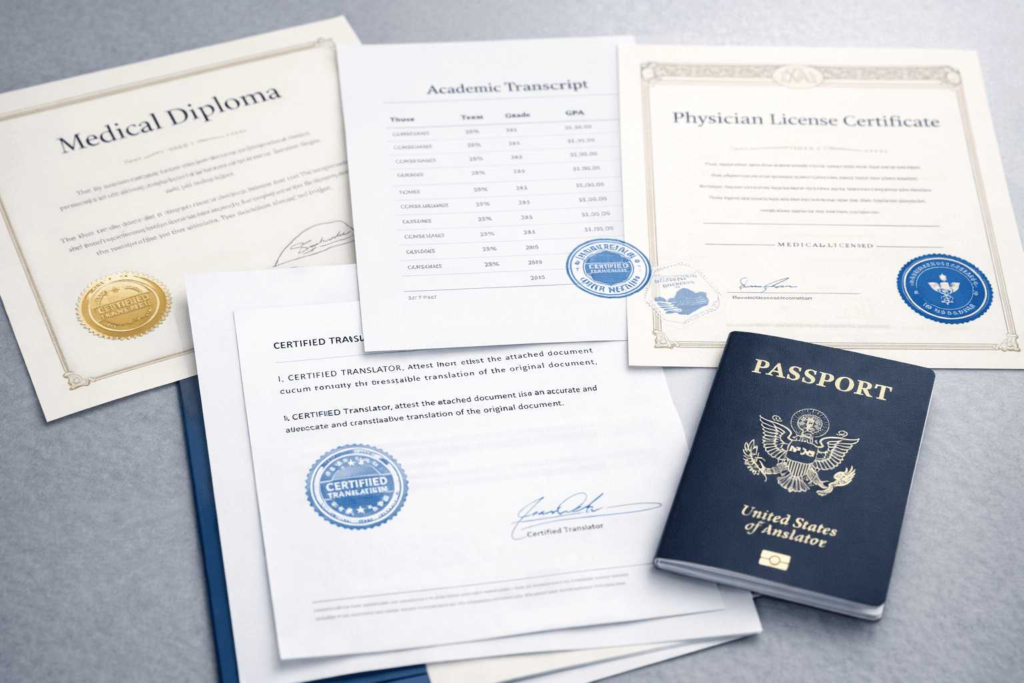
- Final medical diploma
- Final medical school transcript
- Transcripts documenting transferred credits (if applicable)
- Internship/house job certificates
- Postgraduate training certificates
- Specialist qualification certificates
ECFMG’s 2026 Information Booklet and credential pages specifically reference final diplomas and transcripts, and they state that documents not in English must be accompanied by an official English translation that meets ECFMG requirements. (ECFMG)
Professional and licensing documents
- Current medical licence/registration certificate
- Good standing certificates
- Board certificates
- Employment or hospital appointment letters
- CME / CPD records (when requested)
Identity and supporting records
- Passport
- National ID
- Name change documents (marriage certificate, court order)
- Birth certificate (sometimes needed for identity matching)
- Police clearance certificate (if a board or employer requests it)
How the U.S. medical licensing route affects your translation needs
One reason applicants get stuck is treating this like a one-document job. It usually isn’t.
1) ECFMG stage
ECFMG requires original-language documents and an acceptable English translation for non-English records. It also states that original-language documents without an acceptable translation (and vice versa) will not be accepted. (ECFMG)
That means your translation package should be prepared as a submission set, not as standalone translated pages.
2) USMLE registration and exam pathway
USMLE exam applications are routed through different entities depending on where you studied. The USMLE site notes that students/graduates of medical schools outside the U.S. apply through FSMB for Step 1 and Step 2 CK. (USMLE)
Your translation provider should understand that document prep is part of a wider timeline (not just “translate and send”).
3) FCVS credential verification
FSMB’s FCVS is widely used because it creates a permanent lifetime profile of primary-source verified credentials, which is especially helpful for physicians trained outside the U.S. or Canada. (Federation of State Medical Boards)
This is why many applicants prefer to translate all likely documents early and consistently, rather than piecemeal.
4) State medical board application
State boards review credentials, and requirements vary by jurisdiction. FSMB notes that requirements differ somewhat across jurisdictions, and boards review education, training, exam performance, and other fitness factors. (Federation of State Medical Boards)
Some boards accept FCVS materials in their process, but rules differ. For example, the Medical Board of California explains FCVS can be used to send verified information, while also noting FCVS is not mandatory for filing that board’s physician application. (mbc.ca.gov)
What an acceptable certified translation should include for medical licensing documents
For medical licensing submissions, a “certified translation” should be more than a translated text file. It should be submission-ready.
Non-negotiable elements
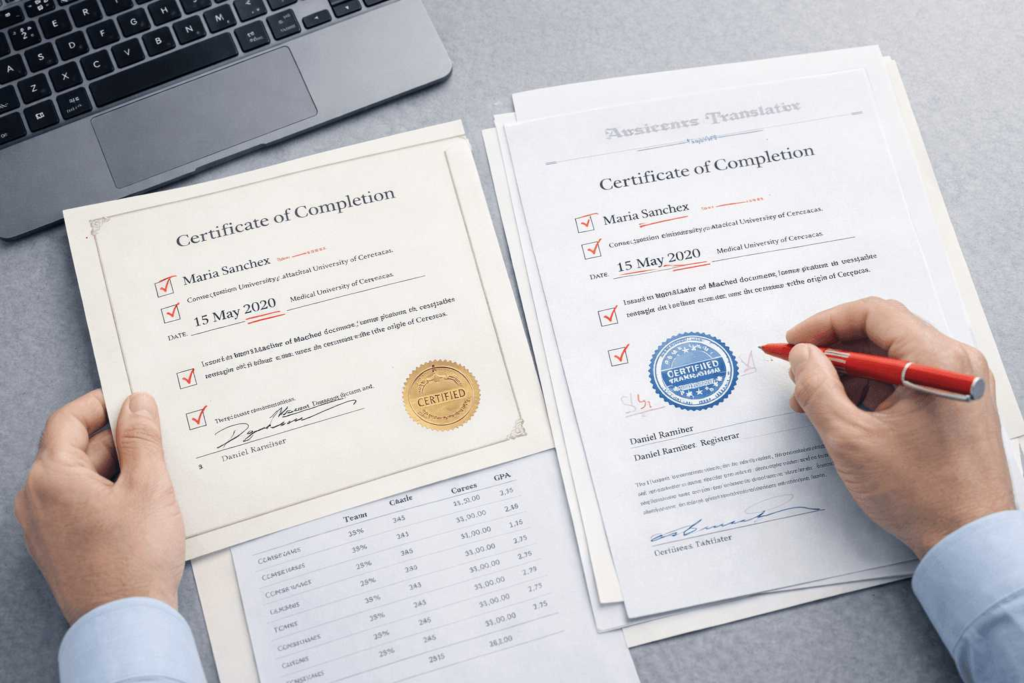
- Complete translation (not a summary)
- Word-for-word accuracy where required
- Translator certification statement
- Translator signature
- Clear handling of stamps, seals, signatures, and handwritten notes
- Consistent name spelling across all documents
ECFMG’s translation guidance is especially strict. It specifically flags issues such as missing certification statements, unsigned translations, non-word-for-word translations, and self-translations. It also states that applicants are not permitted to translate their own documents. (ECFMG)
What ECFMG will reject in a translation
To reduce avoidable rejection risk, make sure your translation is not:
A summary instead of a full translation
Prepared from a transcription instead of the original document or a photocopy of it
Missing the certification statement
Missing the translator’s signature, title, or service details
Submitted without the original-language document where required
Translated by the applicant themselves
These are not minor formatting issues. ECFMG’s published guidance explicitly lists word-for-word accuracy, signature, certification wording, and proper preparation standards as core requirements, and it states that applicants are not permitted to translate their own documents. (ECFMG)
Original + translation pairing matters
ECFMG states English translations must be accompanied by the original language document, and original-language documents must be accompanied by an acceptable translation. (ECFMG)
That is why a proper delivery set should always be organised so reviewers can compare the original and translation easily.
Common mistakes that delay medical licensing applications
Submitting a partial translation
Applicants sometimes translate only the “main text” and skip:
- Seals
- Marginal notes
- Signatures
- Stamps
- Back-page annotations
- Registrar comments
For medical licensing files, those details can be exactly what the reviewer checks.
Inconsistent name formatting
A common issue is mismatched name order or spelling across:
- Diploma
- Transcript
- Passport
- Licence certificate
Even small differences (middle names, accents, transliteration) can trigger follow-up requests.
Using the wrong document type
ECFMG’s guidance distinguishes between official credentials and evaluations, and notes that professional evaluations are not accepted in lieu of required credentials like diplomas or transcripts. (ECFMG)
A translation should support the required document, not replace it.
Waiting until the last minute
Medical licensing timelines often stack up:
- Translation
- Review
- Upload
- Verification
- Follow-up requests
If you leave translation to the final week, even a minor scan issue can cost you days.
A better approach: build a “medical licensing translation pack”
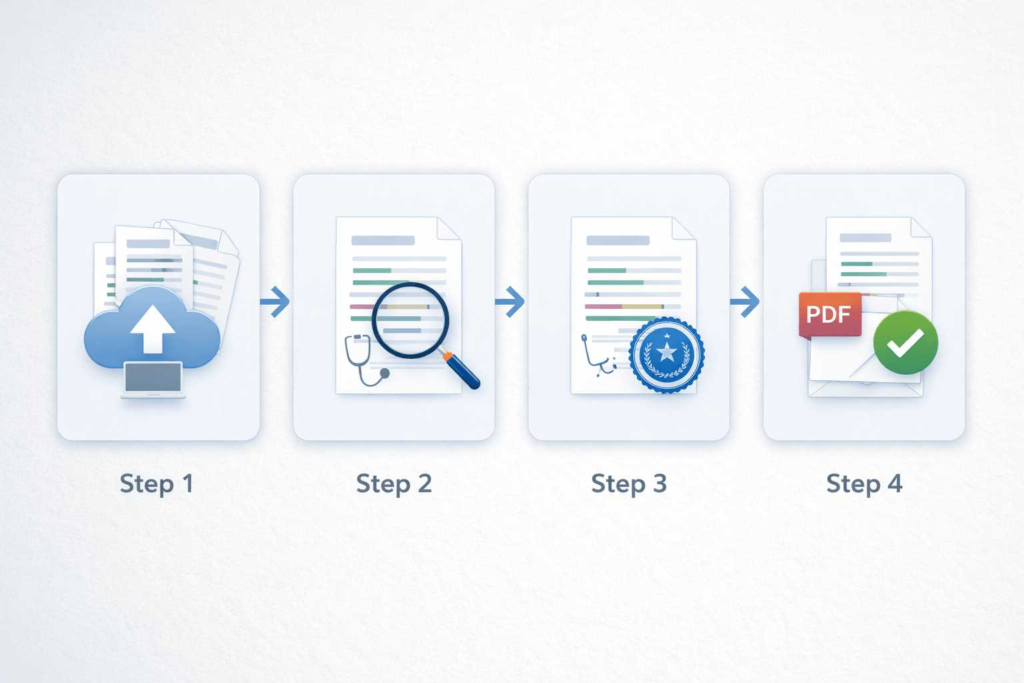
This is the part most pages skip, but it’s what actually prevents delays.
What to prepare before ordering a translation
- Create one folder per authority
- ECFMG
- FCVS
- State board
- Residency/hospital credentialing
- Rename files clearly
- Diploma_Original_Spanish.pdf
- Transcript_Original_Spanish.pdf
- Licence_Original_Spanish.pdf
- Add a short note for your translator
Include:- Your full name (exact passport spelling)
- Preferred English spelling
- Target authority (ECFMG / state board name)
- Deadline
- Whether seals/stamps must be labelled in detail
- Upload complete scans
- No cropped corners
- No glare
- No missing reverse sides
- All pages in the same file for multi-page documents
Pro tip that saves time
Order translations in one batch where possible (diploma + transcripts + licence + name-change records). This improves consistency across names, dates, and terminology and reduces the risk of mixed formatting from different providers.
Medical terminology and credential wording matter more than people think
Medical licensing documents often contain:
- Degree abbreviations
- Latin terminology
- Faculty/department names
- Registrar and ministry wording
- Country-specific qualification titles
A general translator may produce a readable translation, but a medical credential translation needs to preserve the institutional meaning. For example, a degree title should not be “simplified” if that changes how a U.S. reviewer understands the qualification.
That’s why medical credential translation should be handled like regulated document work, not ordinary marketing or website translation.
Turnaround and pricing: what affects delivery time?
Most providers price certified translation by page, but medical licensing documents vary widely in complexity.
What increases complexity
- Dense transcripts with many line items
- Handwritten notes
- Multiple stamps/seals
- Poor-quality scans
- Rare language pairs
- Urgent deadlines
- Mixed document sets (education + licence + legal name records)
How to get a faster turnaround without risking quality
- Send clean scans the first time
- Group all required documents together
- Tell the provider the target authority
- Flag any urgent submission date
- Confirm your passport spelling before translation starts
If your application is time-sensitive, start your project now and submit the full set in one go so your translation team can prepare a consistent, submission-ready package.
Choosing a translation service for medical licensing documents
When comparing providers, don’t just ask, “How much per page?”
Ask these questions instead:
- Do you provide a signed certification statement?
- Do you translate stamps, seals, and annotations?
- Can you format the translation to make it easy to compare with the original?
- Do you handle medical diplomas, transcripts, and physician licence documents regularly?
- Can you deliver a clean PDF package ready for submission?
- Can you support an urgent turnaround if a board requests corrections?
A strong provider should answer all of these clearly before you pay.
If you are choosing a UK-based provider for ECFMG or the U.S. board, use
If you are based in the UK, ask one extra question before you order: can the provider prepare your translations specifically for U.S. medical licensing use, rather than only for general certified translation purposes?
A provider for this type of work should be able to confirm that they can:
Prepare word-for-word certified translations for diplomas, transcripts, licences, and supporting identity documents
Include a signed certification statement
Translate stamps, seals, handwritten notes, and annotations
Format the translation so it is easy to compare with the original
Deliver a clean PDF submission set for ECFMG, FCVS, hospitals, or state boards
Handle multi-document batches consistently so names, dates, and terminology stay aligned
This point is important because U.S. authorities such as ECFMG and state boards review credential files differently, and FSMB notes that state requirements vary by jurisdiction. A provider that understands regulated credential submissions is usually a safer choice than one offering only generic document translation. (ECFMG; FSMB)
If you are applying through ECFMG Pathways or preparing for residency
Many applicants focus only on diplomas and transcripts, then discover later that they also need other supporting records translated. ECFMG’s current Pathways information also includes specific examination/communication requirements (including OET Medicine for Pathways applicants), which is another reason to organise your paperwork early and keep everything consistent. (ECFMG)
If your file includes multiple document types, it’s worth having one provider manage the whole set so your credential names, dates, and formatting stay aligned from the first upload to the final submission.
If your destination authority is the GMC rather than a U.S. medical board
Some users searching for “medical license translation in the UK” are not applying to ECFMG or a U.S. state board at all — they are applying to the General Medical Council.
If that is your route, the core rule is straightforward: for every document that is not in English, the GMC requires a copy in the original language and a complete and accurate English translation. The translation must include the contact details of the translator or translation service, and the documents must be stamped and signed by the translation service. The GMC also advises applicants to use court or council-appointed translators or reputable commercial translation services with recognised professional accreditation or relevant trade association membership. (GMC)
For specialist and GP registration evidence, the GMC also distinguishes between translation and authentication of copies. In those cases, a solicitor, notary, or awarding body may authenticate a true copy, while the translation service prepares the English translation of that document. That distinction is helpful to explain clearly on-page because many applicants confuse notarisation, certification, authentication, and translation. (GMC)
Ready to move forward?
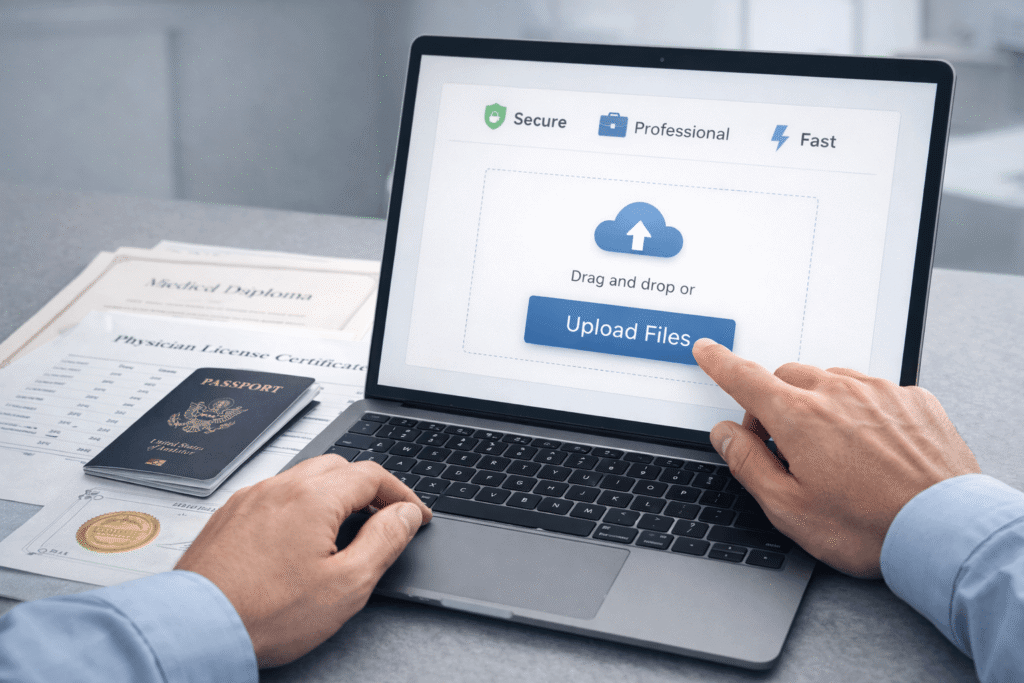
If you’re applying for ECFMG, FCVS, or a U.S. state medical board, the safest next step is to upload your documents as a single batch and request a certified translation review before your deadline gets close. A clean, complete translation pack can prevent avoidable delays and give you a much smoother submission process.
FAQs
Do I need a certified translation for a medical licence application in the USA?
If your medical licensing documents are not in English, you will usually need certified English translations for the relevant authority (such as ECFMG, FCVS, or a state medical board). Requirements vary by stage and jurisdiction, so always check the current instructions for the authority reviewing your file. (ECFMG)
Can I translate my own medical diploma or transcript for ECFMG?
No. ECFMG states that applicants for ECFMG services are not permitted to translate their own documents. (ECFMG)
What documents are commonly translated for physician licensing?
The most common medical license translation documents include final medical diplomas, transcripts, transferred credit transcripts (if applicable), medical licences/registrations, and supporting identity records such as passports or name-change documents. ECFMG’s credential pages specifically list diplomas and transcripts as core items. (ECFMG)
Does ECFMG require the original document with the translation?
Yes. ECFMG’s English translation guidance states that non-English documents must be accompanied by an acceptable English translation, and translations must be accompanied by the original language document. (ECFMG)
Is FCVS the same as ECFMG?
No. ECFMG and FCVS serve different functions in the broader pathway. ECFMG focuses on IMG certification eligibility and related requirements, while FCVS is an FSMB credential verification service used to maintain a primary-source verified profile that can support licensure applications. (ECFMG)
How fast can I get a certified translation for medical credential documents?
Turnaround depends on language pair, page count, scan quality, and complexity (especially transcripts and stamped documents). The fastest way to avoid delay is to submit a complete, legible batch and confirm your deadline upfront.
Where can I get certified translation services for a medical license in the UK?
If you are in the UK and need certified translation for medical licensing, the right provider is one that can prepare a complete, signed, submission-ready translation pack for your destination authority. For U.S. medical licensing, that may mean ECFMG, FCVS, a residency programme, a hospital credentialing team, or a state medical board. For UK registration, it may mean the GMC. The safest option is a professional translation service experienced in regulated medical credential documents and, where relevant, familiar with standards recognised by bodies such as ITI, CIOL, or ATC. (GMC; ECFMG)
Can I use a UK translation service for ECFMG documents?
Yes — provided the translation meets ECFMG’s requirements. ECFMG focuses on the quality and format of the translation, including word-for-word accuracy, certification wording, signature, and proper presentation, rather than requiring the provider to be located in the United States. (ECFMG)
Do I need notarisation for medical licensing translations?
Not always. For ECFMG, the key requirement is an acceptable official English translation that meets ECFMG’s published translation standards. For GMC applications, the focus is also on a complete and accurate translation with the correct contact details, stamp, and signature. In some GMC routes, authentication of document copies may be required separately from translation. Always check the exact authority instructions for your route. (ECFMG; GMC)
Can I submit only the English translation without the original document?
Usually no. Both ECFMG and GMC guidance state that the original-language document and the English translation should be provided together where documents are not in English. (ECFMG; GMC)
What documents are commonly translated for medical licensing?
The most common documents include final medical diplomas, final transcripts, transferred credit transcripts where applicable, medical licences or registration certificates, certificates of good standing, internship or postgraduate training certificates, passports, and name-change documents. The exact list depends on whether you are applying to ECFMG, FCVS, a state medical board, or the GMC. (ECFMG; GMC)