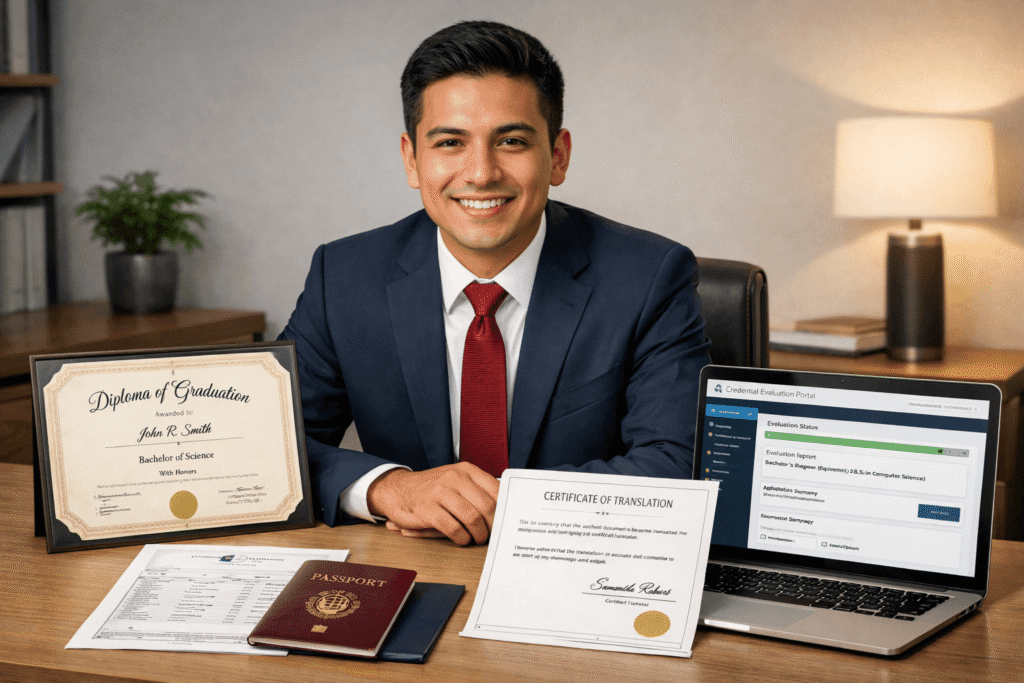
If you’re applying for a university, a job, a professional licence, or an immigration-related process in the United States, you may be asked for a foreign diploma evaluation and translation. These are related, but they are not the same thing, and mixing them up is one of the main reasons people lose time.
A translation converts your documents into English. A credential evaluation compares your education to the U.S. system. In most cases, you need both done correctly, in the right order, and for the right recipient.
If you want to avoid delays, start by gathering your diploma, transcripts, and any recipient instructions, then upload your files for review. A clear document check at the start saves days (and sometimes weeks) later.
Important Scope Note
This guide explains the U.S. process. If your recipient is in the UK rather than the USA, the route is different and usually involves UK ENIC, managed by Ecctis, rather than a U.S. credential evaluator.
Quick Answer: Which Service Should You Use?
If your recipient is in the United States, the best service is usually not the most famous company, but the evaluator and translation route your recipient will actually accept.
In the U.S., foreign credential evaluations are normally done by private evaluation services, not by the U.S. Department of Education. The safest route is to:
- First ask the university, employer, licensing board, or attorney whether they require a specific evaluator
- If they do, use that evaluator
- If they do not, choose a recognised private evaluator that your recipient accepts
- Use a separate certified translation provider for any non-English documents, because evaluation and translation are usually separate services
This matters because many people search for “best foreign diploma evaluation service”, when the better question is: Which evaluator will my recipient accept?
What foreign diploma evaluation and translation actually means
Many applicants use one term for everything, but there are two separate services involved:
Diploma evaluation and translation = (1) certified translation of your documents + (2) credential evaluation by a recognised evaluator.
Translation
This is the English version of your original-language documents, usually including:
- Diploma / degree certificate
- Academic transcripts
- Marksheets
- Course completion certificates
- Academic letters (when requested)
A proper academic translation should be complete, readable, and easy to compare with the original, including stamps, seals, signatures, and notes where visible.
Credential evaluation
This is the report issued by a credential evaluation agency that explains the U.S. equivalency of your education. Depending on your purpose, you may need:
- Document-by-document evaluation (general equivalency)
- Course-by-course evaluation (detailed courses, grades, and credits)
This is why “foreign degree evaluation US” requirements vary: a university admissions office, a state licensing board, and an employer may all ask for different report formats.
Who usually needs this in the USA
You may need credential evaluation and translation services if you are:
- Applying to a U.S. college or university
- Applying for graduate school
- Seeking a professional licence (healthcare, engineering, teaching, etc.)
- Applying for a job that requires degree verification
- Supporting an immigration case where education evidence is relevant
- Seeking salary classification or equivalency for public-sector roles
A simple rule: always follow the recipient’s exact instructions first. The evaluator and translation format should match the institution’s or agency’s requirements, not guesswork.
The fastest way to avoid delays
Before ordering anything, ask the receiving organisation these 5 questions:
- Do you require a credential evaluation?
- Which evaluation agencies do you accept?
- Do you need document-by-document or course-by-course?
- Do you require certified translations for all non-English documents?
- Do you want digital copies, sealed copies, or both?
This single step prevents the most common mistake: paying for the wrong report type.
Step-by-step process for foreign diploma evaluation and translation
1) Confirm the purpose and accepted evaluator list
Start with the end user:
- University admissions office
- Employer HR team
- State licensing board
- Immigration attorney / case officer requirements
- Professional body
Some organisations accept reports from a broad list of agencies, while others list specific evaluators only. Do not assume one evaluator works everywhere.
How to Shortlist Evaluators Without Guessing
In the United States, there is no single government-approved evaluation company for every case. Different recipients can accept different providers, and some institutions evaluate credentials in-house.
If the recipient has not named a provider, use this shortlist method:
- Ask whether they accept reports from a NACES member, an AICE Endorsed Member, or a specific company
- Confirm whether they need a document-by-document or course-by-course report
- Check whether they require digital delivery, sealed copies, or direct delivery
- Confirm whether they need transcripts sent directly from the awarding institution
- Then arrange certified translations separately for any non-English documents
This approach is much safer than choosing an evaluator based on brand recognition alone.
For many applicants, this is where “WES evaluation translation” comes in. WES is widely used, but it is not the only option, and it is not always the required one.
2) Choose the right evaluation type
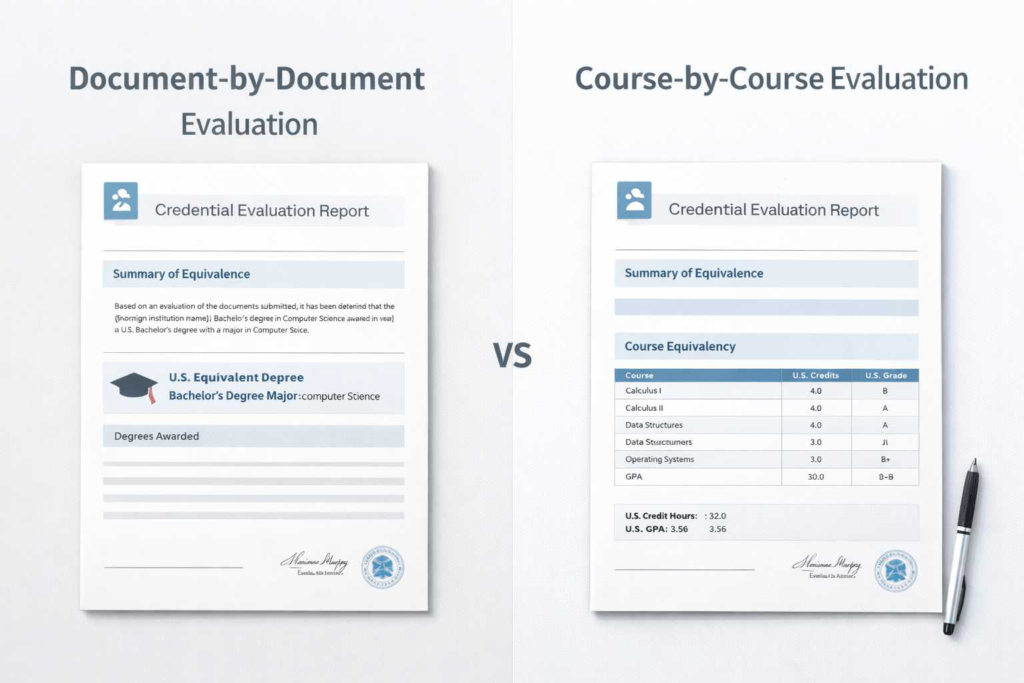
Document-by-document evaluation
Usually best for:
- General employment
- Basic admissions screening
- Immigration or administrative uses where course-level analysis is not required
This usually confirms:
- The level of your qualification
- The U.S. equivalency (for example, bachelor’s or master’s level)
- The awarding institution and country
Course-by-course evaluation
Usually best for:
- University transfer admissions
- Graduate programmes
- Professional licensing boards
- Roles requiring GPA/course credit comparisons
This is more detailed and often takes more coordination because transcripts and course data matter more.
If you are unsure, ask the recipient directly. It is much easier to upgrade correctly before submission than after a deadline is already close.
3) Gather the correct documents before you order anything
For most cases, prepare:
- Diploma / degree certificate
- Academic transcripts / marksheets
- Passport or ID (for name matching, if requested)
- Marriage certificate or legal name change document (if names differ)
- Recipient instructions (email screenshot or PDF is enough)
- Deadline date
Document readiness checklist
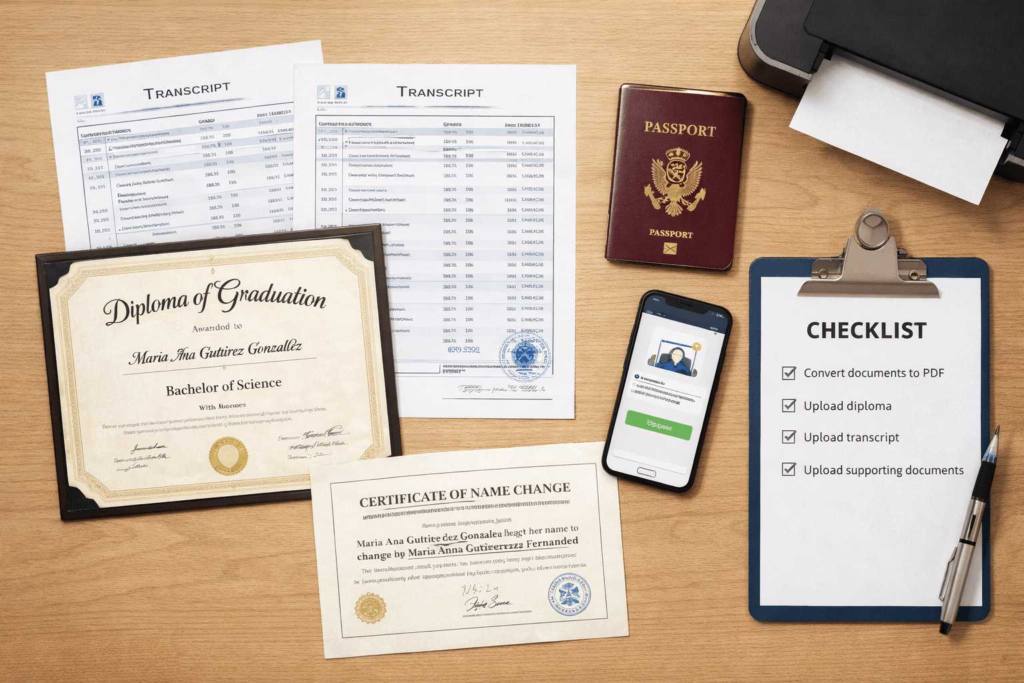
Use this before you upload:
- All pages included
- Corners and edges visible
- Text readable (no blur)
- Stamps/seals visible
- Names and dates clear
- No heavy shadows or glare
- Files labelled clearly (e.g., Diploma_Spanish.pdf, Transcript_Page1.jpg)
A clean submission helps both the translator and the evaluator work faster.
4) Get your academic documents translated correctly
This is the part most people rush, and it is where preventable rejections happen.
What a good academic certified translation should include
- Full translation of all visible text
- Clear rendering of names, institutions, dates, grades, and titles
- Notes for seals/stamps/signatures (where visible)
- Consistent formatting that mirrors the source
- Signed certificate of translation accuracy
Can you translate your own diploma or transcript?
For official use, self-translation is risky and often rejected. Even where self-translation is technically possible in some contexts, it creates avoidable problems with completeness, certification wording, and credibility.
For U.S. submissions involving foreign-language documents, you should use a professional certified translation provider and ensure the certification statement is included.
When Immigration Is Involved
If you are filing documents with USCIS and any supporting document is in a foreign language, you must include a full English translation together with a translator certification confirming that the translation is complete and accurate and that the translator is competent to translate.
That translation requirement does not automatically mean you also need a credential evaluation. Whether you need an evaluation depends on the visa category, petition type, or legal strategy involved. Translation and evaluation are related, but they are still separate steps.
Academic translation tip that saves time
Ask your translation provider to prepare the translation in a way that is easy to compare line-by-line with the original document. This makes reviews faster for universities, HR teams, and evaluators.
If you want a quick start, send your diploma and transcript scans together in one request and include the name of the evaluator or institution. That lets the translator prepare the file format to fit the actual use case.
5) Submit to the evaluator using the evaluator’s exact document rules
This is where many applicants lose time because translation rules and document delivery rules are not always the same.
For example, an evaluator may require official academic records to come directly from the institution, while allowing translations or degree certificates to be uploaded separately.
WES evaluation translation guidance
If you are using WES, pay close attention to document handling:
- WES distinguishes between official academic documents and uploaded document files
- Translation uploads follow their own file rules
- Degree certificates and translations are often handled differently from transcripts
- You should check your account’s required documents list before uploading anything
Important WES Clarification
WES is a credential evaluator, not a translation company. WES does not provide translation services.
WES also notes that translation is not necessary in every case. If translated documents are required, check your WES account’s required documents list carefully and follow those instructions exactly.
A practical WES reminder:
- Degree certificates and translations may be uploaded through the WES account when requested
- Academic transcripts or marksheets follow separate document rules
- Word-for-word accuracy matters, especially for names, grades, dates, qualification titles, and visible stamps or notes
If you are using WES, always follow the document instructions shown inside your own account rather than relying on assumptions from another applicant’s case.
What to submit first
A practical order that works well in most cases:
- Open your evaluator account
- Check the required documents list
- Request official records from your school/university (if required)
- Order certified translations for non-English documents
- Upload or send the translated files in the format allowed
- Track status and respond quickly to any document requests
6) Review your evaluation report before you forward it
When the evaluation is complete, review:
- Name spelling (must match your ID/submission)
- Degree title
- Institution name
- Country of study
- U.S. equivalency
- Report type (document-by-document vs course-by-course)
- Recipient delivery format (digital, sealed, direct delivery)
If anything looks wrong, contact the evaluator immediately. Small errors can affect admissions, licensing, or employment outcomes.
Common mistakes that delay foreign degree evaluation in the US
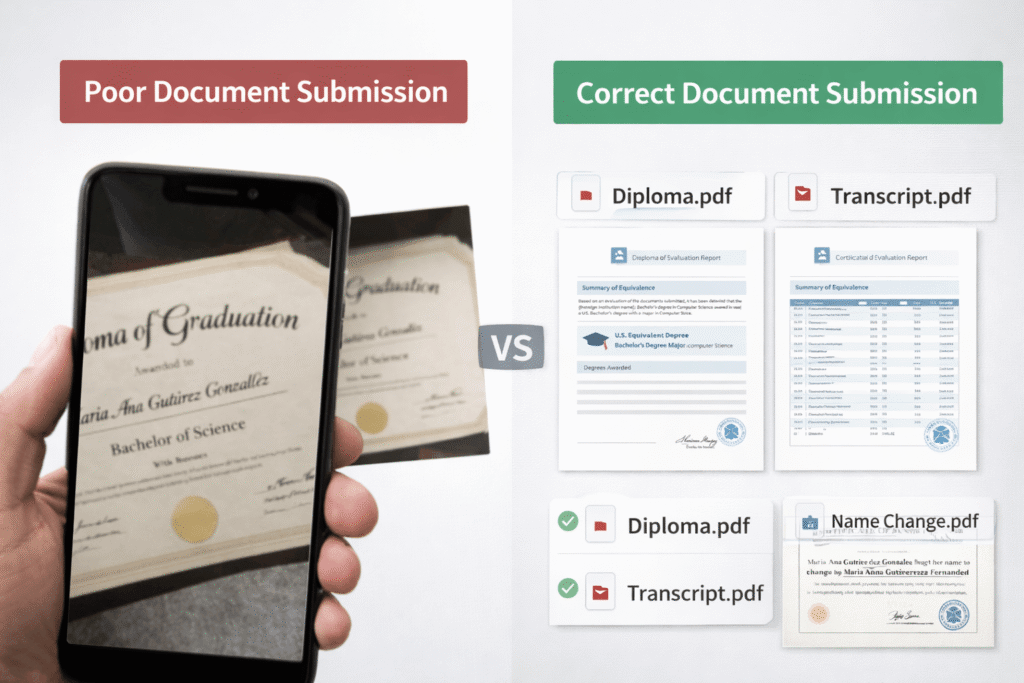
1) Ordering translation before checking evaluator rules
Not every evaluator wants the same file format or submission method.
2) Sending low-quality scans
Blurry stamps and cut-off corners create back-and-forth and slow the process.
3) Translating only the diploma, not the transcript
Many applicants forget the transcript is the document evaluators rely on most.
4) Choosing the wrong evaluation type
A document-by-document report may not satisfy a university or licensing board.
5) Ignoring name mismatches
If your diploma name and passport name differ, provide the supporting name-change document early.
6) Waiting until the deadline week
Even “fast” cases can slow down if your university must send records or respond to verification.
Timeline planning for credential evaluation and translation services
There is no universal timeline because the process depends on:
- Your country of education
- How quickly your institution sends records
- The evaluator’s queue
- Whether your documents need clarification
- The complexity and volume of translation
A realistic planning approach
- Best practice: start several weeks (or more) before your deadline
- Urgent cases: submit scans and recipient requirements immediately so translation can begin while you arrange institutional records
- High-risk cases: licensing and postgraduate admissions often need more detailed reports and more time
If you have a deadline, include it in your first message when requesting a quote. That helps the translation team prioritise the correct workflow from the start.
Cost planning without surprises
Foreign diploma evaluation and translation is usually billed in two parts:
1) Translation cost
Based on:
- Number of pages
- Language pair
- Document complexity
- Turnaround speed
2) Evaluation cost
Based on:
- Evaluator selected
- Report type
- Delivery method
- Rush processing (if available)
- Extra copies (if needed)
Hidden cost to watch for
The biggest hidden cost is rework:
- Wrong report type
- Missing transcript translation
- Poor scan quality
- Name mismatch
- Missed deadline due to incomplete submission
A proper document check at the beginning is often the cheapest part of the entire process because it prevents re-submission fees and deadline stress.
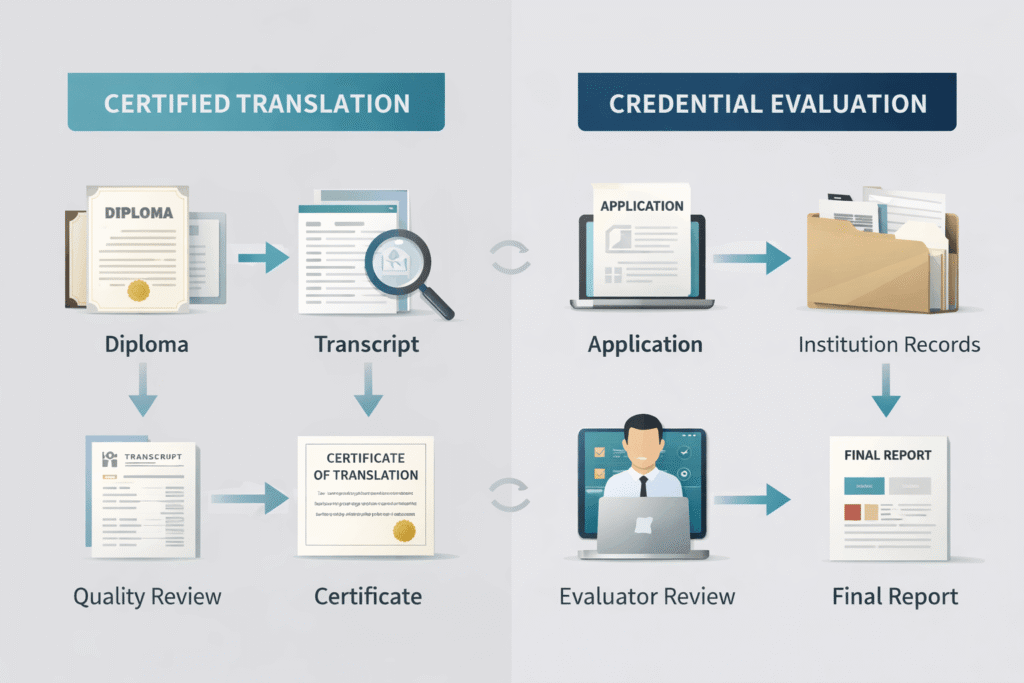
A practical workflow you can use today
Use this “two-track” approach to move faster:
Track A: Translation
- Collect clear scans
- Confirm names and spelling
- Translate diploma + transcripts
- Prepare certification statement
- Final quality review
Track B: Evaluation
- Confirm accepted evaluator
- Open application
- Check required documents
- Request official records from institution
- Upload/send documents as instructed
Running both tracks together (instead of waiting to finish one before starting the other) is usually the fastest way to complete the process.
When you may also need notarisation or extra certification
For many evaluation uses, a certified translation is enough. However, some recipients may ask for extra steps such as:
- Notarisation
- Hard-copy originals
- Sealed delivery
- Apostille/legalisation (less common for U.S. academic evaluation, but possible for other uses)
Do not add these automatically. Only order them if the receiving organisation specifically asks.
Why applicants choose a specialist for diploma evaluation and translation
Academic documents are easy to mistranslate if the provider is not careful with:
- Grade scales
- Course titles
- Abbreviations
- Institutional terminology
- Stamp/seal wording
- Name order conventions
A specialist translation team reduces the risk of formatting errors and incomplete translations that can slow down your evaluator review.
If you’re applying to a university, licensing board, or employer, upload your files and the recipient instructions together. That lets the translation be prepared correctly the first time, with the right certification wording and formatting for official use.
Final checklist before you submit
- Recipient requirements confirmed
- Evaluator selected
- Correct report type selected
- Diploma and transcripts prepared
- Certified translations completed
- Name consistency checked
- Official records requested (if needed)
- Files uploaded/sent in the required format
- Deadline noted and tracked
Getting your foreign diploma evaluation and translation right is mostly about process, not paperwork volume. Once you follow the right order, the entire path becomes much smoother.
If you need help preparing the translation side, send your diploma, transcripts, and deadline in one message. A proper review upfront can save multiple rounds of corrections later.
FAQs
Do I need both translation and evaluation for a foreign diploma in the USA?
Usually, yes—if your documents are not in English and the recipient also wants a U.S. equivalency report. The translation makes the documents readable in English, while the evaluation explains the U.S. educational equivalent.
Can I use WES for foreign diploma evaluation and translation?
WES provides credential evaluation, not translation services. If your documents are not in English, you generally need a separate professional translation before or alongside the WES process, depending on the document type and WES submission instructions.
What is the difference between diploma evaluation and transcript evaluation?
A diploma confirms the qualification awarded, while transcripts show courses, grades, and credits. Many recipients need both, especially for course-by-course reports. Translating only the diploma is a common mistake.
Can I translate my own academic documents for a credential evaluation?
For official use, self-translation is often rejected or creates delays. A professional certified translation is the safer option because it includes the required certification and is easier for evaluators and institutions to accept.
How long does foreign degree evaluation in the US take?
It varies by evaluator, report type, and document delivery method. Delays often come from missing records, poor scans, or wrong report selection—not just evaluator processing time.
What should I send first to get started?
Send clear scans of your diploma and transcripts, your target institution/employer/board name, and your deadline. That gives your translation provider enough information to prepare the correct format and helps you move the evaluation process forward faster.
What is the best service for foreign diploma evaluation and translation in the USA?
There is no single best provider for everyone. The best choice is the evaluator your university, employer, licensing board, or attorney will accept, paired with a certified translation provider for any non-English documents. If the recipient names WES or another specific evaluator, use that evaluator. If they do not, ask whether they accept reports from recognised private evaluators before ordering.
Is there an official U.S. government credential evaluation service?
No. The U.S. Department of Education does not evaluate foreign qualifications or degrees and does not endorse individual credential evaluation services. In practice, credential evaluations in the United States are usually performed by private, non-governmental entities, and the receiving institution or authority decides what it will accept.
Do I always need WES for a foreign diploma evaluation?
No. WES is widely known, but it is not the only evaluator. Some universities, employers, and licensing bodies accept other private evaluators, and some institutions review foreign credentials internally. Always check the recipient’s instructions before paying for any evaluation.
Does WES provide translation services?
No. WES does not provide translation services. If translations are required for your case, you will usually need a separate professional translation provider or a translation issued in the format WES accepts.
Can one company handle both translation and evaluation?
Sometimes applicants use one provider for translation and a different provider for evaluation, which is often the normal arrangement. The key issue is not whether one company does both, but whether the evaluation is accepted by the recipient and whether the translation meets the recipient’s certification requirements.
Is the UK process the same as the U.S. process?
No. In the UK, overseas qualification comparison is commonly handled through UK ENIC, managed by Ecctis, using services such as the Statement of Comparability. That is different from the U.S. credential evaluation process explained on this page.