A power of attorney (POA) is one of the most sensitive documents you can submit. It gives someone legal authority to act on your behalf, so even small translation mistakes can create delays, rejections, or disputes. If you need a translated POA for a court, bank, property transaction, embassy, or immigration case, the safest approach is to treat it as a legal submission, not just a language job.
This guide walks you through the full process from the first scan to the final submission bundle, including when you need a certified translation, when notarisation may be required, and when apostille or legalisation may apply. If you need it quickly, upload your document and deadline and get a fixed quote before work starts.
Quick answer: How can I translate a power of attorney accurately in the UK?
To translate a power of attorney accurately in the UK, use a professional legal translator, send the final signed version of the full document, and order a complete certified translation that includes names, dates, signatures, stamps, seals, witness wording, and any annexes or handwritten notes that are legible. Before you place the order, confirm whether the receiving authority also requires notarisation, apostille, legalisation, or a sworn translation.
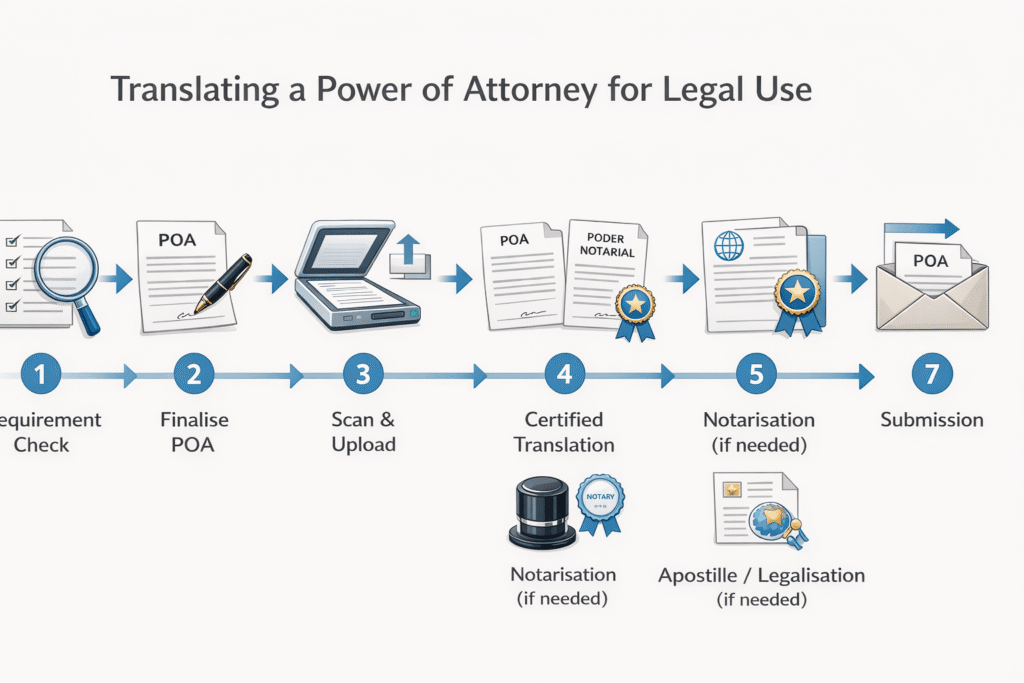
If you want the safest route, follow this order:
- confirm the receiving authority’s exact requirement
- finalise the signed POA
- send every page and attachment
- obtain a complete certified translation
- add notarisation only if requested
- add apostille or legalisation only if required for cross-border use
This is the simplest way to avoid the three most common POA translation problems: incomplete translations, the wrong certification wording, and authentication steps being done in the wrong order.
What a “legal-use” POA translation usually needs
A POA translation for legal use is usually a complete translation of the full document, including:
- Names, signatures, titles, and dates
- Stamps, seals, and notarial wording
- Handwritten notes (if legible)
- Attachments, annexes, and page references
- Witness statements or solicitor/notary endorsements
For most official uses, the translation should also include a signed certification statement confirming:
- the translation is complete and accurate
- the translator is competent in both languages
That is the foundation. After that, the receiving authority may ask for additional steps, such as notarisation, sworn translation, or apostille/legalisation.
The 3-layer rule that prevents most POA translation mistakes
Here is the simplest way to avoid confusion:
1) Translation layer
This is the language part:
- the POA is translated fully
- formatting is clear
- seals/stamps are labelled
- certification is attached
2) Signature/authentication layer
This is the document-authenticity part:
- the POA signature may need witnessing
- a notary or solicitor may need to certify or witness the signing
- some authorities want the translation notarised too (only if requested)
3) Cross-border legalisation layer
This applies when the POA is used in another country:
- apostille or legalisation may be required
- embassy/consular attestation may also be required in some cases
- the order matters (signing/notary → apostille/legalisation → final submission)
Most delays happen because people mix these layers together. A certified translation does not automatically replace notarisation, and an apostille does not automatically confirm the translation text itself.
Step-by-step process for translating a power of attorney
1. Confirm where the POA will be used
Before translating anything, confirm the receiving authority:
- Which country?
- Which office (court, bank, land registry, embassy, immigration, solicitor)?
- What exact wording do they use (certified / notarised / sworn / legalised / apostilled)?
- Do they want the original, a certified copy, or both?
Ask for their written requirement if possible. This saves time and avoids paying for the wrong format.
2. Finalise the POA before translation
Do not translate a draft unless you are certain it will not change.
A POA often includes:
- names and passport numbers
- addresses
- powers granted
- validity periods
- property details or account details
If any of that changes after translation, you may need a full re-translation.
3. Send a complete, readable scan
For a submission-ready translation, send:
- every page (front and back if stamped)
- the full document edges visible
- close-ups of seals/stamps if faint
- any annexes or attachments
- any instruction from the receiving authority
Phone photos are usually fine if they are flat, bright, and readable.
4. Get a certified translation prepared
A proper POA translation should be:
- complete (no summaries)
- consistent (names, dates, numbers)
- clearly formatted
- easy to compare with the original
- delivered with a signed certification statement
For legal documents, clarity matters as much as language accuracy. The person reviewing it may compare it line-by-line.
5. Add notarisation only if required
Some organisations accept a certified translation on its own. Others ask for:
- a notarised translation
- a notarised copy of the original
- a notary-witnessed POA before translation
- all of the above
If they ask for notarisation, confirm which item must be notarised:
- the original POA
- the translated POA
- the translator’s certification
- a copy bundle
This detail is often missed.
6. Check whether apostille or legalisation is required
If the POA is being used abroad, the receiving country may require:
- an apostille (for many countries)
- legalisation/authentication (for others)
- embassy or consular attestation
This step usually applies to the original signed/notarised document, not just the translation. Some authorities also want the translation attached to the notarised original before legalisation. Always confirm the required order.
If the POA was issued in the UK vs issued abroad
This is one of the most important points to clarify before ordering the translation.
If the POA was issued in the UK and will be used abroad
You may need:
- the original signed POA or a properly certified copy
- certification by a UK notary or solicitor, if required
- apostille or legalisation for the destination country
- a certified translation for the receiving authority overseas
If the POA was issued outside the UK
The route is usually different:
- the document normally has to be legalised in the country where it was issued
- the UK cannot usually legalise a foreign-issued POA through the UK apostille process
- once the original document is correctly legalised, you may then need a certified translation for use in the UK or for the final receiving authority
This is where many people lose time. They assume that because they are in the UK, the UK can legalise any POA. In practice, the country of issue usually controls the legalisation route.
7. Submit the bundle in the correct order
A clean POA submission pack often looks like this:
- Copy of original POA (or original, if required)
- Certified translation
- Translator certification
- Notarisation page (if required)
- Apostille/legalisation page (if required)
- Any cover letter or reference number
If you are submitting online, use clear file names:
- POA-Original.pdf
- POA-Certified-Translation.pdf
- POA-Notarised.pdf
- POA-Apostille.pdf
Certified, notarised, sworn, apostilled — what each one actually means
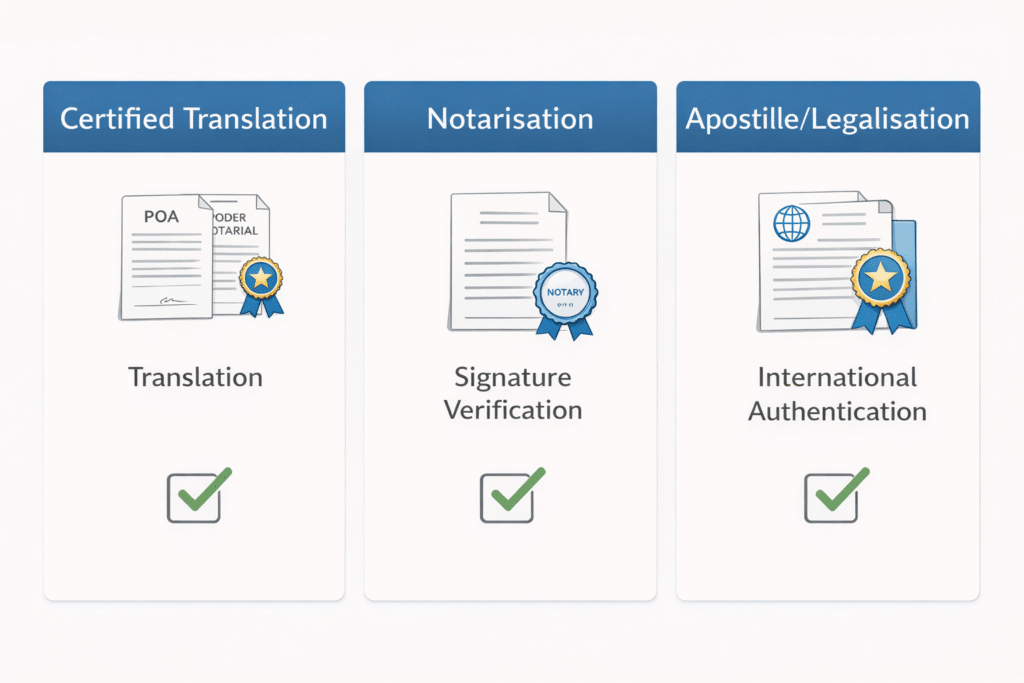
Certified translation
A full translation with a signed statement confirming accuracy and translator competence.
Best for: many immigration, legal, academic, and administrative uses.
Notarisation
A notary verifies identity/signature or certifies a signature process. In translation workflows, this may apply to the translator’s declaration or the original document signing.
Best for: when the receiving authority explicitly asks for notarisation.
Sworn translation
A legally authorised translator produces the translation under a country-specific sworn system.
Best for: countries that specifically require a sworn translator (common in parts of Europe and Latin America).
Apostille / legalisation
A government authentication step used for international document acceptance.
Best for: cross-border use of a POA (property, family matters, business, court matters abroad).
The exact certification wording a POA translation should include
One of the most common reasons a power of attorney translation is rejected is not the translation itself, but the certificate attached to it. If the certification wording is too vague, the authority may still refuse the document.
For legal use, the certification should make it easy for the reviewer to see:
- the document being translated
- the language pair
- that the translation is complete and accurate
- that the translator is competent in both languages
- the date of certification
- the translator or translation company’s name, signature, and contact details
If one certificate covers more than one document, it should identify exactly which documents are included.
A safe model wording is:
“I certify that I am competent to translate from [source language] into [target language], and that the attached translation of the Power of Attorney dated [date], together with any annexes listed in this certificate, is a complete and accurate translation of the original document.”
Practical tip: If the receiving authority has given you its own preferred wording or filing format, use that wording format instead of a generic certificate.
POA translation requirements by use case
POA for property or real estate matters abroad
This is one of the most common scenarios. A foreign property transaction may require:
- the signed POA
- translation into the local language
- notary involvement
- apostille/legalisation
- in some cases, local sworn translation
Practical tip: Ask the receiving lawyer or land office for a one-page checklist before you order the translation.
POA for immigration or official filings in English-speaking jurisdictions
If the POA or supporting documents are not in English, the receiving authority may require a certified English translation. For immigration court filings, translation certification wording and translator details can be especially important.
Practical tip: If you are filing through a solicitor or immigration representative, ask whether they want the translation certificate attached to each document or one certificate covering multiple documents.
POA for banking, probate, or family authorisation matters
Banks and probate offices often have their own internal policies. They may ask for:
- recent date on the POA
- witness/notary details
- certified translation
- proof of identity matching the translated names exactly
Practical tip: Match name spellings to the passport or ID you are using for the transaction.
Special note for UK Lasting Powers of Attorney (LPA)
If your document is specifically an England and Wales Lasting Power of Attorney, there is an extra point many people miss: the LPA must be registered before the attorney can use it.
For domestic use, organisations may ask to see:
- the registered original LPA
- a certified copy of the LPA
- in some cases, the online summary or access details used to confirm authority
If the LPA is being presented abroad or to a non-English authority, you may also need:
- a certified translation
- a certified copy of the registered LPA
- notarisation or apostille, if the receiving authority asks for it
Practical tip: Tell the translator whether the document is a general POA, a property and financial affairs LPA, or a health and welfare LPA, because the wording and supporting pages can differ.
What to send your translator for the fastest turnaround
To avoid back-and-forth, send this in one message:
- Clear scans/photos of the full POA
- Language pair (for example, Arabic to English)
- Country where it will be used
- Deadline
- Whether you need:
- certified translation
- notarisation
- sworn translation
- apostille/legalisation support
- Any formatting preference (PDF only, editable Word, printed copies)
If you already have the authority’s requirements, attach them. That can cut revision time dramatically.
Common mistakes that cause POA translation delays
1) Translating only the main page
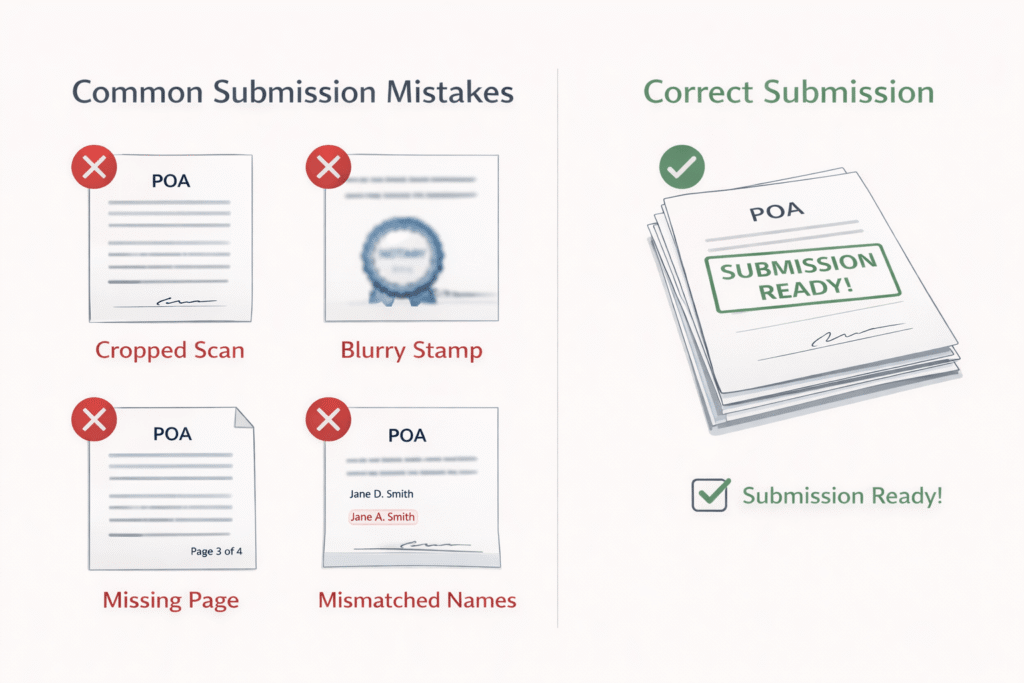
POAs often include notary pages, witness sections, and annexes. Missing pages can make the translation unusable.
2) Ignoring seals, stamps, and handwritten notes
These details matter. They should be translated or clearly labelled where readable.
3) Ordering notarisation before confirming the requirement
Not every authority wants it. Paying for extra steps can waste time and money.
4) Using a draft version of the POA
A small change in authority wording can invalidate the translated version.
5) Mismatched names across documents
If the POA says one spelling and the passport says another, the authority may pause the case.
6) Assuming “apostille” and “translation” are the same thing
They are different steps. One authenticates document origin/signatures; the other converts the content into the required language.
A quick POA submission-ready checklist
Use this before sending your file to a court, bank, solicitor, embassy, or registry office:
- Every page of the POA is included
- Signatures, stamps, and seals are visible
- Names match passport/ID spelling
- Dates and document numbers are clear
- Translation is complete (not partial)
- The certification statement is signed and dated
- Notarisation is included only if requested
- Apostille/legalisation is included if the POA is for overseas use
- File names are clear and organised
- You have kept copies of everything submitted
Example scenarios
Example 1: POA for a property sale overseas
A client signs a POA in the UK so a relative can complete a property transaction abroad. The receiving lawyer asks for:
- the signed POA
- notarisation
- apostille
- local-language translation
The correct order is usually to finalise the signed document first, then handle authentication steps, then prepare the certified translation (or follow the lawyer’s required order if they specify a different sequence).
Example 2: POA included in an immigration or court filing
A client submits a POA as supporting evidence in an English-language case file. The office asks for:
- full English translation
- certification statement
- translator details
In this case, a clean certified translation with proper certification wording is often the key requirement, and formatting quality matters because reviewers compare the original and translation side by side.
When speed matters
POA requests are often urgent because they are tied to:
- property deadlines
- court dates
- embassy appointments
- healthcare decisions
- business signing windows
If you are on a deadline, do not wait until the translation is finished to ask about legalisation or notarisation. Confirm all required steps at the start, then submit the full job in one go.
For urgent cases, send your document and deadline today so the correct route can be confirmed immediately and you can avoid paying twice.
Why clients choose Urgent Certified Translation for POA documents
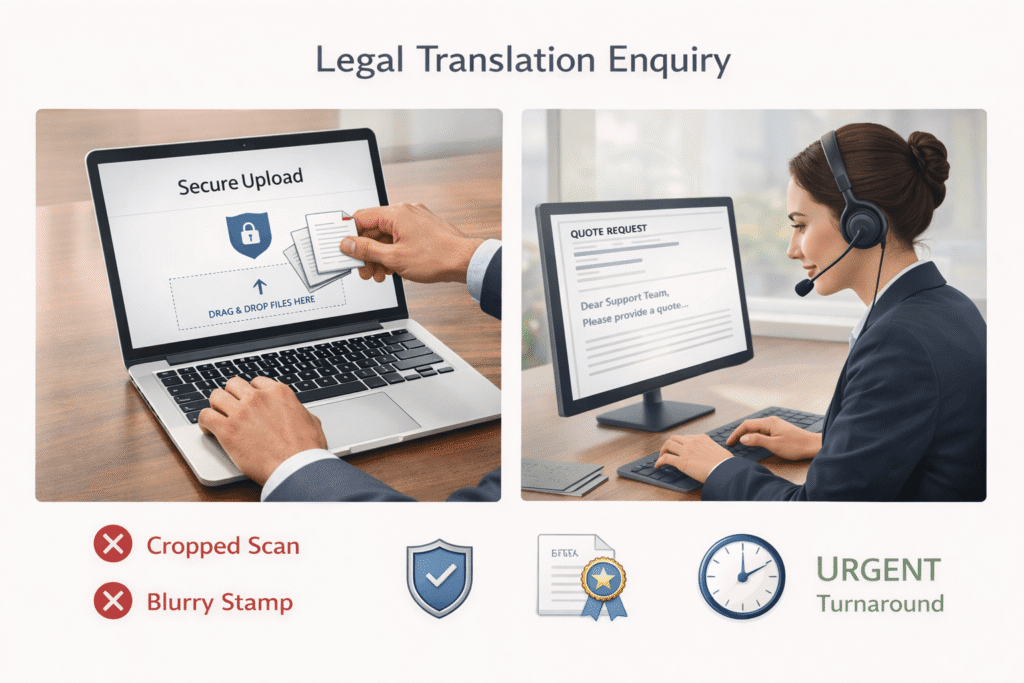
When a POA is involved, you need a process that reduces risk, not just a translated file.
Urgent Certified Translation’s current certified service page already highlights the pieces that matter most for legal submissions: complete and accurate translations, clear formatting, and a signed Certificate of Translation Accuracy. Their workflow also focuses on practical checks such as names, dates, document numbers, and visible seals/stamps, which is exactly what prevents avoidable rejections.
“The best decision I’ve made for my documents. The translation service is accurate, dependable, and ensures my paperwork is accepted worldwide.”
If you need a power of attorney translated for legal use, start with the exact requirement, upload the full POA, and request the correct package from day one (certified translation only, or certified + notarisation + legalisation support).
Trust signals to display next to the enquiry form
Place these directly under the form or quote button:
- USCIS-ready certified translation format
- Signed Certificate of Translation Accuracy
- Clear stamp/seal labelling
- Urgent turnaround options available
- Secure file handling
FAQs
Do I need a certified translation for a power of attorney?
If the receiving authority does not accept the original language, they will usually require a certified translation. For legal use, a complete translation with a signed certification statement is the standard starting point.
Does a POA translation need to be notarised?
Not always. Some authorities accept a certified translation without notarisation. Others specifically require notarisation of the original POA, the translator’s declaration, or both. Always confirm what must be notarised before ordering.
What is the difference between a POA certified translation and an apostille?
A certified translation converts the document into the required language and includes a signed accuracy statement. An apostille is a government authentication used for international document acceptance. They are different steps and may both be required.
Can I translate my own power of attorney?
In some situations, self-translation may be technically possible, but it can create risk for legal submissions. POAs are high-stakes documents, so professional certified translation is usually the safer option.
How long does it take to translate a power of attorney?
Turnaround depends on language pair, document length, scan quality, and whether you also need notarisation or legalisation. Simple POAs can often be completed quickly, but cross-border use may add extra processing time.
Do I need a sworn translation for a power of attorney?
Only if the receiving country or authority specifically requires a sworn translator. Sworn translation rules vary by country, so confirm this before placing the order.
Can a UK apostille be added to a foreign power of attorney?
Usually no. If the POA was issued outside the UK, it normally has to be legalised in the country where it was issued. The UK apostille route is generally for eligible UK-issued documents and documents that have been certified by a UK public official.
Does an apostille prove the translation is accurate?
No. An apostille authenticates the origin of the signature, seal, or certification step on a public document. It does not confirm that the translation text itself is linguistically accurate. That is why the certified translation and the translation certificate still matter.
What should be included in the translator’s certification for a power of attorney?
At minimum, the certificate should identify the document, confirm the translation is complete and accurate, confirm the translator is competent in the language pair, and include a signature and date. Some authorities also want contact details and a clear list of the documents covered by the certificate.
If my power of attorney is a UK lasting power of attorney, does it need to be registered before use?
Yes, if it is an England and Wales LPA. It must be registered before the attorney can use it. If you are sending it abroad, check whether the receiving authority wants the original registered LPA, a certified copy, or a translated and legalised bundle.
Can one certification statement cover the POA and supporting annexes?
Often yes, as long as the certificate clearly identifies every document it covers. If the authority has strict filing or court rules, listing each annex individually is usually safer than using a broad description.
Do all stamps, seals, and handwritten notes need to be translated?
If they are legible and form part of the document, they should usually be translated or clearly labelled in the translation. Reviewers often rely on those details to confirm witnessing, notarisation, and document execution.
Can I use the same translated power of attorney for every country?
Not always. A translation accepted in one country may still need different certification wording, a sworn translator, notarisation, apostille, or further legalisation for another country or authority. Always check the exact requirement of the final receiving office.