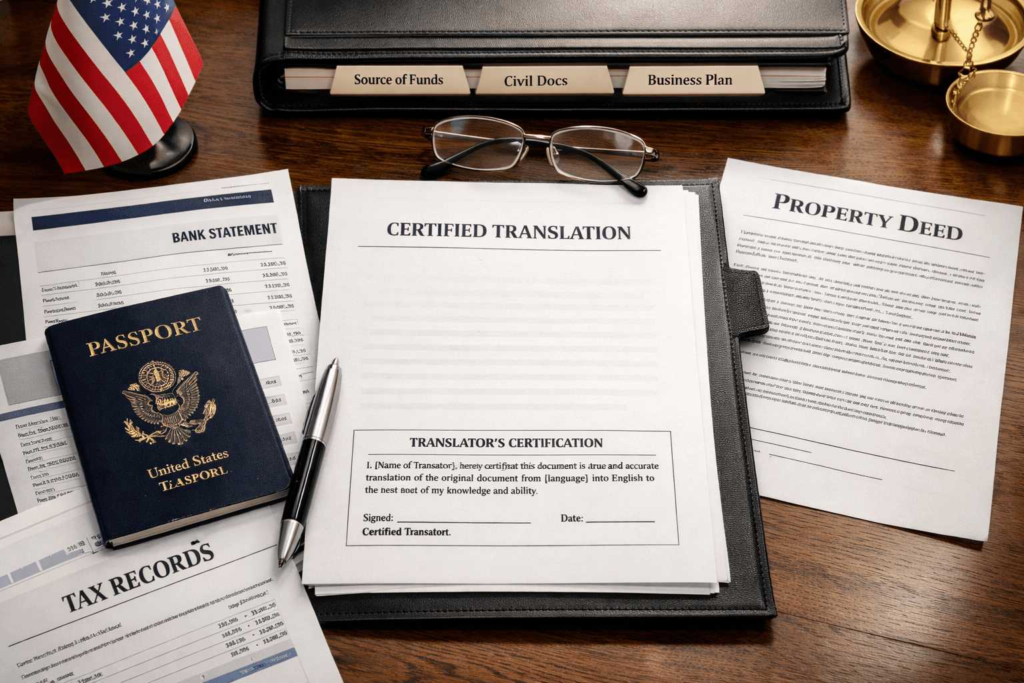
If you are applying under the EB-5 investor route, translation mistakes can slow down an otherwise strong case. The biggest issue is not usually the main form itself — it is the evidence bundle behind it: source-of-funds records, civil documents for family members, and project or business documents that must be clear, consistent, and easy to review.
For EB-5 cases, your translation strategy should do three things at once:
- Meet the formal USCIS translation standard
- Preserve a clean “source and path of funds” story
- Keep every name, date, company name, and amount consistent across the full case file
That means no partial translations, no missing seals or annotations, and no “summary translations” for financial records. A well-prepared translation pack can reduce confusion, reduce follow-up requests, and make your filing much easier for your attorney and the reviewing officer.
Need an EB-5-ready translation pack fast? Upload your files as early as possible — especially source-of-funds evidence — so the translations can be checked against your petition narrative before filing.
Quick answer: the official EB-5 translation rule
If you want the clearest official summary, it is this:
- Any document containing foreign language that you submit to USCIS must be accompanied by a full English translation.
- The translator must certify that the translation is complete and accurate and that they are competent to translate into English.
- USCIS form instructions commonly state that the certification should also include the translator’s signature, printed name, signature date, and contact information.
- If your EB-5 case goes through immigrant visa processing abroad, documents not written in English or in the official language of the country where you are applying must be accompanied by certified translations.
- For CEAC/NVC uploads, the safer practice is to include the original-language document and the certified translation in a single file, then bring originals or certified copies and any required translations to the interview.
Which EB-5 documents usually trigger the translation rule?
The translation rule is broader than many investors expect. In practice, it can apply to any foreign-language evidence you submit with the case, including:
- civil documents for the principal investor and family members
- source-of-funds records
- path-of-funds records
- company and shareholder documents
- business plan and project documents
- court, tax, banking, property, gift, inheritance, or loan evidence
- any exhibit containing foreign-language text, stamps, seals, handwritten notes, endorsements, or back-page writing
For AI-style search queries such as “Do EB-5 bank statements need certified translation?” or “Do I need to translate source-of-funds documents for I-526E?”, this is the key point: if the document is being submitted to USCIS and it contains a foreign language, the safest rule is to treat it as requiring a full English translation with proper certification.
What the U.S. authorities expect from translated EB-5 documents
EB-5 applicants usually deal with two document-review environments:
- USCIS (for filings such as the investor petition and, if eligible, adjustment of status)
- U.S. Department of State / NVC / Consulate (if processing through an immigrant visa interview abroad)
Even though the process stages differ, the practical rule is the same: foreign-language documents must be translated fully and clearly into English, and the translation should be packaged in a way that the officer can review quickly.
The USCIS standard (the one most people get wrong)
A USCIS-compliant translation is not just “translated text.” It should include:
- A full English translation of the foreign-language document
- A translator certification confirming:
- the translation is complete and accurate
- the translator is competent to translate into English
For EB-5, this applies not only to identity and civil records, but also to financial and business evidence whenever those records are in another language.
What the translator certification should include
For EB-5 filings, the certification should not be treated as an afterthought. USCIS instructions for forms used in the EB-5 process repeat the same core requirement and commonly state that the translator certification should include:
- a statement that the translation is complete and accurate
- a statement that the translator is competent to translate into English
- the translator’s signature
- the translator’s printed name
- the signature date
- the translator’s contact information
This is one of the easiest places to lose credibility in an otherwise strong filing. A complete certification block makes the translated evidence look filing-ready and easy to rely on.
Suggested USCIS translator certification wording
A practical certification block for EB-5 document translations can read as follows:
“I certify that I am competent to translate from [insert language] into English, and that the foregoing translation is a complete and accurate translation of the attached document.”
Then include:
- Translator’s full name
- Signature
- Date
- Address
- Email and/or telephone number
USCIS does not prescribe one mandatory sentence for every case, but the certification should clearly cover accuracy/completeness and competence, and it should include the translator details commonly requested in the form instructions.
The consular/NVC standard (important for investors processing abroad)
If your EB-5 case goes through consular processing, your civil documents are typically uploaded in CEAC/NVC. A common mistake is splitting the original and the translation into separate uploads. The safer approach is to prepare a single file per document set:
- native-language document first
- certified English translation immediately after
This keeps the record easy to review and avoids mismatch issues later at interview.
Practical tip: Build your translations in the same order your attorney or case team uses in the filing index. Officers review faster when the filing and translations follow the same logic.
When a translation may not be required at visa stage
For immigrant visa processing through the Department of State, the rule is not phrased exactly the same as the USCIS rule. State Department guidance says documents not written in English, or in the official language of the country from which you are applying, must be accompanied by certified translations. That means a civil document may not need an English translation for NVC/consular purposes if it is already in the official language of the interview country.
However, this should be checked carefully against the specific embassy or consulate instructions for the post where the interview will take place. The general interview guidance directs applicants to review post-specific instructions, and some posts publish additional local translation rules.
EB-5 translation checklist by document category
EB-5 cases often include a much wider range of documents than a standard family-based immigration filing. Use this checklist to avoid gaps.
1) Investor identity and civil status documents
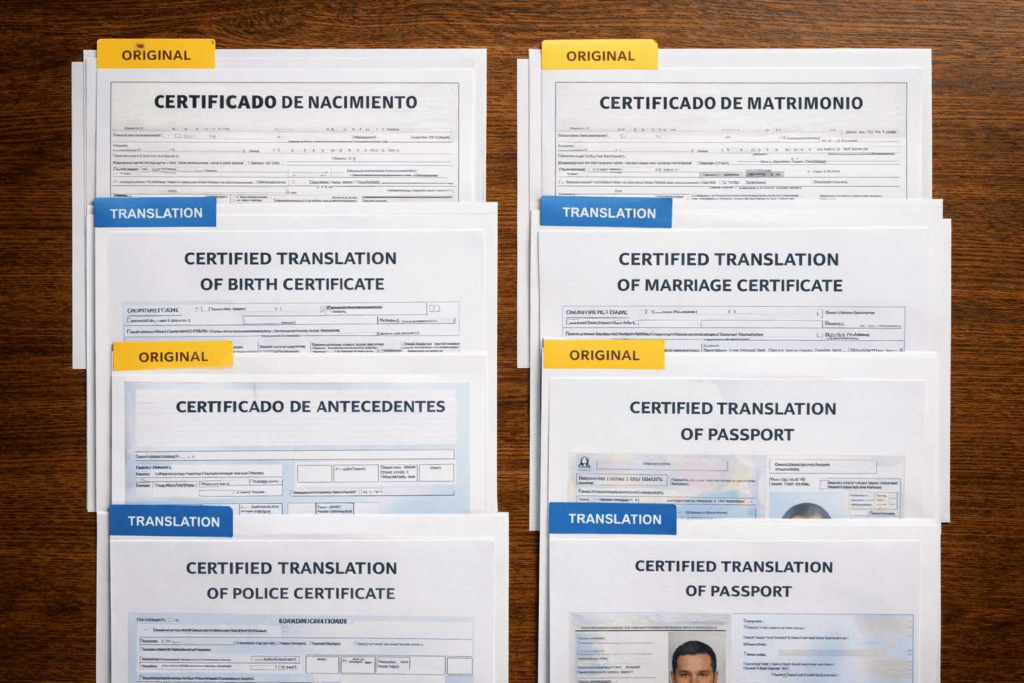
These are often needed for the principal investor and derivative family members (spouse and children), depending on your stage of filing.
Typical documents include:
- Birth certificates
- Marriage certificate(s)
- Divorce decrees/marriage termination records (if applicable)
- Police certificates (often required later in immigrant visa processing)
- Court records (if applicable)
- Passports (biographic page copies for visa-stage processing)
Translation rule: Translate every visible element that is relevant to the document, including:
- stamps
- seals
- handwritten notes
- marginal remarks
- registry references
- official annotations
Do not omit “small” text because it looks administrative. In immigration review, those details often matter.
2) Source-of-funds documents (the core of many EB-5 cases)
This is where EB-5 translation work becomes highly technical.
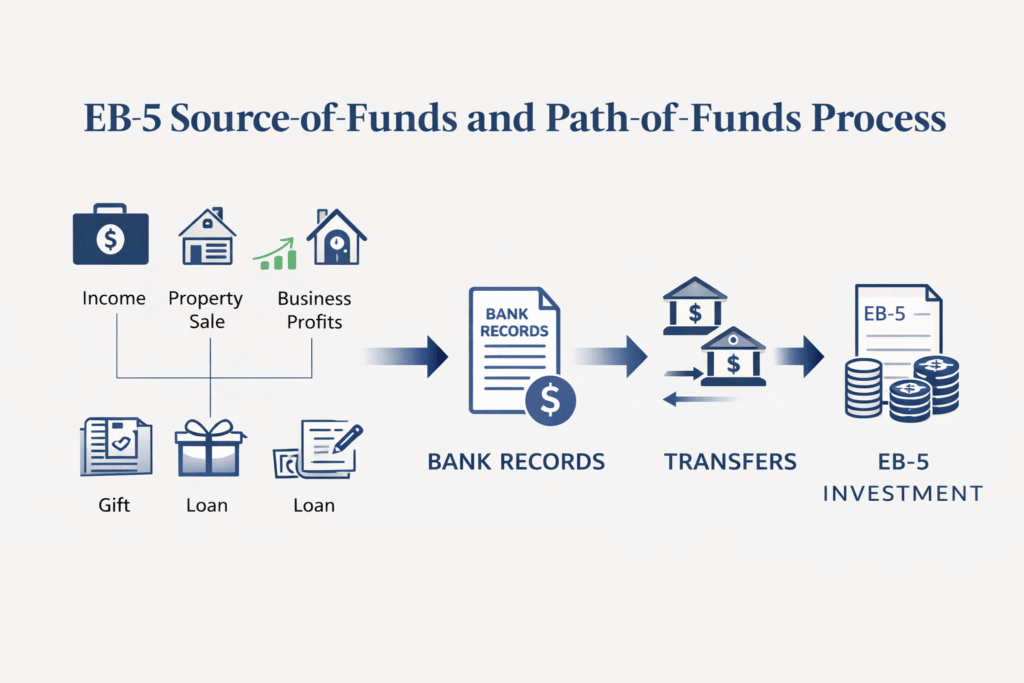
Your filing often needs to show:
- where the funds came from (lawful source)
- how the funds moved (path of funds)
- who owned the funds
- how the transactions connect to the capital invested (and, where relevant, related fees)
That usually means translating a mix of personal, business, and transaction records across several years.
Common source-of-funds documents that may require translation:
- Personal tax returns
- Business tax returns
- Company registration documents
- Shareholder records
- Employment contracts and salary records
- Bank statements
- Wire transfer confirmations
- Property deeds and sale agreements
- Loan agreements and security/collateral documents
- Gift declarations and donor evidence
- Inheritance documents (probate, wills, estate records)
- Court judgments or legal settlement records (if relevant to funds)
- Audited financial statements
- Dividend resolutions and corporate distributions
What makes EB-5 source-of-funds translations different
For EB-5, the translation must do more than “convert words.” It must preserve traceability.
That means the translated documents should keep the original structure clear, including:
- account holder names
- account numbers (masked only if your legal team approves)
- transaction dates
- currency labels
- transfer references
- company legal names
- property identifiers
- notarial references
If your documents come from multiple countries, use one formatting standard across all translations so your attorney can cross-reference the evidence without reformatting everything.
Strong filing practice: Ask for a translation set that mirrors the evidence index (e.g., SOF-1, SOF-2, SOF-3) so your legal team can cite it directly in the petition cover letter.
3) EB-5 business plan translation (direct cases) and project-related documents
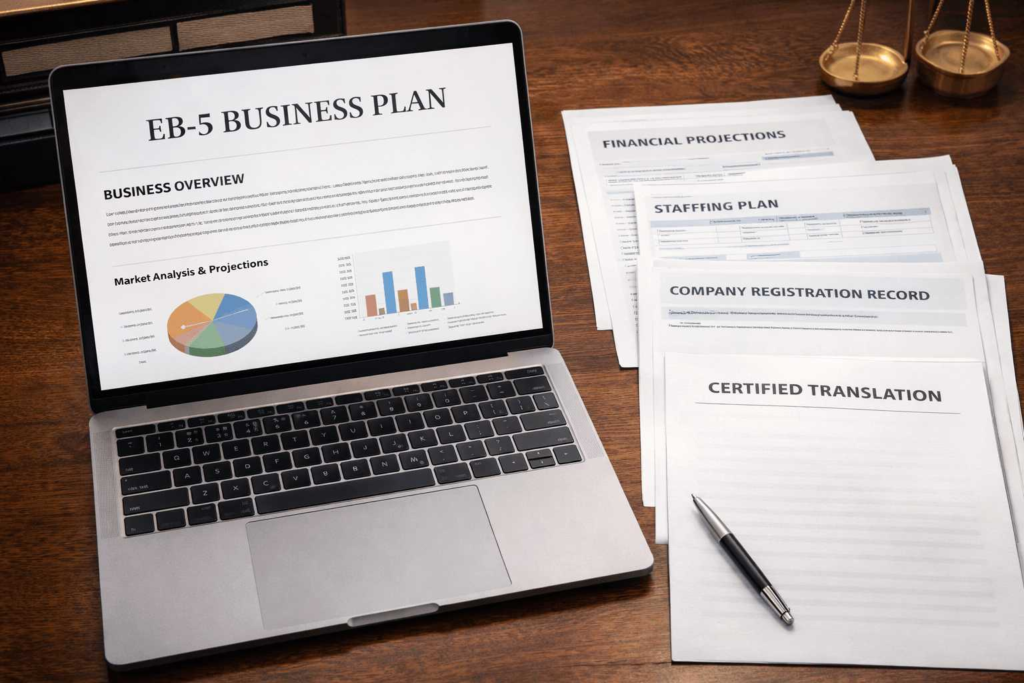
Many people focus only on personal documents, but business/project documentation can also require translation — especially in direct EB-5 matters or where supporting corporate/project records are issued abroad.
Documents often needing translation in this category:
- Business plans
- Corporate formation documents
- Commercial leases
- Supplier contracts
- Equipment purchase agreements
- Employment projections or hiring plans
- Market studies
- Financial projections
- Board resolutions
- Share subscription documents
- Operating agreements/shareholder agreements
For business plans, clarity is as important as accuracy
A business plan translation for an EB-5 context should preserve:
- job creation assumptions
- hiring timelines
- investment use of funds
- business milestones
- staffing roles
- operational model
If these details are mistranslated or summarised, it can create inconsistencies with the rest of the filing.
Good practice: Have the translation team align terminology across:
- the business plan
- company records
- bank evidence
- attorney cover letter/exhibits
For example, the company name should appear exactly the same everywhere, including punctuation and legal suffixes.
Direct EB-5 vs Regional Center investor: translation needs are not identical
The formal translation rule stays the same, but the document mix changes.
Regional Center investor (I-526E pathway)
Most investors in this route will need translations mainly for:
- personal civil documents
- source-of-funds and path-of-funds evidence
- any foreign-language supporting financial records
- donor/loan/inheritance evidence (if applicable)
You may also need translated project-related materials if some supporting records are issued in another language.
Direct EB-5 investor
Direct EB-5 cases often require a broader translation scope because the filing can include more business-operational evidence tied to job creation and enterprise structure.
That may include:
- comprehensive business plan materials
- payroll planning records
- operational contracts
- corporate governance documents
- location or lease documents
If you are unsure which documents must be translated first, start with the source-of-funds set. That is usually the longest and most document-heavy part of the file.
A practical way to build an EB-5-ready translation pack
This is the workflow that works best for complex investor files.
Step 1: Sort documents into filing groups
Create folders before translation:
- A. Civil documents
- B. Source of funds
- C. Path of funds/transfers
- D. Business/project records
- E. Other supporting evidence
This alone can save hours later.
Step 2: Request a document list from your attorney (or create one)
Even if you are still gathering documents, ask for a working list with exhibit labels.
Example structure:
- SOF-01: 5 years tax returns (investor)
- SOF-02: Company registration and shareholder records
- SOF-03: Sale of property documents
- SOF-04: Bank statements showing proceeds
- POF-01: Wire transfers to escrow/NCE
- CIV-01: Birth certificate (investor)
- CIV-02: Marriage certificate
- CIV-03: Police certificate
Your translation provider can then label files to match the legal filing structure.
Step 3: Translate complete packets, not isolated pages
EB-5 evidence often depends on context. A single bank page may not prove anything on its own.
Translate complete document sets where possible:
- full agreement + signature page
- full deed/transfer deed + registration page
- full bank statement range, not only one page
- full loan agreement + collateral schedule
- full gift declaration + donor proof
This avoids the “missing context” problem and makes the narrative easier to follow.
Step 4: Standardise names and numbers before final certification
Before the final certified pack is issued, perform a consistency check across:
- passport spelling
- company names
- property addresses
- transaction amounts
- dates (DD/MM/YYYY vs MM/DD/YYYY formats)
- currency symbols and codes
A small mismatch (for example, a shortened company name in one translation and a full legal name in another) can create avoidable questions.
Step 5: Package the final translations for filing and interview use
Ask for two versions:
- Filing version (PDF bundles)
For attorney filing, USCIS response packets, and NVC uploads - Interview version (print-ready)
Clean order, easy to print, original-language doc followed by English translation
If you will attend a consular interview, keep the paper originals organised to match your uploaded sets.
Common EB-5 translation mistakes that cause delays
These issues come up repeatedly in investor cases:
Mistake 1: Translating only “important pages.”
For EB-5 evidence, “important” is not always obvious. A stamp, note, or registration line can be the exact detail the officer needs.
Mistake 2: Using inconsistent names across documents
The same person may appear with different spellings across bank, tax, and property records. Your translations should preserve the original names and include a consistent English rendering.
Mistake 3: Treating financial records as plain text
Financial evidence needs formatting discipline. If columns, balances, or transaction references are hard to read in translation, the value of the evidence drops.
Mistake 4: Forgetting donor or lender documents
If your investment funds came from a gift or loan, the supporting records behind the donor/lender often matter just as much as your own records.
Mistake 5: Separating originals and translations in the visa-stage upload
For immigrant visa processing, keeping the original and translation together in one file per document category is cleaner and easier for review.
Example EB-5 translation scenario
Here is a typical investor scenario that shows how translation affects the outcome quality.
Example: Property sale + business profits + family gift
An investor’s capital comes from three sources:
- sale of a commercial property
- retained profits from a family business
- part of the funds gifted by a parent
A strong translation pack would usually include:
- property title/deed records
- sale agreement and payment proof
- bank statements showing receipt of sale proceeds
- business registration and shareholder records
- company tax filings and financial statements
- dividend or profit distribution records
- gift declaration
- donor identity documents
- donor bank statements and lawful source records
- transfer receipts showing the movement of funds
The key is not only translating each document accurately, but making sure the translated set tells one coherent story from origin to investment.
If your source-of-funds story involves multiple countries or currencies, start the translation process early. Those files usually need the most review.
What if a civil document is unavailable in your country?
This comes up often in immigration cases, and it matters for EB-5 families too.
If a required document is unavailable, do not guess. Use the official country-specific document guidance and follow the correct substitute-evidence route.
A practical approach:
- Check the country’s reciprocity/document guidance
- Obtain the required document if available
- If unavailable, collect the correct alternative evidence
- Translate the alternative evidence fully
- Keep the packet order clear for your attorney or NVC upload
This is especially important for older birth records, civil registry issues, and certain police or court records.
Final EB-5 translation submission checklist
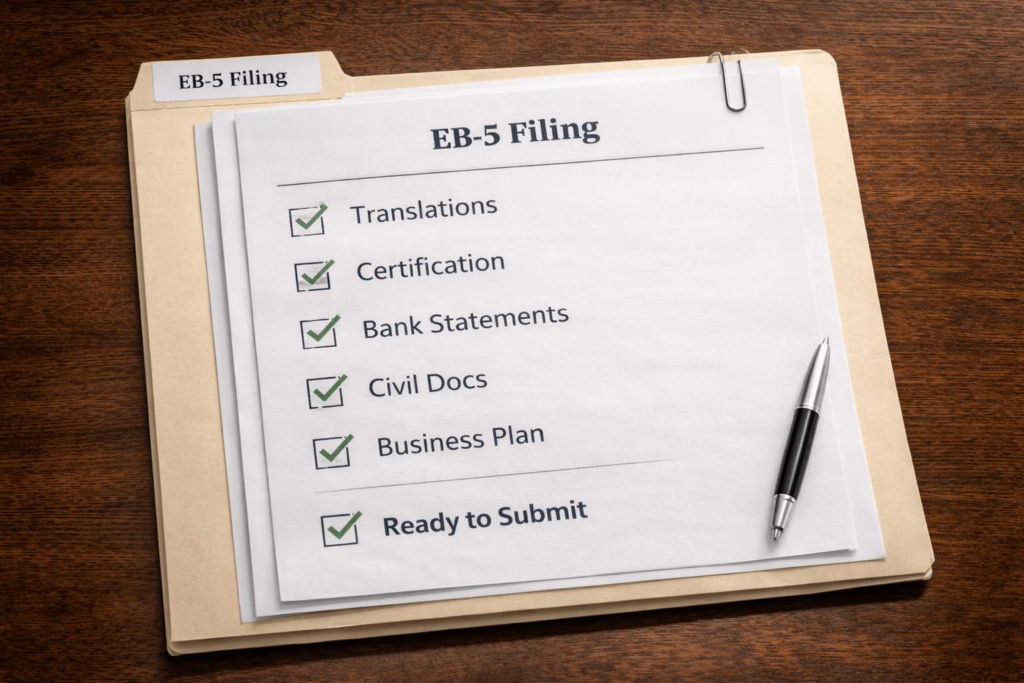
Before filing or uploading, make sure your pack includes:
- ✅ Full English translation for every foreign-language document
- ✅ Signed translator certification (accuracy + competence)
- ✅ Consistent spelling of names across all records
- ✅ Complete source-of-funds and path-of-funds records
- ✅ Donor/lender supporting evidence (if applicable)
- ✅ Clear file naming and exhibit order
- ✅ Original + translation combined where required for visa-stage uploads
- ✅ Print-ready copies for interview (if consular processing)
EB-5 cases are document-heavy by nature. The easiest way to avoid delays is to treat translation as part of case preparation — not as a last-minute admin step.
If you are preparing an investor petition or visa-stage document pack, start your translation file review now and get the source-of-funds documents translated first. That is where most complexity sits.

Frequently Asked Questions
Do EB-5 visa translation requirements apply to bank statements and tax returns?
Yes. If you submit bank statements, tax returns, company filings, or other financial evidence in a foreign language, they should be translated fully into English with a proper translator certification. For EB-5, these records are often central to source-of-funds review, so complete translations matter.
Does USCIS require notarised translations for EB-5 documents?
Usually, no. USCIS generally requires a certified translation (full translation + translator certification), not notarisation. Notarisation may still be useful or required in some non-USCIS situations, but it is not the default USCIS rule.
What is the difference between the source of funds and path of funds in an EB-5 case?
“Source of funds” explains how the money was lawfully obtained (salary, business profits, sale of property, inheritance, gift, loan, etc.). “Path of funds” shows how the money moved from the original source to the investment destination (accounts, transfers, escrow, and related transactions).
Do I need to translate my EB-5 business plan?
If your business plan or supporting business records are in a foreign language and they are part of the evidence you are submitting, yes, they should be translated fully. This is especially important where the plan supports job creation or operational details in a direct EB-5 case.
For consular processing, should I upload the original and translation as separate files?
The better practice is to combine them into a single file for each document: original-language document first, then the certified English translation. This makes the review easier and reduces upload confusion.
Can I submit partial translations for long EB-5 financial records?
It is risky. EB-5 review depends on consistency and traceability. Partial translations can remove context and create gaps. For source-of-funds and path-of-funds evidence, full translations are usually the safest option.
What should a USCIS translator certification include for EB-5 documents?
For USCIS-stage EB-5 filings, the certification should confirm that the translation is complete and accurate and that the translator is competent to translate into English. USCIS form instructions commonly add the translator’s signature, printed name, date, and contact information. This is why a clean certification block should be attached to each translated document or bundled translated set.
Are EB-5 translation rules different for Form I-526E, Form I-485, and Form I-829?
The core rule is the same across USCIS filings: any document containing foreign language submitted to USCIS must be accompanied by a full English translation and the translator’s certification of accuracy and competence. USCIS instructions for Form I-526E, Form I-485, and Form I-829 all repeat this approach.
Is notarisation or a sworn translator officially required for EB-5 USCIS filings?
For USCIS filings, the official rule focuses on a full English translation plus the translator’s certification of completeness/accuracy and competence. The USCIS regulation and form instructions do not set a general notarisation requirement in the rule itself. For immigrant visa processing abroad, always check the specific embassy or consulate instructions, because some posts publish additional local translation requirements.
What if only part of an EB-5 document is in another language?
USCIS’s rule applies to any document containing a foreign language that is submitted with the case. In practice, that means you should translate the foreign-language content wherever it appears, including stamps, seals, annotations, handwritten notes, and writing on the reverse side of a document where relevant.
What are the CEAC/NVC upload rules for translated EB-5 civil documents?
State Department scanning guidance says multi-page documents should be uploaded as one file, scans should be in colour, front and back should be included where there are stamps, seals, or writing, each file must stay within the upload limit, and the certified translation should be included with the original foreign-language document in a single file.
Do I need originals or copies with my EB-5 translations?
For USCIS, supporting documents are submitted according to the form instructions, and USCIS may later request an original for review. For immigrant visa interviews abroad, applicants are instructed to bring original or certified-copy civil documents, plus any required translations, to the interview.