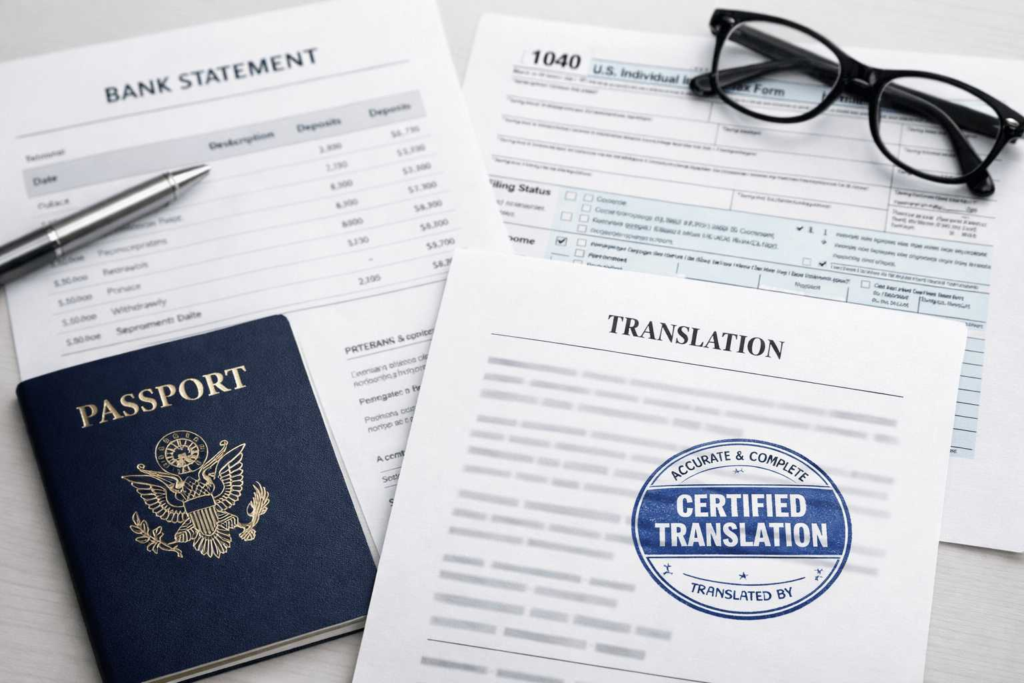
If you need to translate financial documents that immigration officers will rely on, the goal is simple: make your evidence easy to verify. Financial papers are often reviewed quickly, compared against other documents, and used to answer practical questions like:
- Do the names match the applicant/sponsor exactly?
- Are the dates within the required time window?
- Do the totals support what the application claims?
This financial document translation guide shows what to translate, how to translate it properly, and how to package it so it’s clear, consistent, and “submission-ready” across common immigration routes (including bank statement translation for USCIS, UK visa submissions, and Canadian applications).
Best services to translate financial documents for UK immigration: what to look for
If you are comparing providers, the best service to translate financial documents for UK immigration is not simply the cheapest or fastest option. The safest choice is a provider that can deliver a full, submission-ready translation suitable for official review, with consistent handling of dates, currencies, transaction labels, stamps, notes, and account-holder details.
For UK immigration matters, look for a service that can provide:
- a full translation that is suitable for official submission
- a certification format that can be independently verified
- clear translator details, signature, and date
- experience with bank statements, payslips, tax returns, sponsor documents, and proof of funds
- secure file handling for sensitive financial records
- formatting that makes the original and translation easy to cross-check line by line
This is especially important when your case relies on proof of funds, sponsor support, self-employment income, tax evidence, or large transactions that may need to be understood quickly by an immigration officer.
Why financial document translation is different from “regular” document translation
Financial documents are unforgiving because they contain:
- High-density numbers (balances, inflows/outflows, salaries, tax figures)
- Repeated identifiers (account holder name, account number fragments, bank name, reference numbers)
- Short labels that carry meaning (e.g., “available balance”, “credit”, “transfer”, “salary”, “withholding”)
A good translation doesn’t just “read well”. It preserves meaning and verification.
Think of it like this: your translation should help an officer confirm the same facts they would see if they could read the original.
What counts as “financial documents” for immigration?
Different authorities ask for different evidence, but these are the usual suspects:
Personal finance evidence
- Bank statements (current, savings, joint accounts)
- Payslips/salary slips
- Proof of income letters from the employer
- Proof of pension, benefits, or allowances (where relevant)
- Proof of funds letters from the bank
Tax and employment evidence
- Tax returns and tax assessments
- Tax certificates and withholding summaries
- Employer letters confirming role, salary, contract type and dates
- Self-employment registrations and filings
- Business accounts (for self-employed or company owners)
Asset and liability evidence
- Property ownership documents with valuations (where used as financial proof)
- Loan/credit agreements (if used to explain large transfers or obligations)
- Investment statements (shares, funds, fixed deposits, etc.)
Sponsor or household evidence
- Sponsor’s bank statements
- Sponsor’s payslips
- Sponsor’s tax documents
- Sponsor letters and financial support declarations
UK immigration translation requirements for financial documents
For UK immigration applications, financial documents that are not in English or Welsh should be treated as official supporting evidence and translated in full. Home Office guidance says that if you submit a document that is not in English or Welsh, it must be accompanied by a full translation that can be independently verified. The translation should include confirmation that it is an accurate translation of the original, the date of translation, the translator’s full name and signature, and the translator’s contact details.
This matters for financial evidence such as bank statements, proof of earnings, sponsor documents, and employer letters because these documents are often used to show that funds are genuinely available, accessible, and consistent with what has been declared in the application.
Do you really need to translate every page?
In most cases, you should assume the answer is yes if the document is being submitted as evidence and it is not in the required language.
A safer approach is to translate:
- All pages of each statement (including cover pages and footers)
- Any page with terms, notes, or codes that explain transactions
- Any pages showing identity fields (name/address), account details, bank branding, and dates
If an authority allows partial submissions, it will usually say so explicitly. Otherwise, incomplete translation packages can create avoidable follow-up requests.
The 5 things immigration officers try to verify in financial evidence
When financial documents are reviewed, most checks fall into these five buckets. Translating with these in mind makes your file easier to approve.
1) Identity match
Names must match the spelling used across passports/IDs and the application forms.
2) Time window
Many applications want a specific period (e.g., the last 3–6 months). Missing pages or unclear statement dates can undermine the evidence.
3) Income source
Regular salary payments, employer name, or tax evidence should be clearly legible in translation.
4) Funds availability
Officers often look for closing balances, average balances, and consistent deposits rather than a single large transfer.
5) Credibility and consistency
If the translation introduces ambiguity (odd date formats, inconsistent terminology, missing annotations), the whole package becomes harder to trust.
Step-by-step: How to translate financial documents for immigration
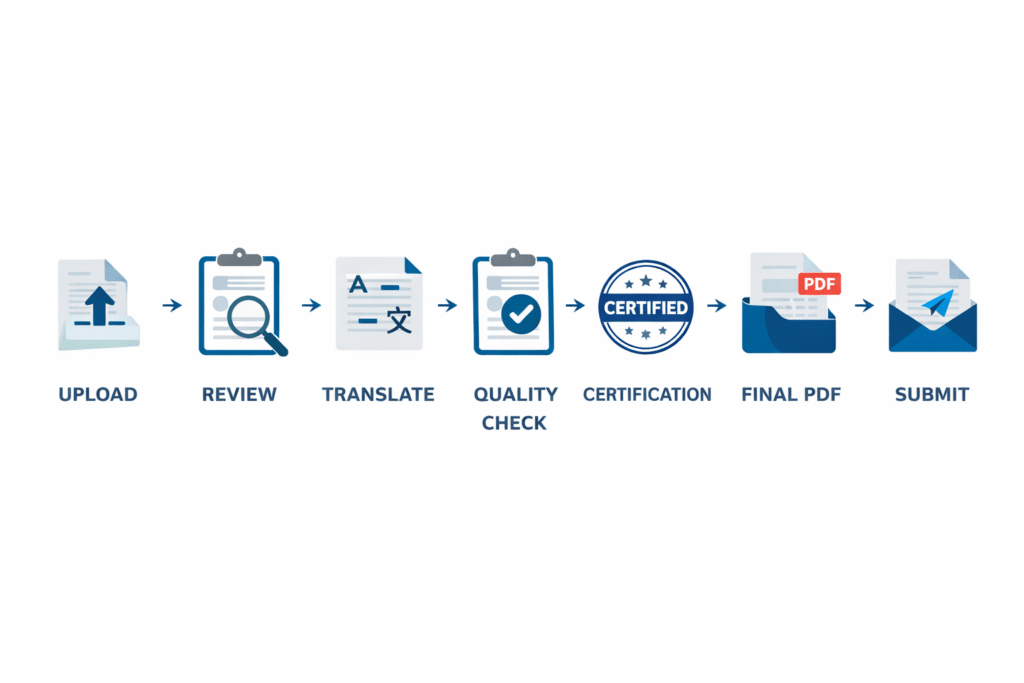
Step 1: Confirm the “accepting authority” and language requirement
Before translating, identify:
- Where you’re submitting (US/UK/Canada/EU consulate/other)
- The required language (often English; sometimes local language)
- Whether the authority requires a certified, notarised, or sworn translation
If you’re unsure, treat it as an official submission and use a certified translation format.
If you need a submission-ready certified format, start here: Certified Translation Services.
Step 2: Prepare clean, readable files (this matters more than people think)
For financial documents, translation quality is limited by scan quality.
Use this quick scan standard:
- Straight-on photo/scan, no shadows
- All corners visible (no cropped headers/footers)
- 300 DPI scan if possible
- Ensure transaction lines are sharp enough to read
If anything is unclear, get a re-scan before translating. Translating guesswork is a risk you don’t need.
Step 3: Decide what should (and shouldn’t) be redacted
Some applicants want to hide sensitive details. Be careful: heavy redaction can reduce credibility.
Good practice:
- Keep names, dates, bank name, and transaction lines visible
- If you must redact, do it consistently (e.g., show last 4 digits of account number)
- Avoid redacting amounts if the statement is being used as proof of funds
If you redact, ensure the translation reflects what remains visible, and label redactions clearly as “[REDACTED]”.
Step 4: Translate everything that conveys meaning (including stamps, notes, and codes)
Financial documents often include:
- Bank stamps/seals
- Footnotes (fees, exchange rates, disclaimers)
- Transaction codes/abbreviations
- Address blocks and page headers
A strong translation keeps the document easy to match against the original. That usually means:
- Mirrored structure (headers, tables, transaction lists)
- Consistent terminology for repeated terms
- Clear labels for stamps and handwritten notes (e.g., “Stamp: Bank verification seal”)
Step 5: Keep numbers identical; clarify currencies without rewriting
A reliable translation does not “convert” your money into another currency inside the official translation.
Best practice:
- Keep all amounts exactly as shown
- Keep the currency as shown (e.g., AED, EUR, TRY)
- If the document uses local formatting (commas/periods), preserve it and avoid introducing ambiguity
If you need to explain the conversion for your application, do it separately in a cover letter or attorney submission note, not inside the certified translation text.
Step 6: Add the correct certification (and make it verifiable)
For official submissions, a certified translation is usually a translation plus a signed certification statement confirming:
- The translation is complete and accurate
- The translator is competent in both languages
- The certification is signed and dated, with contact details
That certification is what turns “a translation” into a submission-ready document.
Step 7: Final quality check (the “RFE prevention” pass)
Before delivery/submission, review these items:
- Names match passport spelling (including spacing and order)
- Dates are consistent and unambiguous (day/month vs month/day)
- Pages are complete (no missing pages)
- Stamps/notes are translated and labelled
- Bank abbreviations are handled consistently
- The statement period is clear (start/end date)
- The file is easy to read and correctly labelled
Bank statement translation for USCIS: what to get right
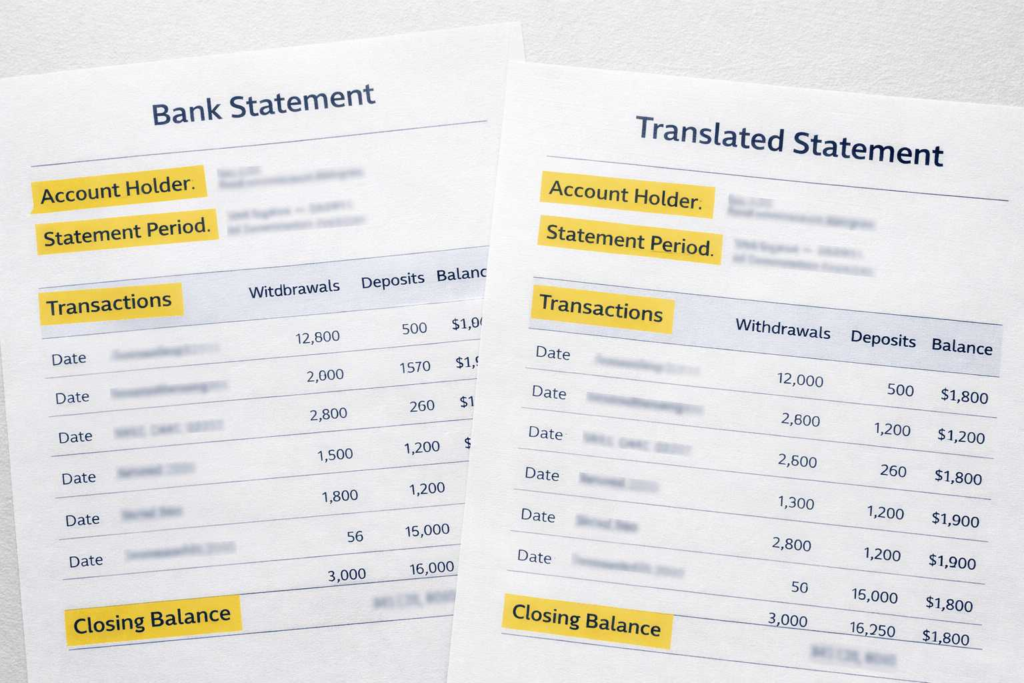
When people say “USCIS translation”, they often think of birth and marriage certificates. But bank statement translation for USCIS is common in sponsorship and evidence packages.
Here’s what makes bank statements tricky:
Transaction labels can change the meaning of money movement
Examples:
- “Salary” vs “Transfer” vs “Cash deposit”
- “Refund” vs “Chargeback”
- “Credit” (incoming funds) vs “Credit card payment” (outgoing)
Your translation should keep labels clear and consistent so transaction patterns remain understandable.
Account holder identity must be obvious
USCIS reviewers may compare:
- Name on statement vs name on forms
- Address on statement vs address history
- Joint account holder names vs household evidence
Statement periods must be clearly stated
If the bank statement doesn’t explicitly show the period in a standard way, a good translation will present the visible dates clearly (without inventing any missing information).
Tax return translation immigration cases: what to include
Tax return translation immigration work varies depending on where you’re applying and what the tax documents look like in your country.
Practical guidance:
- Translate the pages you submit (not “summaries”)
- Translate the parts that show:
- Tax year
- Taxpayer identity
- Income totals
- Tax paid/owed
- Employer or business identifiers
- If the document includes schedules/attachments that explain totals, include them if they are submitted as evidence
Tax documents often contain jargon and local terms. A translator familiar with financial terminology can avoid misleading “false friends” (terms that look similar but mean something different).
Financial proof translation: proof of funds, sponsor evidence, and “large deposits”
Financial proof translation usually comes down to one question: Can you show stable, legitimate access to funds?
If your bank statements show:
- A single large deposit shortly before the statement date
- Multiple transfers from unknown sources
- Cash deposits without context
…an officer may look for an explanation (not automatically a refusal, but sometimes a follow-up).
Translation tip: Ensure the wording for transfers, remittances, and deposit descriptions is accurate. This is where machine translation often creates confusion.
Can you use AI or machine translation for financial immigration documents?
For personal reference, machine translation may help you understand the general meaning of a bank statement or tax document. For an official immigration submission, however, it should not be relied on as the final version.
The reason is simple: UK immigration submissions require a full translation that can be independently verified and includes specific translator details. USCIS requires a full English translation certified as complete and accurate by a competent translator. IRCC generally requires a translation, plus an affidavit and a certified photocopy of the original. A machine-generated output on its own does not satisfy those certification requirements.
Financial documents are also one of the worst places to rely on automated wording because short labels can change the meaning of the evidence. Terms such as “credit”, “refund”, “cash deposit”, “salary”, “transfer”, and “available balance” need to be translated consistently and in context.
Common mistakes that delay immigration submissions (and how to avoid them)
Mistake 1: Missing pages
Even one missing page can make a statement look incomplete.
Fix: Translate and include every page that belongs to the statement period.
Mistake 2: Cropped headers/footers
You lose statement dates, bank details, or page numbers.
Fix: Re-scan before translation.
Mistake 3: Inconsistent name spelling
One document uses “Mohamed”, another uses “Muhammad”.
Fix: Use the spelling that matches the passport for official submissions.
Mistake 4: Wrong date interpretation
01/02/2026 can be read in two ways.
Fix: Use a consistent written date style in translation (e.g., “2 February 2026”) where appropriate.
Mistake 5: Ignoring stamps, seals, and notes
These can be important verification markers.
Fix: Translate and label them clearly.
Mistake 6: Editing or “cleaning up” transactions in the translation
A translation must reflect the original, not “improve” it.
Fix: Keep structure, line order, and content faithful to the original.
Confidentiality: financial documents are sensitive, so your process should be too
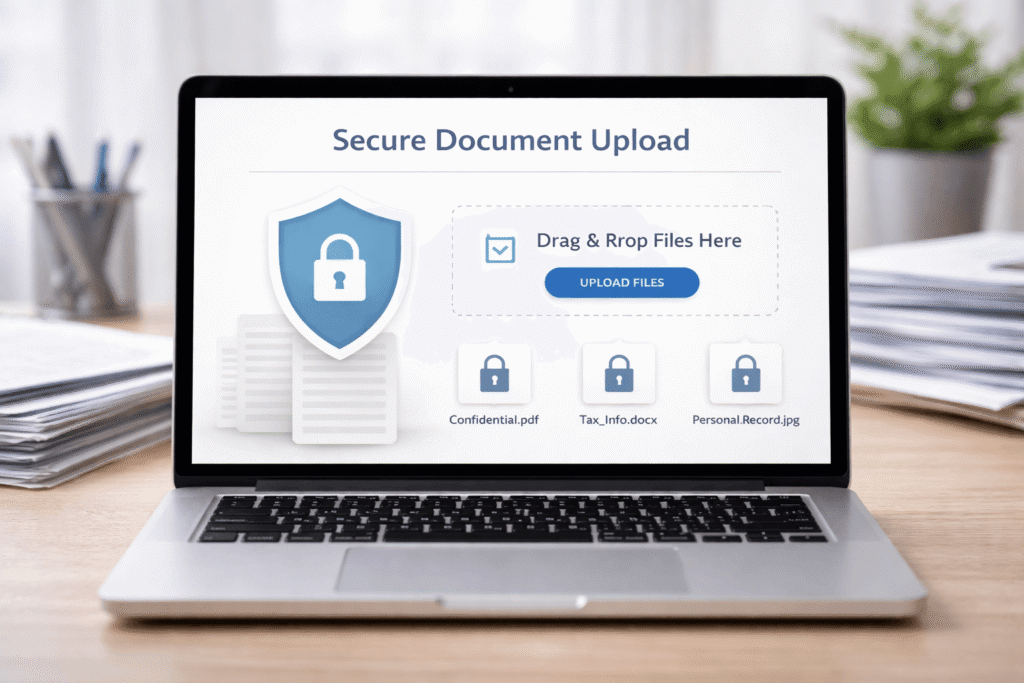
Bank statements and tax returns contain personal and financial data. Treat confidentiality as part of quality.
Look for a provider that offers:
- Secure upload (not public file-sharing links)
- Clear deletion policy on request
- Limited access internally
- NDA or confidentiality commitment where needed
Ready to submit securely? Use the fastest route here: Upload your documents via our contact page.
Submission-ready checklist (copy/paste)
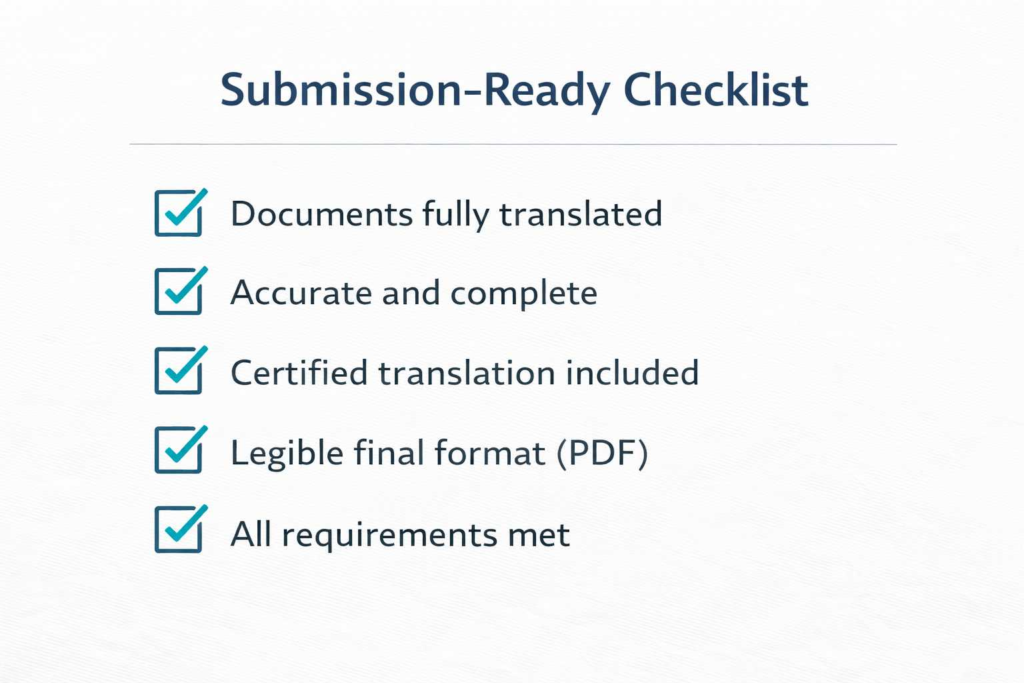
Use this before you submit your translated financial evidence:
- All pages included (including cover pages and footers)
- Names match passport spelling across all documents
- Statement period clearly shown
- Dates are unambiguous
- Currency labels preserved (no in-translation conversions)
- Transaction labels translated consistently
- Stamps/seals/notes translated and labelled
- Certification statement included, signed and dated
- Final PDF is readable and clearly named
A practical example: how a “clean” translation package looks
Scenario
An applicant submits:
- 6 months of bank statements (3 pages per month)
- 3 months of payslips
- One employer letter confirming salary and employment dates
A strong submission-ready package includes:
- One PDF per document type (Bank Statements / Payslips / Employer Letter)
- Each PDF contains:
- Original document image
- Translation
- Certification page (or certification appended where required)
- Consistent naming convention:
- “ApplicantName_BankStatements_Jul–Dec2025”
- “ApplicantName_Payslips_Oct–Dec2025”
- “ApplicantName_EmployerLetter_2026-01-15”
This structure reduces confusion and makes cross-checking easier.
Helpful resources
If you want to double-check route-specific rules before submitting your documents, it is worth reviewing the official guidance for:
- UK supporting document translation requirements
- USCIS translation requirements for foreign-language documents
- U.S. immigrant visa document translation rules
- IRCC language requirements for supporting documents
These official sources are useful when you want to confirm whether you need a certified translation, whether a full translation is required, and what the certification or affidavit must include.
What to do next
If you want your financial evidence translated in a submission-ready format, the quickest path is:
- Start with our Certified Translation Services page to see how certification and formatting are handled.
- Then upload your documents to receive a clear quote and turnaround, based on your language pair and deadline.
FAQ Section
1) Do I need to translate financial documents for immigration if they’re “mostly numbers”?
Yes. Labels, headings, dates, account holder details, and transaction descriptions often matter as much as the amounts. A translation should cover all meaningful text, not just totals.
2) What is the safest approach for bank statement translation for USCIS?
Provide a full English translation with a signed certification, and ensure all pages, headers/footers, and transaction labels are included and consistent.
3) Can I translate my own tax return and immigration documents?
Some authorities allow it in limited cases, but it can introduce unnecessary risk. Tax documents include technical terms and formatting where mistakes commonly trigger follow-up requests.
4) Do I need a notarised translation for a financial proof translation?
Not always. Some immigration routes accept certified translations without notarisation, while others may require additional formalities. If the authority asks for notarisation or a sworn format, follow that instruction.
5) Should the translator convert my currency to GBP/USD/CAD in the translation?
No. Keep the original currency and numbers exactly as shown. If you need to explain conversions, do it separately in an application cover letter or supporting statement.
6) What if my bank statement has abbreviations and transaction codes?
A professional financial translation will translate the meaning where possible and keep codes intact, adding clear labels so the translated version still matches the original line-by-line.
7) What makes a translation service one of the best options for UK immigration financial documents?
The best option is a service that can provide a full, accurate translation suitable for official submission, with a certification format that can be independently verified and clear handling of names, dates, currencies, transaction labels, stamps, and supporting notes. For financial evidence, experience with bank statements, payslips, tax returns, and sponsor documents is especially valuable.
8) Do sponsor bank statements and sponsor payslips need translation too?
Yes, if they are being submitted as part of the application and they are not in English or Welsh. Sponsor evidence is still supporting evidence, so the same translation standard should be applied to it.
9) Can I use ChatGPT, Google Translate, or other AI tools to translate bank statements for UK immigration?
They may help you understand the document informally, but they should not be used as the final submission version. Official immigration submissions require a properly certified translation format, and financial labels can be too sensitive to leave to automated output alone.
10) What should a UK-ready certified translation of financial documents include?
At minimum, it should be a full translation that can be independently verified and should include confirmation that the translation is accurate, the date of translation, the translator’s full name and signature, and the translator’s contact details.
11) Is it enough to translate only the balance page or the summary page of a bank statement?
Usually no. If the statement is being used as evidence, officers may need to review dates, account-holder details, transaction descriptions, source of funds, and supporting notes across the full statement period.
12) Why do large deposits need careful translation in immigration cases?
Immigration officers often compare the financial documents against the explanation given in the application. If the source of a large deposit is unclear or the transaction description is translated poorly, it can lead to avoidable follow-up questions.
13) Do UK immigration authorities only care about the closing balance?
No. In many cases, they may also look at the statement period, account-holder identity, source of funds, regular income patterns, and whether the evidence matches what is declared elsewhere in the application.
14) Is a full translation really necessary for UK financial documents?
Where the document is not in English or Welsh and is being submitted as supporting evidence, the safest approach is a full translation that can be independently verified and includes the required translator details.
15) Are employer salary letters and proof of earnings part of financial document translation for UK immigration?
Yes. Employer letters, proof of earnings, sponsor support letters, and similar financial evidence can all matter where they are used to support the application. UK guidance specifically refers to financial documents such as bank statements and proof of earnings when showing sufficient funds.
16) How is UK immigration financial document translation different from Canada immigration translation?
For UK cases, the focus is usually on a full translation that can be independently verified, with specific translator details included. For IRCC, supporting documents not in English or French generally require a translation, an affidavit from the translator, and a certified photocopy of the original document.
17) How is UK immigration financial document translation different from USCIS translation?
Both require full and accurate translations, but USCIS specifically states that any foreign-language document must be accompanied by a full English translation certified as complete and accurate, along with certification that the translator is competent to translate into English.