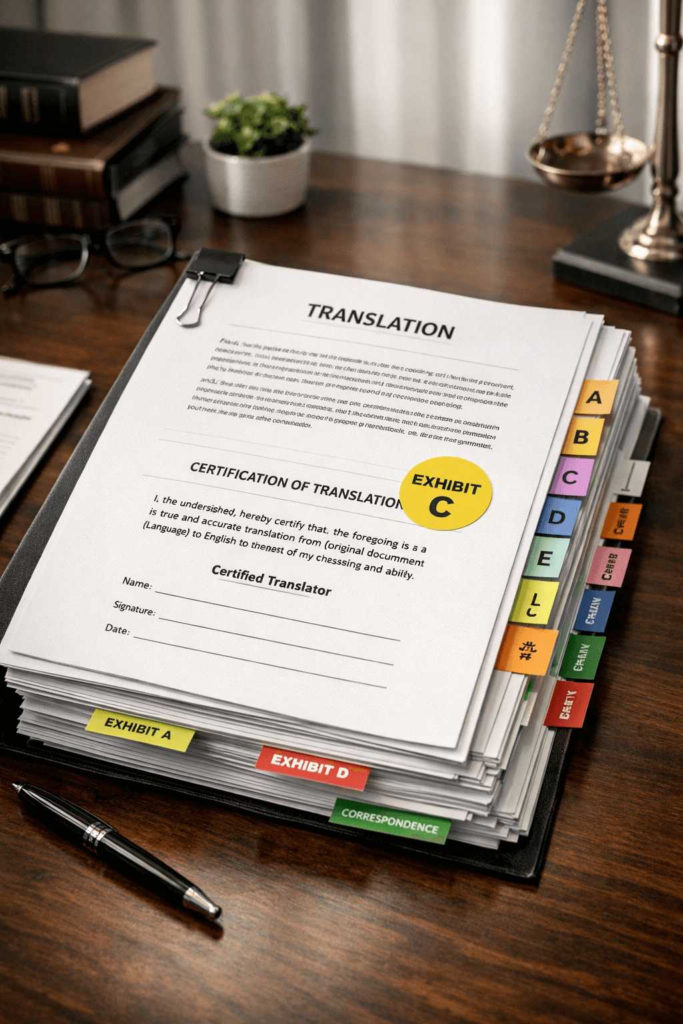
Court deadlines don’t wait, and courts don’t accept “close enough”. If you’ve been asked to file, serve, or submit documents in another language, this guide shows you how to translate court documents properly—so your evidence is usable, your filings are compliant, and your case doesn’t stall because of avoidable formatting or certification issues.
Whether you’re dealing with a court order, judgment, witness statement, claim form, exhibits, or a full court bundle, the principles are the same: accuracy, completeness, and a certification package that matches the court’s expectations.
If you’re working to a hearing date or service deadline, you can start immediately by uploading clear scans for a fast, compliant quote: Upload your court documents.
How can I get professional translation services for court documents in the UK?
If you need professional translation services for court documents in the UK, the safest route is to use a legal-specialist translation provider that can handle full-document translation, certification, and court-ready formatting. In practice, that means sending clear scans, confirming which court or tribunal the documents are for, stating the country where they will be filed, naming the target language, giving your deadline, and confirming whether you need certified, notarised, or affidavit-backed wording.
Before you instruct anyone, ask these practical questions:
- Can you translate court orders, judgments, witness statements, exhibits, and supporting evidence?
- Can you provide a signed certification statement and, if required, notarisation or affidavit support?
- Can you preserve pagination, exhibit labels, stamps, signatures, and handwritten notes?
- Can you handle urgent hearings, filing deadlines, and amended bundles if the court requests changes?
This is the quickest way to avoid generic translation services that may be suitable for ordinary documents but not for litigation, evidence, or bundle preparation.
What courts usually require (and why translations get rejected)
Courts typically focus on four things:
1) A complete translation (not a summary)
A court translation must reflect the entire document, including:
- Headings, footers, case numbers, and reference codes
- Stamps, seals, signatures, handwritten notes
- Tables, schedules, exhibits, and annexes
- Dates, times, and numerical formatting (including decimals and currency)
Skipping “unimportant” sections is one of the fastest ways to trigger rejection or challenges.
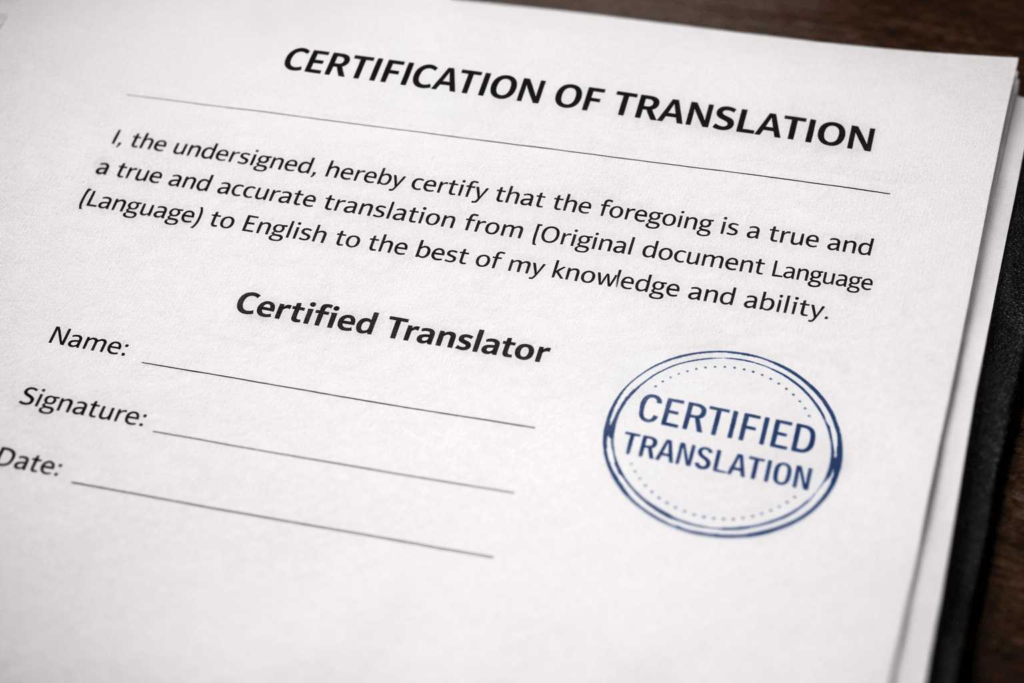
2) A certification statement
For many filings, you’ll need a formal certification confirming:
- the translator is competent in both languages
- the translation is accurate and complete to the best of their ability
- the translator signs and dates the certification
- contact details and credentials are included (as required)
In some jurisdictions, the certification may need to be sworn before a notary (an affidavit). In others, a signed declaration is sufficient.
3) Format that preserves meaning
Courts don’t require the translation to “look pretty”, but they do need it to be easy to compare. A strong court document translation guide approach is to:
- mirror the original layout where possible
- keep paragraph numbering aligned
- preserve page breaks and exhibit labels
- clearly mark illegible text, redactions, or missing pages
4) The right version of the document
Courts can ask for:
- the original language document and the translated version
- certified copies (depending on filing rules)
- translations attached to statements/exhibits in a specific way
If you’re unsure, your safest move is to confirm requirements with the court or your solicitor before you pay for extras you don’t need.
UK court translation requirements at a glance
If your documents are for proceedings in England and Wales, it helps to know the procedural basics before you order anything. For civil witness statements in a foreign language, the Civil Procedure Rules Practice Direction 32 says the party wishing to rely on the statement must have it translated, file the foreign-language witness statement with the court, and the translator must sign the original statement and certify that the translation is accurate.
For family proceedings, rule 6.47 of the Family Procedure Rules states that every translation filed under that rule must be accompanied by a statement by the person making it that it is a correct translation, together with their full name and address and the date of the statement.
In practical terms, this means court translations are not just about “getting the words into English”. They must also fit the filing process, the correct statement or certification wording, and the evidential structure of the case.
What this usually means for you:
- don’t submit the English translation on its own if the court also requires the foreign-language original
- don’t assume one generic certification wording fits every matter
- if your solicitor or the court has given specific wording or filing instructions, follow those exactly
- if the matter is cross-border, check whether the receiving court wants a certified, notarised, or country-specific sworn translation before ordering
1
Before you translate: 7 questions that prevent last-minute problems
Use this checklist before ordering any legal document translation process:
- Which court/tribunal is this for—and which country? Requirements vary.
- Do they require certified, sworn, or notarised translation?
- Do they want the original filed alongside the translation?
- Do they need a translator’s declaration wording in a specific format?
- Is this for filing, service, disclosure, or evidence only? (Different standards can apply.)
- Do you have a deadline for service or filing? (Build in buffer time.)
- Are there exhibits, screenshots, chat logs, or audio transcripts? These need special handling.
If you want help confirming the right level of certification and format, request a quick review: Request a free consultation.
The legal document translation process (step-by-step)
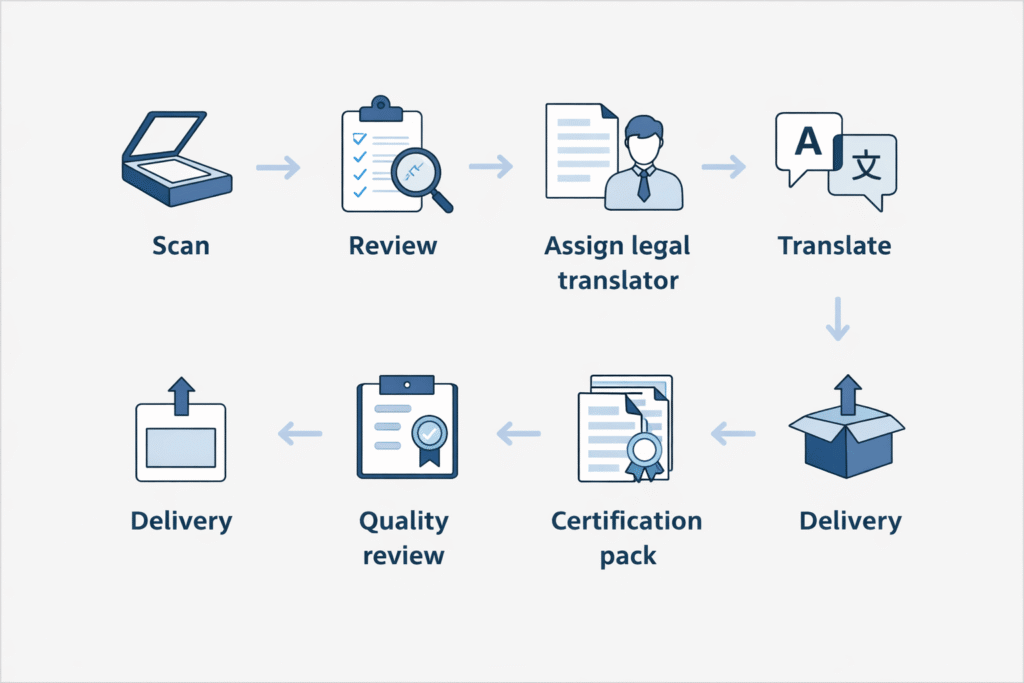
Here’s a court document translation guide workflow that consistently holds up under scrutiny.
Step 1: Prepare a clean, readable file set
Provide:
- A single PDF per document, where possible (or labelled files)
- Colour scans when stamps/highlights matter
- 300 DPI scans if you can (especially for seals and small print)
- All pages in the correct order (including blank stamped pages)
If you only have photos, that can still work—just keep them straight, well-lit, and uncropped.
Step 2: Identify what must be preserved
Tell your translation provider if you need:
- exact formatting replication (bundle-ready)
- bilingual layout (side-by-side)
- exhibit-ready labelling (Exhibit A, B, C…)
- redactions mirrored exactly
- page numbering matched to the original
For evidence (WhatsApp, emails, invoices), preserving timestamps and sender labels is crucial.
Step 3: Assign the right legal linguist (not just “a translator”)
Court documents aren’t general content. The translator should:
- understand legal terminology in both systems (not just language)
- recognise court-specific formatting conventions
- know how to translate names, titles, and procedural terms consistently
- follow a strict confidentiality process
You can explore specialist support here: Legal translation services.
Step 4: Translate with terminology controls and consistency checks
For multi-document bundles, consistency is everything. A good provider will use:
- a case-specific glossary (names, offences, claims, legal phrases)
- consistent treatment of dates, addresses, and reference numbers
- careful handling of “false friends” (terms that look similar but mean something else)
Step 5: Independent quality review (bilingual)
Court documents should be reviewed by a second qualified linguist to catch:
- omissions
- inconsistent terminology
- formatting shifts that change meaning
- numerical or date errors (often the most damaging mistakes)
Step 6: Produce the certification pack (and notarisation if required)
Depending on your court translation requirements, your pack may include:
- translator certification / declaration
- notarised affidavit (if required)
- company cover letter (where helpful)
- optional hard copy stamping, if the court requests physical originals
If you need certified formats, start here: Certified translation.
Step 7: Deliver in filing-ready formats
Common delivery formats include:
- searchable PDF
- Word (editable, helpful for solicitors)
- bundle-ready PDF with matched pagination
- print-and-post options (when physical filing is needed)
To begin, upload your documents for a turnaround estimate and compliance check: Get a quote.
How to translate a court order, judgment, or ruling without losing legal meaning
Court orders and judgments often contain wording where tiny shifts change obligations. Pay special attention to:
Operative paragraphs
These are the lines that create duties and deadlines (e.g., “must”, “shall”, “is ordered”, “is prohibited”). The translation must preserve:
- who must do what
- by when
- under what conditions
- consequences of non-compliance
Defined terms
If the document defines terms (e.g., “the Claimant”, “the Respondent”, “the Property”), those definitions must remain consistent throughout.
Remedies, penalties, and costs
These sections can include:
- monetary amounts
- interest calculations
- cost orders
- enforcement directions
A single digit error can be catastrophic.
References to exhibits or prior orders
Keep references identical (Exhibit numbers, order dates, case IDs). If the original references “Schedule 2”, the translation must reference “Schedule 2”—not “Appendix” or a renamed label.
If the person signing a statement of truth cannot read English
Translation is only part of the compliance picture. If a document contains a statement of truth and the person signing it cannot read or sign it other than by reason of language alone, extra procedural care may be needed.
In that situation, the document may need a certificate by an authorised person confirming that the document has been read to the person, that they appeared to understand it, that the statement of truth was also explained to them, and that they signed or made their mark in that person’s presence.
What to do in practice:
- tell your solicitor or provider early if the witness cannot read English
- check whether the statement must be read back in the witness’s own language before signature
- make sure the final signed version, certification, and any translation stay in the same document trail
- do not assume that translation alone solves the statement-of-truth requirement
This is one reason court document translation often needs coordination between the translator, solicitor, and the person taking the statement.
Translating evidence: emails, WhatsApp chats, screenshots, and invoices
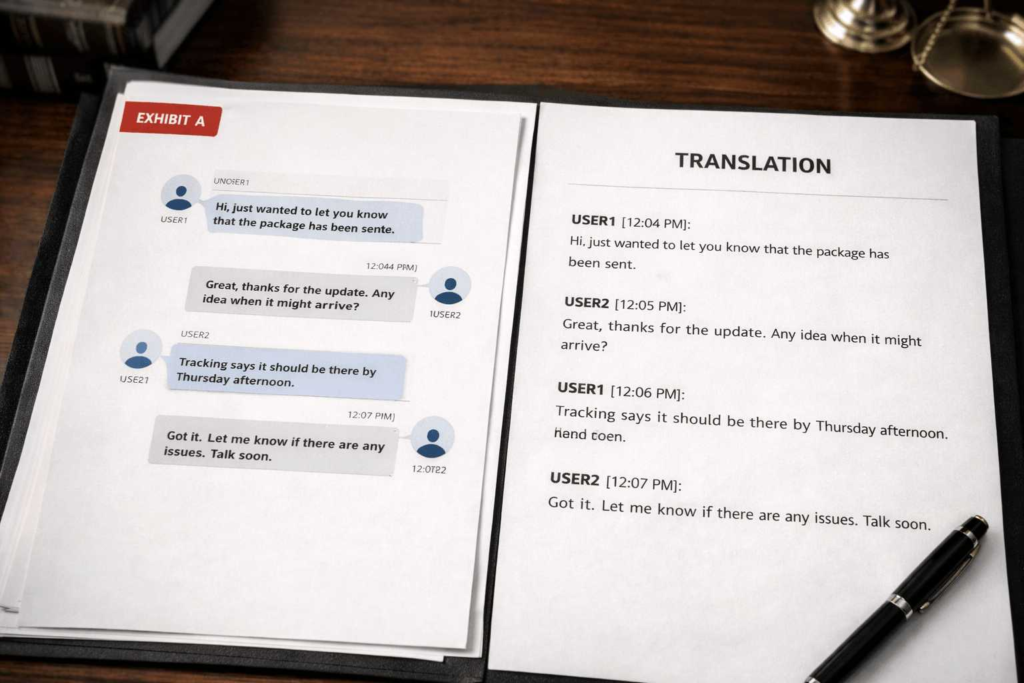
Modern cases rely heavily on digital evidence. The main risk isn’t vocabulary—it’s authenticity and traceability.
What to preserve in chat and email translations
- timestamps (including time zones if shown)
- sender names/handles and phone numbers
- message order
- emojis and reactions (translate meaning, retain symbol)
- attachments referenced (label clearly)
Best practice for screenshots and multi-image evidence
- keep each screenshot as an exhibit with a unique label
- include a “screenshot index” listing file name and exhibit number
- translate visible UI elements only when relevant (buttons, error messages)
- mark any illegible text as [illegible] rather than guessing
When you need a transcript first
For audio/video evidence, you may need:
- transcription in the original language
- translation of the transcript
- certification of the translated transcript
If your case involves mixed evidence, you’ll save time by asking for a single coordinated evidence pack. Start your project.
Certified vs sworn vs notarised: which type of court translation do you need?
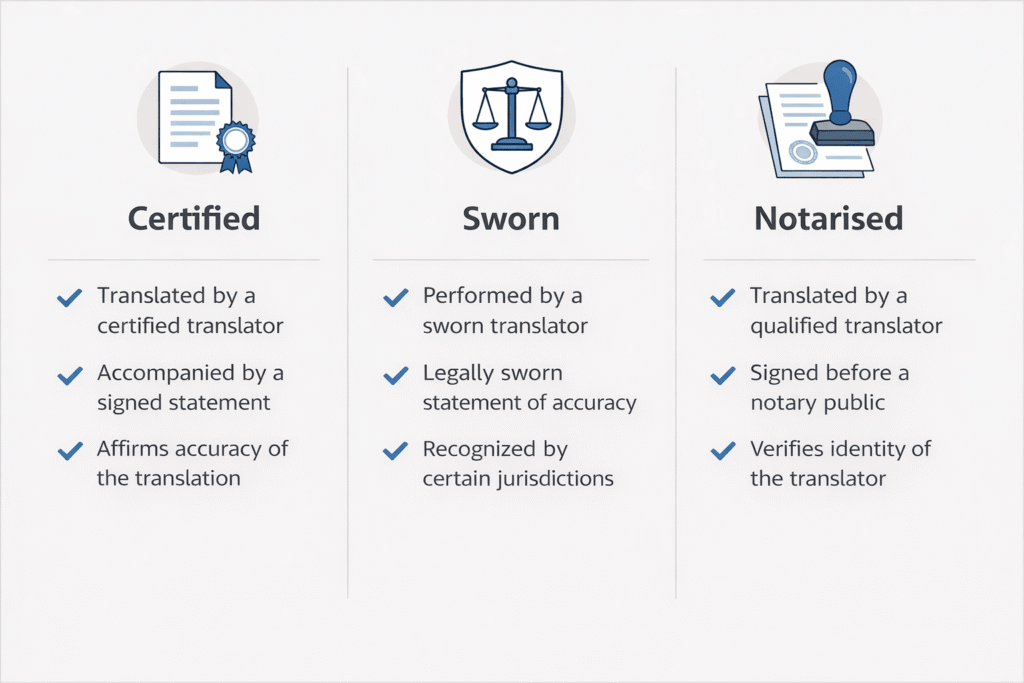
People often use these terms interchangeably, but they’re not the same.
Certified translation
A translation accompanied by a signed statement confirming accuracy and translator competence. This is the most common requirement for court and official use.
Sworn translation
Used in some countries where translators are officially appointed/authorised by a court or government body. If you’re filing abroad, this may be mandatory.
Notarised translation
A notary verifies the identity/signature of the person signing the certification (often the translator). Notarisation doesn’t automatically prove translation quality—it proves the signature process.
“Court-certified translator”
Some jurisdictions use this to mean a translator with court recognition or qualification for interpreting/translation in legal settings. Don’t assume this is required unless the court specifies it.
If you’re filing in a different country to where the document was issued, you may also need legalisation or an apostille after translation. See: Apostille and legalisation support.
Important UK point
In the UK, there is no formal status of “sworn translator” in the same sense as used in some civil law countries. So if someone says you need a “sworn translation” for a UK court matter, check whether the court actually means a certified translation, a notarised certification, or a translation intended for use in another country.
If you’re filing in a different country to where the document was issued, you may also need legalisation or an apostille after translation. See: Apostille and legalisation support.
What does court document translation cost (and what affects turnaround)?
Pricing depends less on the “type of case” and more on how the document behaves in translation.
Factors that increase cost or time
- handwritten notes, stamps, marginalia
- dense legal reasoning (judgments, pleadings)
- poor scan quality or missing pages
- multi-document bundles requiring consistency control
- urgent deadlines (same-day or 24–48 hour turnaround)
- notarisation, courier delivery, hard-copy certification
- complex formatting (tables, schedules, exhibits)
How to keep costs down without risking rejection
- scan clearly (it reduces clarification cycles)
- send everything at once (avoids glossary resets)
- tell your provider exactly how the documents will be used
- request “bundle-ready” only if you truly need it
If you want a fast estimate, upload files, and you’ll receive a clear breakdown of what’s required for your situation. Upload your file.
What to send when asking for a quote for a court document translation
To get an accurate quote quickly, send as much of the real filing context as possible, not just a few sample pages.
Include:
- the full document set
- the court or tribunal name
- the country where the translation will be filed
- the target language
- the filing, hearing, or service deadline
- whether certification, notarisation, or an affidavit is required
- any instruction about bundle formatting, exhibit numbering, or bilingual layout
- whether the matter includes screenshots, chat evidence, annexes, or transcripts
This reduces the risk of getting a low initial quote that later changes once the provider sees the actual certification or formatting requirements.
How to choose a court document translation provider (a quick vetting checklist)
Before trusting anyone with court material, check these essentials:
Accuracy and legal competence
- legal-specialist translators (not generalists)
- documented quality review process (second linguist review)
- consistent terminology across bundles
Court-ready certification
- certification wording included
- signed and dated
- translator details provided
- notarisation available where required
Confidentiality and data handling
Court documents often contain sensitive personal data. Look for:
- secure upload options
- limited access controls
- NDA availability on request
- clear retention and deletion practices
Real-world readiness
A reliable provider can handle:
- urgent turnaround
- formatting replication when required
- mixed evidence packs (scans + screenshots + annexes)
- last-minute court-requested amendments
If you want your documents checked for readiness before you commit, send them for a quick review. Contact us today.
The most common court translation mistakes (and how to avoid them)
Mistake 1: Using machine translation for legal filings
Even when it “reads fine”, machine output often fails on:
- legal nuance
- defined terms
- negative constructions (“unless”, “except”, “without prejudice”)
- jurisdiction-specific concepts
Mistake 2: Omitting stamps, notes, or “obvious” boilerplate
Courts often treat stamps and marginal notes as part of the evidential record.
Mistake 3: Inconsistent names and titles
If a name appears in multiple formats (passport, court file, police record), you need a consistent approach and a note where necessary.
Mistake 4: Date and number errors
A single swapped digit can undermine credibility. Courts take this seriously.
Mistake 5: Wrong certification level
Certified vs notarised vs sworn is not a preference—it’s a requirement. Confirm it early.
Copy-and-paste templates you can use
Translator certification (general-purpose wording)
I certify that I am competent to translate from [Language] into [Language], and that this translation is true and accurate to the best of my ability.
Name:
Signature:
Date:
Contact details:
(Your provider may adapt this to match local court wording.)
Court bundle translation intake checklist
- Court/tribunal name and country
- Purpose: filing/service/evidence/disclosure
- Deadline date and time
- Required certification type: certified/sworn/notarised
- Any formatting needs: matched pagination/exhibit labels / bilingual layout
- List of exhibits and attachments
- Any redactions that must be mirrored
To get this handled end-to-end, submit your bundle and receive a court-ready plan and quote: Get a quote.
Frequently Asked Questions
How do I translate court documents so they’re accepted?
Use a qualified legal translator, translate the full document (including stamps and notes), preserve key formatting, and include a signed certification statement—plus notarisation if the court requires it.
Do court documents need a certified translation?
Often, yes. Many courts and tribunals require a certified translation with the translator’s declaration of accuracy and competence. If the court specifies notarised or sworn translation, follow that instruction.
Can I translate a court order myself?
If the translation must be certified, you generally cannot certify your own translation. Courts typically expect an independent translator who can certify accuracy and competence.
What is a translator’s affidavit for court?
It’s a sworn statement (often notarised) confirming the translator’s identity, competence, and that the translation is accurate and complete. Some courts request this instead of (or alongside) a standard certification.
How long does it take to translate court documents?
Turnaround depends on length, scan quality, complexity, and whether you need bundle formatting or notarisation. Simple documents can be fast; multi-document bundles take longer due to consistency and review.
What should I provide to start a court document translation?
Clear scans/photos of every page, the target language, the court/jurisdiction, your deadline, and whether you need certified, sworn, or notarised translation—plus any exhibit/bundle requirements.
How can I get professional translation services for court documents in the UK?
The quickest route is to send clear scans to a legal-specialist translation provider, explain which court or tribunal the documents are for, confirm the target language and deadline, and ask whether you need certified, notarised, or affidavit-backed wording. Also, check whether the provider can handle witness statements, orders, judgments, exhibits, and bundle formatting.
Will a UK court accept an online court document translation service?
Often, yes—provided the translation itself meets the court’s requirements. What matters is the quality, completeness, certification wording, and whether the provider can supply the correct signed declaration or affidavit where needed.
Is there such a thing as a sworn translator in the UK?
Not in the same formal sense used in countries such as France, Spain, Germany, or Italy. In the UK, the key issue is usually whether the translation is accurate and whether the certification or affidavit matches the relevant procedural requirement.
Do I need to file the original foreign-language witness statement as well as the translation?
If you want to rely on a foreign-language witness statement in civil proceedings, you should not assume the translation alone is enough. Check the applicable procedural rules and filing instructions so both the original-language statement and the certified translation are handled correctly.
Can a court reject a translation if the certification or wording is wrong?
Yes. Errors in certification wording, signatures, dates, statements of truth, or filing format can cause delays, objections, or admissibility problems, so the procedural side matters as much as the translation itself.