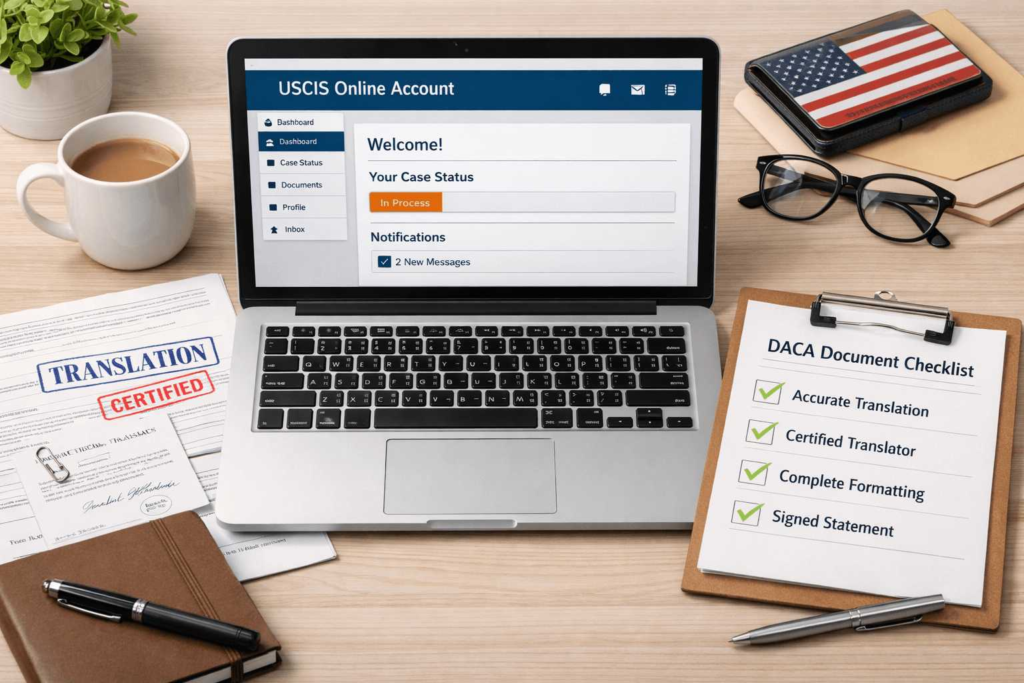
If you’re applying for DACA or renewing, translations are one of the easiest details to underestimate — and one of the fastest ways to trigger delays if they’re done incorrectly.
Here’s the rule to remember:
If you submit any document that includes a foreign language, USCIS expects a full English translation plus a signed certification from the translator. That’s the core of DACA translation requirements — and it applies whether the foreign language appears on a full page, a stamp, a handwritten note, or a single line on the back of an ID.
This guide explains exactly what to translate, what the certification must say, and how to organise everything so your packet (or online upload) is clean, readable, and “submission-ready”.
Need help fast? Start here: Certified translation services (USCIS-ready)
Prefer to upload first and get a quick quote? Upload your file here
Official USCIS translation rule for DACA
For DACA applications and renewals, the official USCIS rule is simple: if a supporting document contains foreign-language text, submit a full English translation together with a translator’s signed certification. USCIS says the translator must certify that the translation is complete and accurate and that they are competent to translate from the foreign language into English.
If you are uploading evidence online, upload the original foreign-language document together with the certified English translation so the officer can review both at the same time.
That rule is broader than many applicants expect. It is not limited to “main text” only. In practice, it covers anything you are relying on as evidence if any part of it is not in English.
DACA translation requirements at a glance
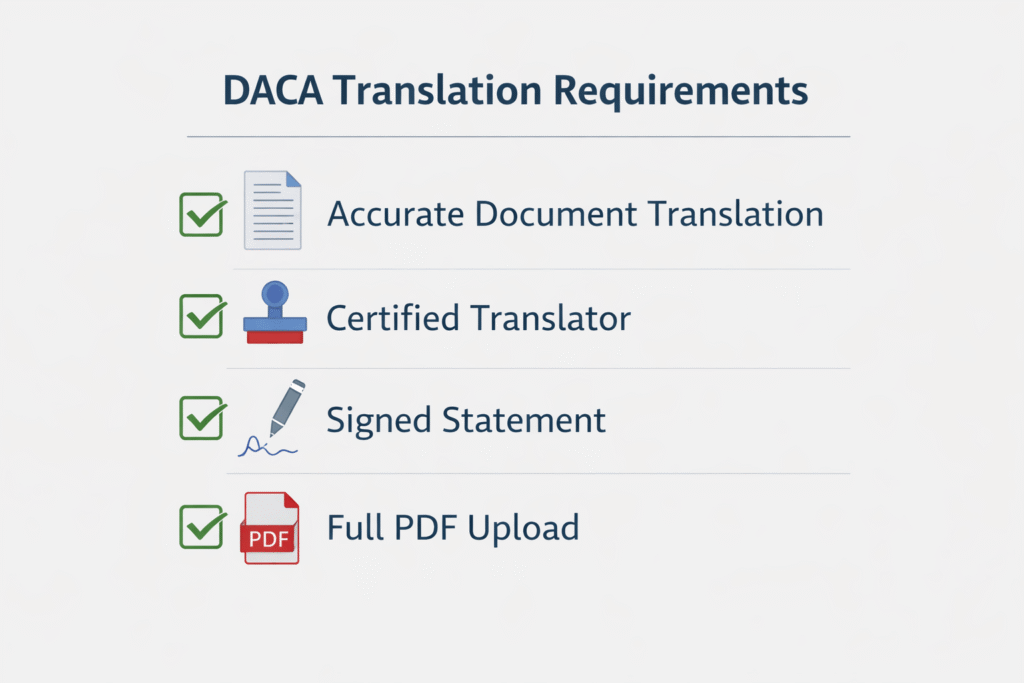
Translate it if:
- It’s not fully in English (even if it’s “mostly English”).
- It contains a foreign-language stamp, seal, footer, margin note, or handwritten annotation.
- It’s a supporting document you’re submitting with your forms (identity, school, medical, financial, legal, etc.).
USCIS-style “certified translation” generally means:
- A complete English translation (no summaries, no skipped sections).
- A signed certification statement confirming:
- the translation is complete and accurate, and
- the translator is competent in both languages.
Good to know: DACA forms themselves are in English — translation issues usually come from supporting evidence.
What documents need translation for DACA?
There isn’t a single universal list because every case is different. Instead, use this simple filter:
If you plan to submit the document to USCIS and any part of it is in a foreign language, translate it.
That said, DACA applicants and renewals commonly run into translation needs in these categories:
1) Identity and civil documents
Often includes foreign-language text even when issued internationally in “standard formats”.
Common examples:
- Birth certificate
- Passport bio page (and any endorsement pages you submit)
- National ID / consular ID
- Family documents you include (if relevant): marriage certificates, name-change documents, etc.
2) School and education records
If you’re submitting school records, letters, diplomas, or transcripts that contain foreign-language headings or remarks, they typically need translation.
Examples:
- School transcripts or records from outside the US
- Diplomas/certificates of completion
- Letters confirming enrolment or attendance (if not in English)
3) Medical and vaccination records
Applicants sometimes use medical records as part of an evidence trail (especially older records). These frequently include foreign-language medical terms and clinic stamps.
Examples:
- Vaccination records
- Clinic letters
- Appointment summaries (if submitted)
4) Financial, employment, and “life history” records
Not always required for every case, but if you submit them and they’re not in English, translate them.
Examples:
- Bank statements
- Pay slips
- Tax letters or official notices (if relevant)
5) Legal or court-related documents
If you include any documentation relating to arrests, charges, court outcomes, or legal history, and it’s not in English, it must be translated fully and carefully.
Examples:
- Court dispositions
- Police certificates (when submitted)
- Legal notices or letters
DACA evidence categories that often trigger translation needs
For first-time DACA filings in particular, translation issues commonly arise in the same evidence categories applicants use to prove eligibility. That often includes:
proof of age and identity,
proof you came to the US before age 16,
proof of continuous residence,
proof of physical presence on relevant dates,
records showing prior lawful status ended before the required date (if applicable),
education evidence, and
criminal or court records, if any exist.
This matters because applicants sometimes focus only on “identity documents” and forget that school, medical, court, or entry-related records can also need certified translation if they are submitted in support of the case.
DACA renewal vs initial: how translation needs usually differ
Renewals (most common)
Most renewals are lighter on evidence, but translations may still be needed if you submit:
- A foreign-language identity document (or a new/updated version)
- Any supporting documents that contain non-English text
- Documentation for anything that has changed since your last filing (for example, name changes)
First-time or “more complex” filings
If your situation requires more supporting documents, translation needs typically increase — especially for older records, documents from abroad, or evidence that spans multiple years.
Practical tip: Even if you don’t think you need to submit a foreign-language document, your case can change quickly (for example, if you’re responding to a request for more evidence). Having translations ready early can prevent last-minute stress.
What “certified translation” means for DACA (and what it doesn’t)
In the DACA context, “certified translation” is usually about the translator’s signed statement, not a government stamp.
A strong certified translation package includes:
- The English translation (complete, legible, well-formatted)
- A certification statement (signed and dated)
- Translator or company details (so USCIS can identify who certified it)
- Clear reference to the source document (what was translated)
Sample certification wording you can use
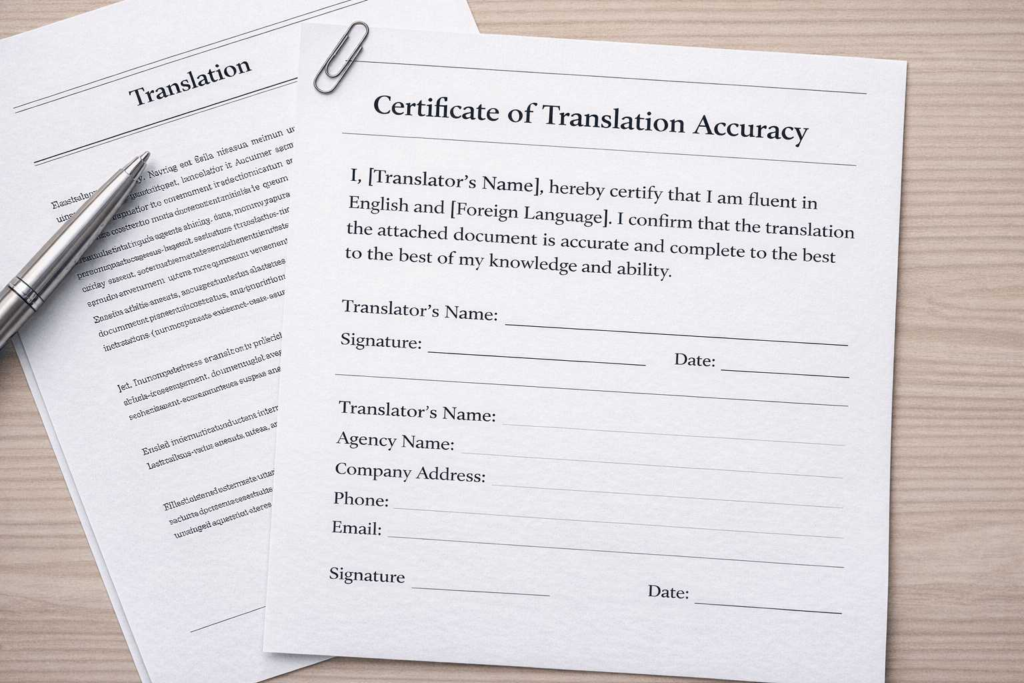
You can include a certification like the following (adapted to your document):
Certificate of Translation Accuracy
I, [Translator’s full name], certify that I am competent to translate from [Language] into English, and that the attached translation is a complete and accurate translation of the attached document titled [Document name/description].
Signature: ____________________
Name: [Translator’s full name]
Date: [DD Month YYYY]
Contact: [Email/phone]
Important: The certification should match the document. If you translate three different documents, each translation should have its own certification (or clearly separated certifications).
What USCIS expects to appear with the certification
Alongside the statement itself, include the translator’s signature, printed name, date, and contact details. That extra information helps the certification look complete and align more closely with current USCIS form-instruction wording.
Does USCIS require a full translation of the entire document?
Yes — and this is one of the most important points to get right.
For DACA evidence, “full translation” should be treated as exactly that: the whole document, not just the sections you think matter. If a document includes foreign-language text anywhere on the page, the safer approach is to translate all of it, including:
stamps and seals,
headers and footers,
marginal notes,
handwritten annotations,
back-page text,
endorsements, and
registration numbers or issuing authority text.
This is especially important for civil records, IDs, school records, and legal paperwork, where small details often carry dates, registration data, or issuing authority information.
The DACA document translation guide: how to avoid the mistakes USCIS actually flags
Most translation problems aren’t about “bad English”. They’re about missing details.
Here are the issues that most often cause delays, confusion, or follow-ups:
Common translation mistakes
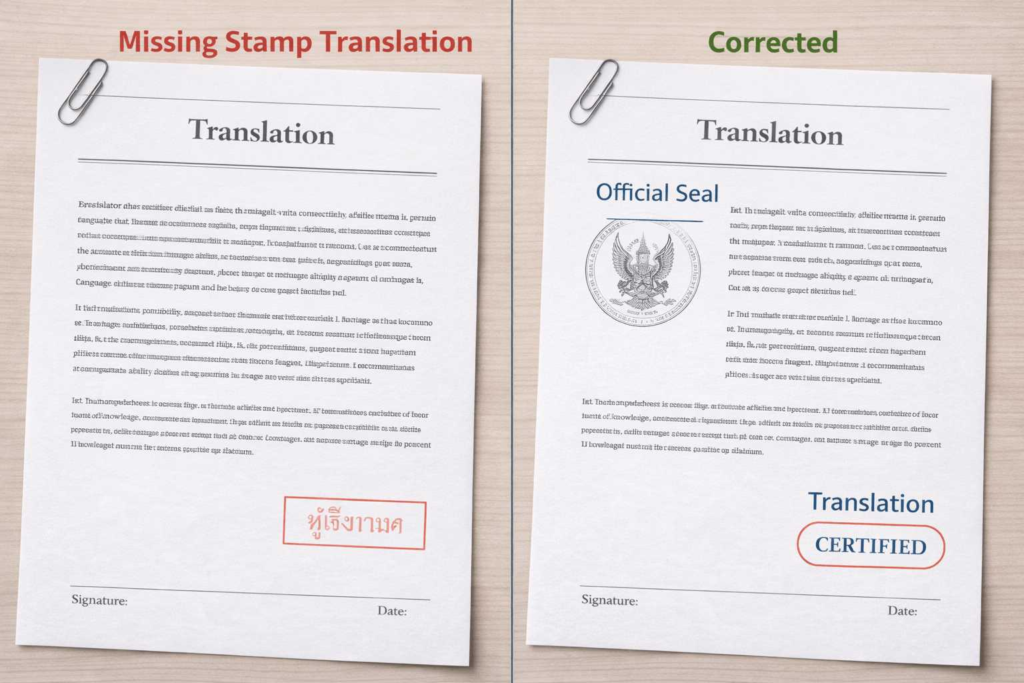
- Translating only the “main text” and ignoring stamps, seals, or handwritten notes
- Leaving out back pages (IDs and certificates often have critical text on the reverse)
- Submitting a summary instead of a full translation
- Missing the certification statement (or leaving it unsigned/undated)
- Using inconsistent name spelling across documents (especially diacritics and surname order)
- Translating dates inconsistently (switching between DD/MM/YYYY and MM/DD/YYYY without clarity)
- Poor scan quality (cropped edges, glare, blurry seals)
- Relying on machine translation for official documents
- Not labelling what a stamp/seal says (a stamp can contain issuing authority and dates)
A simple “submission-ready” checklist (use before you file)
Before you submit, confirm:
- All pages are included (front/back where relevant)
- Every non-English line is translated (including headers/footers)
- Stamps/seals/handwritten notes are accounted for and labelled
- Names match the spelling you use across your forms
- Dates and document numbers are consistent and readable
- The certification is signed and dated
- Files are cleanly named (especially for online filing)
If you want this checked professionally, start here: Certified translation services (USCIS-ready)
Can you translate your own documents for DACA?
Some people do — but it’s not always the safest move.
If you choose to translate yourself, you still need to provide:
- A complete English translation, and
- A certification statement confirming competence and accuracy (signed and dated)
Where self-translation often goes wrong: formatting, completeness, and overlooked stamps/notes. Even a small omission can create avoidable back-and-forth.
If your document set includes legal history, dense records, or multiple stamps/seals, professional translation is strongly recommended.
A practical note on who signs the certification
USCIS focuses on whether the translator is competent and whether the certification is signed properly. If another person translates the document for you, the certification should identify that person clearly and include their own signature and contact details. The goal is to make it easy for USCIS to see who completed the translation and what document the certification relates to.
Step-by-step: how to prepare translations for DACA application or renewal
Step 1: Gather and scan your documents properly
Use a flat scan when possible. If using a phone:
- Photograph in bright, even light
- Avoid shadows and glare
- Capture the full page edges (no cropping)
- Include the back page if there is any text or stamp
Step 2: Decide what you’re actually submitting
Only translate documents you plan to submit — but remember: if you upload it, translate it.
Step 3: Provide context to the translator
Tell them:
- This is for DACA (USCIS)
- Any deadline you’re working to
- Your preferred spelling format for names (especially if you use multiple surnames)
Step 4: Review for “matchability”
A USCIS officer should be able to match the translation to the original quickly. Look for:
- Clear structure
- Labels for stamps/seals
- Page references if needed
- Consistent terminology
Step 5: Assemble for filing (paper or online)
- Keep originals at home unless USCIS specifically requests originals
- Upload as clean PDFs (one document per PDF is often easiest for tracking)
- Name files clearly (example: Birth_Certificate_English_Translation.pdf)
Want the fastest route? Upload your documents here, and you’ll receive a clear quote and turnaround options.
Paper filing vs online upload: how to submit translated documents cleanly
If you are filing by mail, send legible copies unless USCIS specifically asks for originals. Keep your originals in a safe place.
If you are uploading evidence online, upload the original foreign-language document together with the certified English translation. Keep each document set easy to follow so the original and translation can be matched quickly.
A clean pairing usually looks like this:
Original document copy
English translation
Signed certification
That simple order makes review easier and reduces the chance that a translation gets separated from the document it belongs to.
DACA renewal translation checklist (quick, practical, printable)
Use this as your DACA renewal translation checklist — especially if you’re trying to file without second-guessing.
Translate these if they contain any non-English text:
- Birth certificate (if submitting)
- Passport or national ID pages you submit
- Any new/updated civil documents (name change, marital status docs)
- Any supporting evidence you submit that’s not in English:
- school records
- medical/vaccination records
- financial records
- legal/court documents
Before you submit, confirm:
- ✅ Full translation (no skipped lines)
- ✅ Stamps/seals/notes included
- ✅ Back pages included when relevant
- ✅ Signed + dated certification attached
- ✅ Names/dates consistent with your forms
- ✅ Scans are readable and uncropped
Do DACA translations need to be notarised?
Usually, no — unless the organisation receiving the translation explicitly requests notarisation.
For DACA/USCIS-style submissions, the key requirement is typically the translator’s signed certification.
If you’re unsure, the simplest move is to follow the instruction that applies to your exact situation. When in doubt, upload the instructions along with your document so it can be handled correctly from the start.
A real-world example (composite)
Composite example based on common issues we see:
A DACA renewal applicant submitted a birth certificate that was “mostly straightforward” — but the reverse side included a municipal stamp with dates and a registration number. The first translation omitted the stamp text, which made the record look incomplete. A corrected, fully labelled translation (including stamp content and a clean certification) resolved the issue quickly.
The takeaway: stamps and back pages matter more than people think.
Ready to get it done without stress?
If you want translations prepared in a USCIS-ready format — complete, clearly labelled, and certified properly — you can start in minutes:
- Start with: Certified translation services (USCIS-ready)
- Upload and request a quote: Upload your file here
FAQs
What are the DACA translation requirements for USCIS?
If you submit any document that contains a foreign language, include a full English translation and a signed certification from the translator confirming accuracy and competence.
What documents need translation for DACA renewal?
Any supporting document you submit that isn’t fully in English — commonly birth certificates, passports/IDs, school records, medical records, and legal documents (if included).
Can I translate my own documents for DACA?
Some applicants do, but you must still provide a complete English translation and a signed certification. Many people choose a professional service to reduce avoidable mistakes.
Do DACA translations need to be notarised?
Usually not. Most USCIS-style submissions rely on the translator’s signed certification. Notarisation is typically only needed if specifically requested.
What should a DACA translation certification statement include?
It should confirm the translator is competent in both languages and that the translation is complete and accurate, plus a signature, date, and translator/company details.
What’s the most common translation mistake for DACA applications?
Omitting stamps, seals, handwritten notes, or back-page text — even when the main document looks simple.
Do I need to translate a document if only one stamp or line is in another language?
Yes. If any part of a document you submit is in a foreign language, the safest USCIS-ready approach is to provide a full English translation rather than translating only selected parts.
Do I need to submit the original foreign-language document with the translation?
Yes. USCIS review is easier when the foreign-language document and the certified English translation are submitted together. For online filing, upload both together; for paper filing, include legible copies unless originals are specifically requested.
What should be included with the translator’s certification for DACA?
Besides the wording about competence and accuracy, include the translator’s signature, printed name, date, contact information, and a clear reference to the document translated.
Can a family member or friend translate DACA documents?
USCIS focuses on competence and certification, but many applicants still prefer a professional translation service for clarity, formatting, and reduced risk of omissions.
Do I need to translate the back of an ID or certificate for DACA?
Yes, if the reverse side contains any text, stamps, notes, or numbers, you are submitting as part of the document set.