
International adoption is emotionally big — and administratively unforgiving. A single mismatch in a name spelling, a missing stamp translation, or the wrong type of certification can trigger requests for rework, extra appointments, and weeks of lost time.
This guide walks you through certified translation for adoption in plain English: what “certified” really means, which documents usually need translation, how requirements change by country, and the step-by-step checklist families and agencies use to keep submissions moving.
If you’re on a deadline, you can upload your adoption documents here and get a submission-ready translation prepared with the correct certification statement: certified translation services.
Certified translation services for adoption documents in the UK: the direct answer
If you need certified translation services for adoption documents in the UK, the safest approach is to use a professional translation provider that can prepare a complete translation with a signed certification statement confirming accuracy and translator competence. In practice, this is the format most often requested when foreign-language adoption paperwork is being reviewed in the UK or prepared for use abroad from the UK.
For UK-related adoption matters, certified translations are commonly used for:
- foreign birth certificates
- adoption certificates or adoption decrees
- court orders and registry documents
- marriage or divorce certificates
- police checks and background documents
- home study reports and social worker assessments
- medical records
- consent or relinquishment documents
- passport or identity pages, where relevant to the case
In many cases, a clear scanned copy is enough to start. The translation is then prepared as a submission-ready PDF, and hard copies can be added if your solicitor, agency, court, or overseas authority asks for them. If the receiving authority also requires notarisation, apostille, or legalisation, that step should be checked separately because it depends on where the document will be used.
The quick answer (save this if you’re mid-process)
For most adoption cases, your translated documents must be:
- Complete (every page, stamp, note, and annotation included)
- Accurate (no summaries; dates, names, and numbers match exactly)
- Certified (a signed statement confirming accuracy + translator competence)
- Formatted for comparison (easy for an officer to match to the original)
- In the right “legal chain” (some cases also need notarisation, apostille, or consular legalisation — depending on where the document will be used)
Official guidance differs by country and authority, but these principles show up repeatedly across immigration bodies, courts, and central adoption authorities.
What “certified translation” means in an adoption context
A certified translation is a translation delivered with a signed certification statement confirming (1) the translation is complete and accurate and (2) the translator is competent in the language pair.
In adoption, certification matters because your documents are typically reviewed by multiple stakeholders:
- Adoption agency/adoption service provider
- Central Authority (in Hague cases)
- Family court or civil registry
- Immigration authority in the receiving country
- Sometimes a consulate or authentication office
Each reviewer needs confidence that the translation is reliable, traceable, and usable as evidence.
Certified vs notarised vs sworn vs legalised (what’s actually different?)
People often use these terms interchangeably — and that’s where problems start.
- Certified translation: The translator/company signs a certificate of accuracy and competence.
- Notarised translation: A notary verifies the identity of the signer (usually the translator) and witnesses the signature. It does not certify the translation quality by itself.
- Sworn translation: In some countries, translations must be produced by a government-authorised/sworn translator (rules vary widely).
- Apostille/legalisation: Authentication attached to an original document (or sometimes to a notarised certification) for cross-border use.
Key point: One authority may accept a certified translation alone, while another may require notarisation or an apostille on the underlying document. It’s about the receiving authority’s rules, not what’s “standard”.
Who may ask for a certified translation in an adoption case
Depending on the stage of the process, certified translations for adoption documents may be requested by:
- an adoption agency or adoption service provider
- a family solicitor handling the paperwork
- a family court or foreign court
- a local authority
- a civil registry
- a central authority in Hague adoption cases
- an immigration authority if the child’s entry, residency, or citizenship is being processed
- a consulate, embassy, or document authentication office
This matters because families often assume there is one universal rule for all adoption paperwork. In reality, the document may pass through multiple reviewers, and each one may focus on a different requirement: translation accuracy, certification wording, notarisation, apostille status, or document traceability.
Why adoption translations get rejected (and how to avoid it)
Most delays come from a small set of predictable issues. Here’s what caseworkers and adoption coordinators flag most often:
1) Name mismatches across documents
Adoption files often contain:
- birth name(s)
- transliterations
- married names
- diacritics (é, ñ, ü)
- different surname order conventions
Prevention tip: Choose one “submission spelling” that matches the passport/ID used for immigration, and keep it consistent across every translation. Where the original differs, add a translator note (e.g., “Name appears as X on document; matches Y on passport.”)
2) Incomplete translation of stamps, seals, and handwritten notes
Stamps and annotations are not decoration — they are evidence. Omitting them can look like missing information.
Prevention tip: Ensure your provider translates/labels all visible stamps and handwritten notes (even if partially illegible, this should be indicated clearly).
3) Missing pages (especially backs of certificates)
Back pages often carry registry notes, legal references, or official endorsements.
Prevention tip: Always scan front and back, even if the back “looks blank”.
4) Wrong type of certification
Some authorities need a particular wording format, a sworn translator stamp, or an affidavit.
Prevention tip: Treat certification format as a requirement document. If your agency or authority provides written instructions, submit them alongside your files.
5) Poor formatting that makes the review difficult
If an officer can’t easily match translated lines to the original, they may push back.
Prevention tip: Ask for “side-by-side comparability”: clear headings, preserved structure, and labelled stamps/seals.
International adoption translation requirements: what changes by country
Think of adoption translation requirements as a two-lane system:
- Adoption lane (central authority/court/agency in the child’s country of origin and/or receiving country)
- Immigration lane (visa/residency/citizenship processing once the adoption is recognised)
You may need translations for one lane first, then again for the other, and the required format can differ.
Hague vs non-Hague cases (why it matters for documents)
- Hague cases typically involve central authorities and structured documentation steps.
- Non-Hague cases may involve different court processes, civil registries, and consular requirements.
Either way, translation quality and certification are non-negotiable because the documents move between systems.
If you’re adopting into (or out of) the United States, the U.S. Department of State’s intercountry adoption hub is a useful starting point for understanding the process flow: Intercountry Adoption.
Adoption translation checklist (the documents most often needing certified translation)
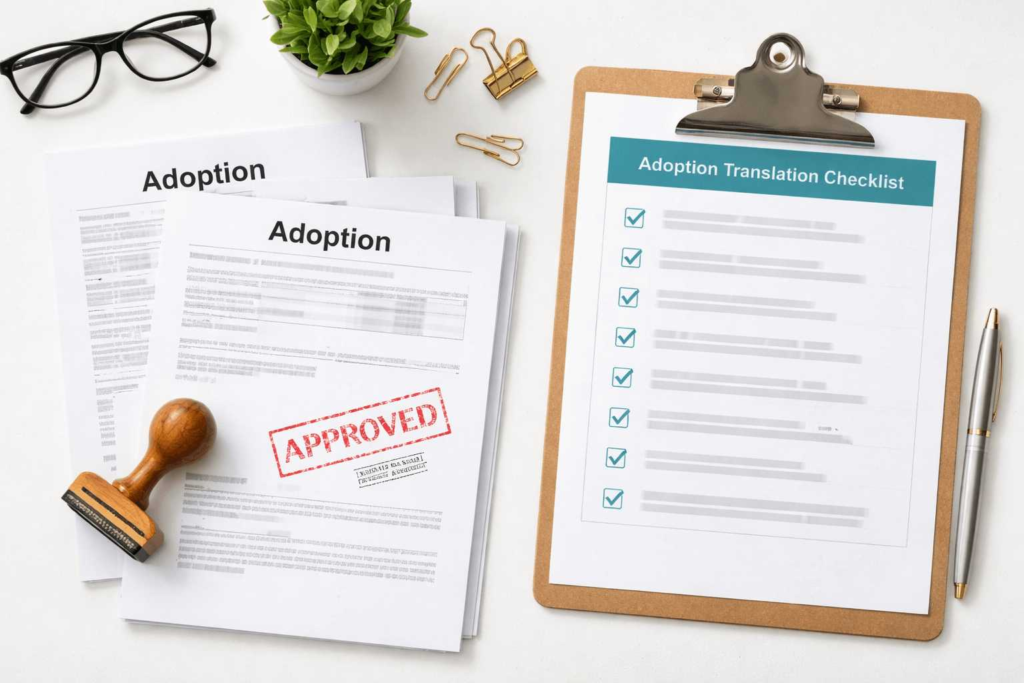
Your exact list depends on the country and whether you’re translating into or out of English, but the following are repeatedly requested in international adoption cases.
A) Documents about the adoptive parent(s)
Common requests include:
- Birth certificate(s)
- Marriage certificate/divorce decree(s)
- Passport bio page / national ID
- Police clearance/background checks
- Proof of income and employment letters
- Tax returns, payslips, bank statements (when required)
- Medical reports (where requested by the agency/court)
- Proof of address
- Reference letters (where required)
B) Home study and agency documentation
Often required for court review or central authority processing:
- Home study report
- Agency agreements/approvals
- Training certificates
- Social worker assessments
- Post-placement plan/follow-up reporting plan
C) Child-related documents
Frequently needed for recognition and immigration:
- Birth certificate (child)
- Relinquishment/consent documents (as applicable)
- Court orders/adoption decree
- Guardianship orders
- Medical records and vaccination history
- Identity documentation issued locally
D) Court and legal evidence (case-specific)
Examples:
- Powers of attorney
- Affidavits
- Notarial acts
- Civil registry extracts
- Guardianship or custody determinations
If you want a simple way to reduce back-and-forth: bundle everything that’s being submitted as “evidence” and translate it as one controlled set — consistent names, consistent date formats, consistent terminology.
What your certified translation should include (submission-ready standard)
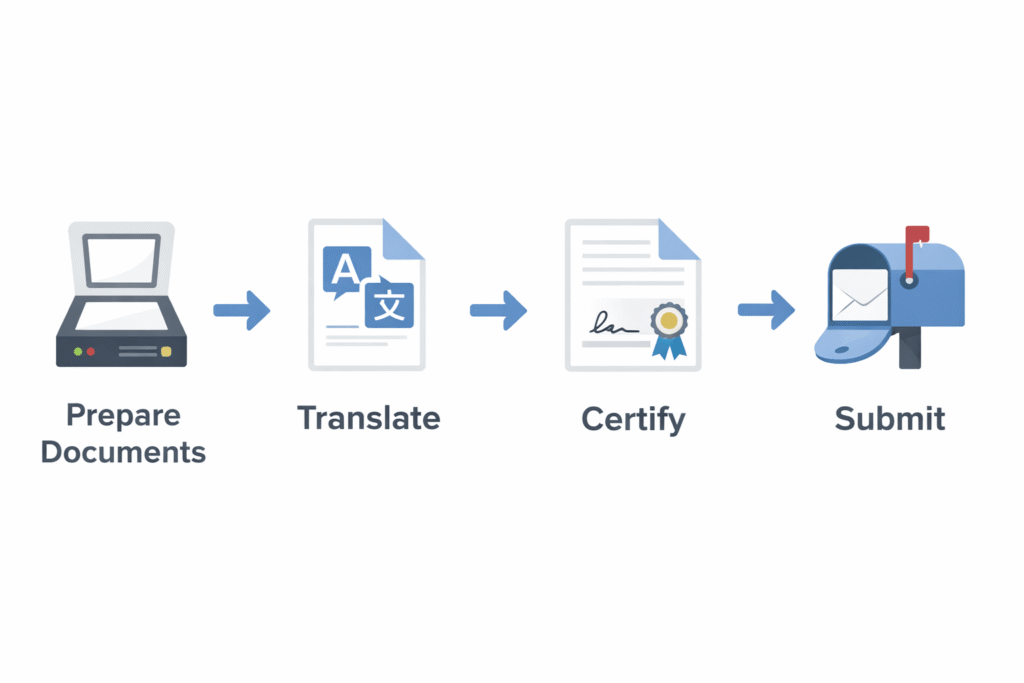
A submission-ready adoption translation usually includes:
- The full translated text (no omissions)
- Clear labelling for stamps, seals, signatures, and handwritten notes
- Page numbering (so files can be referenced in requests)
- A certification statement that includes:
- translator’s name
- signature
- date
- contact details (often helpful)
- declaration of competence and accuracy
Are digital certified translations enough, or do you need hard copies?
In many adoption matters, a digitally delivered certified translation is enough for initial review or submission, especially when documents are being sent by email to a solicitor, agency, or caseworker. However, some authorities, courts, or overseas offices may later ask for:
- a wet-ink signed hard copy
- a posted original certification page
- notarisation of the translator’s signature
- apostille or legalisation on the relevant document set
A practical rule is this: use a provider that can issue a certified PDF quickly, but also confirm whether hard copies may be needed later in the process. That way, you avoid ordering the wrong format first and paying twice.
A practical certification statement template (copy/paste)
Certificate of Translation Accuracy
I, [Full Name], certify that I am competent to translate from [Language] to English and that the attached translation is a complete and accurate translation of the original document.
Signature: _____________ Date: _____________
Name: _____________ Contact: _____________
(Your receiving authority may require a slightly different wording; when in doubt, align to their instruction.)
Do you also need notarisation, apostille, or legalisation?
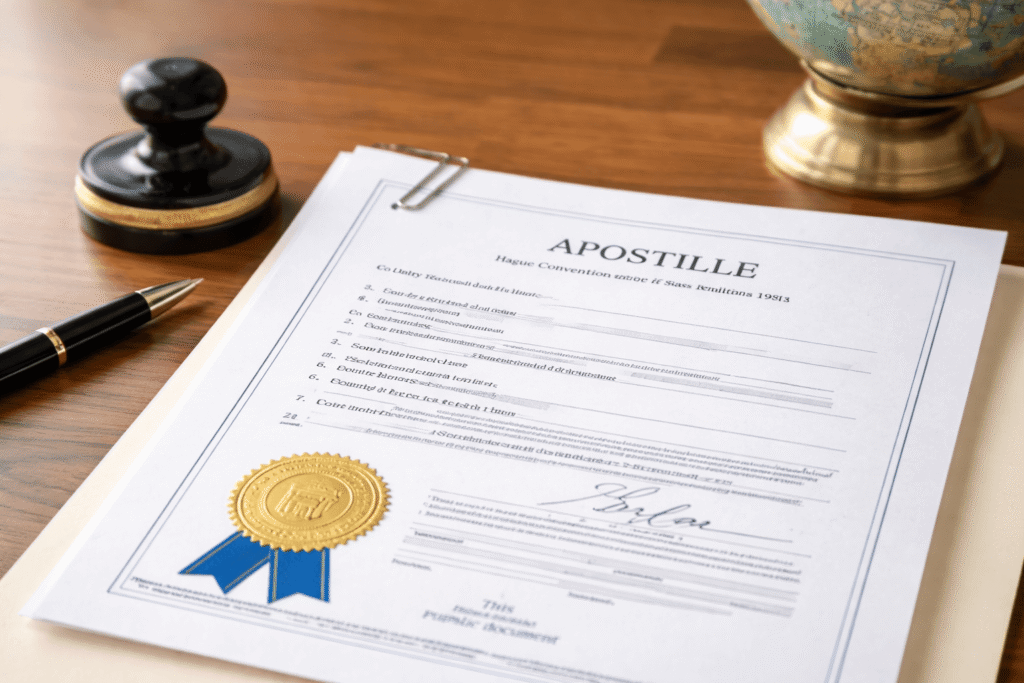
This is where many adoption cases lose time — because families get the right translation, but the wrong authentication step.
Here’s a reliable way to decide:
Step 1: Identify what must be authenticated
- Sometimes it’s the original document (e.g., an adoption decree or birth certificate)
- Sometimes it’s the translator’s certification signature
- Sometimes it’s both, depending on the receiving country’s rules
Step 2: Check whether the destination country accepts apostilles
If both countries are in the Hague Apostille system, you may only need an apostille rather than full consular legalisation.
For the most accurate overview of what an apostille does (and why it replaces older legalisation chains), see the Hague Conference’s Apostille section: HCCH Apostille Convention.
Step 3: If you’re using U.S.-issued documents abroad
The U.S. State Department’s apostille guidance helps you understand how authentication works for U.S. public documents: Apostille requirements.
A simple decision guide (fast and safe)
- If the authority only asks for “certified translation” → you likely do not need notarisation.
- If the authority asks for “notarised translation” or “affidavit” → you need notarisation/affidavit steps.
- If the authority asks for “apostille/legalisation/authentication” → that usually applies to the original document (and sometimes to the notarised certification).
When you’re not sure, don’t guess. Ask the adoption agency or receiving authority for the requirement wording in writing — or upload it with your document so the translation can be prepared in the correct format from the start: contact us.
Can you translate adoption documents yourself?
In some situations, a person may think they can translate their own adoption paperwork or ask a relative or friend to do it. That can create avoidable problems. Adoption files are sensitive, multi-document, and often reviewed by more than one authority. A self-prepared translation may be questioned because of:
- missing stamps, notes, or back-page details
- incomplete certification wording
- inconsistent spelling across the document set
- concerns about independence or conflict of interest
- formatting that makes the translation hard to compare with the original
Where the paperwork is important, time-sensitive, or cross-border, a professionally prepared certified translation is usually the lower-risk option.
How to prepare your adoption documents for translation (so you don’t pay twice)
Use this mini-prep routine before you upload anything:
1) Scan quality checklist
- Full document visible (no cropped edges)
- No glare/shadows on stamps or signatures
- All pages included (including blank backs)
- Consistent orientation (rotate images upright)
- Colour scans preferred for stamp clarity
2) File naming that prevents mix-ups
Use a naming scheme like:
- Parent1_BirthCert_Country_YYYY.pdf
- HomeStudy_Report_YYYY.pdf
- Child_BirthCert_City_Country.pdf
3) Decide your “official spelling”
Send the spelling exactly as it appears on:
- passport/ID used for immigration
- your application forms
If your documents disagree, note it once and apply consistently across the translation set.
Timelines: when to order translations in an adoption journey
Adoption paperwork arrives in waves. A practical timing strategy:
- Early stage: translate parent documents + home study materials that will be submitted to an agency/central authority.
- Court stage: translate court filings, decrees, registry documents.
- Immigration stage: translate foreign-language civil documents required for visa/residency processing.
Best practice: Translate in batches aligned to each submission milestone, not document-by-document. It reduces inconsistency and keeps you from re-certifying the same item multiple times.
Cost drivers (what actually affects pricing)
For adoption translation, pricing usually depends on:
- Language pair (rarer languages can cost more)
- Document length and density (home studies are longer than certificates)
- Formatting complexity (tables, multi-stamp pages, handwritten notes)
- Urgency (same-day/next-day delivery)
- Add-ons (notarisation, apostille support, hard copies)
If you want an accurate quote, the fastest route is to upload clear scans and your deadline — you’ll get a price and turnaround that matches the real workload: get started here.
How to choose a translation provider for adoption (a short screening list)
Ask these questions before you pay:
- Will you translate every stamp, seal, and handwritten note?
- Will the translation include a signed certification statement suitable for official submission?
- Can you match names and dates consistently across a multi-document set?
- Can you provide notarisation or guidance if the receiving authority requires it?
- What’s your process if an authority requests a revision? (e.g., formatting tweak, certification wording)
If the provider can’t answer these clearly, you’re likely to face rework later.
A practical “risk map” for adoption translations (original insight)
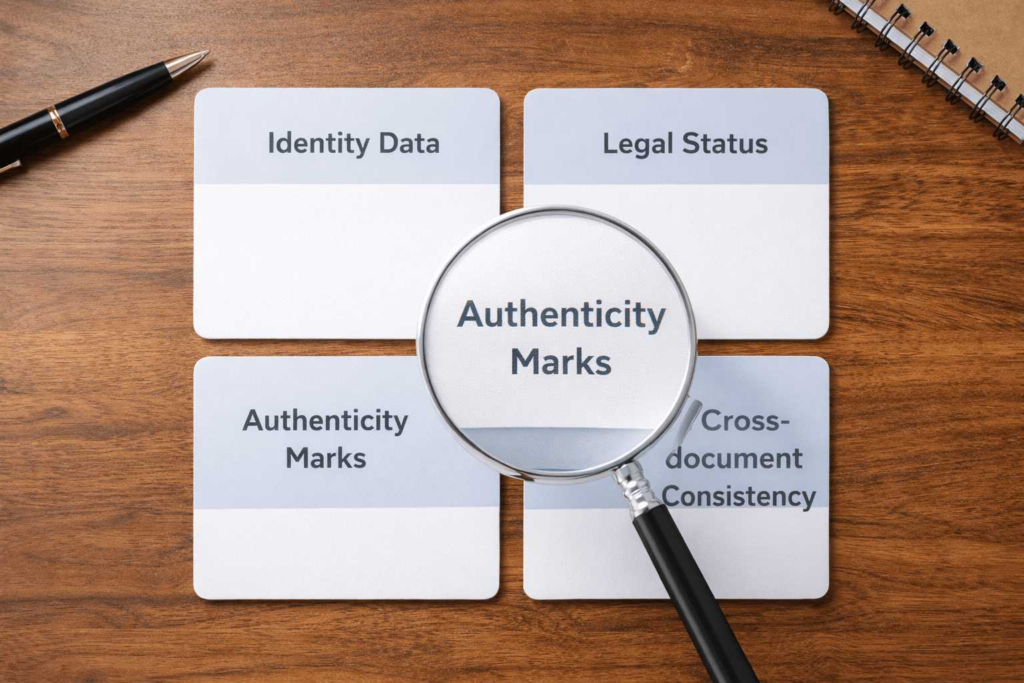
Most translation issues cluster into four risk zones. If you control these, you prevent most delays:
- Identity data: names, dates of birth, places, document numbers
- Legal status: decrees, consents, custody/guardianship language
- Authenticity marks: stamps, seals, signatures, registry references
- Cross-document consistency: same facts repeated across multiple documents
A strong adoption translation process checks all four zones before delivery — not after an officer sends a correction request.
Ready to submit? Here’s the final pre-submission checklist
Before you upload or file your packet, confirm:
- All pages included (front/back; attachments; exhibits)
- Names match passport/ID spelling used for immigration
- Dates and numbers copied exactly (no “normalising” without notes)
- Stamps/seals/handwritten notes are translated or clearly labelled
- The certification statement is signed and dated
- Output is easy to compare against the original (clear formatting)
- Any extra requirements (notarisation/apostille/sworn) are confirmed in writing
If you want a submission-ready set prepared and checked against these points, upload your documents and any authority instructions here: certified translation services.
FAQ Section
Do I need a certified translation for adoption paperwork?
In most international cases, yes. Courts, agencies, and immigration bodies typically require a certified translation for adoption documents so they can be accepted as reliable evidence.
Which adoption documents usually need translation?
Common examples include birth certificates, marriage/divorce documents, police checks, home study reports, medical records, and the child’s legal documents (birth certificate, consents, court orders, adoption decree).
Do adoption translations need notarisation?
Sometimes — but not always. Notarisation is only required when the receiving authority explicitly asks for it. Many authorities accept certified translations without notarisation, while others require an affidavit or notarised certification.
What’s the difference between translating adoption papers and translating immigration documents?
Adoption translations often need additional context handling (multi-country review, legal terminology, and consistency across a large packet). Immigration translations may have strict rules on completeness and certification wording. In practice, adoption cases frequently involve both.
Can we translate adoption papers ourselves?
Some authorities allow it in limited scenarios, but it often creates avoidable risk (formatting issues, missing stamp translations, incomplete certification wording, perceived conflict of interest). A professional process reduces the chance of delays.
How long does a certified translation for adoption take?
Turnaround depends on language, document length, and urgency. Certificates can be fast; home studies and multi-document packets take longer. The safest approach is batching documents per submission milestone.
Are certified translations of adoption documents accepted in the UK?
In many cases, yes — provided the translation is complete, accurate, and accompanied by a proper certification statement. Acceptance depends on the receiving body and the purpose of the document, so if a solicitor, court, agency, or authority has specific wording requirements, those should be followed.
Can I send scans or photos of adoption documents for translation?
Usually, yes. Clear colour scans or high-quality photos are often enough to start the translation process. Every page should be visible, including stamps, handwritten notes, attachments, and the reverse side of certificates where relevant.
Do stamps, seals, and handwritten notes need to be translated?
Yes. In adoption paperwork, stamps, seals, endorsements, and handwritten notes can carry legal or evidential value. They should be translated or clearly labelled in the certified translation.
What should a certified translation for adoption include?
It should include the full translated text, clear labelling of stamps/seals/signatures, and a signed certification statement confirming that the translation is complete and accurate and that the translator is competent in the language pair.
Are PDF-certified translations enough for adoption cases?
Often, they are enough for first-stage review or submission, but some authorities may later ask for posted hard copies, wet-ink signatures, notarisation, or apostille/legalisation. It is best to confirm the final format required before submission.
Can one provider help with certified translation, notarisation, and apostille support?
Some providers can assist with all three or guide you through the sequence. This can be helpful in adoption matters because it reduces the risk of ordering the right translation but the wrong authentication step.