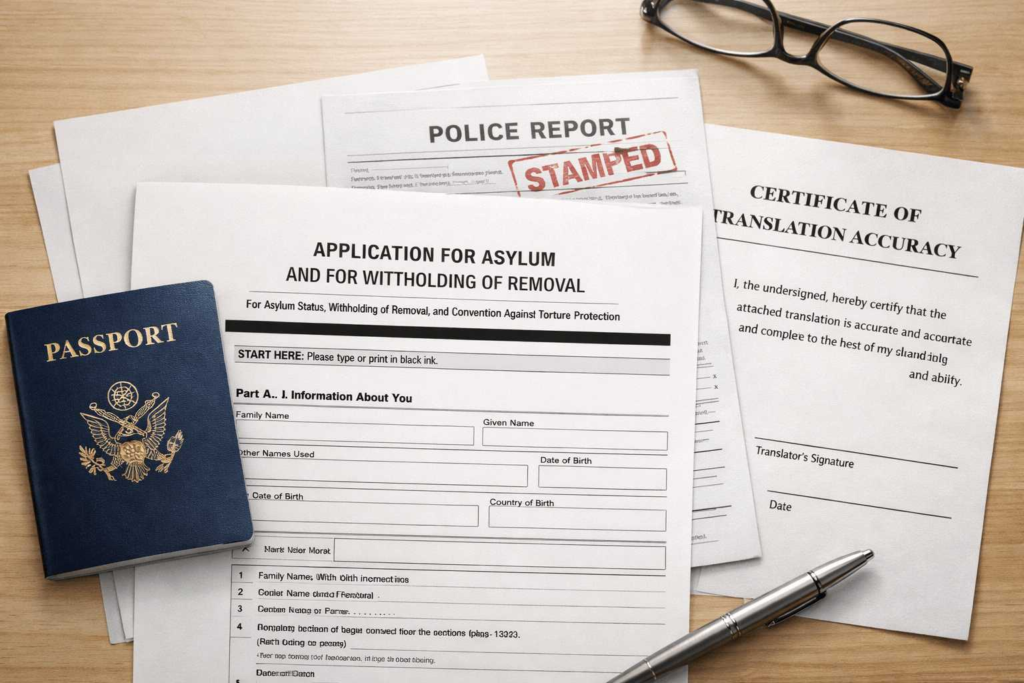
If you’re applying for asylum in the United States, your story matters — and so do your documents. A single missing page, an untranslated stamp, or unclear certification wording can slow your case down at the worst possible time.
This guide explains asylum application translation requirements in plain English, with a practical checklist you can follow whether you’re filing with USCIS or submitting evidence in immigration court.
If you’d like to remove the stress (and the risk), you can upload your documents and request a certified translation quote here — we’ll confirm turnaround and next steps based on your deadline.
Important jurisdiction note
This page is specifically about asylum application translation requirements in the United States. It is written for applicants dealing with USCIS, Form I-589, and U.S. immigration court procedures.
If your asylum case is in another country, including the UK, the translation rules, filing procedures, and decision-makers will be different. In that situation, use guidance written for that country’s asylum system rather than assuming U.S. requirements will apply.
Official rule at a glance
If you want the short version of the official rule, this is the safest way to understand it:
For USCIS filings:
Any document in a foreign language submitted with your asylum case should be accompanied by a full English translation and a signed translator certification confirming that the translation is complete and accurate and that the translator is competent to translate into English.
For immigration court filings:
Foreign-language documents offered in proceedings should be accompanied by an English translation and a typed, signed certification from the translator. In court filings, the certification should be attached to the foreign-language document and should include the translator’s contact details.
Practical takeaway: if your asylum evidence is not in English, do not rely on partial notes, informal summaries, or “explaining it later.” Use a complete English translation with proper certification from the start.
What the translation requirement means in asylum cases
In U.S. asylum filings, the rule is straightforward:
Any supporting document that isn’t in English should be submitted with a complete English translation and a signed translator certification.
That applies to:
- Documents you include with Form I-589
- Evidence you bring or submit for an asylum interview
- Evidence you file in immigration court (defensive asylum) or on appeal
Certified translation in asylum cases does not mean “government-certified”
In the U.S., “certified translation” usually means the translation includes a signed statement confirming:
- the translator is competent in both languages, and
- the translation is complete and accurate.
You do not typically need:
- a notarised translation (unless a specific authority asks), or
- an “official” translator licence (USCIS generally focuses on the certification statement and accuracy).
If you want submission-ready formatting and correct certification language included automatically, see our certified translation services.
Why “full English translation” matters
One of the most common mistakes in asylum evidence is assuming that only the “main text” needs to be translated.
In practice, officers, asylum staff, and immigration judges need to understand the document as a whole. That means the translation should reflect the full content of the document, not just the parts you think are important. If a stamp, handwritten note, date, or annotation appears on the page and could affect how the document is interpreted, it should appear in the translation too.
This is especially important in asylum cases, where credibility, chronology, and consistency matter. Small untranslated details can create unnecessary follow-up questions or make it harder for the decision-maker to evaluate the evidence quickly.
USCIS vs immigration court: what changes for translations
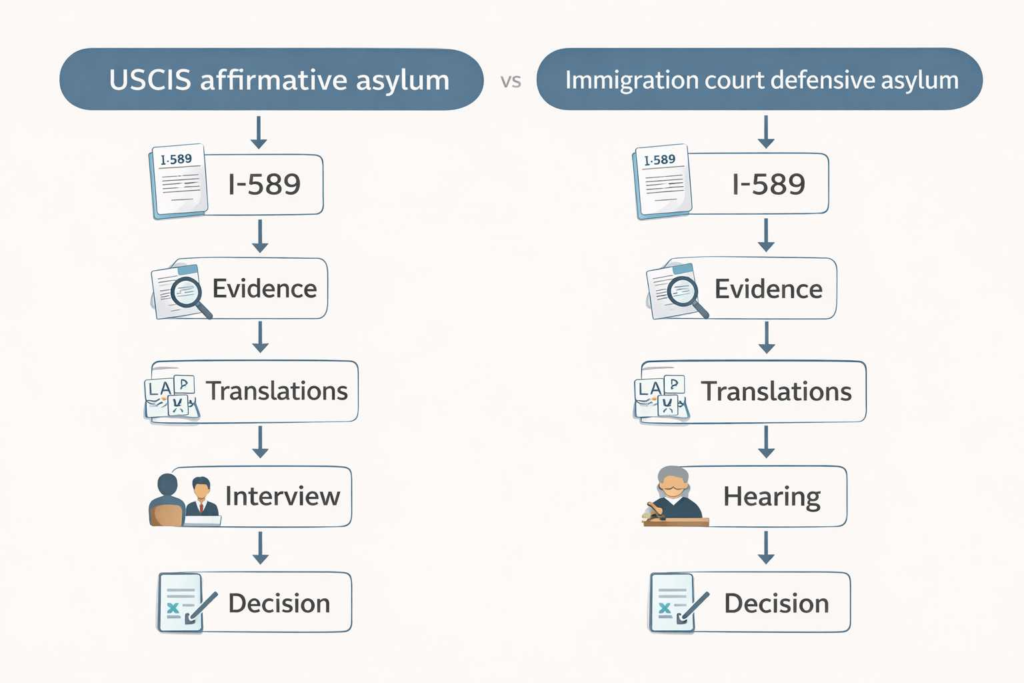
Most applicants fall into one of two tracks:
Filing with USCIS (affirmative asylum)
You submit Form I-589 and your supporting evidence to USCIS, then attend an asylum interview. Translations must be clear and properly certified.
Filing in immigration court (defensive asylum)
If you’re in removal proceedings, your case is handled in immigration court. Translations still need certification — and courts often expect clean exhibit organisation and consistent formatting, because your evidence becomes part of a formal record.
Practical takeaway: The translation standard is similar, but court submissions are less forgiving of messy presentation.
What the immigration court usually expects beyond the translation itself
If your asylum case is in immigration court, translation quality is only one part of the picture. The way your evidence is presented also matters.
A cleaner, court-ready evidence set usually includes:
- A clear cover page
- Proposed exhibits organised in order
- A table of contents with page numbers
- Consecutive pagination across the evidence package
- Legible copies that are easy to scan and review
- Proof of service where required
This matters because immigration court evidence becomes part of a formal record. Even when the translation itself is accurate, poor organisation can make the filing harder to follow and easier to challenge on practical grounds.
What must be translated for an asylum application?
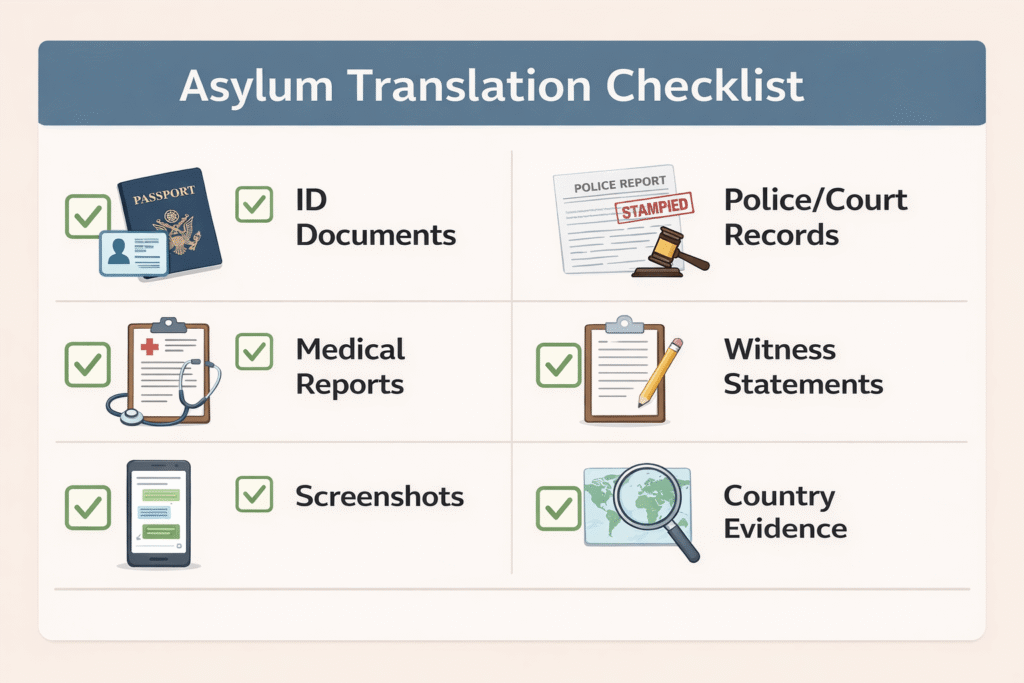
Here’s a practical asylum translation checklist of common documents. If it supports identity, timeline, harm, or credibility — assume it needs English.
Identity and civil status documents
These help prove who you are and who your family members are:
- Passport pages and national ID cards
- Birth certificates
- Marriage certificates, divorce decrees
- Household registration documents (where relevant)
- Name-change documents
Police, court, and government records
These can be crucial for proving threats, targeting, or prior reporting:
- Police reports and complaint filings
- Arrest records, charge sheets, court judgments
- Summons, warrants, detention documents
- Military service records (if relevant)
Medical and psychological evidence
Often used to support harm or trauma:
- Hospital/clinic reports
- Psychiatric or psychological evaluations
- Treatment records for injuries
- Forensic medical reports
Employment, education, and affiliation documents
These help prove your background and why you were targeted:
- Employment letters, termination letters
- Union membership, political party documents
- Press cards, NGO affiliation letters
- Diplomas, student records (when relevant)
Witness statements and declarations
If your statement (or a witness’s statement) is written in a non-English language, translate it fully — including headings, signatures, and dates.
Digital evidence and screenshots
If you submit screenshots of messages, posts, threats, or online articles:
- Translate visible text
- Label the source clearly (platform, date, username, where visible)
- Keep formatting tidy so it’s easy to compare with the original
Country-condition evidence in other languages
Many country reports are already in English. But if you rely on local-language articles or reports, translate the relevant parts (and avoid selective “summary translations” unless your legal representative specifically advises it).
Additional document types people often forget to translate
Some of the most important asylum evidence is easy to overlook because it does not look like a traditional “official document.”
Make sure you also review:
- Envelopes showing sender, recipient, postmarks, or official delivery markings
- Email printouts with headers, dates, and sender details
- Social media posts, comments, and profile names where relevant
- Text-message threads with dates and times
- Photos of notices, posters, or graffiti if the wording matters
- Audio or video evidence that may need a written English transcript or translation
- Attachments bundled with police complaints, court filings, or hospital records
If the content helps prove identity, events, threats, reporting, injury, or credibility, it should be reviewed for translation rather than left unexplained.
What “complete translation” really means
A complete translation includes everything the officer or judge can see, not just the main body text.
Make sure your translation covers:
- Stamps, seals, letterheads, and logos (described clearly)
- Handwritten notes, marginalia, annotations (where legible)
- Front and back pages
- Tables, ID numbers, file numbers, case references
- Date formats (kept consistent across documents)
Quick rule: If it appears on the page, it should appear in the translation — either translated or clearly labelled.
Full-page rule for asylum evidence
When in doubt, follow a full-page rule rather than a selective-summary approach.
That means:
- Translate both sides if both sides contain content
- Translate page headers and footers if they identify the source or case number
- Include stamps even if they are brief or repetitive
- Mark unclear handwriting as illegible rather than guessing
- Preserve names, dates, and document numbers consistently from page to page
This approach reduces the risk of a document looking incomplete or selectively presented.
Translator certification wording you should include
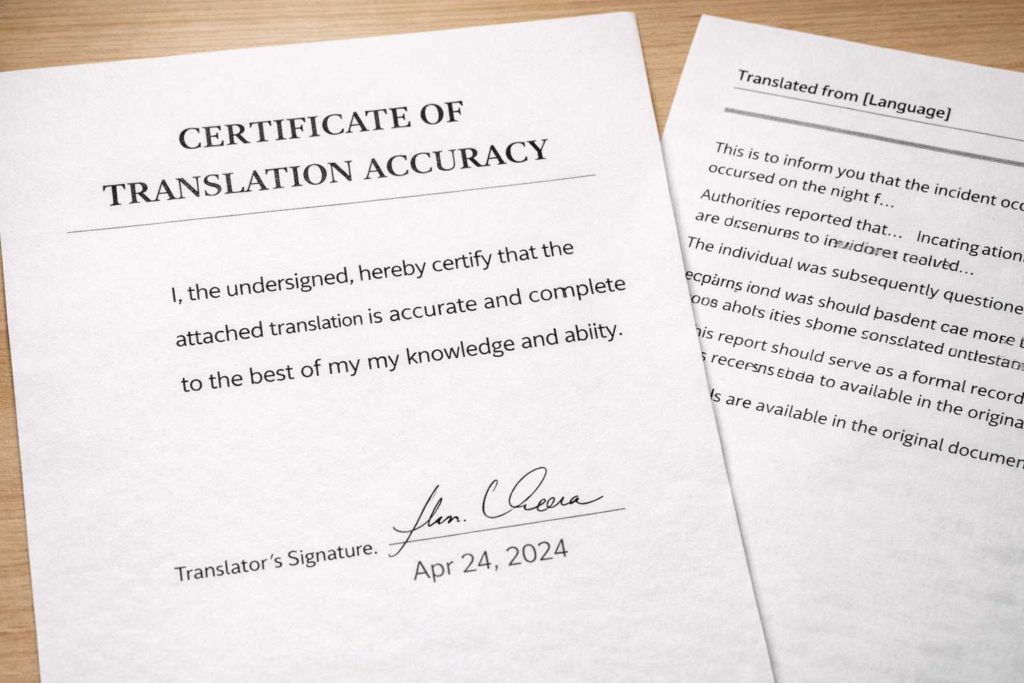
A strong certification statement prevents avoidable delays.
Simple certification template for asylum document translations
Use wording like this (your translator should sign and date it):
Certificate of Translation Accuracy
I, [Translator Name], certify that I am competent to translate from [Language] into English and that the translation is complete and accurate to the best of my ability.
Signature: ___________ Date: ___________
Name: ___________
Contact details: ___________
For immigration court submissions
Immigration court filings commonly expect the translator’s certification to be typed, signed, and attached to the foreign-language document, with translator contact details included.
If you want the certification handled correctly every time (including clean formatting for exhibits), use our certified translation services.
What a court-ready translator certification should also include
For asylum matters in immigration court, the safest practice is to make the certification more specific and more usable, not less.
A stronger court-ready certification usually includes:
- The full title of the source document
- The source language and target language
- The translator’s full name
- A typed certification statement
- The translator’s signature
- The date
- The translator’s address
- The translator’s telephone number
If one certification is being used for more than one translated document, it should clearly identify which documents it covers. In practice, that means avoiding vague wording like “the attached documents” if the package contains multiple items. Spell out the document names so there is no confusion.
If a declaration is in English, but the signer is not fluent in English
This is a point many asylum applicants and even some preparers miss.
If a declaration or affidavit is written in English, but the person signing it does not understand English, the issue is no longer just document translation. In that situation, the filing may also need a certificate of interpretation confirming that the contents were read or interpreted to the signer in a language they understand before they signed it.
Practical takeaway:
- A translated foreign-language statement needs a translator’s certification
- An English-language declaration signed by a non-English speaker may need a certificate of interpretation
- Do not treat those as the same thing
This matters most in immigration court, where declarations and witness statements may be scrutinised closely.
Step-by-step asylum document translation guide
This is the safest workflow for building a “submission-ready” evidence set.
1) Build a document list before you translate
Start with a simple inventory:
- Document name
- Issuing authority
- Date issued
- Language
- Why it matters (identity, timeline, harm, credibility)
This prevents last-minute panic when you realise something important is still not translated.
2) Scan clearly and keep documents in order
- Use high-resolution scans or clear phone photos
- Keep multi-page documents together
- Don’t crop stamps or edges
- Include front/back where applicable
3) Decide how you want names and places written in English
This is where many asylum packages break down.
Before translation begins:
- Confirm spelling exactly as it appears on your passport (or preferred identity document)
- Keep one standard for place names and dates
- Make sure family-member names match across documents
4) Translate, certify, and format for easy comparison
A good asylum translation package is:
- Easy to compare line-by-line
- Clearly labelled with document titles
- Delivered with the signed certification statement
- Organised in a way that matches your exhibit list
5) Do a final “risk check” before you submit
Use this mini checklist:
- All pages included
- All stamps/seals shown and labelled
- Names match across all documents
- Dates consistent in one format
- Certification statement signed and dated
- Translation attached to the correct source document
- Files named clearly (Exhibit A, Exhibit B, etc.)
Simple exhibit-format example for defensive asylum
If your case is in immigration court, a practical evidence structure might look like this:
- Cover page
- Table of contents
- Exhibit A: Passport and ID documents
- Exhibit B: Birth or family-status documents
- Exhibit C: Police complaint and related records
- Exhibit D: Medical evidence
- Exhibit E: Witness statement
- Exhibit F: Screenshots and digital evidence
- Proof of service
Within each exhibit, keep the source document and the English translation together so they can be compared easily. That makes the package easier for the court to review and reduces confusion about which certification belongs to which document.
Common mistakes that delay asylum cases
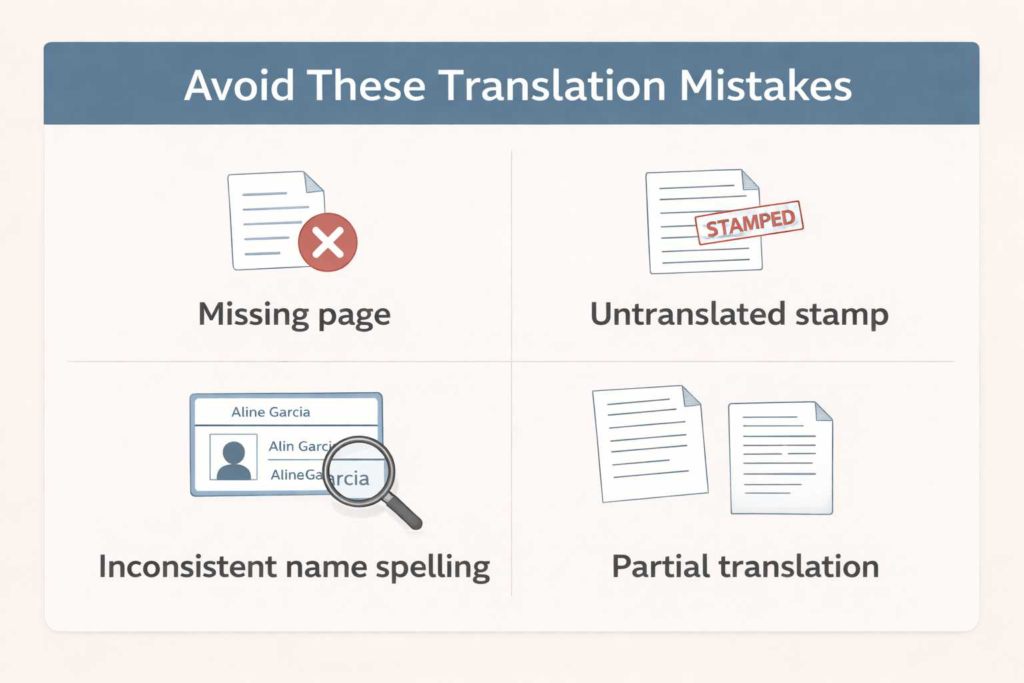
These are the issues that most often cause follow-ups, confusion, or evidence being given less weight.
Missing pages and missing backs
A one-page translation of a two-sided document is a common red flag.
Translating only “important parts”
Unless your representative specifically tells you otherwise, avoid partial translations. “Summary translations” can raise credibility questions.
Ignoring stamps, seals, and handwritten notes
Officers and judges look at stamps and annotations. If they’re present but not translated, it creates doubt.
Inconsistent spelling of names and places
Even small differences can cause administrative delays — especially with identity documents.
Using unclear or incomplete certification wording
Your certification should clearly state competence and accuracy, and it should be signed.
Special situations asylum applicants run into
Handwritten documents
If handwriting is not fully legible, a professional translator will:
- translate what is legible, and
- clearly mark unclear sections as illegible rather than guessing.
Dialects and uncommon languages
If your language has multiple written standards or dialects, ensure the translator states the correct language (and script) in the certification.
Screenshots and chat messages
Label what the judge/officer is seeing:
- “Screenshot of WhatsApp chat”
- “Facebook post”
- “SMS message thread”
Include dates/times if visible.
Interviews and interpreters
Document translation is separate from interpretation at your interview or hearings. If you’re not comfortable proceeding in English, plan interpretation early and ensure the interpreter is qualified, neutral, and prepared.
A short case-style example
Example scenario (details anonymised):
An applicant submitted a police complaint and hospital report in the original language with partial translations. The officer requested a complete translation because the stamps and handwritten notes could not be evaluated. After resubmitting with full translations and proper certification, the evidence was easier to verify, and the case moved forward without additional document-related delays.
Takeaway: Full translation + clear certification reduces unnecessary back-and-forth.
Frequently asked questions
What are the asylum application translation requirements for Form I-589?
In practice, supporting documents not in English should be provided with a complete English translation and a signed translator certification stating competence and accuracy.
What documents need translation for asylum?
Common items include passports/IDs, birth and marriage certificates, police reports, court records, medical records, witness statements, and screenshots or articles used as evidence — if they are not in English.
Do asylum translations need to be notarised?
Not usually. Most asylum submissions rely on a certified translation (with a signed certificate of accuracy). Notarisation is typically only needed if a specific authority requests it.
Can I translate my own documents for an asylum case?
It’s risky. Self-translations often create avoidable issues with certification wording, completeness, and consistency. A qualified translator helps reduce errors that can slow things down.
What is an asylum translation checklist I can follow?
Use the checklist sections in this guide: translate identity/civil documents, police/court records, medical evidence, statements, and digital evidence — including stamps, seals, and notes — and attach signed certification to each translation set.
How fast can certified translations be done for an asylum deadline?
Timing depends on language, length, and document complexity. If you have a deadline, the safest move is to send scans early and confirm turnaround before final submission. You can request a quote here.
What is the official USCIS translation rule for asylum documents?
For USCIS filings, foreign-language documents should be submitted with a full English translation and a translator certification confirming that the translation is complete and accurate and that the translator is competent to translate into English.
What is the official immigration court translation rule for asylum evidence?
For the immigration court, foreign-language documents should be accompanied by an English translation and a typed, signed certification from the translator. A court-ready certification should be attached to the foreign-language document and include the translator’s contact details.
Can one certification cover more than one asylum document?
It can, but only if the certification clearly identifies the documents it covers. If you are filing multiple exhibits, the safer approach is to make the certification specific so there is no ambiguity.
Do I need to translate every stamp, seal, and handwritten note?
As a practical rule, yes. If it appears on the document and could affect meaning, authenticity, timing, or context, it should appear in the translation or be clearly labelled.
What if my declaration is written in English, but I do not understand English?
That may require more than a normal document translation. If the signer does not understand English, the filing may need a certificate of interpretation confirming that the contents were read or interpreted to the signer in a language they understand before signing.
Can a family member or friend translate my asylum documents?
The official rule focuses on competence and certification, but for asylum cases, it is usually safer to use an independent professional translator. That helps reduce disputes about accuracy, completeness, or bias, especially for key evidence.
Do screenshots, chat messages, and social media evidence need translation?
Yes — if you are relying on them as evidence. Translate the visible text, preserve dates and usernames where visible, and label the source clearly so the original and translation can be compared.
Do I need the translator’s address and phone number on the certificate?
For immigration court filings, including the translator’s address and telephone number is the safer practice and often expected as part of a proper court-ready certification.