If you’re applying for a visa, green card, citizenship, or family sponsorship, divorce documents often become a “make-or-break” item—especially if any part of your paperwork isn’t in the destination country’s official language.
Immigration caseworkers don’t have time to interpret foreign legal wording, stamps, handwritten notes, or court formatting. That’s why you usually need a complete, accurate, submission-ready translation of your divorce papers—done in a way that lets an officer quickly match the translation to the original.
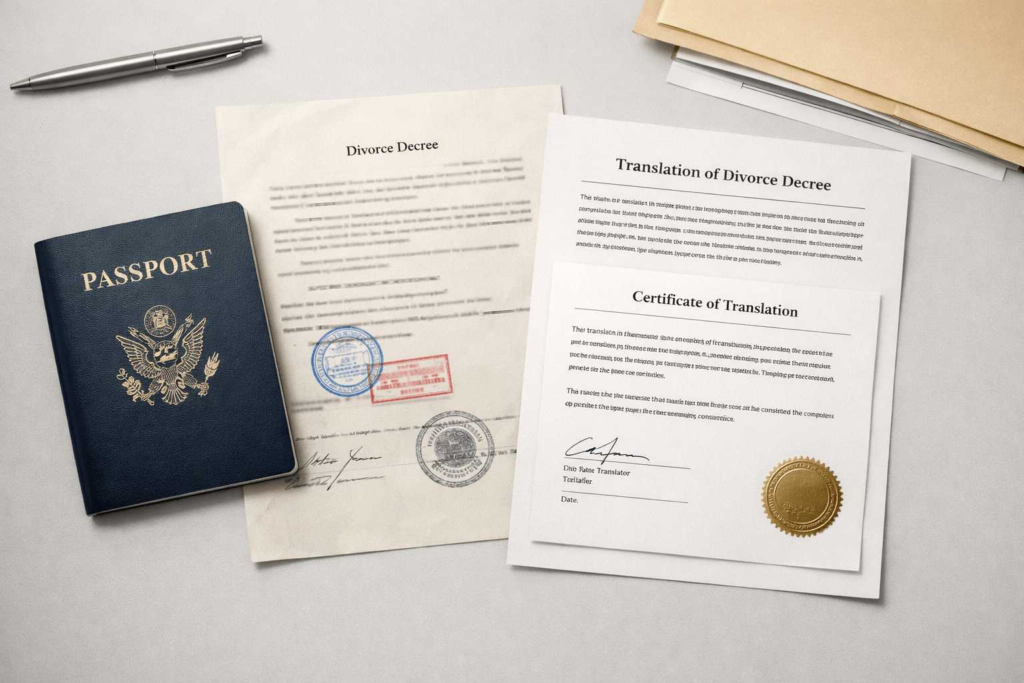
If you want the fastest route with the least risk, start here: get a certified translation that includes a signed translator’s certificate, keeps the formatting easy to compare, and covers every mark on the page (including stamps and annotations).
Ready to move? You can start with our Certified Translation Services or contact us to upload your file for a quote.
How to get divorce papers translated for UK immigration purposes
If your divorce papers are not in English or Welsh, the safest route for UK immigration is to submit the original-language document together with a full English translation prepared by a professional translator or translation company. For UK immigration use, the translation should be complete, easy to compare against the original, and suitable for independent verification.
In practice, that means your divorce paper translation should include:
- a full translation of the relevant document pages
- the translator’s confirmation that the translation is accurate
- the date of translation
- the translator’s full name and signature
- the translator or translation company’s contact details
If you are applying under a UK immigration route with stricter document-packaging requirements, it is also sensible to make sure the translation is fully certified, and that the translator’s or company credentials are available if requested. This is one reason applicants often choose a certified translation service rather than a plain translation.
To avoid delays, send a clear scan of the full divorce document set, mention that the translation is for UK immigration or Home Office / UKVI submission, and ask for all stamps, seals, handwritten notes, and case references to be covered in the final translation package.
What counts as “divorce papers” for immigration?
“Divorce papers” is a catch-all phrase. Immigration authorities may accept different documents depending on where you divorced and what the divorce produced (e.g., custody orders, name changes, financial orders).
Common divorce documents that may need translation:
- Divorce decree / final judgment
- Divorce certificate (some countries issue a separate certificate)
- Decree Absolute / Final Order (UK terminology)
- Court decision dissolving the marriage
- Settlement agreements filed with the court
- Custody and parenting orders
- Maintenance/alimony orders
- Property division orders
- Name change orders connected to the divorce
If your file is multi-page, don’t assume “only page 1 matters”. Immigration reviewers often look for court references, finality wording, dates, and the judge’s confirmation—sometimes located at the end or on attached pages.
When do you need to translate divorce papers for immigration?
You’ll typically need divorce translations when you must prove one (or both) of the following:
- A prior marriage ended legally
- You’re eligible to marry or sponsor someone now
Examples where divorce decree translation for immigration is commonly required:
- Marriage-based immigration petitions (previous marriages must be documented)
- Fiancé(e) visa applications (proof you’re free to marry)
- Spousal sponsorship (US, UK, Canada, EU routes)
- Family reunion and dependent visas
- Citizenship/naturalisation applications where marital history is reviewed
- Immigration interviews where an officer requests confirmation of prior divorce(s)
- “Request for Evidence” situations (tight deadlines—urgent translations matter)
The most common reasons divorce translations get rejected or questioned
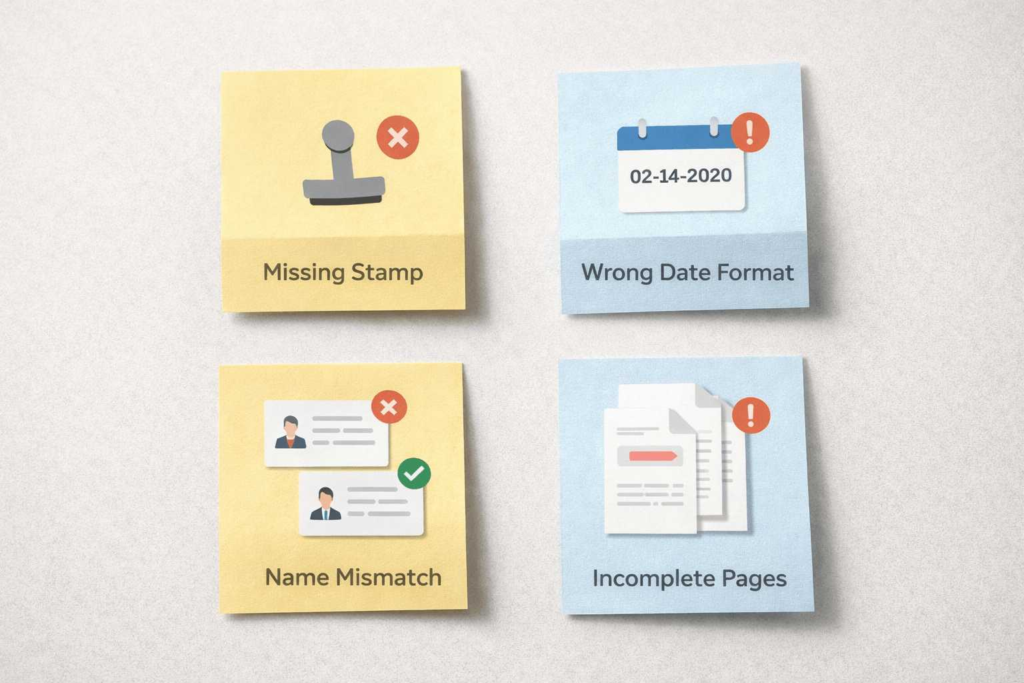
A lot of immigration delays come from preventable issues. These are the repeat offenders:
1) Missing pages, stamps, or “back page” content
Court documents often include reverse-side stamps, filing notes, marginal annotations, or multi-page references. If the translation doesn’t account for them, it can look incomplete.
2) The translation isn’t clearly “complete.”
Immigration officers want confidence that nothing was omitted—especially in legal papers.
3) Names don’t match the rest of the application
Your divorce document may use:
- maiden names
- different spelling/diacritics
- transliteration variants (e.g., Arabic, Cyrillic, Chinese)
A good immigration divorce document translation checks consistency and flags potential mismatches early.
4) Legal terminology is softened, summarised, or “explained.”
Divorce papers are not the place for paraphrasing. Immigration reviewers expect a faithful translation—especially for findings, orders, and finality language.
5) The certification statement is missing or weak
Many authorities expect a formal statement that the translator is competent and that the translation is accurate/complete (and often signed and dated).
Certified, notarised, sworn: what do you actually need?
These terms are often confused, and the wrong choice can waste time.
Certified translation
A translation delivered with a signed certificate from the translator or translation company confirming:
- competence in both languages
- the translation is complete and accurate
This is the most common requirement for immigration submissions.
Notarised translation
A notary confirms the identity of the signer of a statement (often the translator). This is not always required for immigration. Only do it if your immigration authority, lawyer, or case instructions explicitly request notarisation.
Sworn translation
In some countries, “sworn translators” are officially authorised. If your destination country requires sworn translations, you’ll need that specific format.
Apostille
An apostille authenticates a document/signature for international use in certain contexts. It’s usually related to the original document or notarisation—not the translation itself—unless your process specifically calls for it.
If you’re unsure which version you need, the safest approach is to order a standard certified translation first—then add notarisation or other steps only if the receiving authority requires it.
To start the right way, use our Certified Translation Services and include the destination country/authority when you upload.
What UK immigration usually expects in the translation package
If you’re translating divorce papers for a UK visa, spouse application, settlement application, or another Home Office process, your submission is stronger when the package includes:
- the original-language divorce document
- a full English translation of every page that matters
- a signed translator’s certification
- the date of translation
- the translator or translation company’s contact details
- a format that lets the caseworker compare the translation to the original quickly
If your divorce papers contain stamps, seals, registry marks, handwritten amendments, margin notes, or a finality statement on a later page, those details should be translated too. This is one of the most common reasons applicants end up being asked for replacement documents or additional evidence.
For UK immigration purposes, it is also sensible to keep the package simple and verifiable: one clean source document, one clean translation, and one clear certification statement. The easier it is for a caseworker to compare the English translation to the original, the lower the risk of confusion or delay.
How to translate divorce papers for immigration (step-by-step)
Step 1: Confirm which immigration authority you’re submitting to
Before ordering, identify:
- destination country
- immigration route (e.g., spouse visa, adjustment of status, sponsorship)
- any portal rules (upload format, single PDF requirements)
Even when requirements are similar, the “extras” differ by country.
Step 2: Gather the full divorce document set (not just the decree page)
Collect:
- every page
- any attached orders
- certified copies if required for your route
- translations of stamps, seals, handwritten notes (if legible)
If your divorce was processed in stages (interim decision, then final order), include the final order confirming the divorce is effective.
Step 3: Scan it properly so it’s readable (this matters more than people think)
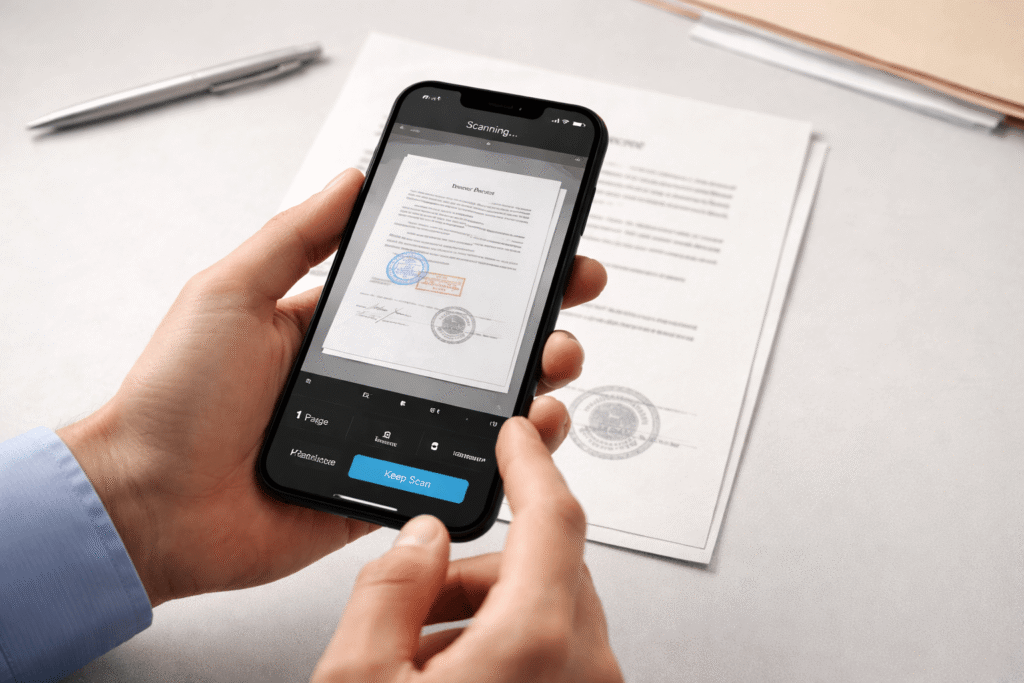
Use a phone scan app or a flatbed scanner. Aim for:
- all four corners visible
- no blur on stamps and dates
- colour scan if stamps are faint
- one PDF per document, where possible
If anything is unclear, it’s better to rescan first than to pay for a translation that will be questioned later.
Step 4: Choose an immigration-aware translation provider
A provider experienced in divorce decree translation for USCIS / UKVI / IRCC-style submissions should:
- keep formatting easy to compare
- translate stamps and seals as labelled notes
- include a proper certification statement
- run a quality check on names/dates/document numbers
You can start in minutes via our contact page upload form or review what’s included in our Certified Translation Services.
Step 5: Review a “risk check” before final delivery
Before you submit to immigration, confirm:
- names match your passport and application spelling
- dates are consistent (especially day/month swaps)
- the finality language is present (e.g., “final judgment”, “decree absolute”, “this divorce is effective on…”)
- all stamps and signatures are accounted for
- the translator’s certificate is signed and dated
Step 6: Submit the translation with the original
For most immigration submissions, you provide:
- a copy of the original divorce paper(s)
- the English (or required language) translation
- the certification statement
Can you order a divorce paper translation from a scan or photo?
Yes—most applicants start with a scan or clear photo of the original divorce papers. What matters is readability. If the court stamp, filing mark, signature, handwritten amendment, or effective date cannot be read clearly, the translation may be challenged or delayed.
For best results, upload:
- every page in the document set
- any back pages that contain registry marks or endorsements
- colour scans where stamps or seals are faint
- close-up images as well, if a section is hard to read
A good scan speeds up quoting, reduces follow-up questions, and lowers the chance that the final translation will need to be redone because a key court detail was not legible in the original upload.
How much does it cost and how long does it take?
Cost usually depends on:
- the language pair
- the number of pages
- whether the document includes handwriting, court stamps, or poor scans
- whether you need certification only or additional notarisation
- how quickly you need it returned
Simple one-page divorce certificates are usually faster to process than multi-page court judgments or divorce files with custody, maintenance, or property orders attached. If you have a deadline, the quickest way to get an accurate quote is to upload the full document set and mention:
- the immigration destination
- your deadline
- whether you need digital delivery only or printed hard copies as well
This helps avoid vague estimates and makes it easier to recommend the right turnaround option from the start.
The certification statement immigration officers expect (copy/paste template)
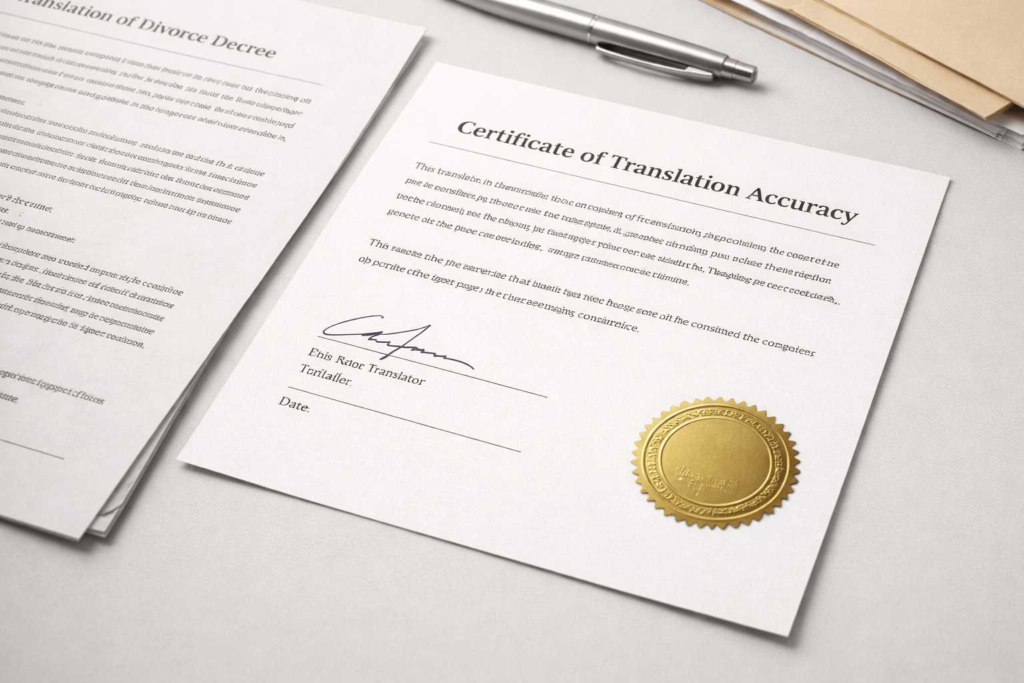
Below is a standard format widely accepted for immigration use. Your provider may format it differently, but the core elements should remain.
Certificate of Translation Accuracy
I, [Translator Full Name], certify that I am competent to translate from [Source Language] into English, and that the attached translation of [Document Name] is a complete and accurate translation of the original document.
Signature: _______________________
Name: [Translator Full Name]
Date: [DD Month YYYY]
Contact details: [Email / Phone]
Address (if required): [Address]
If your destination authority requires additional details (membership number, company stamp, affidavit, etc.), include that requirement when you upload your document.
Country-by-country translation expectations (quick comparison)
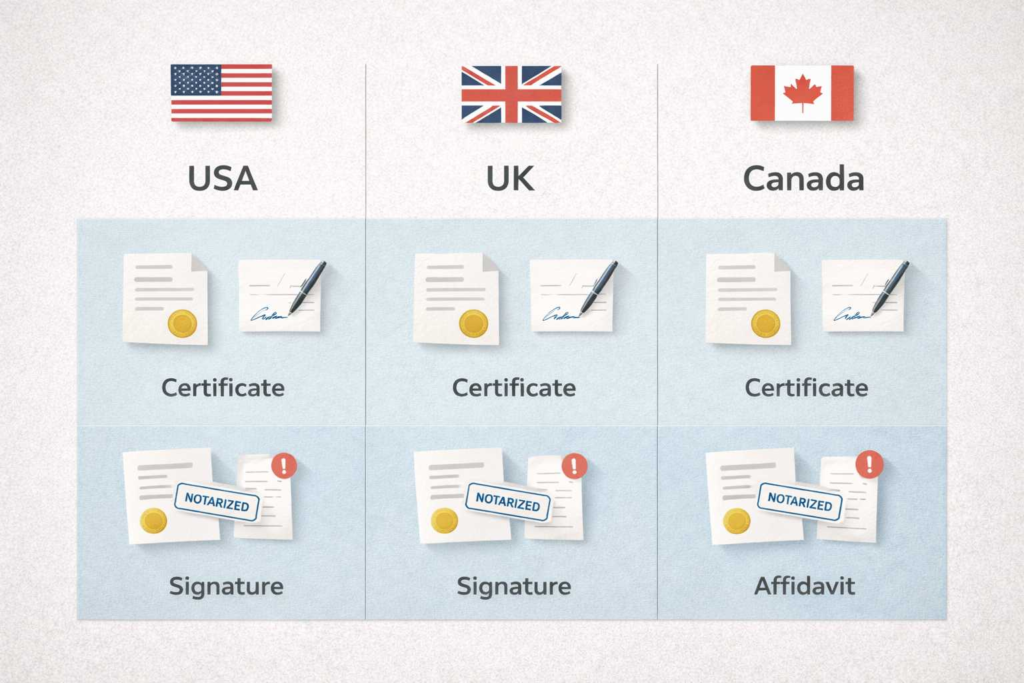
While divorce translation immigration guides often focus on just one country, many applicants are dealing with multi-country processes (e.g., divorce in one country, marriage in another, immigration to a third).
Here’s a practical snapshot of what changes:
| Destination route | Target language | Typical requirement | Extra step sometimes needed |
| United States (USCIS-style filings) | English | Certified translation with signed certificate | Notarisation rarely required unless specifically requested |
| United Kingdom (Home Office/UKVI-style submissions) | English (or Welsh where relevant) | Full translation + translator confirmation + contact details | Independent verification expectations are common |
| Canada (IRCC-style submissions) | English or French | Translation + supporting statement | Affidavit may be required depending on translator status/location |
This is exactly why the “tell us where you’re submitting it” step is so important. The translation itself can be perfect—but the packaging (certificate vs affidavit) is what determines acceptance.
Real-world examples: what a good divorce translation captures
Divorce papers are often “stamp-heavy” and full of procedural language. A submission-ready translation typically includes:
- Case number and court name exactly as shown
- Judge/registrar title and signature lines
- Effective date of the divorce
- Statements of finality (no further appeal, marriage dissolved, etc.)
- Seals, stamps, and filing marks translated as labelled entries (e.g., “[Seal]”, “[Court stamp: Date filed…]”)
- Handwritten notes if legible (or a note stating illegible content where appropriate)
If your divorce includes multiple orders (custody/maintenance), it’s often better to translate the entire set rather than risk an officer deciding your divorce documentation is incomplete.
A “submission-ready” checklist (use this before you upload or file)

You can use this checklist to reduce delays, re-uploads, and avoidable follow-up requests:
- All pages included (front/back if applicable)
- Stamps, seals, and annotations are visible and translated/labelled
- Names match passport spelling (including diacritics choices)
- Dates are consistent (watch day/month swaps)
- Document numbers and case references included
- Finality/effective wording is clearly translated
- Certification statement included, signed, and dated
- Output is easy to compare against the original
If you want us to run this checklist for you, start here: Certified Translation Services (or upload via Contact).
FAQs
Can I translate my own divorce papers for immigration?
Sometimes rules allow it, but it’s risky. Divorce documents contain legal phrasing and formatting that can trigger questions if anything looks incomplete. A professional translation with a proper certificate reduces the chance of delays.
Do I need a divorce decree translation for USCIS specifically?
If you’re submitting divorce documents as part of a USCIS case and they’re not in English, you typically need a complete English translation plus a translator’s certification statement.
Is a notarised translation required for immigration divorce documents?
Often, no. Notarisation is usually only needed when the receiving authority explicitly requests it. Many immigration submissions accept certified translations without notarisation.
What’s the difference between translating a divorce certificate and a divorce decree?
A divorce certificate is often a short confirmation document, while a decree/judgment is the full court order. Immigration may require the final court order if it contains the effective date and finality wording.
How fast can I translate divorce papers for immigration if I have a deadline?
Turnaround depends on length, language pair, and whether stamps/handwriting need extra attention. If you’re facing a short deadline, upload the document and your due date so the correct rush option can be confirmed.
Do you translate stamps, seals, and handwritten notes on divorce papers?
Yes—when they’re visible and legible. Stamps and seals are typically rendered as labelled notes so the officer can match them to the original at a glance.
Do I need to translate every page of my divorce papers for UK immigration?
Yes, if the page forms part of the divorce record or contains a stamp, seal, case number, signature, registry note, or effective-date wording. Leaving out “administrative” pages can create delays if the missing page proves finality, authenticity, or court filing history.
Can I use a friend, family member, or AI tool to translate divorce papers for UK immigration?
That is not the safest option. For immigration use, the translation should be independently verifiable and professionally packaged. A professional certified translation is far less likely to be questioned than a translation done by someone connected to the application or produced without proper human review and certification.
What if my divorce papers are already partly in English?
You should still check whether the English text covers the full document and whether the package is suitable for immigration submission. Some bilingual documents still contain untranslated stamps, handwritten notes, legal endorsements, or registry entries that need to be translated or clearly explained.
Do I need an apostille on the translation for UK immigration?
Usually, no. An apostille is normally relevant to the original document or a notarised signature, not to a standard certified translation. Only add an apostille or notarisation if your solicitor, caseworker guidance, or route-specific document list specifically asks for it.
What should I upload to get an accurate quote for divorce paper translation?
Upload every page of the divorce document, including attachments, stamps, seals, and any back pages. It also helps to mention the destination authority, your deadline, and whether you need digital delivery only or hard copies as well.