
Choosing between online vs in person translation services sounds simple—until you’re dealing with a visa deadline, a legal filing, or a document packed with stamps, handwriting, and tiny print. The truth is: the “right” choice isn’t about where the translator sits. It’s about risk, requirements, and reliability.
This guide helps you choose confidently—whether you’re comparing an online translation vs local translator, wondering should I use an online translation service, or trying to decide if an in person translator vs online is better for your specific document.
Need a fast answer? Upload your file and we’ll tell you exactly what’s required (certified, notarised, sworn, apostille) and the fastest turnaround:
Upload your document for a quote
Quick answer: what are the main differences between online and in-person translation services?
The main differences between online and in-person translation services are speed, convenience, physical handling, access to specialist linguists, and how documents are submitted. Online translation is usually faster, easier, and more cost-effective because you can upload a clear scan, receive a quote quickly, and get a certified PDF by email. In-person translation can be helpful when documents are hard to scan, contain handwriting or faint stamps, or when you need immediate physical collection or face-to-face support. For most standard document translations, online is fully suitable if the provider offers proper certification, quality checks, and secure handling. In-person is mainly useful for more complex physical-document situations, not because it is automatically more accurate or more official.
What is an ATA-certified translator and why does it matter?
An ATA-certified translator is a translator who has passed the American Translators Association certification exam for a specific language pair and direction. In other words, the certification is tied to the languages and translation direction involved, not to “all languages” generally. ATA presents this credential as objective evidence that the translator has the knowledge and skills needed to produce quality translation work.
This matters because many clients, law firms, immigration applicants, universities, and businesses want an independent sign that the translator has been professionally assessed. It can add confidence for high-stakes documents. However, an ATA-certified translator is not the same thing as a certified translation. In the United States, a certified translation is a translation accompanied by a signed statement confirming that it is complete and accurate. ATA explains that a translator does not need to be ATA-certified in order to provide a certified translation.
So, do you need an ATA-certified translator? Sometimes—but not always. Many receiving bodies accept a properly prepared certified translation without specifically requiring ATA certification. For example, ATA notes that USCIS does not require ATA certification, even though some applicants still prefer an ATA-certified translator for extra assurance.
For online vs in-person translation services, this is the key takeaway: the real question is usually not whether the provider is online or local. It is whether the provider can supply the right certification level, in the right format, for the right purpose—and, where relevant, whether they can assign an ATA-certified translator for the required language pair.
First, a quick reality check (so you don’t choose the wrong service)
Translation vs interpreting (people mix these up)
- Translation = written documents (certificates, contracts, transcripts, letters)
- Interpreting = spoken communication (appointments, hearings, interviews)
If you need someone physically in the room to facilitate a conversation, you’re looking for an interpreter. This article is about document translation—online ordering vs visiting a local provider.
If your question is really about spoken appointments, hearings, or meetings
People often ask about “translation services” when they actually mean interpreting. If you need help with live spoken communication, the online vs in-person decision works a little differently:
Online interpreting is often best when:
- you need fast access to an interpreter
- the meeting is short or urgent
- the language is less common locally
- the appointment is already taking place by phone or video
In-person interpreting is often best when:
- body language and room dynamics matter
- multiple speakers are involved
- the setting is sensitive, formal, or high-stakes
- you need the interpreter physically present to manage communication smoothly
For written documents, however, the key question is usually not “online or in person?” but “Is the translation complete, accurate, certified correctly, and submission-ready?”
The 60-second decision: pick online or in-person in three questions
Answer these honestly:
- Do you need wet-ink handling, witnessing, or same-day physical collection?
- Yes → in-person may help
- No → online is usually fine
- Is your document scan/photograph perfectly readable (every stamp, note, and edge)?
- Yes → online is usually ideal
- No → in-person can reduce risk (or you can re-scan properly)
- Are the consequences of rejection high (immigration, court, licensing, regulated sectors)?
- Yes → choose the provider with the strongest verification, QA, and certification process (not the closest address)
- No → choose based on speed and convenience
If you’re still unsure, keep reading—because the details matter.
What “online” and “in-person” really mean for document translation
Online translation services (what you’re actually buying)
With online services, you typically:
- upload a scan/photo
- receive a quote and turnaround time
- get a certified PDF by email (and optional posted hard copies)
Key advantages of online certified translation often include speed, convenience, and access to a wider pool of specialist linguists (especially for rarer languages).
In-person translation services (what’s different)
With in-person services, you might:
- bring originals to a local office
- clarify tricky formatting face-to-face
- scan on-site or verify legibility together
- pick up hard copies quickly
In-person can feel “safer” because it’s tangible—but reliability still depends on process, competence, and accountability.
Online vs in-person certified translation: the direct answer
For certified document translation, online is usually the better option if your document is clear and the provider has a strong certification and quality-control process. In-person does not automatically make a certified translation more official, more accurate, or more likely to be accepted. What matters most is whether the translation is complete, professionally prepared, and accompanied by the correct certification statement for its intended use.
In practice:
Choose online certified translation when:
- your scan or photo is fully readable
- you need speed and email delivery
- you want access to specialist linguists beyond your local area
- you are submitting digitally or can print the certified PDF yourself
Choose in-person support when:
- the original is difficult to scan properly
- the document includes faint seals, folded pages, or unclear handwriting
- you need urgent same-day hard copy collection
- you want help organising a messy document pack before translation begins
For most certificates, IDs, transcripts, letters, and standard official paperwork, online certified translation is usually the most efficient and practical choice.
A clear comparison: online vs in-person (at a glance)
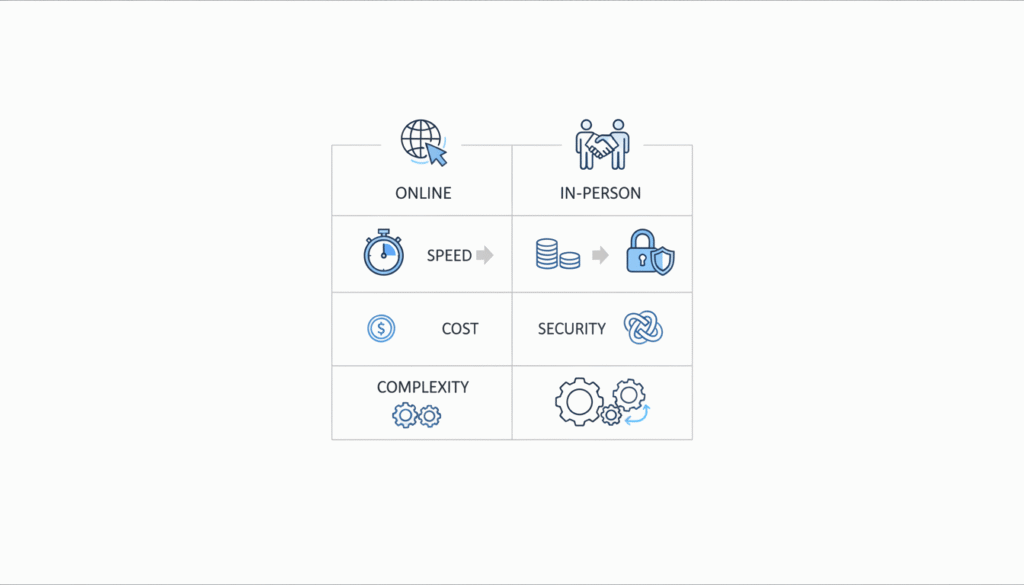
| Factor | Online service | In-person service |
| Speed | Often fastest for certified PDFs | Faster for immediate physical drop-off/pick-up (where offered) |
| Convenience | Highest (no travel) | Lower (travel + scheduling) |
| Language availability | Usually broader | Can be limited locally |
| Security | Depends on provider’s systems | Depends on office processes + handling |
| Document complexity | Works well if scans are clear | Helpful when scans are poor or layout is complex |
| Cost | Often lower overall | Can add travel/time costs |
| Best for | Most official document translations | Edge cases: physical handling, complex packs, urgent hard copy collection |
When online translation is the best choice (most people are here)
Online is usually the smart option if you want:
- fast certified delivery by email
- a simple submission-ready translation for immigration, education, banking, employment, or general official use
- access to specialist translators (rare languages, niche document types)
- transparent turnaround without travel
Best-fit examples
- Birth certificate, marriage certificate, divorce decree
- Academic transcripts, diplomas, enrolment letters
- Bank statements, payslips, tax letters
- ID documents (passport bio page, national ID)
- Routine business documents (letters, policies, standard contracts)
If your scan is clear, online is often the cleanest route—especially under time pressure.
Want the simplest path? Start here:
Certified translation services
When in-person translation is worth it (and why)
In-person can be genuinely useful when:
- your documents are hard to capture correctly (creased, faded, low-contrast stamps)
- the pack is messy (mixed pages, missing backs, handwritten additions)
- you must walk away with a physical copy quickly (where local collection is available)
- you want real-time review of names, spellings, and formatting before the job starts
Best-fit examples
- multi-document bundles for legal or regulatory submissions
- documents with heavy handwriting, marginal notes, or layered stamps
- cases where you need immediate scanning support (or your scan quality is repeatedly rejected)
Important: in-person doesn’t automatically mean higher quality. A strong online provider with excellent QA can beat a weak local office every day of the week.
The 7 factors that should decide your choice (not guesswork)
1) Acceptance requirements: what the receiving body actually wants
Before comparing in person translator vs online, confirm:
- Do they require certified translation only?
- Do they also require notarisation, sworn translation, or an apostille?
- Do they need hard copies, or is PDF accepted?
Many organisations want a translation that is:
- complete (no missing pages or stamps)
- accurate (names, dates, numbers match)
- accompanied by a proper certification statement
If the requirement is unclear, don’t gamble—send the instruction page (or screenshot of the requirement) along with your upload.
Will an online translation be accepted?
In many cases, yes—an online translation can be accepted just as readily as one arranged in person, provided it meets the receiving organisation’s requirements. Acceptance usually depends on the content and certification of the translation, not whether you ordered it online or visited an office.
A receiving body will usually care about whether the translation is:
- complete
- accurate
- properly certified
- clearly linked to the original document
- delivered in the format they require
Some organisations accept certified PDFs without issue. Others may ask for posted hard copies, notarisation, a sworn translation, or an apostille depending on the country, document type, or legal purpose. That is why the safest approach is always to check the exact requirement first, then choose the provider who can meet it correctly.
A useful rule of thumb:
Online ordering is usually fine for official documents. The real risk is not the online format—it is using the wrong certification level or an unreliable provider.
2) Speed: deadline pressure changes everything
Online services typically win for fast digital turnaround, because:
- no travel time
- easier scheduling
- easier delivery (PDF)
In-person can win when:
- you need a physical copy collected quickly
- you need scanning help immediately
3) Quality control: how errors are prevented (and fixed)
The biggest risk in certified translation isn’t big, dramatic mistakes—it’s small details:
- name order and spelling
- dates written in different formats
- document numbers, issuing authorities
- missing notes, seals, or reverse sides
A good provider will explain their QA process clearly and have a realistic revision policy.
4) Security and confidentiality: protect what you’re uploading

Official documents can contain:
- passport/ID numbers
- addresses and bank details
- medical or legal information
For online services, look for:
- secure upload
- clear data handling and retention practices
- professional communication channels (not “send it anywhere and hope”)
For in-person services, look for:
- controlled handling
- clean scanning procedures
- discreet storage and limited access
5) Communication: can you get answers quickly?
This is where many people get stuck deciding should I use online translation service.
Online can be excellent if you can:
- speak to a real person quickly
- clarify names/spellings before translation starts
- get a clear confirmation of turnaround
In-person can help if you prefer face-to-face—but only if the staff actually understand certification requirements and can explain them.
6) Logistics: PDF vs hard copy, and what you truly need

Ask yourself:
- Are you submitting online? (PDF is usually enough)
- Are you mailing originals and want a matching hard copy? (posted certified copies may help)
- Do you need multiple stamped copies?
A strong online service often covers both: PDF delivery + optional posted hard copies.
7) Total cost: don’t compare only the headline price
When people compare online translation vs local translator, they often forget hidden costs:
- travel time and parking
- urgent collection fees
- extra scanning/printing
- courier/postage
- resubmission cost if the translation is rejected
A slightly higher fee can be cheaper overall if it prevents delays and rework.
The “Submission-Ready” test: how to vet any provider (online or local)

Use this checklist before paying anyone:
Green flags (good signs)
- Clear explanation of what “certified translation” includes
- Will translate everything visible (stamps, seals, annotations, handwritten notes where legible)
- Names and spellings are confirmed before final delivery
- Real QA step (not just one pass)
- Clear delivery format (professional PDF, optional hard copy)
- Clear revision policy and response time
Red flags (walk away)
- Vague promises like “accepted everywhere” with no explanation
- Refuses to show what the certification statement includes
- No clear way to contact them beyond a form
- Pricing that seems too good to be true for urgent deadlines
- Doesn’t ask what the translation will be used for (immigration, court, education)
If you want a reliable baseline for how a certified job should be handled, use this reference point:
Certified translation services
Real-world scenarios: what to choose (and why)
Scenario A: Immigration application with multiple certificates
Best choice: online (if scans are clear)
Why: fast, trackable, easy PDF submission; certification wording can be formatted consistently across all documents.
Tip: upload all documents together so names and dates can be checked for consistency.
Scenario B: Court-related document with heavy stamps and handwritten notes
Best choice: depends
- If you can capture clean scans → online works well
- If scans are poor or handwriting is hard to read → in-person may reduce risk
Tip: choose the provider who will clearly label stamps/seals and confirm uncertain text.
Scenario C: University transcript needed fast
Best choice: online
Why: speed + digital delivery; easy formatting for tables and grades.
Tip: confirm whether the university wants hard copy or PDF is acceptable.
Scenario D: Business contract for internal use
Best choice: online
Why: no need for physical handling; faster collaboration; easy version control.
Tip: ask for a consistent glossary for defined terms.
The best-of-both approach: hybrid often wins
You don’t have to treat this as a strict either/or.
A good “hybrid” workflow looks like:
- you upload online (fast + convenient)
- you get a quick human review call/message (clarity + confidence)
- you receive a certified PDF and (if required) posted copies
This is often the safest route for high-stakes submissions because you get speed and clarity.
A simple process that reduces rejection risk
If your goal is a translation you can submit without drama, the process should be straightforward:
- Upload a readable scan/photo
- Confirm purpose + deadline
- Translation + quality check
- Delivery as a professional PDF (and optional hard copy)
Start your project in minutes here:
Upload your document for a quote
Want to see how certified translations are prepared and checked?
How our certified translations work
Final takeaway: the best choice is the most verifiable one
The online vs in-person debate is often framed the wrong way. The real question is:
Which provider can prove they’ll deliver a submission-ready translation—accurately, securely, and on time?
If you want speed, clarity, and a clean certified output, online is usually the best choice. If your document pack is messy, hard to scan, or physically time-sensitive, in-person may be worth it.
Either way, don’t guess. Get the requirement right first—and choose the provider who can explain how they’ll meet it.
Ready to start?
Upload your document for a quote
Frequently Asked Questions
Do online vs in person translation services produce different quality?
Quality depends on the translator’s competence and the provider’s quality checks—not the delivery method. A strong online process often matches or exceeds local quality.
Should I use an online translation service for certified documents?
Yes, if the provider offers a proper certification statement, translates all visible content (including stamps), and delivers a clear, professional PDF suitable for submission.
Is an in person translator vs online better for immigration documents?
Most immigration document translations can be handled online if your scans are readable. In-person may help only when documents are difficult to scan or you need urgent physical handling.
What’s the biggest risk with online translation vs local translator options?
The risk isn’t “online” itself—it’s choosing an unverifiable provider. Always check how certification is handled, what QA exists, and how your documents are protected.
When is in-person translation genuinely necessary?
When you need immediate on-site scanning support, urgent physical collection, or your documents are too unclear to capture properly without help.
What should a certified translation include?
A complete translation plus a signed certification statement confirming accuracy and translator competence, with clear identification of the translator/company and relevant details for verification.
What are the main differences between online and in-person translation services?
Online translation services are usually faster, more convenient, and easier to access across multiple languages because you can upload documents remotely and receive certified PDFs by email. In-person translation services can help when documents are difficult to scan, contain faint stamps or handwriting, or when you need physical collection or face-to-face support.
Is online translation faster than in-person translation?
Usually, yes. Online translation often saves time because there is no travel, no office visit, and delivery can be made by PDF. In-person can be faster only in specific situations, such as urgent local drop-off or same-day hard copy collection.
Are online certified translations accepted for official use?
They often are, as long as the translation is complete, properly certified, and delivered in the format required by the receiving organisation. Acceptance depends on the organisation’s rules, not simply on whether the order was placed online.
Does in-person translation mean better quality?
No. Quality depends on the translator, the provider’s quality-control process, and whether all visible content is translated correctly. A strong online provider can easily outperform a weak in-person provider.
Which is better for passports, birth certificates, diplomas, and similar documents?
For most standard official documents, online certified translation is usually the better option because it is faster, easier, and fully suitable when the scan is clear and the provider certifies the translation correctly.
Do I need in-person translation if my document has stamps, seals, or handwriting?
Not always. If your scan clearly shows the stamps, seals, and handwritten content, online translation can still work very well. In-person becomes more useful when the document is difficult to capture clearly or needs on-site scanning support.
What is an ATA-certified translator?
An ATA-certified translator is a translator who has passed the American Translators Association certification exam in a specific language pair and direction. It is a professional credential tied to particular languages, not a general label for every translation service.
Is an ATA-certified translator the same as a certified translation?
No. A certified translation is a translated document accompanied by a signed statement confirming that it is complete and accurate. ATA explains that a translator does not need to be ATA-certified in order to provide a certified translation in the United States.
Do I need an ATA-certified translator for USCIS or other official documents?
Not always. The key requirement is usually that the translation is complete, accurate, and properly certified for the receiving body. ATA specifically notes that USCIS does not require ATA certification, although some clients still choose an ATA-certified translator for additional reassurance.
Can a non-ATA translator provide a certified translation?
Yes. In the United States, a non-ATA translator may still provide a certified translation if they supply the required signed certification statement and the translation meets the receiving organisation’s rules.
Does ATA certification apply to every language pair?
No. ATA certification is specific to particular language pairs and directions, and ATA also notes that certification is not available for every language combination.