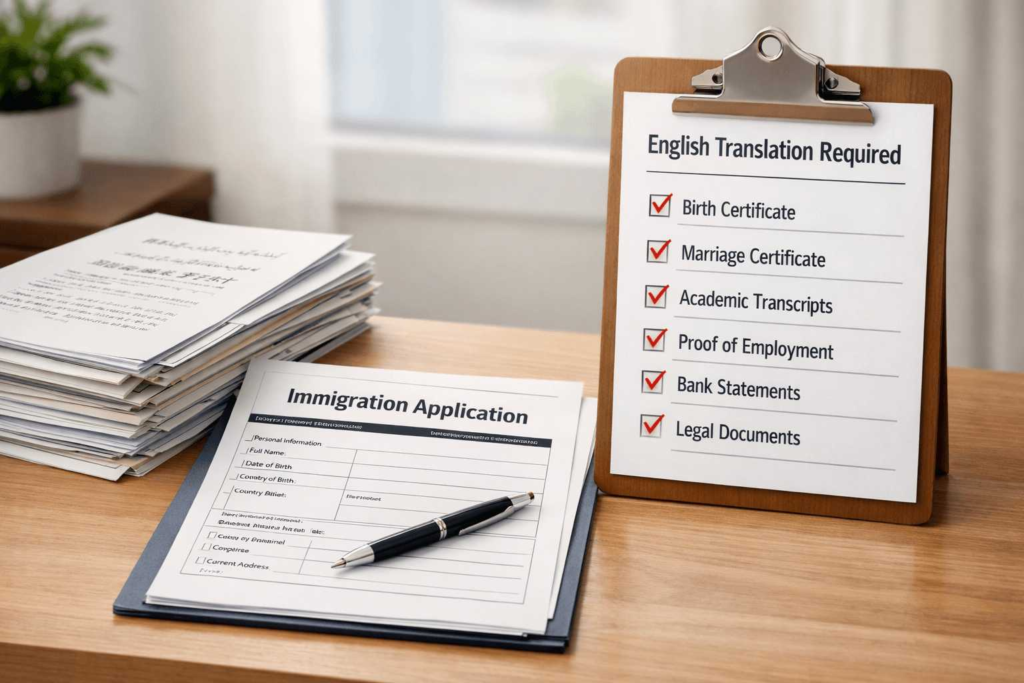
If you’re filing with USCIS and your documents are in any language other than English, you’ll need an English translation that meets USCIS rules. There isn’t a special list of “approved” languages or “common languages that don’t need translating”.
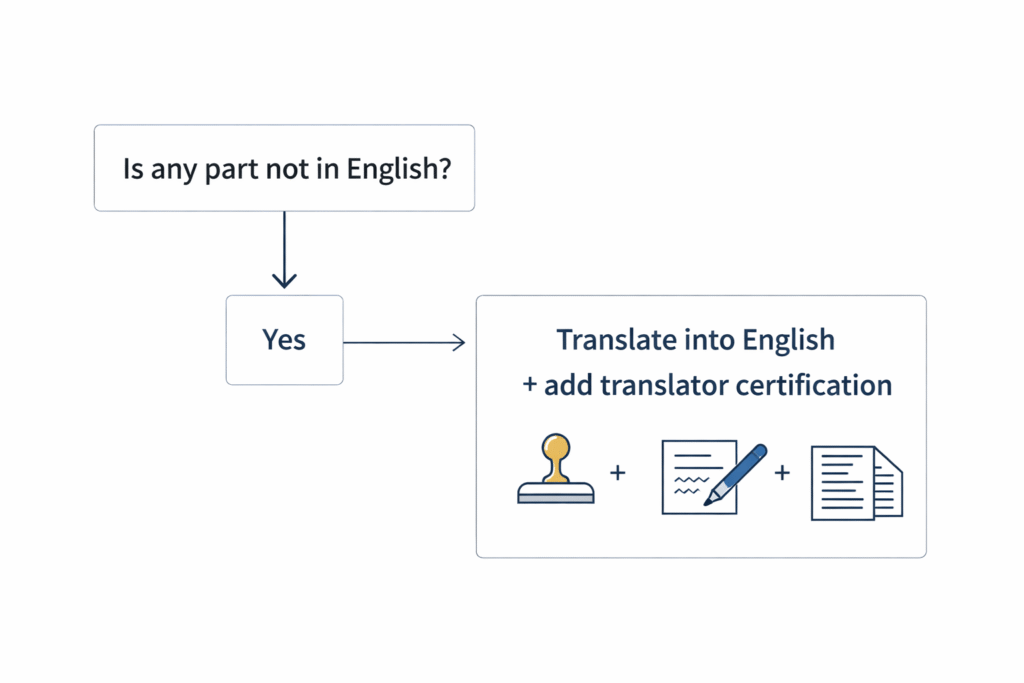
In practice, the question isn’t “Which languages does USCIS require translation for?”
It’s “Is any part of this document not in English?” If the answer is yes, translate it.
If you want a quick confirmation before you submit, you can use our USCIS-ready certified translation services or upload your document here, and we’ll tell you what needs translating.
The official USCIS rule, in one sentence
USCIS’s rule is broader than many people think: if a document you submit contains foreign-language text, it must be accompanied by a full English translation and a translator certification.
That certification should confirm:
- The translation is complete
- The translation is accurate
- The translator is competent to translate into English
This is why the safest question is not “Does USCIS accept this language?”
It is “Does this document contain any non-English text that matters?”
If yes, translate it.
There is no special USCIS list of “approved” or “exempt” languages. The rule is based on whether the document contains foreign-language content, not on how common the language is or whether someone reviewing the case might personally understand it.
The simple rule most people miss
USCIS adjudicators review filings in English. So USCIS expects supporting evidence to be understandable in English, including:
- The main printed text
- Stamps and seals (when readable)
- Handwritten notes (when readable)
- Marginal notes and amendments
- Back pages (where information appears)
- Addenda, attachments, and annotations
That’s why “it’s only a stamp” can still cause a delay if the stamp contains the issuing authority, date, location, or a note that changes the meaning of the document.
So… what languages need translation for USCIS?
All of them—if they’re not English.
That includes (but isn’t limited to):
- Spanish, French, Portuguese
- Arabic, Farsi, Urdu
- Chinese (Simplified/Traditional), Japanese, Korean
- Russian, Ukrainian, Polish
- Hindi, Punjabi, Bengali, Tamil
- Amharic, Somali, Tigrinya
- Any regional dialects or minority languages
Myth check: “USCIS officers speak Spanish, so Spanish doesn’t need translation.”
Even if an officer could understand a language, USCIS still expects submissions to follow the English-translation rule. Treat this as a compliance requirement, not a language-confidence test.
What counts as a “foreign-language document”?
USCIS doesn’t only mean “a fully foreign document”. A document counts if any meaningful part is not in English.
Here’s a practical guide:
| What you have | What to do |
| Entire document in English | No translation needed |
| Entire document in a non-English language | Translate the full document + add a translator certification |
| Bilingual document (English + another language) | Translate any non-English content not fully duplicated in English |
| English document with non-English stamps/notes | Translate stamps/notes if they carry meaning (dates, authority, status, approvals, restrictions) |
| Mixed pages (some English, some not) | Translate every non-English page and include all pages in the final PDF set |
If you’re unsure, the safest approach is to translate everything that is not English, including visible stamps, headings, and side notes.
Does one word, one line, or one stamp still need translation?
Often, yes.
USCIS does not set a “minimum amount” of foreign-language text before translation is required. If a meaningful part of the document is not in English, the safer filing approach is to translate it.
That commonly includes:
- A single sentence at the bottom of a certificate
- A foreign-language stamp showing status, authority, or date
- One handwritten correction or side note
- A short note on the reverse side
- A field label or remark that changes how the document should be understood
A practical test is:
“If an officer could miss something important by not reading this text in English, should it be translated?”
For USCIS filings, the safest answer is usually yes.
Bilingual documents: when English is “present” but not “complete”
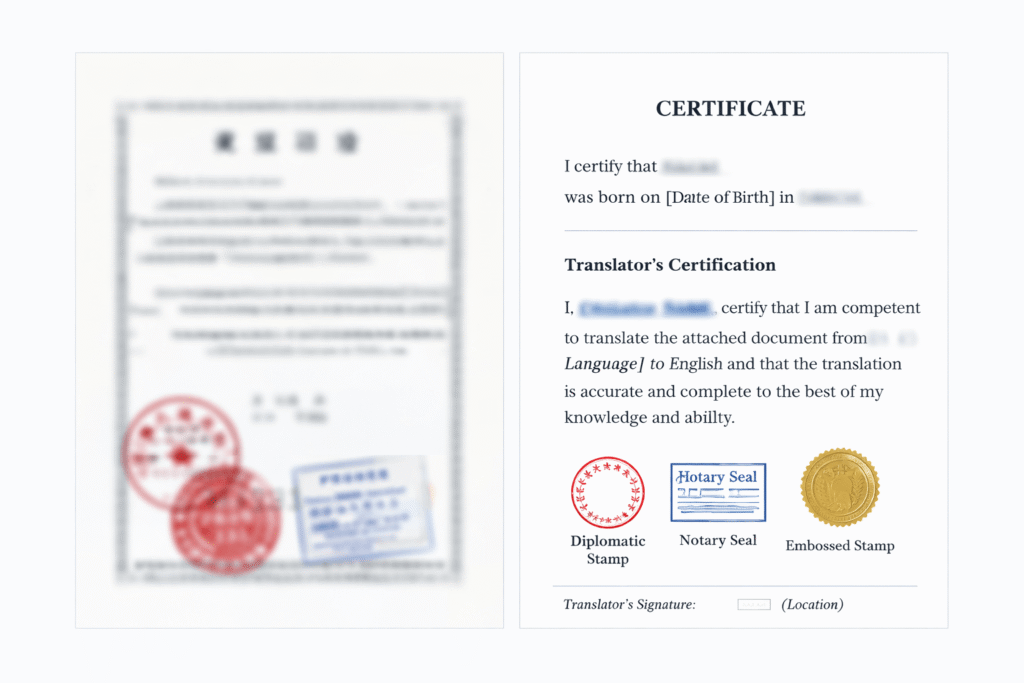
Bilingual certificates and extracts are common (especially civil registry documents). The trap is assuming the English side is “enough”.
English may be incomplete if:
- It summarises rather than mirrors the original
- It omits remarks, annotations, or registry notes
- It doesn’t include stamp content or marginal notes
- It translates headings, but not the filled-in fields
- It uses abbreviations or codes without explanation
Best practice: If the English portion doesn’t reproduce the full meaning, submit a certified translation of the non-English parts (and ideally the full document for clarity and consistency).
Do all USCIS documents need to be translated into English?
Only the documents you submit as evidence need translation when they contain non-English text.
That includes evidence typically filed with applications like:
- Birth certificates, marriage certificates, divorce decrees
- Passports, national IDs, household registries
- Police certificates, court records
- School transcripts, diplomas
- Employment letters, tax documents, bank letters (when used as evidence)
- Medical records (when used as evidence)
If a document is optional and you’re debating whether to submit it, ask yourself:
- Does it strengthen my case?
- Can it be misunderstood without translation?
If the second answer is yes, either translate it properly or leave it out unless your attorney advises otherwise.
What USCIS expects from the translation (and what it does not)
A USCIS-compliant submission is usually made of:
- A copy of the original document (as you received it)
- The English translation
- A signed translator certification statement
Does USCIS require notarisation?
Often, no. USCIS generally looks for a translator certification rather than notarisation.
Does USCIS require a “sworn translator”?
Not typically. The key is that the translation is complete/accurate, and the translator certifies competence.
Does the translation rule change for online filing vs filing by mail?
No. The translation rule is the same either way.
If you file by mail, USCIS expects the foreign-language document to be accompanied by a full English translation and translator certification.
If you file online, USCIS expects you to upload the certified English translation in addition to the original foreign-language document.
So the safest document set stays the same:
- The original document
- The full English translation
- The signed translator certification
Whether you upload your evidence or mail it in, the translation requirement does not go away.
Who can translate for USCIS?
USCIS focuses on competence and certification wording, not membership badges.
That said, there’s a practical reality:
- If the translation is poor, incomplete, or formatted confusingly, USCIS may issue a request for evidence (RFE) or delay the case.
- If the translator appears conflicted (for example, the applicant translating their own evidence), it can create avoidable scrutiny—especially in relationship-based or humanitarian filings.
Best practice: Use an independent translator or a professional service with a clear QA process.
If you’d rather not risk it, use our USCIS-ready certified translation services and keep your filing clean and consistent.
Can you use Google Translate, AI, or ChatGPT for USCIS documents?
Not on their own.
USCIS requires the translator to certify that the English translation is complete and accurate and that the translator is competent to translate into English. A software tool cannot personally make that certification.
That means raw machine translation, by itself, is not the standard USCIS is asking for.
A competent human translator may use software as part of their workflow, but the final USCIS submission should still be reviewed by a human translator who:
- Checks the full document
- Verifies names, dates, numbers, and document terminology
- Confirms the translation is complete and accurate
- Signs of the certification
For high-stakes filings, especially where stamps, handwritten notes, registry remarks, or legal wording matter, relying on unreviewed machine output is an avoidable risk.
The translator certification: what it must cover
USCIS expects the translator’s certification to confirm:
- The translation is complete
- The translation is accurate
- The translator is competent to translate from the source language into English
- The certification is signed (and commonly dated)
A simple certification template you can copy
Translator Certification
I, [Translator Full Name], certify that I am competent to translate from [Language] into English, and that the foregoing is a complete and accurate translation of the document titled [Document Name].
Signature: ____________________
Name: ________________________
Date: ________________________
Contact (optional): ___________
Pro tip: If your document is multi-page, label it clearly (e.g., “Birth Certificate – Page 1 of 2”) and keep the translation easy to match line-by-line or section-by-section.
Transliteration is not the same as translation
This matters a lot for passports, IDs, and civil documents.
Sometimes applicants see a name already written in Latin letters and assume the document no longer needs translation. But transliteration is not the same thing as translation.
For example, a passport may show a romanised version of a name, while other parts of the page still contain foreign-language content that matters, such as:
- Issuing authority text
- Field labels
- Notes or endorsements
- Restrictions
- Stamps or annotations
In short:
A name written in English letters can help with consistency, but it does not replace the translation of the rest of the non-English content on the document.
The “hidden text” USCIS still expects you to translate
Most USCIS translation problems aren’t about the main fields. They’re about what people forget:
- Registry remarks and marginal notes
- Stamps that show “certified copy”, “amended”, “annulled”, or “late registration”
- Handwritten corrections
- Notes on the back page
- Seals with issuing authority names
- Dates written in long form or local calendars
- Abbreviations that change meaning (e.g., status codes)
Rule of thumb: If it appears on the document and carries meaning, translate it (or mark it clearly as illegible if it truly cannot be read).
Common USCIS translation mistakes that cause delays
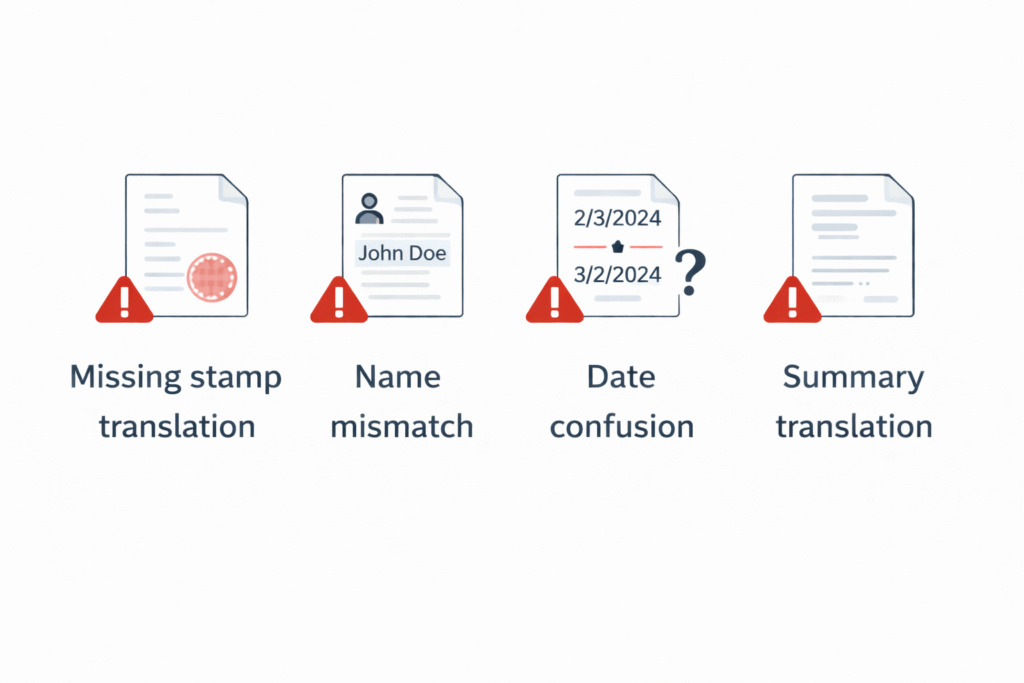
1) Missing stamps, notes, or back pages
A translation that ignores stamps or annotations can look incomplete—even if the main fields were translated perfectly.
2) Names don’t match other evidence
Diacritics, spelling order, and spacing matter. If your passport says “Al-Hassan” and the translation says “Al Hassan”, keep it consistent unless the original document clearly differs.
3) Dates are converted inconsistently
Keep the original date format visible where possible (and add the English interpretation). Consistency across the whole packet helps.
4) “Summary translations”
USCIS expects a translation, not a paraphrase. “This document says the applicant was born on…” is not the same as translating the full content.
5) Formatting that makes verification hard
When an officer can’t quickly compare the translation to the original, it increases the chance of a follow-up request.
A quick self-check before you file (2 minutes)
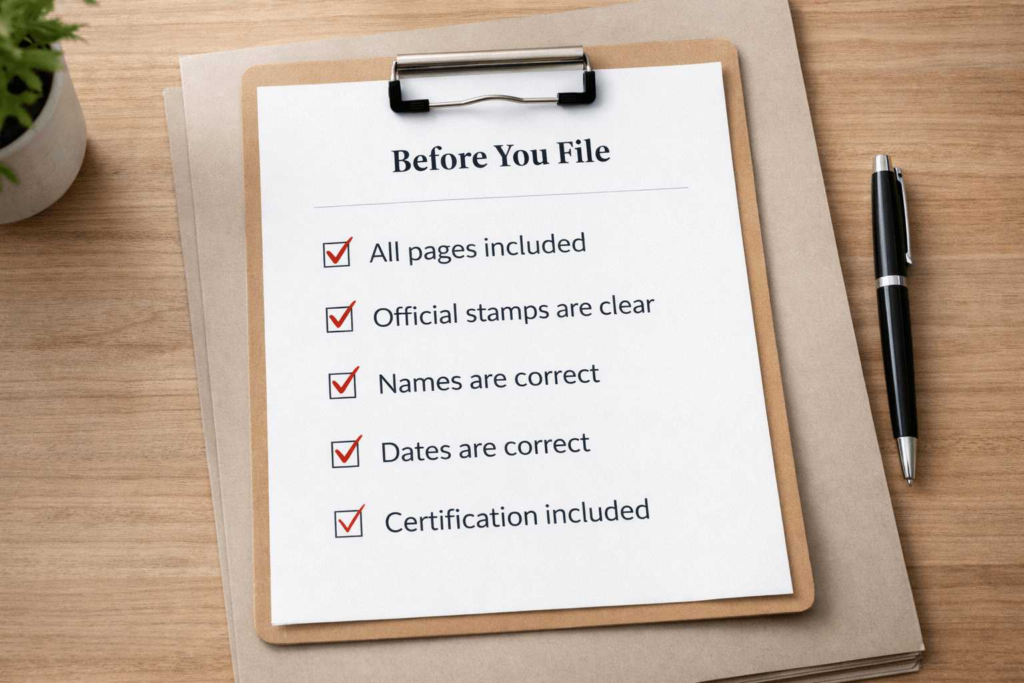
Use this checklist before you upload or mail your packet:
- Every non-English page has an English translation
- Stamps/seals/notes are translated (or labelled illegible)
- The translation includes all visible fields and remarks
- Names and numbers match your other evidence
- A translator certification is included, signed, and dated
- The final PDF set is clearly labelled and in order
If you’d like us to sanity-check your document set, upload your document here and include your deadline.
Practical examples (so you know you’re doing it right)
Example 1: Spanish birth certificate with handwritten side note
What needs translating: printed fields + side note + stamps.
Why: Side notes often contain corrections or registry references.
Example 2: Arabic marriage certificate with English headings
What needs translating: everything filled in Arabic, plus stamp text.
Why: Headings in English don’t translate the content.
Example 3: French police certificate with a single line in French at the bottom
What needs translating: that line still needs an English translation (and a certification).
Why: one line can include status (“no record”, “record attached”, “valid until”).
Make it easy for the officer: the formatting approach that reduces risk
The goal is simple: make your translation easy to verify.
What usually works best:
- Keep the same order as the original document
- Use clear labels for stamps and seals (e.g., “[Round stamp: Civil Registry Office, City, Date]”)
- Preserve numbers exactly as printed
- Use consistent spelling for names across all translated documents
- Don’t “clean up” the meaning—translate it faithfully
If you want translations prepared in a submission-ready format, start with our USCIS-ready certified translation services.
Final takeaway
USCIS translation language requirements are simple on paper:
- Any non-English content you submit must be translated into English.
- The translation must be complete and accurate.
- It must include a signed translator certification.
The hard part is execution: stamps, notes, missing pages, and sloppy formatting are what trigger delays.
If you want to remove the guesswork, upload your document here, and we’ll confirm what needs translating and how fast it can be done.
FAQs
Do all documents need an English translation for USCIS?
Only the documents you submit as evidence need translation, and only when they contain non-English text. If it’s not in English, translate it.
Which languages need translation for USCIS?
Any language other than English. USCIS does not publish a list of languages that are exempt from translation.
Do bilingual documents still need translation for USCIS?
Sometimes. If the English portion fully matches the non-English content, you may not need an additional translation. If anything is missing, translate the non-English content (often safest to translate the full document).
Does USCIS require notarised translations?
USCIS typically requires a signed translator certification, not notarisation. Notarisation is usually only needed if another organisation specifically asks for it.
Can I translate my own documents for USCIS?
It may be technically possible, but it’s often risky. Any missing stamp, note, or flawed certification wording can create delays. Many applicants use an independent translator to avoid avoidable issues.
What if a stamp or handwriting is not readable?
Don’t guess. The translation should mark it clearly as illegible (for example, “[illegible stamp]”) rather than inventing content.
What does USCIS mean by a full English translation?
A full English translation means the foreign-language content you submit should be translated completely, not summarised. In practice, that usually includes the main text, visible remarks, stamps, notes, and other meaningful annotations.
Does one foreign-language stamp or sentence still need translation?
Usually yes, if it carries meaning. A short line, stamp, or handwritten note can still affect how the document is understood, so it is safest to translate it.
Does filing online change the translation requirement?
No. Whether you file online or by mail, USCIS still expects the original foreign-language document plus the English translation and translator certification.
Can I use Google Translate or AI for a USCIS translation?
Not by itself. USCIS requires a translator to certify completeness, accuracy, and competence. A human translator may use software during drafting, but the final translation should be reviewed and certified by a competent person.
If my name already appears in English on my passport, do I still need a translation?
Possibly, yes. A romanised name does not automatically translate the rest of the non-English content on the page. If other meaningful text is still in a foreign language, that content should be translated.