Visa applications are paperwork-heavy for one reason: decision-makers need to verify identity, eligibility, finances, and relationships with documents they can read and trust. If any supporting document isn’t in the required language, you’ll usually need an official translation that matches the original exactly—right down to stamps, annotations, and page order.
This guide walks you through document translation for visa application requirements, how to choose the right type of translation, and a practical checklist you can follow today—whether you’re applying for a visitor visa, student visa, spouse/partner visa, work visa, or permanent residence.
If you’re on a deadline, you can upload your documents for a fast quote, and we’ll confirm the correct format for your destination and visa type.
UK visa translation requirements in plain English
If you’re applying for a UK visa, the practical rule is simple: if a document you rely on is not in English or Welsh, you will usually need to submit a full certified translation that can be independently verified. In most cases, that translation should include:
- confirmation that it is an accurate translation of the original document
- the date of translation
- the translator’s full name and signature, or the signature of an authorised official from the translation company
- the translator’s or the translation company’s contact details
This is the part applicants often miss: the translation is not just about language. It also needs to be traceable, complete, and easy for a caseworker to verify. That means no summaries, no skipped stamps, and no guessed wording where the scan is unclear.
For UK routes, it’s also worth remembering that the issue is usually not whether the document is “foreign”, but whether it is in English or Welsh. If it isn’t, translation requirements are likely to apply.
How visa translation requirements actually work
Most applicants lose time because they assume “translation is translation”. For visa purposes, the rules usually come from one of three places:
- The immigration authority (e.g., a home office/immigration department)
- The embassy or consulate handling your application
- A visa application centre (which often enforces document format rules)
Before you translate anything, confirm these four points:
1) Which language do they want?
Common scenarios:
- English-only (many immigration routes and online portals)
- English or local language (some consulates accept English even if the destination language is different)
- Local-language only (often seen in jurisdictions where official filings must be in the national language)
2) Do they require a certified translation?
For visas, “certified translation” typically means the translation includes a signed statement of accuracy and the translator’s details.
3) Do they require notarisation or sworn translation?
Some destinations (and some document types) need additional authentication, such as:
- notarisation of the translator’s signature
- a sworn translator’s stamp (where sworn translators are a legal category)
- legalisation/apostille for the original document or the translation
4) Do they need hard copies, or is a PDF acceptable?
Many applications accept digital PDFs, but some consulates still request physical sets or originals for verification appointments.
Visa application translation checklist (copy/paste)
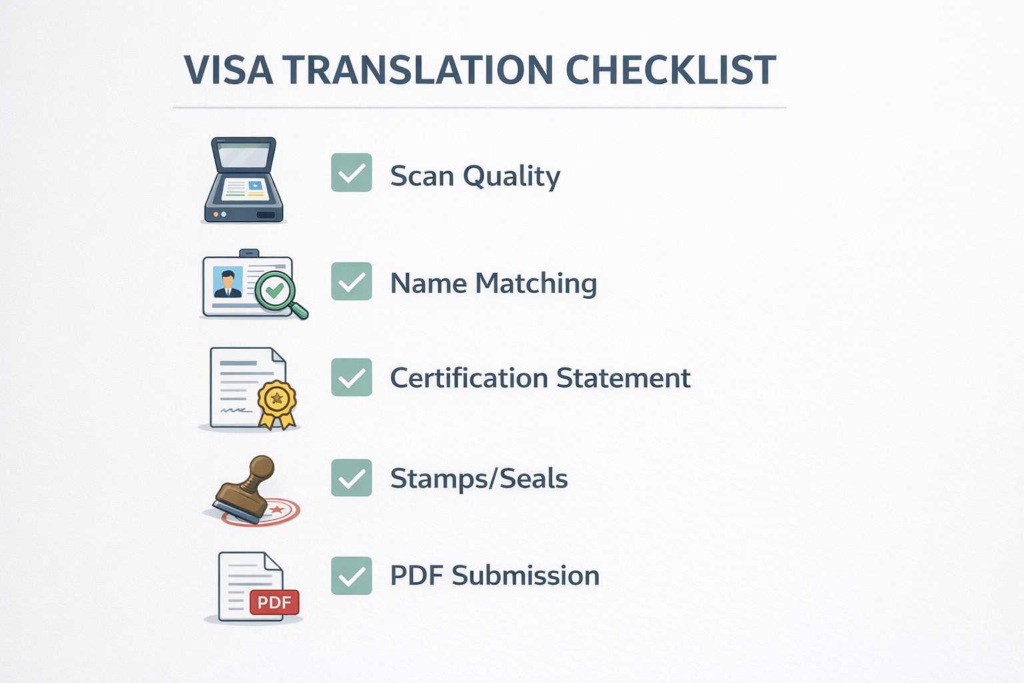
Use this as your visa application translation checklist before you submit.
Your documents
- Final, official versions (not drafts or screenshots of portals unless accepted)
- Clear scan/photo of every page (front/back where relevant)
- All stamps, seals, marginal notes, and handwritten entries are visible
- Pages in order, named clearly (e.g., “Bank_Statements_Jan–Mar.pdf”)
Your details (the #1 cause of avoidable delays)
- Names match your passport spelling (including spacing and hyphens)
- Dates are consistent across documents (format differences are explained if needed)
- Document numbers (passport/ID/certificate) are correctly captured
The translation package
- Complete translation (nothing omitted)
- Stamps/seals are translated or described clearly
- Certification statement included, signed and dated
- Translator’s full name + contact details included
- Output is easy to compare with the original (layout is readable and structured)
Want this as a one-page printable PDF? Request it when you send your files here.
Who can certify a translation for a UK visa application?
This is one of the most common points of confusion. For UK visa purposes, applicants often search for a “UKVI-approved translator”, but the more useful question is whether the translation meets the required format and can be independently verified.
In practice, the safest option is a professional translator or translation company that can provide:
- a full translation of the document
- a signed certification statement
- the translator’s or the company’s contact details
- a format that clearly matches the source document
A friend, family member, or informal bilingual contact may be able to understand the document, but that does not make the translation suitable for a visa submission. For official applications, it is much safer to use a professional service used to prepare submission-ready certified translations.
Is there really a “UKVI-approved translator”?
You may see that phrase online, but what matters in practice is not a special public list of “approved” translators. What matters is whether the translation is complete, certified, signed, dated, and independently verifiable. In other words, focus less on marketing labels and more on whether the translation package meets the document requirements for your route.
Which documents usually need translation for a visa?
Requirements vary by destination, but the most commonly translated visa documents include:
Identity and civil status
- Birth certificate
- Marriage certificate / civil partnership certificate
- Divorce decree/decree absolute
- Adoption papers
- Name change documents
- National ID card/family book (where applicable)
Immigration history and travel
- Passports (biographical page and relevant visas/stamps if requested)
- Entry/exit records (where relevant)
- Prior visas, refusal letters, or immigration decisions (if you’re asked to include them)
Finance and employment
- Bank statements
- Payslips
- Tax documents
- Employment letters and contracts
- Company registration documents (for business owners)
Education (student routes and some work routes)
- Diplomas and degrees
- Academic transcripts
- Enrolment letters
- Professional licences
Relationship evidence (family/spouse routes)
- Marriage evidence (where requested)
- Birth certificates of children
- Custody documents / parental consent letters (for minors)
- Household registration documents (in some countries)
If you’re unsure what to translate, start with the rule of thumb: anything the visa officer must rely on to make a decision needs to be readable in the required language.
Certified, notarised, sworn, apostille: what you actually need
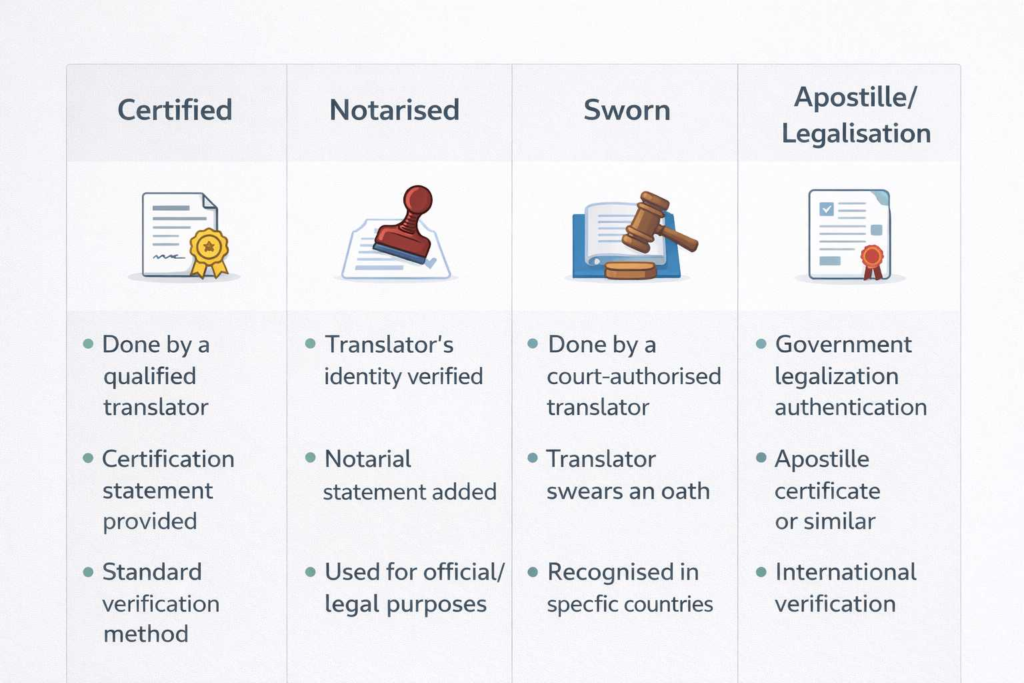
This is where many applicants overspend—or submit the wrong thing.
Certified translation (most common for visa applications)
A certified translation typically includes:
- the full translation of the document
- a signed statement confirming it’s complete and accurate
- the translator’s name, signature, date, and contact details
For most visa applications, certified translation is the correct default.
If you need a reliable, submission-ready format, start with our certified translation services.
Notarised translation (only when explicitly requested)
Notarisation usually verifies the identity of the signer (often the translator), not the quality of the translation. You typically only need this if:
- The embassy/authority explicitly requires notarisation, or
- Your destination has a strict legalisation chain for certain documents
Sworn translation (country-specific)
Some countries require translations completed by sworn translators registered or authorised in that jurisdiction. This is common in parts of Europe and Latin America. If the rule says “sworn translator only”, a standard certified translation may be rejected.
Apostille/legalisation (usually for originals, sometimes for translations)
An apostille authenticates a document for international use under the Hague Convention. Whether it’s needed depends on:
- the destination country
- the document type (civil status docs are frequent candidates)
- whether they want the original apostilled or the translation notarised and apostilled
If the authority’s wording is unclear, don’t guess. Send us the requirement note, and we’ll confirm what’s actually necessary before anything is translated: upload your documents here.
Do visa translations have to be done in the UK?
Not necessarily. What usually matters is whether the translation is professionally prepared, fully certified, and independently verifiable — not the physical location of the translator. Many applicants arrange visa-ready certified translations remotely and submit them as PDFs.
What matters more than location is whether the provider understands official submission standards, follows your passport spelling exactly, and supplies a complete certification statement.
What if only part of the document is in another language?
If you are relying on the document for your application, the safe approach is to translate every part that matters to the reviewer. That includes:
- stamps
- seals
- handwritten notes
- marginal annotations
- reverse-side notes
- mixed-language fields
A common mistake is translating only the main body text while leaving official markings untranslated. For visa submissions, those details can matter just as much as the typed content.
Step-by-step: how to translate documents for a visa application
Step 1: Confirm the authority’s rules (10 minutes that can save weeks)
Find the relevant page or checklist for your visa category and note:
- required language
- whether a certified translation is required
- whether notarisation/sworn/legalisation is required
- whether they need the original + translation, or translation only
- any file format rules (PDF size limits, colour scan requirements)
If you can’t find a clear rule, use the exact wording from your embassy email/portal screenshot and share it with your translator.
Step 2: Prepare “translator-friendly” files (this reduces cost and revision cycles)
Aim for:
- a single PDF per document type (where possible)
- readable resolution (avoid heavy compression)
- no cut-off edges (especially document numbers and stamps)
- correct orientation (rotate pages before sending)
If your document has faint stamps or embossed seals, take photos from multiple angles so the mark is visible.
Step 3: Decide your official spelling (especially for non-Latin scripts)
For Arabic, Cyrillic, Chinese, and other scripts, the same name can be romanised multiple ways. Choose one spelling that matches your passport and apply it consistently.
Practical tip: send your translator the passport bio page and a note that says:
“Please use this spelling for all names and places across all translations.”
Step 4: Choose a translator who understands visa formatting (not just language)
For visa work, accuracy is expected—but presentation reduces questions. The best translations are:
- complete
- easy to compare with the original,
- consistent across a whole application pack
Our process includes translation plus a quality check, and a proper certification statement, built for official submission. Start here: certified translation services.
Step 5: Review the translation like a visa officer would
You’re not proofreading language—you’re checking identity and traceability.
Focus on:
- names (everywhere)
- date of birth
- document numbers
- issuing authority names
- addresses (especially on bank and employment docs)
- stamps, seals, annotations
If anything is unclear on the scan, it should be clearly marked as illegible rather than guessed.
Step 6: Keep your submission pack consistent
When you submit, organise files so the reviewer can follow your story quickly:
- Original document + translated version (where required)
- Clear file names
- One document per file, unless the authority prefers combined bundles
Step 7: Leave yourself a buffer for re-uploads and portal issues
Even if the translation is perfect, online portals can be unpredictable (file size limits, temporary errors, additional evidence requests). Give yourself at least 48 hours’ buffer before the final deadline when possible.
What a “submission-ready” certified translation should include
Use this quick quality checklist:
- Completeness: Every visible element is translated (including stamps/seals/notes)
- Structure: Easy to match with the original (sections, headings, spacing)
- Consistency: Names and dates match across the whole application
- Certification: Present, signed, dated, and includes contact details
- Clarity: No ambiguous terms for key fields (relationship type, issuing authority, document type)
Sample certification wording (for reference)
“I certify that I am competent to translate from [Language] into English, and that this translation is a complete and accurate translation of the attached document.”
(Exact wording can vary by destination; what matters is competence + accuracy + completeness + traceability.)
Common mistakes that trigger delays (and how to avoid them)
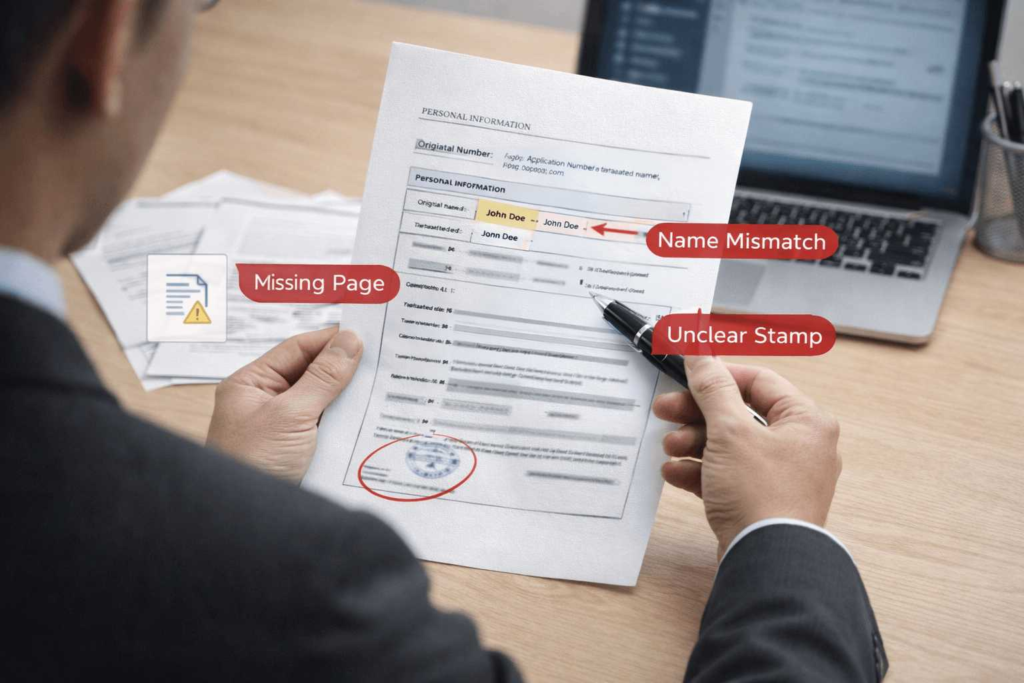
1) Missing pages (including the back page)
Many official certificates have notes or stamps on the reverse. If it exists, it must be included and translated.
2) Inconsistent spelling across documents
A single-letter difference can cause review questions, especially for relationship and identity documents.
3) Partial translations
Summaries are rarely accepted. Visa officers need full translations, not highlights.
4) DIY translation for official submissions
Even when rules don’t explicitly forbid it, self-translation often leads to formatting problems, missing certification statements, or credibility concerns.
5) Overpaying for notarisation when it’s not required
Notarisation can be useful when requested—but it’s not a universal visa requirement. Confirm first.
Real-world example: the “one-letter” delay that cost a month
A spouse visa applicant submitted a translated marriage certificate where the surname was spelled “Al Hamed” instead of “Alhamed” (matching the passport). The application wasn’t refused—but it triggered a follow-up request for clarification and additional documents, adding weeks to the process.
The fix wasn’t rewriting the translation—it was making the entire submission pack consistent (marriage certificate, bank letters, and employment letters) so the reviewer could match identities instantly.
How to get your visa documents translated quickly (without cutting corners)
If you want the simplest path:
- Gather your documents and any embassy/portal instructions
- Upload clear scans/photos
- Tell us your destination country and visa type
- We confirm the required format and turnaround
- You receive a professional PDF ready to submit
Start here: upload your documents for a fast quote.
How to choose the best document translation service for a UK visa application
If you’re comparing providers, don’t judge only on speed or price. The best document translation service for a UK visa application is one that reduces the risk of delays, follow-up questions, and re-submissions.
Look for a provider that will:
- confirm whether you need certified translation only, or additional steps such as notarisation, sworn translation, or apostille
- translate the full document, including stamps, seals, and handwritten entries
- match names exactly to your passport spelling across all files
- provide a signed and dated certification statement with contact details
- deliver a clear PDF that is easy for a caseworker to compare with the original
- flag anything unreadable instead of guessing
- handle urgent deadlines without turning the translation into a summary or partial version
- review embassy, consulate, or portal instructions before work begins
A good provider should also tell you when extra services are not needed. That matters because many applicants overpay for notarisation or legalisation when a standard certified translation would have been enough.
FAQs
Do I need a certified translation for a visa application?
In many cases, yes. If your supporting documents aren’t in the required language, authorities often request a certified translation that includes a signed statement of accuracy and translator details.
What should a certified translation include for embassy translation requirements?
Typically: a complete translation, a signed and dated certification statement, the translator’s full name, signature, and contact details, and a clear format that matches the original document’s structure.
Can I translate my own documents for a visa?
Sometimes applicants try, but it can create avoidable risk—missing certification statements, incomplete translations, and inconsistent name spellings are common reasons for delays. A professional service is usually safer for visa submissions.
Do visa translations need notarisation?
Only if the embassy or immigration authority explicitly requires it. Many visa routes accept certified translations without notarisation, so it’s best to confirm before paying for extra steps.
How long does document translation for a visa application take?
Turnaround depends on document length, language pair, and whether you need urgent delivery. Many standard personal documents can be completed quickly, but you should always allow buffer time for portal uploads or follow-up requests.
What’s the fastest way to translate documents for a visa application correctly?
Send clear scans/photos, include any embassy instructions, and confirm spelling for names exactly as in your passport. If you’re ready, upload your documents here, and we’ll confirm the correct format and timeline.
Will UKVI accept a scanned, certified translation PDF?
In many cases, yes — especially for online submissions. What matters is that the scan is clear, complete, and includes the certification statement, signature, date, and contact details. Always check the specific upload rules for your visa route or appointment centre.
Can a friend or family member translate my visa documents?
It is risky for official submissions. Even if they are fluent, the translation may not meet certification or traceability requirements. A professional certified translation is usually the safer option.
Do I need to translate stamps, seals, and handwritten notes?
Yes, if they appear on a document you are relying on. Visa reviewers may use those elements to verify authenticity, dates, issuing authorities, or official annotations.
Does the translation have to be done in the UK?
Usually no. The key issue is whether the translation is professionally prepared, certified correctly, and independently verifiable.
Will the embassy or visa application centre translate my documents for me?
Usually not. Applicants are normally expected to arrange their own compliant translation before submission or appointment.
What if my document is partly in English and partly in another language?
If the non-English or non-Welsh content is relevant to the document, it should still be translated fully. Partial translation can create review problems if key fields, stamps, or notes are left untranslated.
How much does document translation for a visa application usually cost?
Cost depends on the language pair, number of pages, handwriting, certification level, turnaround time, and whether you also need hard copies, notarisation, or apostille. The most accurate quote usually comes from sending the exact files rather than estimating by document title alone.