If you’re preparing documents for use abroad, you’ll quickly run into two terms that sound similar but solve completely different problems: apostille and certified translation. Confusing them is one of the fastest ways to get an application delayed, rejected, or kicked back with a request for resubmission.
Here’s the simplest way to remember it:
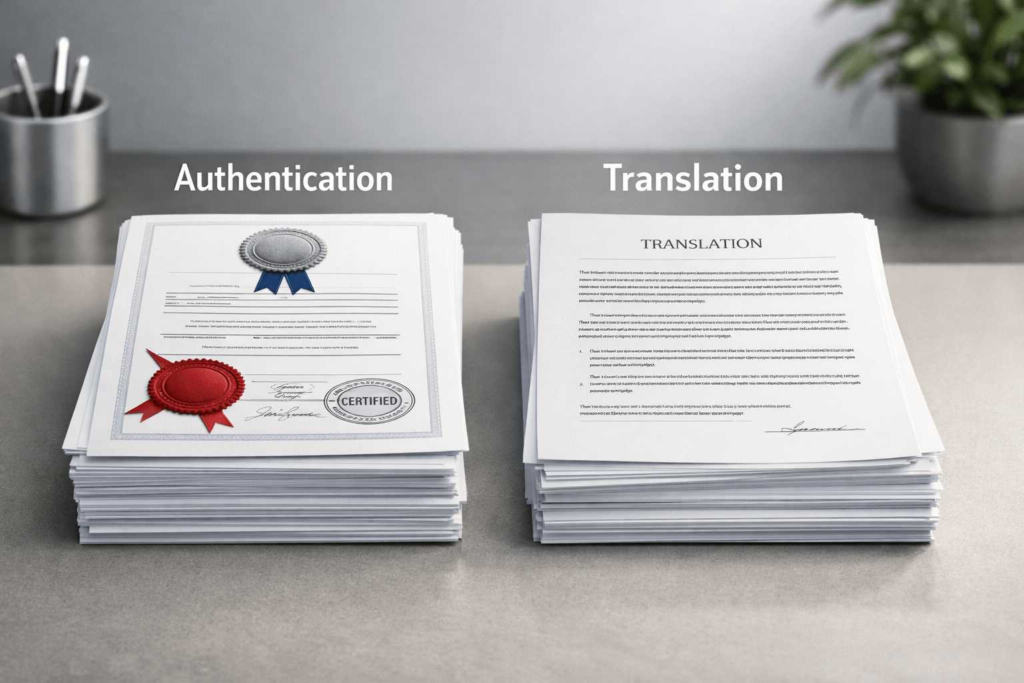
An apostille proves a document’s signature/seal is authentic. A certified translation proves the translation is accurate.
If you want to avoid guesswork, the safest move is to start with the receiving organisation’s instructions (country + authority + purpose), then match your document to the right pathway. And if you’re on a deadline, upload your file and the requirements you’ve been given — we’ll confirm exactly what you need before work starts.
Direct Answer: Difference Between an Apostille and a Certified Translation

The difference between an apostille and a certified translation is simple: an apostille confirms that the signature, seal, or stamp on a document is genuine for international use, while a certified translation confirms that the wording of the document has been translated accurately and completely into another language. An apostille does not translate the document, and a certified translation does not authenticate the original document. If the receiving authority needs both authenticity and readability, you may need both.
People often describe them as doing two separate jobs:
- Apostille = document authentication for use abroad
- Certified translation = language accuracy for official submission
That distinction matters because many rejected applications happen when someone orders only one service when the authority actually needs both.
The 20-Second Answer (Most People Need This)
You might need:
Only an apostille (your document is already in the correct language, but must be authenticated for foreign use).
Only a certified translation (the authority needs the content in their language, but does not require authentication).
Both apostille + certified translation (very common for immigration, education, marriage, and legal filings abroad).
The key variables are:
Where the document was issued,
Where it will be used, and
What the receiving authority requires.
Apostille vs Certified Translation in One Glance
If you want the clearest possible distinction:
- An apostille answers: Is this signature or seal officially genuine?
- A certified translation answers: Has this document been translated accurately and completely?
Another way to think about it:
- An apostille deals with authenticity
- Certified translation deals with understanding
Neither one replaces the other. A document can be properly apostilled but still unreadable to the receiving authority if it is in the wrong language. A document can also be perfectly translated but still rejected if the authority requires proof that the original document is officially authenticated.
What Is an Apostille?
An apostille is an official certificate attached to a document to confirm that a signature, seal, or stamp is genuine so the document can be accepted in another country (typically under the Hague Apostille Convention framework).
An apostille does not verify:
the accuracy of the document’s content,
whether the information is true, or
whether the translation is correct.
It verifies the authenticity of the signature/seal and the capacity of the official who signed/stamped the document.
Common documents that get apostilled
Birth, marriage, and death certificates
Court orders and judgments
Diplomas, transcripts, degrees (depending on country)
Background checks/police certificates (depending on issuing authority)
нотариal documents, powers of attorney, affidavits
Corporate documents (certificates of incorporation, board resolutions)
Apostille vs legalisation (important distinction)
An apostille is usually used when the destination country recognises apostilles.
Legalisation (consular legalisation) is often required when the destination country does not accept apostilles, meaning your document may need a longer “chain” of authentication steps.
What Is a Certified Translation?
A certified translation is a complete translation of a document that includes a signed certification statement confirming that the translation is accurate and complete, and that the translator is competent to translate between the relevant languages.
A certified translation is about language accuracy and completeness, not document authentication.
What a certified translation typically includes
A full, faithful translation of all visible text
Clear handling of stamps, seals, and handwritten notes (as visible/legible)
A certification statement (signed and dated)
Professional formatting that makes it easy to compare with the original
Certified translation is not the same as notarised translation
Certified translation: translator/agency certifies accuracy.
Notarised translation: a notary verifies the identity of the person signing the certification (often the translator), adding an extra layer that some authorities request.
What an Apostille Does Not Do — and What a Certified Translation Does Not Do
This is one of the biggest points of confusion, so it helps to be explicit.
An apostille does not:
- translate the document
- certify that the contents are true
- confirm that the translation is accurate
- replace notarisation or legal advice where separately required
A certified translation does not:
- prove that the original document is genuine
- confirm that the issuing authority is legitimate
- replace an apostille where authentication is required
- automatically make a document valid in every country or authority
In practical terms:
If an authority needs to know the document is real, that points to apostille/legalisation.
If an authority needs to read the document in another language, that points to a certified translation.
If they need both, you need both.
Apostille vs Certified Translation: The Real Differences
| Feature | Apostille | Certified Translation |
| Purpose | Proves a signature/seal is authentic | Proves the translation is accurate |
| Who issues it | A designated government authority | A qualified translator or translation provider |
| What it applies to | The original document (or a properly certified copy) | The translated text (plus certification statement) |
| Does it validate content? | No | No (it validates translation accuracy, not factual truth) |
| When it’s usually required | Using official documents abroad | Submitting documents in a different language |
When Do You Need an Apostille?

You usually need an apostille when:
Your document is being used outside the country where it was issued, and
The receiving country/authority requires authentication.
Fast “yes/no” check
You’re more likely to need an apostille if the receiving authority says any of the following:
“apostille required”
“document must be legalised”
“authentication certificate”
“Hague apostille”
“consular legalisation”
Situations where an apostille is commonly requested
Getting married abroad or registering a marriage
Applying for citizenship/residency using foreign civil records
Overseas employment/licensing (teaching, healthcare, regulated roles)
International business transactions and corporate filings
Cross-border court matters
A crucial nuance: within the EU (sometimes less paperwork)
If you’re presenting certain public documents between EU countries, apostille requirements may be reduced or removed for specific categories of documents. This does not apply to every document type or every situation — and it doesn’t automatically remove language requirements — but it can change what you need.
When Do You Need a Certified Translation?
You usually need a certified translation when:
The receiving authority operates in a different language from your document, and
They require a translation suitable for official use.
Common scenarios
Immigration applications
Visa/residency processes
University admissions and credential evaluations
Court filings and legal processes
Financial/HR compliance (bank statements, payslips, employment letters)
Medical documentation for treatment abroad
What authorities typically care about (and why rejections happen)
Rejections tend to come from:
missing pages,
untranslated stamps/seals/notes,
inconsistent names/dates,
unclear formatting,
missing or weak certification wording.
A certified translation should feel “submission-ready” — nothing missing, nothing ambiguous.
When Do You Need Both an Apostille and a Certified Translation?
This is where most people land.
You’ll often need both when:
the destination country/authority requires the document to be authenticated, and
the authority needs to understand the content in their language.
Common “both required” examples
Birth certificate for immigration or family sponsorship abroad
Marriage certificate for a spousal visa or registering a marriage in another country
Degree/transcripts for overseas study, work, or professional licensing
Court documents for cross-border legal matters
Police certificates/background checks (depending on destination rules)
The practical reality
You’re building a submission bundle:
The authenticated document (apostilled/legalised as required), plus
A certified translation of the entire document set (often including the apostille page itself).
Common Document Examples: What You Usually Need
While requirements always depend on the destination country and receiving authority, these examples reflect the most common pattern people encounter:
Birth certificate for immigration abroad
Often needs:
- apostille/legalisation to authenticate the civil record, and
- certified translation if the authority does not accept the original language
Marriage certificate for visa or registration in another country
Often needs:
- apostille/legalisation on the original certificate, and
- certified translation of the certificate and sometimes the apostille page
Degree certificate or transcript for overseas study or licensing
Often needs:
- authentication depending on the country/institution, and
- certified translation if the academic record is not in the required language
Power of attorney for use overseas
Often needs:
- notarisation first in some cases,
- then apostille/legalisation,
- then certified translation for the receiving authority
Court order or legal judgment for use in another jurisdiction
Often needs:
- authentication of the issued document, and
- certified translation for filing or review
These examples are useful as a guide, but the final answer always depends on the instructions of the authority receiving the document.
What Comes First: Apostille or Certified Translation?
Most of the time:
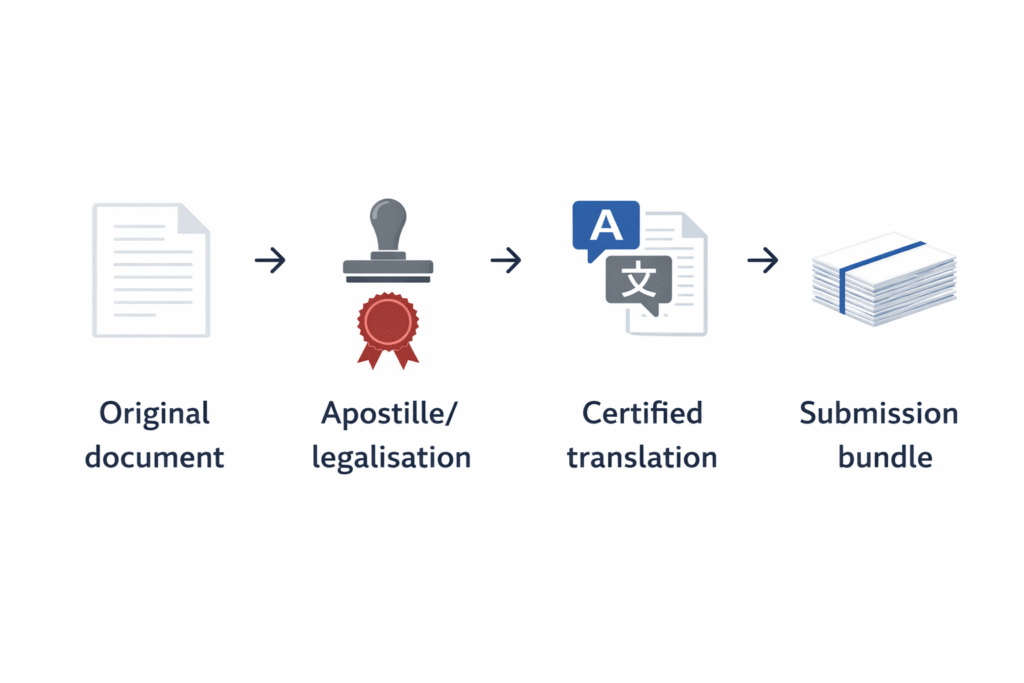
Typical order (most common and safest)
Obtain the correct original (or certified copy, if allowed)
Apply for the apostille/legalisation (if required)
Translate the complete set (document + apostille page) as a certified translation
Why this order works:
The apostille is attached to the document, and many authorities want the apostille translated too if it contains official text that the officer must read.
If you translate first, you may end up redoing the translation after the apostille is added.
The exception: when a translated document itself must be apostilled
Some authorities ask for an apostille on:
a notary’s signature on the translator’s certification, or
a notarised translator declaration.
In that case, the workflow can look like:
Translate and certify
Notarise the translator’s signature (if required)
Apostille the notarisation
This is not the default — it’s an authority-specific requirement — but it’s common enough that it’s worth checking upfront.
Do You Apostille the Original Document or the Translation?
Usually, the apostille is applied to the original document or to a properly certified copy of that document — not to the translation itself.
That is the standard route because the apostille is designed to authenticate the signature, seal, or stamp on the source document or on a notarised certification attached to it.
However, there are exceptions. Some authorities ask for:
- a notarised translator declaration,
- notarisation of the translator’s signature, or
- an apostille on the notarised certification connected to the translation
That is why the answer is usually:
- Original document apostilled first
- Certified translation prepared afterwards
- Translation itself is apostilled only if the authority specifically requests it
If the instruction wording is unclear, do not guess. This is exactly the kind of detail that can cause avoidable rejection or duplicate costs.
Notarisation, Sworn Translations, and “Legalisation”: The Terms That Confuse Everyone
If your instructions include any of these terms, slow down and confirm the exact requirement:
Notarisation
A notary confirms the identity of the signer and witnesses the signature.
It does not confirm translation accuracy by itself.
Sworn translation
Some countries require translations done by a translator with a specific legal status (often court-authorised). This can be stricter than a standard certified translation.
Legalisation (consular)
If the destination country does not accept apostilles, you may need consular legalisation — a longer authentication route involving additional steps.
Cost and Timeline: How to Plan Without Overpaying
While prices vary by document type, language, and urgency, the best way to avoid paying twice is to avoid rework.
What drives certified translation turnaround
Page count and handwriting density
Rare language pairs
Formatting complexity (tables, stamps, multi-page certificates)
Same-day or weekend deadlines
What drives apostille/legalisation turnaround
Issuing authority rules
Whether your document is eligible as-is or requires a certified copy/notary first
Shipping and handling time (if physical submission is required)
Peak demand periods
The hidden cost people miss
The most expensive outcome isn’t the higher-priced option — it’s the rejected submission that forces:
rush re-translation,
re-notarisation,
re-apostille,
and lost time on appointments, filings, or deadlines.
If you’re unsure, the fastest route is to send the document plus the receiving authority’s requirements so we can confirm the correct pathway before you commit.
The “Submission-Ready” Checklist (Use This Before You Send Anything)

Before you submit, verify:
All pages included (front/back where relevant)
Apostille/legalisation page included (if issued)
Stamps, seals, handwritten notes handled (translated or clearly noted)
Names match passport/ID spelling (including accents where required)
Dates and document numbers are consistent and readable
Correct certification wording included, signed, and dated
File labelling makes sense (so the officer can follow it quickly)
If you want us to run this check for you, upload your document and tell us where it’s being submitted. We’ll confirm what’s needed and what isn’t — no unnecessary steps.
Common Reasons Documents Get Rejected (and How to Avoid Them)
Apostille attached but not translated (the authority can’t read it)
Translation missing stamps/seals (looks incomplete)
Name format mismatch (passport says one thing, translation shows another)
Partial translation (only “main text” translated, not the rest)
Weak certification statement (missing signature/date/competence wording)
Wrong type of authentication (apostille vs consular legalisation mix-up)
Assuming “English is fine” (authority still requires local language)
Photocopy submitted when an original/certified copy is required
Poor scan quality (missing corners, blur, cropped seals)
Doing steps in the wrong order (leading to rework)
A Simple Way to Get It Right First Time
If you’re dealing with apostille vs certified translation confusion, you don’t need another generic checklist — you need a decision based on your document and your destination authority.
Upload your document (a scan or clear phone photo is fine) and include:
the country where you’ll use it,
the receiving authority (e.g., immigration, university, court),
and any instructions you were given.
We’ll confirm whether you need:
certified translation only,
apostille/legalisation only,
or the full bundle — and we’ll prepare it in a submission-ready format.
FAQ Section
Do I need an apostille or a certified translation?
It depends on where you’re submitting the document. If the authority needs proof that the document is authentic, you may need an apostille. If they need to read the document in another language, you need a certified translation. Many official uses abroad require both.
What is the difference between an apostille and a translation?
An apostille authenticates the signature/seal on a document for international use. A translation converts the content into another language. A certified translation adds a signed statement confirming the translation is accurate and complete.
Do I need an apostille for a translated document?
Sometimes, but usually the apostille applies to the original document (or a certified copy), not the translation. In some cases, authorities request an apostille on a notarised translator declaration. Always follow the receiving authority’s wording.
Which comes first: apostille or certified translation?
Most commonly, you obtain the apostille first and then translate the full set (including the apostille page). If the translation itself must be notarised and apostilled, then the translation comes first.
If my document is already in English, do I still need a certified translation?
No — but you may still need an apostille/legalisation if the receiving country requires authentication. Language and authentication are separate requirements.
What happens if I submit an apostilled document without a certified translation?
If the receiving authority cannot read the document (or the apostille page), they may reject it or request a certified translation, causing delays.
Can an apostille replace a certified translation?
No. An apostille does not translate a document or confirm language accuracy. It only authenticates a signature, seal, or stamp for international use.
Can a certified translation replace an apostille?
No. A certified translation confirms that the translation is accurate and complete, but it does not authenticate the original document.
Does an apostille prove the contents of a document are true?
No. An apostille does not verify whether the information in the document is factually correct. It verifies the authenticity of the signature, seal, stamp, or official capacity behind the document.
Who issues an apostille, and who issues a certified translation?
An apostille is issued by a designated government authority. A certified translation is issued by a qualified translator or translation company that signs a certification statement confirming accuracy and completeness.
Do I need to translate the apostille page as well?
Often, yes. If the receiving authority needs to read every official part of the submission bundle, the apostille page may also need to be translated.
Is an apostille the same as notarisation?
No. Notarisation and apostille are different steps. A notary verifies identity and signature formalities. An apostille authenticates the notary’s or official’s signature/seal for international use where applicable.
Do I apostille the original document or a copy?
Usually, the original document or an officially certified copy, depending on the document type and the issuing rules. The translation itself is not usually what gets apostilled unless the receiving authority specifically requests that workflow.
What if the destination country does not accept apostilles?
You may need consular legalisation instead of an apostille. This usually involves a longer authentication chain and may require additional steps before the document can be accepted abroad.