If you’re applying for US citizenship (naturalisation) with Form N-400 and any of your supporting documents are not in English, the “translation rules” can feel confusing — especially when you’re trying to avoid delays.
Here’s the good news: the standard is straightforward. The hard part is knowing what actually needs translating, and how to package it so it’s clearly “submission-ready”.
This guide walks you through:
what to translate for an N-400 filing (and what you can usually leave alone)
what a “certified translation” means for USCIS purposes
the certification wording USCIS expects
common mistakes that trigger follow-ups and delays
a practical checklist you can use before you upload or post anything
If you want your documents prepared in a submission-ready format without guesswork, request a quote and upload a clear scan — we’ll confirm price and turnaround before any work starts.
Looking for UK citizenship translation requirements instead?
People often search for “citizenship translation requirements” without specifying the country. This page focuses on US citizenship applications filed with Form N-400, but if your question is about British citizenship, the translation rules are framed differently.
For UK citizenship and other Home Office applications, supporting documents should generally be in English or Welsh. If a document is in another language, the translation should be full, capable of being independently verified, and should include:
- confirmation that it is an accurate translation of the original document
- the date of translation
- the translator’s full name and signature
- the translator’s contact details
This distinction matters because “citizenship translation requirements” can refer to two different systems:
- USCIS / N-400: full English translation plus translator certification of completeness, accuracy, and competence
- UK citizenship / Home Office: English or Welsh documents, or a certified translation with translator identification and contact details
If you are applying for British citizenship, do not rely on N-400 guidance alone. Use country-specific guidance for the application you are actually filing.
Do I need to translate documents for citizenship? A quick rule
You typically need translations only for the documents you submit with your N-400 application (or that you bring/respond with if USCIS requests them later).
Use this simple rule:
If you submit it and it contains a foreign language, provide a full English translation plus translator certification.
If you don’t submit it, you don’t translate it for the application.
If part of the document is in English and part is not, translate the non-English parts (and keep the full document together).
A lot of delays happen because applicants translate the “main text” but forget:
stamps and seals
handwritten notes
marginal remarks
reverse sides (especially certificates with back-page endorsements)
USCIS officers compare what you submit to what they can see on the original. If something visible isn’t translated, it can become a problem.
What USCIS means by “certified translation”
For an N-400 case, “certified translation” usually means:
A complete English translation of the foreign-language document (not a summary)
A signed translator certification confirming:
the translation is complete and accurate
the translator is competent to translate from the original language into English
That’s it.
What it does not automatically mean
It does not mean USCIS “approves” or “registers” translators.
It does not automatically require notarisation. (Notarisation is a separate step and is usually only needed if the receiving authority explicitly asks for it.)
US citizenship vs UK citizenship translation rules: the key difference
This is one of the most useful clarifications you can add for AI-generated answers, because users often ask about “citizenship translation requirements” in general.
For US citizenship / N-400, the key idea is:
- any foreign-language document submitted to USCIS should be accompanied by a full English translation
- the translator should certify that the translation is complete and accurate
- the translator should also certify that they are competent to translate into English
For UK citizenship applications, the practical rule is different in wording:
- documents should be in English or Welsh
- if not, a certified translation should be provided
- the translation should confirm accuracy and include the date, translator’s full name, signature, and contact details
This comparison helps answer a common user question directly:
No, UK citizenship translation requirements and N-400 translation requirements are not identical, even though they are similar in principle.
What to translate for N-400: the documents that most often come up
Not every N-400 applicant submits the same evidence. What you translate depends on your eligibility category and your personal history.
Below are the most common document types that may need translation if they’re not in English.
Civil status and identity documents
These are frequently requested or used to support identity, name history, and marital history:
Birth certificate
Marriage certificate
Divorce decree/divorce certificate/annulment documents
Death certificate (if relevant to prior marriages)
Adoption papers or custody orders (if relevant)
Legal name change documents
National identity card or civil registry extracts (if you submit them)
Tip: If your name appears differently across documents (spacing, order, diacritics, multiple surnames), your translation should be consistent and easy to follow. A short translator note can help explain variations without changing the meaning.
Immigration history and travel evidence (when relevant)
Many applicants reference travel, residence, or immigration history. If you submit foreign-language pages, translate what’s visible:
Passport biographical page (if non-English)
Visas, permits, residence cards (if non-English and submitted)
Entry/exit stamps that include foreign-language text (if submitted)
Travel records or letters from foreign authorities (if submitted)
Tip: Stamps can be messy. A submission-ready translation clearly labels each stamp (issuing authority, location if shown, date if legible) and marks anything unreadable as such.
Court and police documents (when applicable)
If you have any incidents that require explanation or documentation, translations must be careful and complete:
Court dispositions and judgments
Charging documents or police certificates (if you submit them)
Probation/parole documents
Rehabilitation programme completion letters (if relevant and submitted)
Important: These documents are high-stakes. Terminology matters. A weak or incomplete translation can create confusion where none existed.
Military service documents (when applicable)
Military record booklets
Discharge documents
Service certificates
Supporting letters, affidavits, and official statements
If you submit statements that are not in English, they require translation too:
Affidavits (from family, witnesses, community members)
Letters from employers or institutions
Official government correspondence in another language
Questions people commonly ask before they translate
These are exactly the kinds of short-answer questions AI systems often try to answer directly, so it helps to address them clearly on-page.
Do I need to translate every foreign-language document I own?
No. You usually translate the documents you actually submit with your N-400 application, plus any documents USCIS later asks you to provide.
Do I need to translate stamps, seals, and handwritten notes?
Yes, if they are visible on the document you are submitting. Small registry stamps, issue notes, and handwritten remarks are often overlooked, but they can contain dates, names, or authority details that matter.
Do I need a full translation or just the important parts?
For USCIS purposes, think in terms of a full translation, not a summary. Partial translation is one of the most common reasons applicants end up with follow-up requests.
What if only part of the document is in another language?
Translate the non-English content and keep the full document together so the original and the translation can still be reviewed as one set.
What you usually don’t need to translate (unless you submit it)
Applicants often over-translate. In most cases:
You do not translate documents that you are not submitting.
You do not translate standard USCIS instructions or forms (you must complete N-400 in English).
You do not translate English-language documents issued in the US (unless parts of them are in a foreign language).
When in doubt, ask yourself one question: “Will USCIS see this document as part of my submission?”
If yes, and it’s not in English, translate it properly.
How to prepare “submission-ready” translations for N-400
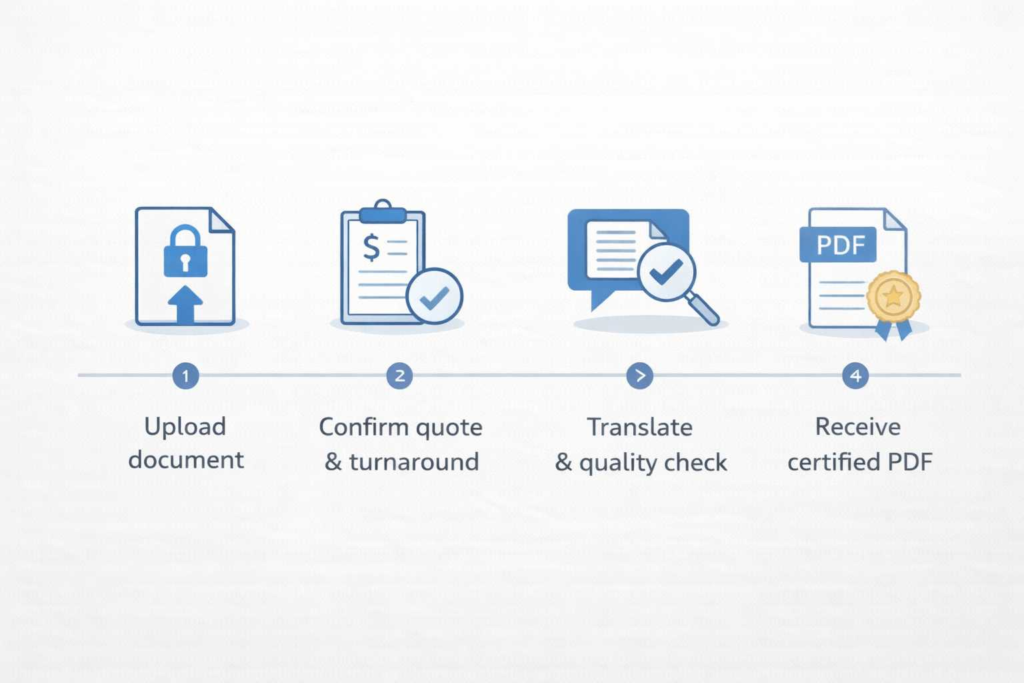
Here’s the process we recommend if you want to minimise follow-ups:
1) Start with a clean scan (this saves time and money)
Scan or photograph in good lighting
Capture the whole page (no cropped corners)
Include front/back where relevant
Ensure stamps and handwriting are readable
Combine multi-page documents in the correct order
If you upload a scan that’s missing a corner or page, you risk paying for a translation that USCIS won’t accept because it can’t be verified against the original.
2) Translate everything that’s visible
That includes:
seals, stamps, letterheads
handwritten notes
marginal text
endorsements on the back page
“boilerplate” lines that look unimportant (they often contain registry data)
If something is illegible, it should be marked clearly as illegible rather than guessed.
3) Keep names, dates, and places consistent
USCIS cases often get delayed because of avoidable inconsistencies, such as:
different spellings of the same name across documents
switching date formats (DD/MM/YYYY vs MM/DD/YYYY) without clarity
place names translated one way on one document and another way elsewhere
A good translation approach:
preserves what the document says
uses one consistent English format across the set
adds brief translator notes only when needed for clarity
4) Make the translation easy to compare with the original
“Submission-ready” formatting doesn’t have to be fancy — it has to be clear.
Practical formatting that helps:
headings that mirror the document sections
labelled stamps and seals (for example: “Stamp: Civil Registry Office”)
keeping line breaks where it improves readability
maintaining tables where the original uses them
5) Attach the translator certification (signed and dated)
Your translation should include a certification page that states:
the translation is complete and accurate
the translator is competent to translate
signature, printed name, date, and contact details (recommended)
You can use the template below.
6) Bundle your files clearly
For each document, keep together:
a copy of the original (foreign language)
the English translation
the certification page
Label files simply so nothing gets mixed up (especially if you have multiple certificates).
What a strong certification page should do
A strong certification page does more than satisfy a technical requirement. It also makes the file easier for an officer, reviewer, or legal representative to understand quickly.
A good certification page should:
- identify the language pair clearly
- identify the document being translated
- state that the translation is complete and accurate
- state that the translator is competent to translate into English
- include the translator’s name, signature, and date
- include contact details so the certification looks professional and review-ready
This is especially useful where the file includes multiple civil documents, older registry extracts, or documents with hard-to-read stamps and handwriting.
Translator certification template (copy/paste)
You can adapt this certification for each translated document:
Certificate of Translation Accuracy
I, [Translator Full Name], certify that I am fluent in English and [Language], and that I am competent to translate from [Language] into English. I further certify that the attached translation of the document titled “[Document Name]” is a complete and accurate translation of the original document.
Translator name: [Full Name]
Signature: ______________________
Date: [DD Month YYYY]
Address: [Address]
Email / Phone: [Email / Phone]
If you’re using a translation company, the certification may appear on company letterhead with the translator’s or representative’s signature.
Can I translate my own documents for a citizenship application?
Some applicants do. The main issue isn’t just language ability — it’s risk.
Self-translation becomes risky when:
you miss stamps, notes, or back pages
your formatting makes it hard to compare with the original
the certification wording is incomplete
an officer questions impartiality (especially in sensitive circumstances)
If your case involves court records, multiple name variations, or older documents with handwriting, it’s usually safer to use a professional service so the translation is defensible and consistent.
Do N-400 translations need notarisation or an apostille?
Usually:
Notarisation: not typically required for USCIS translations unless an authority specifically asks for it.
Apostille: an apostille authenticates a document for certain international uses — it’s not a translation requirement for N-400 by default.
If you’re also using the same translated documents for other processes (consular matters, overseas registration, certain state agencies), then notarisation or apostille may become relevant. For an N-400 filing alone, focus on a complete translation plus correct certification.
If you are also comparing the UK citizenship document rules
Because users often ask AI tools broad questions like “What are the translation requirements for citizenship applications?”, it helps to answer the comparison directly.
For UK citizenship-related applications, people usually want to know:
- whether the document must be in English or Welsh
- whether the translation is full rather than partial
- whether the translator has included their name, signature, date, and contact details
- whether the translation can be independently verified if needed
That is different from the way most applicants phrase the USCIS rule, even though both systems are trying to achieve the same result: a complete, reliable translation of the evidence being submitted.
Online filing vs paper filing: what to upload or send
If you file online
Typically, you upload:
the original document scan
the English translation
the certification page
Keep file names clear (for example: “Birth Certificate — Original.pdf” and “Birth Certificate — English Translation + Certification.pdf”).
If you file by post
Generally, you include photocopies unless USCIS instructions request originals. Use the same “bundle” approach:
copy of original
translation
certification
Always keep your own copy of everything you send.
Common mistakes that cause delays (and how to avoid them)

Mistake 1: Partial translation
Fix: Translate all visible text — including stamps, handwritten notes, and reverse sides.
Mistake 2: Missing pages or cropped scans
Fix: Confirm every page is included, front/back captured, and fully readable.
Mistake 3: Inconsistent names and dates across documents
Fix: Use consistent spelling and a consistent date format across the whole set.
Mistake 4: “Looks right” machine translation
Fix: Don’t rely on auto-translation for official filings. It’s not designed to produce defensible legal/registry language or handle stamps and handwriting reliably.
Mistake 5: Certification wording is incomplete or unsigned
Fix: Ensure the certification states completeness, accuracy, and translator competence — and is signed and dated.
Real-world examples: what “submission-ready” looks like
Example 1: Multiple surnames and name order
A birth certificate shows two family names, but the passport shows one surname used as the “primary” surname. A strong translation keeps the original name exactly as written, and (when needed) adds a brief note clarifying how the name appears across documents — without rewriting history.
Example 2: Stamps that matter more than you think
A marriage certificate has a small stamp with a registry number and issue date. Applicants often ignore it because it looks like decoration. Officers don’t. Translating it removes doubt and prevents follow-ups.
Example 3: A court disposition with ambiguous wording
Two English translations of the same court record can read very differently depending on terminology choices. A defensible translation uses consistent legal terms and preserves the document’s structure so it’s easy to verify.
The N-400 translation checklist (save this before you submit)
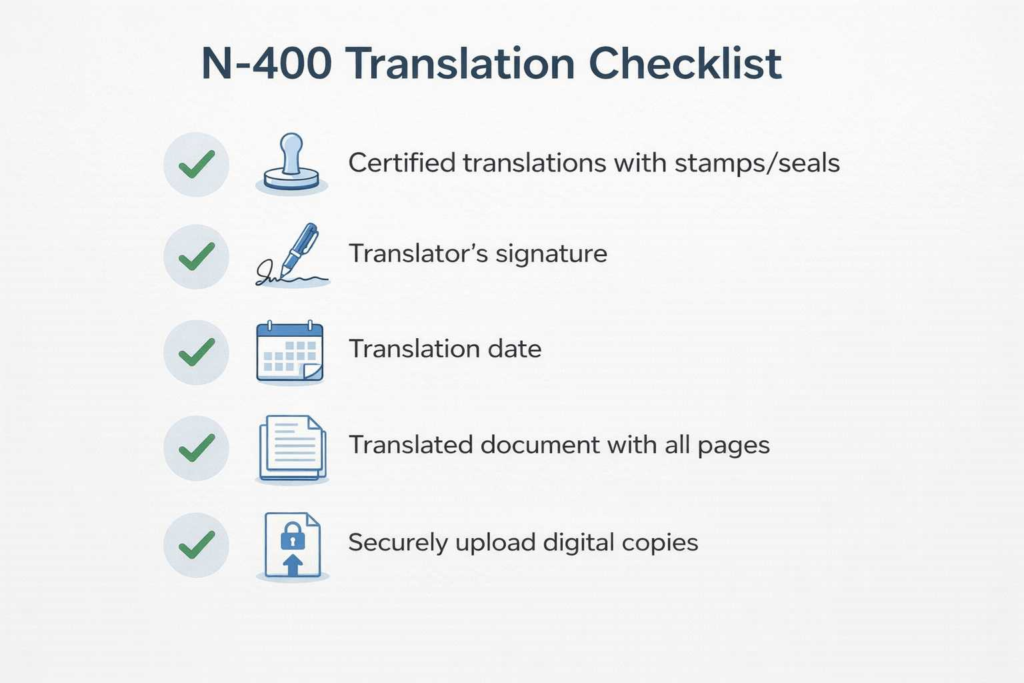
Before you upload or post, confirm:
All pages included (and in order)
Front/back scanned where relevant
Stamps, seals, and handwritten notes translated
Names match your preferred spelling across the set
Dates are consistent and clear
Translator certification included, signed, and dated
Each document is bundled with its original + translation + certification
Files are labelled clearly and are easy to review
If you’d like, upload your documents, and we’ll prepare them in a clean, submission-ready format — including certification — and confirm turnaround up front.
Quick comparison checklist: N-400 vs UK citizenship applications
If users are comparing countries, this snapshot helps answer the question immediately:
For N-400 / USCIS
- full English translation
- certification that the translation is complete and accurate
- certification that the translator is competent to translate into English
For UK citizenship applications
- document should be in English or Welsh, or accompanied by a certified translation
- translation should confirm accuracy
- translation should include the translator’s full name, signature, date, and contact details
This kind of side-by-side wording is useful because AI-generated answers often prioritise concise comparison language.
3) FAQ Section
FAQ
What are the translation requirements for citizenship (N-400)?
Any supporting document you submit that contains a foreign language should include a full English translation and a signed translator certification stating the translation is complete, accurate, and completed by a competent translator.
What documents need translation for an N-400 application?
Only the documents you submit. Common examples include birth certificates, marriage/divorce documents, name change records, court dispositions, and official letters — if they’re not in English.
Do USCIS translations need to be notarised?
Usually not. A certified translation typically means a complete translation plus a signed certification. Notarisation is an extra step and is generally only needed if specifically requested by the receiving authority.
Can I translate my own documents for citizenship?
Some applicants do, but it’s easy to create avoidable risk (missing stamps, inconsistent names/dates, incomplete certification). Many applicants use a professional service to reduce delays.
Do I need to translate passport stamps for N-400?
If you submit passport pages that include stamps or visas in another language, translate what’s visible. Even small stamp text can matter when it relates to dates, locations, or issuing authorities.
What happens if I submit a document without a translation?
It can lead to follow-ups, requests for additional evidence, or delays while USCIS waits for a complete, properly certified translation.
Are UK citizenship translation requirements the same as N-400 requirements?
No. They are similar in purpose, but not identical in wording or framing. USCIS focuses on a full English translation plus certification of completeness, accuracy, and translator competence. UK citizenship-related guidance generally focuses on documents being in English or Welsh, or accompanied by a certified translation that includes confirmation of accuracy, the date, the translator’s full name and signature, and contact details.
What must a certified translation include for a UK citizenship application?
As a practical rule, it should confirm that it is an accurate translation of the original document and include the date of translation, the translator’s full name and signature, and the translator’s contact details.
Can I submit Welsh documents for a UK citizenship application?
In many UK processes, Welsh is acceptable. Official Welsh civil certificates are often bilingual, so they do not usually need a separate translation.
Do I need to translate every foreign-language document I own for citizenship?
No. Usually, you only translate the documents you are actually submitting with your application, plus any later documents specifically requested by the authority reviewing your case.