A “good enough” translation is rarely good enough when the document is going to an embassy, a court, a university, a bank, or an immigration authority. One missing stamp, one inconsistent name spelling, or one awkward mistranslation of a key term can trigger delays, rejection, or costly rework.
This guide breaks down the most common translation mistakes people make with official documents, plus practical ways to avoid them so your translation is clear, complete, and ready for submission.
Quick takeaway: Most document translation mistakes happen before a translator even starts—unclear requirements, missing pages, poor scans, and no instructions about names, dates, or formatting. Fix those first, and quality improves fast.
What Are the Most Common Translation Mistakes in Professional Documents?
The most common translation mistakes in professional documents are:
- Leaving out stamps, seals, signatures, or handwritten notes
- Using the wrong type of service, such as standard instead of certified or sworn
- Inconsistent spelling of names, places, and addresses
- Date and number formatting errors
- Word-for-word translation that loses the intended meaning
- Using terminology that does not match the relevant country, authority, or legal system
- Working from poor scans or incomplete source files
- Ignoring formatting and layout
- Choosing speed or price over quality control
- Skipping a final verification step before submission
In practice, the highest-risk mistakes are the ones that create doubt about identity, completeness, or accuracy. If a reviewer cannot quickly compare the translation to the original, the document is more likely to be questioned, delayed, or rejected.
If you want the short version, the mistakes most likely to cause problems are missing pages, missing stamps, name mismatches, ambiguous dates, incomplete certification wording, and terminology errors in legal, medical, academic, or financial documents.
Before You Order: A 2-Minute “Translation Pre-Flight” Checklist

Use this short checklist before you upload anything. It prevents the majority of problems below.
- You have every page, including blank pages that contain stamps, numbers, or notes
- You included the front and back of IDs or cards, if anything is printed on the reverse
- Your scan is sharp, straight, and readable, with no shadows, fingers, or blur
- You know where the translation is going: country, authority, and purpose
- You’ve confirmed whether you need certification, notarisation, or apostille/legalisation
- You want names and addresses copied exactly as shown, or you’ve stated preferred spellings
- You can provide the deadline and time zone
When you’re ready, you can upload your document, and we’ll confirm the correct format for your destination before work begins.
1) Leaving Out Stamps, Seals, Signatures, or Handwritten Notes
Why it happens: People assume “extra marks” do not matter, especially faint stamps, marginal notes, or signatures.
What can go wrong: Authorities often want a translation that reflects the entire document. Missing stamps and annotations are a common reason for resubmissions.
How to avoid it
- Provide full scans that include margins, edges, and reverse sides
- Ask for a complete translation that includes:
- stamps and seals, described clearly
- handwritten notes
- signatures, labelled
- marginal annotations
- watermarks, where visible
- stamps and seals, described clearly
Fast fix: If something is illegible, request a “best effort” rendering plus an [illegible] note rather than omitting it.
2) Using the Wrong Type of Service (Standard vs Certified vs Sworn)
Why it happens: “Certified”, “sworn”, “notarised”, and “legalised” are often used interchangeably online, but they are not the same in every country.
What can go wrong: You may receive a translation that is linguistically fine but does not meet the submission rules for your authority.
How to avoid it
Share the destination country, authority, and purpose, such as immigration, court, academic, or employment.
Confirm whether you need:
- Certified translation – translation plus a signed certificate
- Sworn translation – where required in certain jurisdictions
- Notarisation – a notary verifies identity or signature, not linguistic accuracy
- Apostille/legalisation – authentication for international use
Fast fix: If you’re unsure, start with certified translation services, and we’ll tell you what’s typically accepted for your destination.
3) Inconsistent Spelling of Names, Places, and Addresses
Why it happens: Transliteration varies, especially for Arabic, Russian, Chinese, and many South Asian languages. Even within the Latin alphabet, accents and spacing can change.
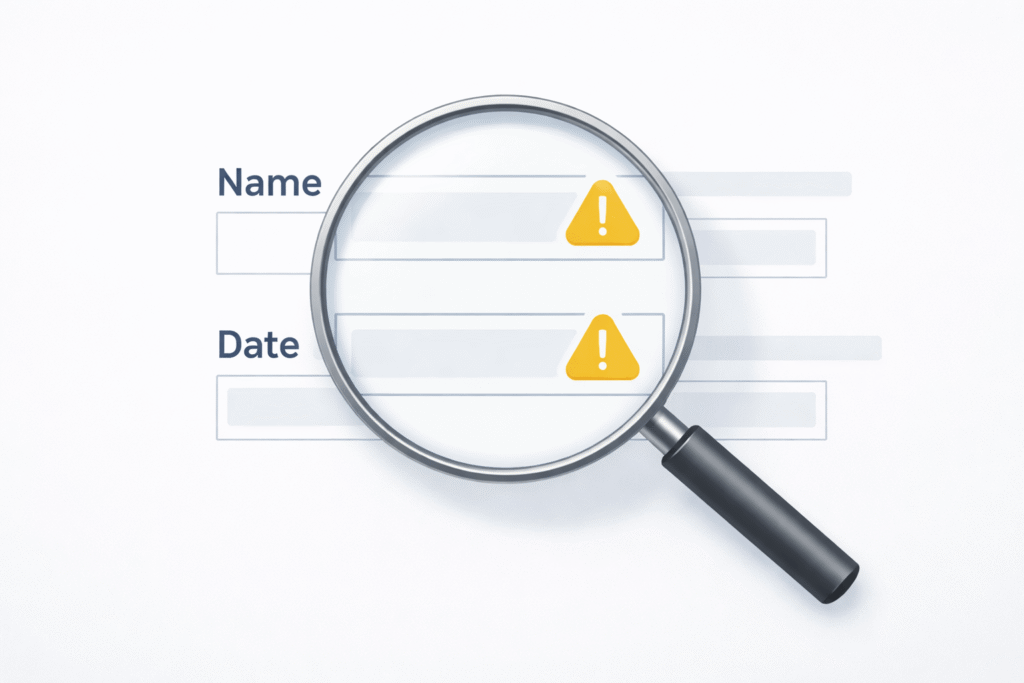
What can go wrong: Inconsistencies can trigger identity mismatches, especially across passports, birth certificates, marriage certificates, and application forms.
How to avoid it
- Decide on a “source of truth” for names, usually the passport, and ask for consistency across all documents
- Provide preferred spellings if you’ve used them in prior applications
- Ask the translator to keep:
- hyphens, spacing, and middle names consistent
- date formats consistent
- the same place name spelling across documents
- hyphens, spacing, and middle names consistent
Practical tip: If your document already contains multiple spellings, request a translator note such as: “Name appears as X and Y on the original.”
4) Date and Number Formatting Errors (A Surprisingly Common Problem)
Why it happens: Different countries use different formats, such as DD/MM/YYYY vs MM/DD/YYYY, decimal separators like 1,000.50 vs 1.000,50, and different numbering systems.
What can go wrong: A simple date swap can change the meaning of eligibility, age, deadlines, or financial statements.
How to avoid it
Ask for dates to be translated clearly. For example:
- “03/04/2026” should become 3 April 2026, not be left ambiguous
Confirm how numbers should appear for your destination:
- keep the original format where needed, or convert with care
Double-check:
- document numbers, including IDs and case numbers
- addresses with flat or unit numbers
- financial totals and currencies
Fast fix: Request a quick “numbers-only” verification pass during proofreading.
5) Word-for-Word Translation That Loses the Real Meaning
Why it happens: Literal translation feels “safe”, but languages do not map neatly.
What can go wrong: You end up with awkward phrasing or, worse, incorrect meaning, especially with legal, medical, and administrative wording.
How to avoid it
- Choose a translator experienced in your document type, whether legal, academic, or medical
- Ensure there is a review step by a second linguist or senior editor
- For official documents, aim for faithful meaning and formal register, not literalness
Mini example (conceptual):
A phrase that literally translates as “I make you know” may actually mean “I hereby notify you”. One sounds odd; the other matches official style.
6) Ignoring Jurisdiction-Specific Legal or Official Terminology
Why it happens: People treat legal terms as universal. They are not.
What can go wrong: The translation may be technically “correct” but not aligned with how the receiving authority expects the concept to appear.
How to avoid it
- Tell the translator where it will be used, including the country and authority
- Request terminology choices that match the target system while staying faithful to the source
- For legal documents, ask for:
- consistent terminology
- a glossary for repeated terms in larger files
- consistent terminology
Fast fix: If you already have prior accepted translations, share them so terminology can be matched.
How Translation Mistakes Differ by Document Type
Not every professional document fails for the same reason. The risk depends on what kind of document you are translating, who will review it, and what the translation needs to prove.
For legal documents, the biggest risks are incorrect legal terms, omitted handwritten annotations, inconsistent names, and clauses translated too literally.
For medical documents, the biggest risks are medicine names, dosage units, diagnoses, abbreviations, laboratory values, and treatment terms being mistranslated or reformatted incorrectly.
For academic documents, the biggest risks are subject names, award titles, grading scales, institution names, issue dates, and transcript formatting being translated inconsistently.
For business and financial documents, the biggest risks are totals, currencies, decimal separators, company registration numbers, invoice references, and signatory job titles being copied incorrectly.
For civil and identity documents, the biggest risks are passport spellings, parent names, places of birth, registry numbers, and issue or expiry dates not matching the supporting documents.
Practical tip: Tell your translator what type of document you are sending before work starts. A marriage certificate, court order, medical report, and university transcript all require different terminology choices and different checking priorities.
7) Poor Scan Quality and Missing Context for Illegible Sections

Why it happens: Phone photos are quick until the stamp is faint, the text is skewed, or glare wipes out key details.
What can go wrong: The translator guesses, omits, or marks too much as illegible, reducing acceptance and confidence.
How to avoid it
- Scan at high resolution where possible
- Photograph in bright, indirect light with no flash glare
- Include multiple photos if a stamp is faint, such as one normal and one angled
- If something is genuinely unreadable, request a clear, honest marker such as [illegible] rather than invention
Ready to start? Use our secure upload your document page—photos are fine as long as everything is readable.

8) Not Asking for Formatting That Mirrors the Original
Why it happens: People assume layout does not matter as long as the words are translated.
What can go wrong: Many authorities and many reviewers expect an official translation to be easy to compare line by line. Poor formatting slows verification and increases suspicion.
How to avoid it
Request formatting that reflects the source:
- tables stay tables
- headings remain headings
- stamps and seals are placed near the relevant text, or described clearly
For certificates, ask for a clean certificate-style layout that matches the original structure.
Fast fix: If your document has complex formatting, ask about document translation with formatting so it is handled properly from the start.
9) Choosing a Provider Based on Speed or Price Alone
Why it happens: Deadlines and budgets are real. But ultra-cheap, ultra-fast offers often cut corners, with no review, no certification accuracy checks, or heavy reliance on machine translation.
What can go wrong: You pay twice—once for the first translation, then again to fix it. Worse, you lose time if an application is delayed.
How to avoid it: a quick red-flag list
- No questions asked about destination authority or purpose
- No clear certificate wording for certified translations
- Refuses to translate stamps or notes, or says “we translate only text”
- No review process or quality checks
- Vague about who translates, with no accountability
- Pushes “instant” turnaround on multi-page or complex documents
A safer approach: Get a quote that includes review and certification in writing. You can get a quote in minutes, and we’ll confirm what your submission needs.
10) Skipping a Final Verification Step (The “Acceptance Check”)
Why it happens: Once the translation arrives, people submit immediately, especially under time pressure.
What can go wrong: Small errors slip through: a name letter, a date, a missing stamp description, or a page count mismatch.
How to avoid it: the 5-point acceptance check
- Page count matches the original, including reverse sides if relevant
- Names match passports and other documents
- Dates are unambiguous and written out where needed
- Stamps, seals, and signatures are included, translated, or clearly described
- The certificate statement includes what your authority expects, such as accuracy, competence, contact details, signature, and date
Fast fix: Ask for a quick “submission-ready” review before you file. If you’re on a deadline, request priority review by contacting us today.
Which Mistakes Are Most Likely to Cause Rejection?
If your goal is first-time acceptance, treat these issues as the highest priority:
- missing pages or reverse sides
- missing stamps, seals, signatures, or handwritten notes
- name mismatches across supporting documents
- ambiguous dates or number formatting
- the wrong certification, notarisation, or legalisation level
- layout that makes the translation difficult to compare with the source
- incorrect legal, medical, academic, or financial terminology
These are the issues reviewers tend to notice first because they affect identity, completeness, readability, and trust. If a receiving authority cannot easily verify that the translation matches the original, the chances of delay or rejection increase sharply.
A Simple “Translation Brief” You Can Copy and Paste
If you want fewer errors and faster turnaround, give your translator a clear brief. Copy this into your message when you upload:
Destination country + authority:
Purpose (immigration/court/academic/bank/other):
Do you need certification / notarisation / apostille?
Deadline + time zone:
Preferred spelling of names (if any):
Any prior accepted translations to match (optional):
Delivery format needed (PDF, Word, stamped hard copy, etc.):
What If You Already Submitted a Translation and It Was Rejected?
Don’t panic—most rejections are fixable quickly.
Common reasons for rejection and the usual fix:
- Missing stamp or signature translation → add stamp or signature descriptions and reissue
- No certificate statement or incomplete certificate → reissue with correct certification wording
- Name mismatch → standardise names and add a brief translator note if the original varies
- Illegible scan → rescan and correct the uncertain sections
- Formatting confusion → reformat to mirror the source for easier comparison
If you’ve received a rejection notice, upload it with your document, and we’ll prioritise a corrected, submission-ready version: start your project.
FAQs
What are the most common translation mistakes for official documents?
The most common translation mistakes are missing stamps or seals, inconsistent name spelling, date and number format errors, and using the wrong translation type, such as standard instead of certified or sworn.
How do I avoid bad translations when I’m on a tight deadline?
Avoid bad translations by sending a clear scan, providing a short brief with destination, purpose, and deadline, and choosing a service that includes review. Speed should never remove quality checks.
Are machine translations acceptable for certified translation?
For many official uses, machine-only translation is risky because it can miss context, formal wording, and layout requirements. If technology is used, it should be professionally reviewed and certified properly.
What should a certified translation include?
A certified translation typically includes the full translated document plus a signed certificate stating the translation is complete and accurate, with the translator’s name, signature, date, and contact details. Exact requirements vary by authority.
Why do authorities reject document translations?
Authorities commonly reject translations due to missing pages, missing stamps or seals, unclear certification statements, illegible source scans, and inconsistencies in names, dates, or numbers.
Do I need notarisation for a certified translation?
Not always. Notarisation is sometimes requested by specific institutions, but many authorities accept a properly certified translation without notarisation. Always check the submission requirements for your destination.
What are the most common translation mistakes in professional documents?
The most common mistakes in professional documents are omitted stamps or notes, inconsistent names, date and number formatting errors, literal translations that lose the intended meaning, incorrect terminology, poor formatting, and choosing the wrong type of translation service for the authority receiving the document.
Can one spelling mistake in a translated document cause rejection?
Yes, it can. A single spelling mistake in a person’s name, place of birth, document number, or date can create an identity mismatch, especially when the translation is being compared with a passport, visa file, court record, or academic application.
Should stamps, seals, and signatures be translated?
Yes. In most professional and official document translations, stamps, seals, signatures, handwritten notes, and visible annotations should either be translated or clearly described so the receiving authority can understand the complete document.
What is the difference between certified, sworn, notarised, and legalised translation?
Certified translation usually means the translation comes with a signed statement of accuracy. Sworn translation is a specific legal status used in certain jurisdictions. Notarisation confirms identity or signature, not linguistic accuracy. Legalisation or apostille is an authentication step for international use. The correct option depends on the country and authority requesting the document.
Why does formatting matter in professional document translation?
Formatting matters because reviewers often compare the translation against the original document line by line. When tables, headings, stamps, and certificate structures are mirrored clearly, the translation is easier to verify and more likely to be accepted without question.
What should I send a translator to reduce mistakes?
Send every page of the document, including reverse sides where relevant, a clear scan or photo, the destination country and authority, the purpose of the translation, your deadline, and any preferred spelling of names. If you have a previously accepted translation, include that too.
What if part of my original document is unclear or illegible?
If part of the source document is unclear, the translation should say so honestly rather than guessing. The best approach is to provide a clearer scan or additional photo. If that is not possible, the translator can mark the section as [illegible] or provide a best-effort note where appropriate.