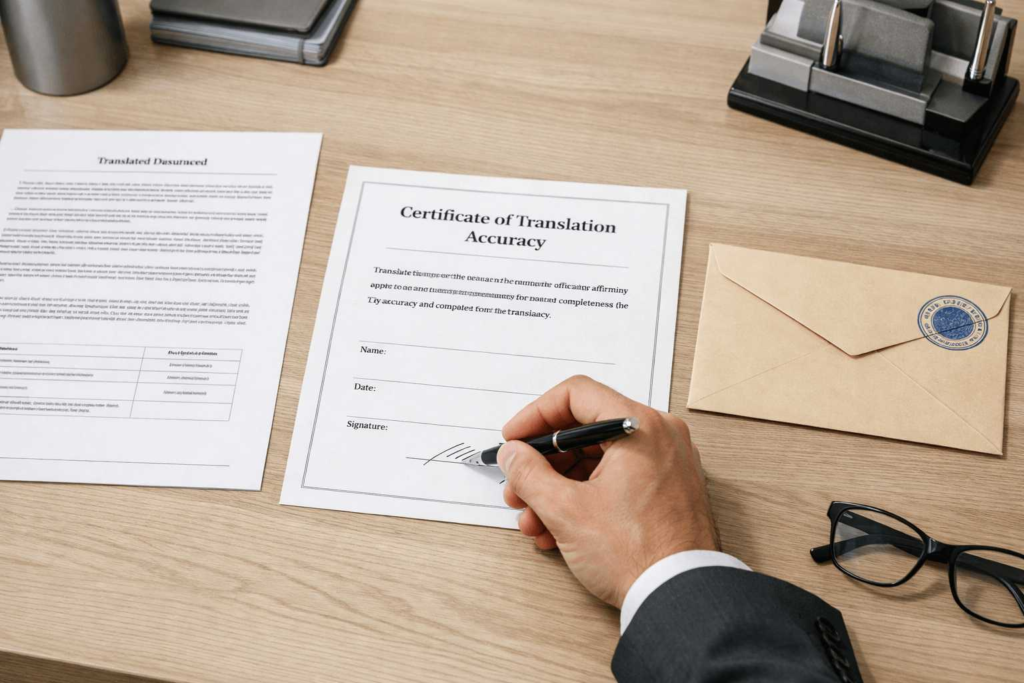
If you’ve been told you need a certified translation, you’ll almost always need one extra page attached to it: a certificate of translation accuracy (also called a translation certification statement or certified translation accuracy statement).
It’s a signed declaration from the translator (or translation company) confirming two things:
the translation is complete and accurate to the best of their ability
the translator is competent in the language pair
That single page is often what turns a “translation” into something an official organisation can accept.
If you’re submitting documents for immigration, visas, courts, universities, professional licensing, or regulated employment checks, the certificate matters just as much as the translation itself.
Need it done the first time properly? Upload your document and we’ll return a submission-ready certified translation with the correct certificate wording.
Why is a certificate of translation accuracy important?
A certificate of translation accuracy is important because it gives the receiving organisation a formal statement that the translation is complete, accurate, and prepared by someone competent in the language pair. In other words, it is the page that gives the translation credibility for official use.
For immigration officers, courts, universities, employers, regulators, and other decision-makers, the certificate helps answer the practical questions behind the document:
- Is this translation complete?
- Has anything been left out?
- Who is taking responsibility for the accuracy?
- Can the translator or agency be contacted if verification is needed?
Without that signed statement, a translated document can be treated as unofficial, incomplete, or harder to rely on. That can lead to delays, requests for resubmission, or outright rejection.
So while people often focus on the translated pages themselves, the certificate is often the part that makes the whole submission acceptable.
The simple definition (and why it exists)
A certificate of translation accuracy is a formal statement attached to a translated document that confirms the translation is faithful to the original.
Official organisations rely on it because they usually cannot assess the original language themselves. The certificate creates accountability: someone identifiable has put their name and signature to the work.
Think of it as the “attestation page” that answers the questions an officer would otherwise have to ask:
Who translated this?
Are they qualified to translate these languages?
Is this the full document, including stamps and notes?
Can we contact the translator if something is unclear?
What it is not (common misunderstandings)
This topic is full of confusing terms, so let’s clear up the biggest mix-ups.
A certificate of translation accuracy is not the same as…
1) A “certified translator” licence
In many countries, the requirement is for a certified translation, not a “government-certified translator”. The certificate is usually the key requirement.
2) Notarisation
Notarisation verifies the identity of the signer and witnesses the signature. It does not verify translation quality. Some organisations request notarisation in addition to the certificate, but it’s a separate step.
3) An apostille or legalisation
An apostille authenticates a public official’s signature or seal for international use. It’s not a translation quality statement. You may need an apostille for certain cross-border document processes, but it’s not a substitute for a translation certificate.
4) A sworn translation (country-specific)
Some countries require sworn translations completed by translators authorised by courts or government bodies. In those cases, the “certificate” may be built into the sworn format. Elsewhere, a standard certificate of translation accuracy is used.
When do you need a translation accuracy certificate?
You typically need a translation accuracy certificate whenever a document is being used for an official decision or legal record.
The most common scenarios
Immigration and visas (applications, supporting evidence, civil status documents)
Courts and legal matters (affidavits, exhibits, judgments, police reports)
Universities and credential evaluation (transcripts, diplomas, letters)
Employment and licensing (professional registrations, background checks)
Government processes (benefits, registrations, regulated compliance)
Medical and insurance (records used for official determinations)
Documents that often require certified translation + certificate
Birth, marriage, divorce, and death certificates
Passports, national IDs, residence permits
Police certificates and court records
Academic transcripts and diplomas
Bank statements, payslips, tax letters (when requested)
Medical records used for official submissions
If an organisation says “provide a certified translation”, they usually mean “provide a translation plus the certificate”.
Is a certificate of translation accuracy required for USCIS, UKVI, courts, and universities?
In many official processes, yes. Either the requirement is stated directly, or it is built into what the organisation means when it asks for a certified translation.
For immigration-related submissions, the translation is often expected to be accompanied by a signed certification confirming that it is accurate and complete and that the translator is competent in the relevant language pair.
For visa, court, university, and licensing submissions, the wording may vary, but the practical expectation is often very similar:
- a full translation
- a clear accuracy statement
- a translator competency statement
- a signature and date
- contact details where requested
The safest approach is to read the exact wording from the receiving organisation and match the format to that requirement. If they ask for a certified translation, do not assume the translated pages alone are enough. In many cases, the certificate is the page that makes the document set submission-ready.
What must a certificate of translation accuracy include?
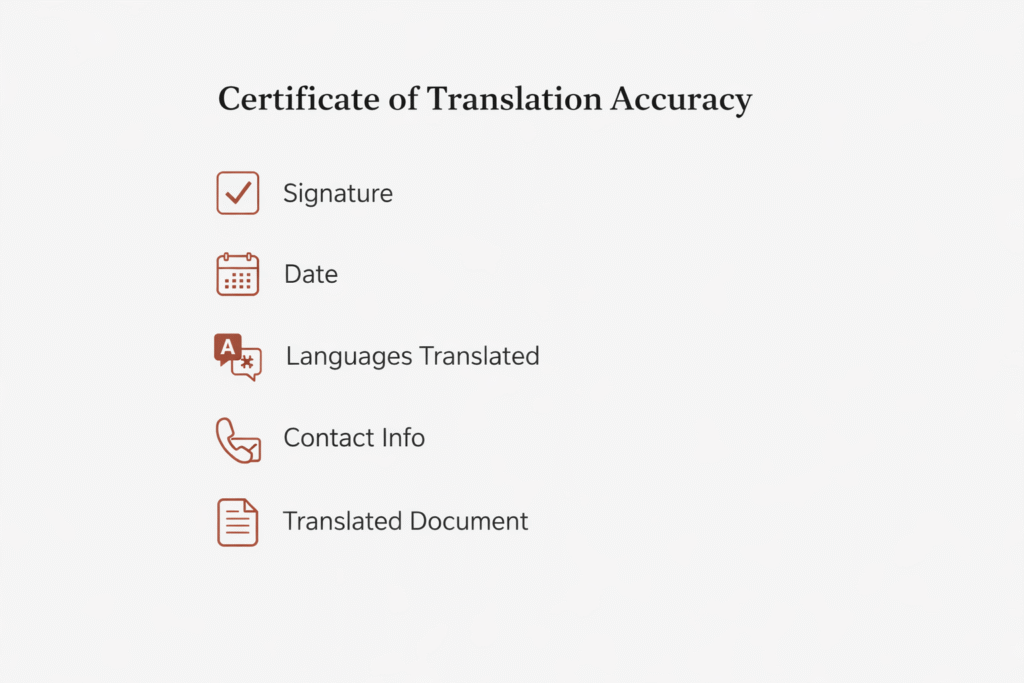
Requirements vary by country and receiving organisation, but a strong certificate usually includes:
The short version
If you want the quickest possible answer to the question “what should a certificate of translation accuracy include?”, the core items are:
- the translator’s full name
- the source language and target language
- the document name or description
- a statement that the translation is complete and accurate
- a statement that the translator is competent in the language pair
- the signature and date
- contact details for verification if needed
That combination answers the exact points most officers, admissions teams, caseworkers, and compliance reviewers are looking for.
Essential elements
Translator’s full name
Signature (handwritten or valid e-signature, depending on requirements)
Date of certification
Source language and target language (e.g., Spanish to English)
Document title/description (e.g., “Birth Certificate”, “Marriage Certificate”)
Statement of completeness and accuracy
Statement of translator competence in the language pair
Strongly recommended (often requested)
Translator’s contact details (email, phone, address or business address)
Translator credentials (qualification, membership, experience)
Company details if issued by an agency (letterhead, registration info)
Page count (useful when the original has multiple pages)
Reference to included stamps/seals/handwritten notes (to show nothing was ignored)
A practical rule
If an officer needed to verify the translation, the certificate should make it easy to:
identify the translator
see what document was translated
confirm it’s complete
contact the translator if necessary
Certificate wording that gets accepted (copy-ready templates)
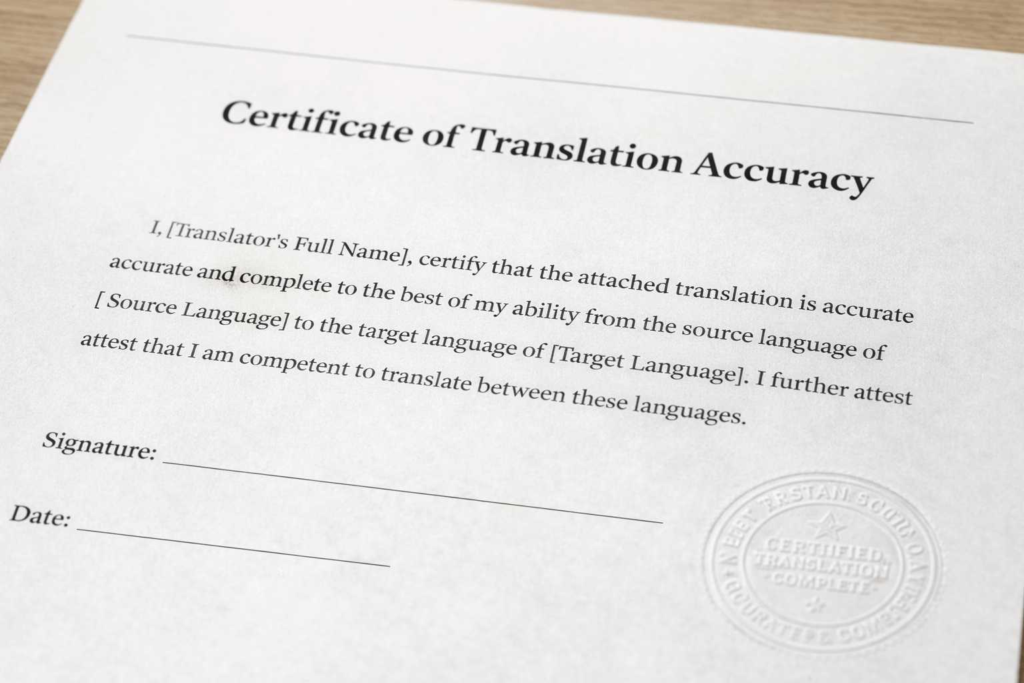
Below are practical templates you can adapt. Always match the wording to the receiving organisation’s requirements if they provide specific instructions.
Template 1: General certificate of translation accuracy (most common)
Certificate of Translation Accuracy
I, [Full Name], certify that I am competent to translate from [Source Language] into [Target Language] and that the attached translation of [Document Name/Description] is a complete and accurate translation of the original document to the best of my knowledge and ability.
Translator Name: [Full Name]
Signature: _______________________
Date: [DD Month YYYY]
Contact Details: [Email] | [Phone] | [Address or Business Address]
Qualifications/Credentials (optional): [Degree, membership, years of experience]
Template 2: Certificate issued by a translation company (agency format)
Certificate of Translation Accuracy
This is to certify that the attached translation of [Document Name/Description] from [Source Language] into [Target Language] has been completed by a qualified translator and has been checked for completeness and accuracy.
Translator/Reviewer: [Full Name]
Competency Statement: The translator is competent in both languages stated above.
Signature: _______________________
Date: [DD Month YYYY]
Company: Urgent Certified Translation
Company Contact: [Email] | [Phone]
Company Address: [Business Address]
Company Stamp (if applicable): _______________________
Template 3: Extra clarity for stamps, seals, and handwritten notes (highly recommended)
Add this single line to either template when the original includes stamps/seals/handwriting:
“All visible stamps, seals, signatures, and handwritten notes have been translated and/or clearly marked where illegible.”
That one line prevents a surprising number of “missing information” rejections.
Who can issue or sign a certificate of translation accuracy?
A certificate of translation accuracy should be signed by the translator who completed the work or by the translation company responsible for the certified translation, depending on the format being used.
The important point is not just the title of the signer. The signer should be identifiable, competent in the language pair, and willing to stand behind the translation.
In practice, receiving organisations usually want to see that:
- the certificate is signed by a real person or accountable translation provider
- the language pair is clearly stated
- the document being translated is clearly identified
- the signer can be contacted if verification is needed
A notary does not replace the translator’s certification role. A machine translation tool does not replace it either. The certificate only carries real weight when a competent human translator or an accountable translation company certifies the work.
What does a certificate of translation accuracy look like?
In practice, a certificate of translation accuracy is usually a separate page attached to the translated document or included as the final page of the certified translation pack.
It often appears on company letterhead or in a clean professional format and usually includes:
- a heading such as “Certificate of Translation Accuracy” or “Certification of Translation”
- the exact document name or a short description of the original
- the source and target languages
- a statement confirming completeness and accuracy
- a statement confirming translator competence
- the translator’s or company’s name and contact details
- the signature and date
If the original document contains stamps, seals, signatures, logos, annotations, or handwritten notes, the certificate and translated pages should make that clear. This helps show that the translation was complete and not selective.
Certified translation vs notarised vs sworn vs apostille (quick comparison)
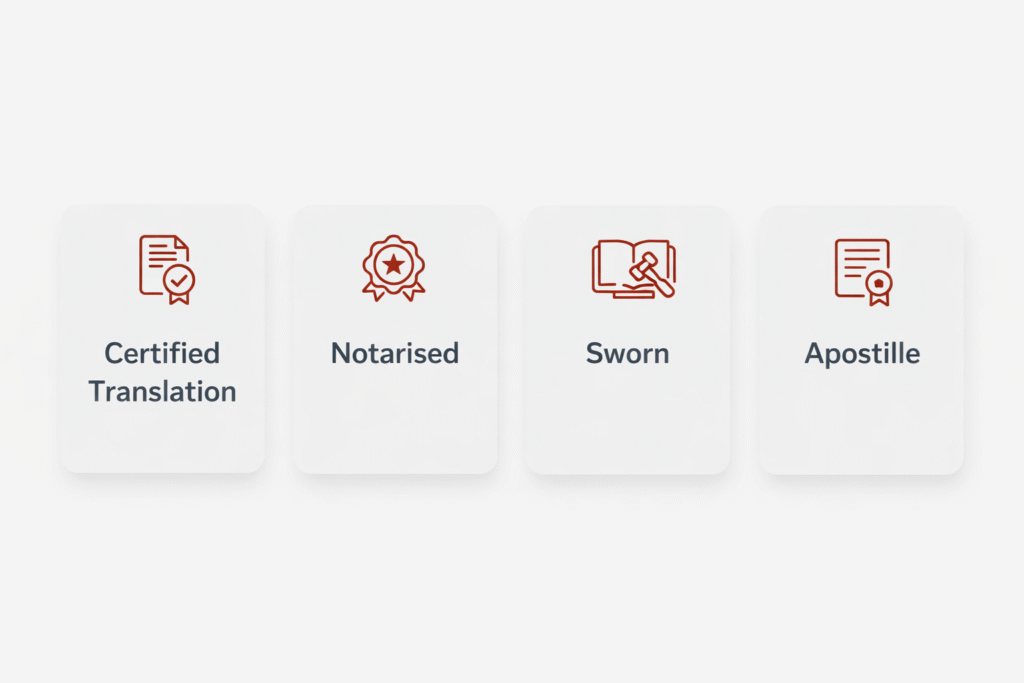
| Term | What it means | What it proves | When it’s used |
| Certified translation + certificate | Translation with a signed accuracy statement | Completeness, accuracy, translator competence | Immigration, courts, universities, licensing |
| Notarised translation | A notary witnesses the translator’s signature | Identity of signer (not translation quality) | Only when explicitly requested |
| Sworn translation | Translation completed under an authorised sworn framework | Legal status under that country’s rules | Country-specific legal/government use |
| Apostille/legalisation | Authentication of a public official’s signature/seal | Document authenticity for international use | Cross-border official processes |
If you’re unsure what you need, the fastest way to avoid wasted time is to confirm the receiving organisation and country, then match the format to their requirement.
The “acceptance test”: why translations get rejected (and how to prevent it)
Most rejections aren’t about language nuance. They’re about missing basics.
The most common failure points
No certificate attached
Certificate not signed or not dated
No translator contact details (common for UK visa-style requirements)
Language pair not stated
Partial translation (back pages, stamps, marginal notes omitted)
Names and dates are inconsistent with the original or passport spelling
Poor scan quality leading to guesswork instead of clear marking (e.g., “illegible”)
A submission-ready checklist you can use
Before you submit, confirm:
Every page is included (front and back, where relevant)
stamps and seals are either translated or clearly labelled
names match the spelling you need for the process
dates and document numbers are consistent and readable
the certificate includes competence + accuracy statements
The certificate is signed and dated
The translator can be contacted if needed
If you want this handled end-to-end, we apply a checklist like this before delivery so you’re not troubleshooting under a deadline.
Can I write my own translation certification statement?
People ask this a lot. The practical answer depends on the receiving organisation’s rules and risk tolerance.
Even when self-translation is not explicitly prohibited, it can create avoidable issues:
it can look less objective for high-stakes submissions
formatting and completeness mistakes are more common
if there’s a discrepancy, you have no independent translator to reference
For official submissions, the safest route is simple: use a qualified translator who can sign a proper translation certification statement with verifiable contact details.
Do you need notarisation as well?
Sometimes, but only if the receiving organisation explicitly asks for it.
A helpful way to think about it:
The certificate of translation accuracy speaks to the translation
Notarisation speaks to the identity of the signer
If you’re told “notarised translation,” clarify whether they mean:
notarised certificate signature, or
notarised copy of the original, or
a different legalisation step entirely
If you upload the instruction you received, we can format your translation for that exact request.
How to get a certificate of translation accuracy (the stress-free way)
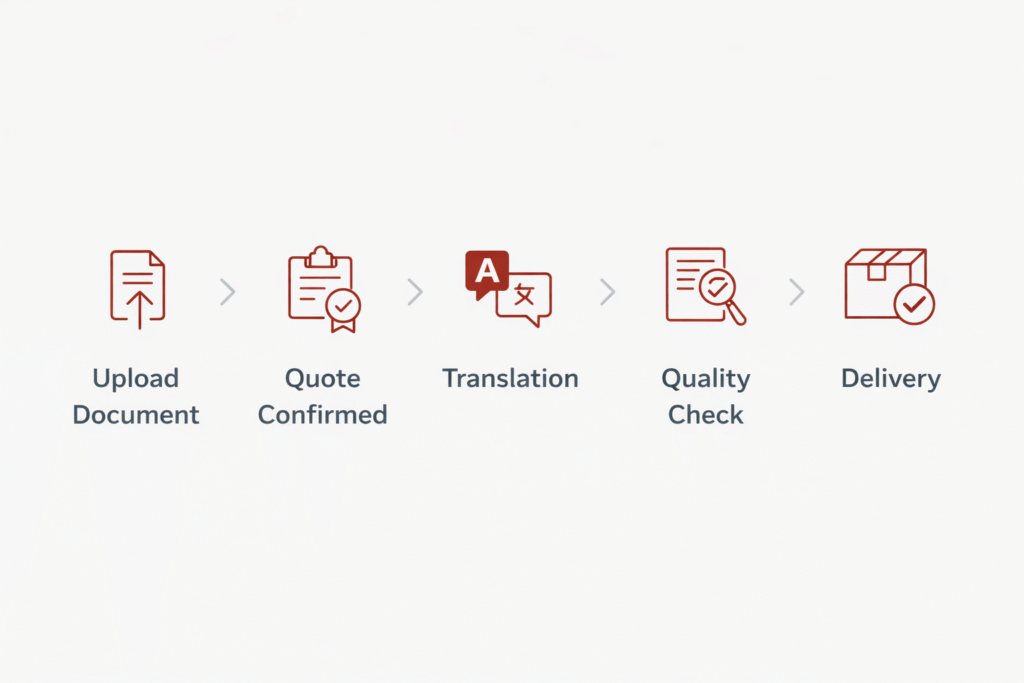
1) Use a clear scan or photo
Make sure edges aren’t cropped, and both sides are included where relevant.
2) Tell the translator where you’re submitting it
US immigration, UK visa, a university, a court, a professional regulator—requirements vary.
3) Confirm what needs translating
Stamps, seals, handwritten notes, headers, footers, registration numbers.
4) Ask for the certificate format in advance
A proper translation accuracy certificate should be signed, dated, and include contact details.
5) Review names and date formats before finalising
This is the most common “simple but costly” issue.
Ready to start? Upload your document, and we’ll confirm turnaround and deliver a certified translation with the correct certificate included.
FAQs
What is a certificate of translation accuracy?
A certificate of translation accuracy is a signed statement attached to a translation confirming it is complete and accurate, and that the translator is competent in the language pair.
What should a translation accuracy certificate include?
A strong translation accuracy certificate includes a completeness and accuracy statement, a translator competency statement, the translator’s name, signature, date, language pair, and contact details.
Is a certificate of translation accuracy the same as a certified translation?
It’s part of it. A certified translation typically means the translation is accompanied by a signed certificate of translation accuracy (also called a translation certification statement).
Do certified translations need to be notarised?
Not always. Notarisation is usually only needed if the receiving organisation specifically requests it. The certificate of translation accuracy is the core requirement in many official submissions.
Can machine translation come with a certificate of accuracy?
Machine translation tools can generate text, but they do not provide a credible, accountable certification statement signed by a competent translator, which is what official organisations expect.
Do I need a separate certificate for each document?
In most official contexts, yes. Each translated document should have its own certificate so it’s clearly tied to that specific document and language pair.
Why is a certificate of translation accuracy important?
It is important because it gives the receiving organisation a formal statement that the translation is complete, accurate, and prepared by a competent translator. Without it, a translation may be treated as unofficial or incomplete.
Who can sign a certificate of translation accuracy?
A qualified translator or accountable translation company can sign it, as long as the certificate clearly identifies the signer, states translator competence, and is tied to the specific document and language pair.
Is a digital signature acceptable on a translation accuracy certificate?
Often yes, but it depends on the receiving organisation’s rules. Some accept a valid e-signature or signed PDF, while others may ask for a wet signature or notarisation.
Does every stamp, seal, and handwritten note have to be translated?
For official submissions, visible stamps, seals, signatures, annotations, and handwritten notes should be translated or clearly marked if illegible. Omitting them is a common reason documents get questioned or rejected.
What happens if I submit a translation without a certificate of accuracy?
The receiving organisation may ask you to resubmit the document, delay processing, or reject the translation as incomplete.
How long is a certificate of translation accuracy valid?
The certificate itself usually does not have a standard expiry date, but the receiving organisation may have rules about how recent the translation or supporting documents must be. If in doubt, use a recently issued certificate.