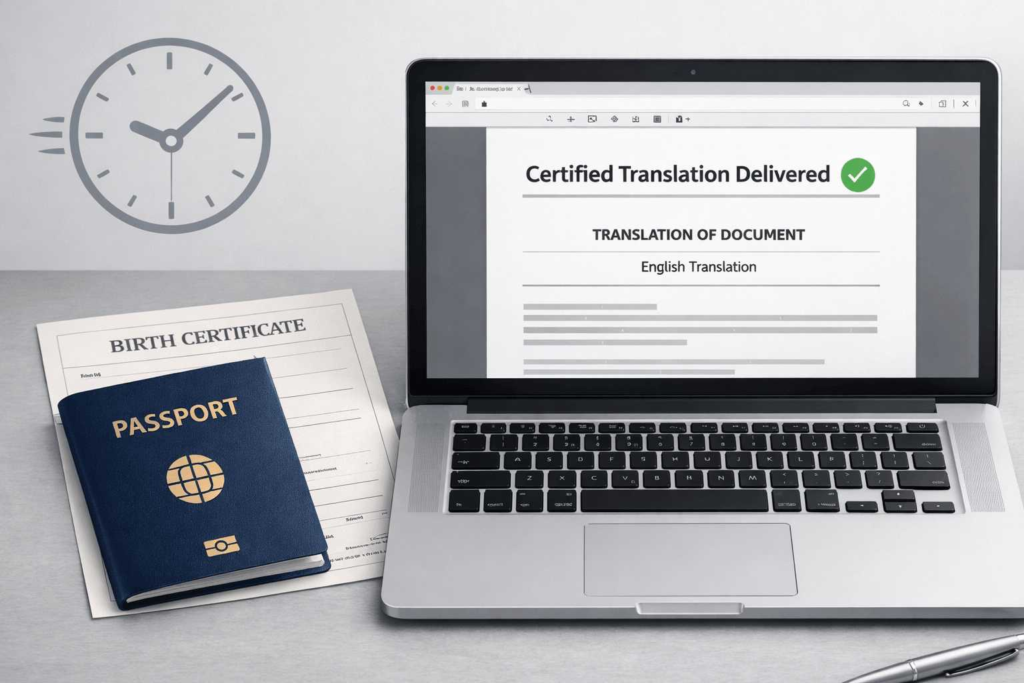
Deadlines don’t wait—especially when you’re dealing with immigration, courts, universities, or last-minute visa submissions. If you’re searching for rush certified translation options, you probably have one core question:
Can I get a certified translation today (and will it be accepted)?
The answer is yes in many cases—but “rush” isn’t one single service. There are tiers, trade-offs, and a few common pitfalls that can slow things down or cause a rejection.
This guide breaks down realistic turnaround times, what actually makes a certified translation fast, and how to choose the right emergency translation service without cutting corners.
What are the fastest certified translation services available in the UK?
In the UK, the fastest certified translation services are usually the providers that can genuinely offer one of three things:
- Same-day delivery for short personal documents
- 24-hour turnaround for small document packs
- Weekend or overnight processing for urgent deadlines
The best option is not simply the provider with the boldest speed claim. It is the provider that can confirm your file is suitable for rush handling, include the certification statement, preserve important names, dates, stamps, and references, and deliver a submission-ready PDF on time.
If you are comparing fast providers, look for:
- A realistic promised turnaround tied to your actual document
- A clear statement that the translation includes certification
- Experience with official submissions such as immigration, legal, academic, and employer use
- Acceptance of clear scans or mobile phone photos
- Digital delivery first, with hard copies only if needed
Rush certified translation options: what “rush” really means
A certified translation is a translation delivered with a signed certification statement confirming the translation is complete and accurate, and that the translator is competent in both languages.
A rush or emergency translation service simply compresses the workflow—without skipping what matters: accuracy checks, formatting consistency, and a compliant certification page.
Most providers’ rush options fall into these tiers:
Common turnaround tiers (what you can realistically expect)
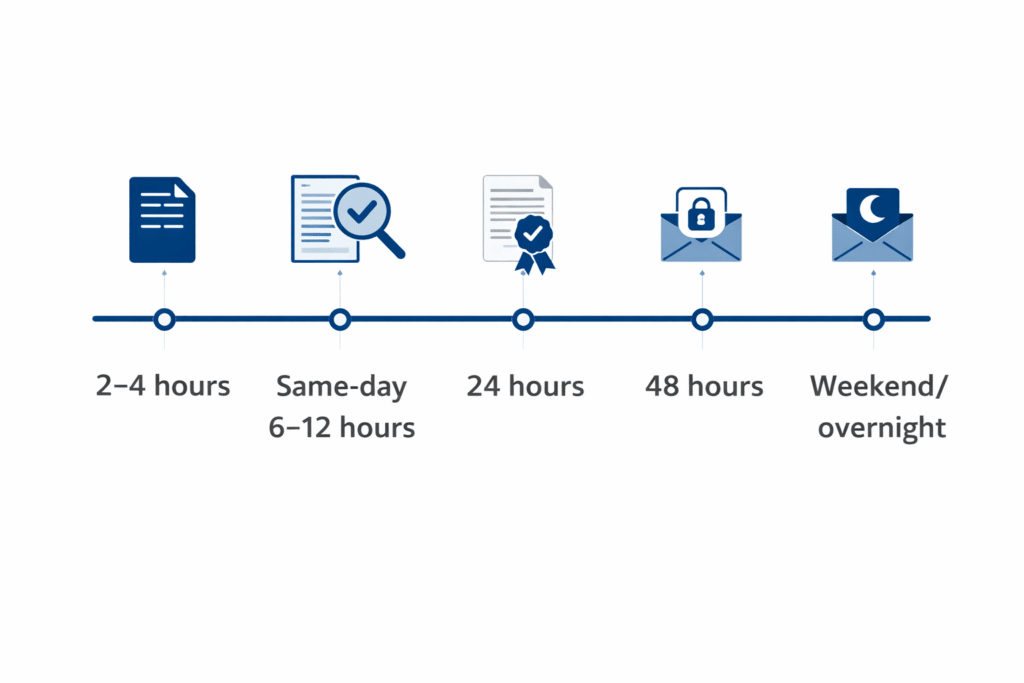
| Rush tier | Best for | Typical fit |
| Same-day (6–12 hours) | 1–2 page personal documents | Birth/marriage certificates, IDs, short letters |
| 24-hour (next-day) | 1–5 pages, common languages | Immigration packets, academic docs, bank statements |
| 48-hour | 5–15 pages or more complex layouts | Multi-page records, forms, scanned bundles |
| Weekend/overnight | Monday-morning deadlines | Documents submitted Fri–Sun |
| Ultra-urgent (2–4 hours) | Very short, very clear docs | Single-page certificates, short declarations |
If someone promises “any document, any language, in 1 hour,” treat it like a warning sign. Speed is achievable—but only when the document and language pair make it feasible.
What a fast certified translation needs to include
A fast service is only useful if the translation is still compliant for official use. In practice, a proper certified translation should include:
- A complete and accurate translation of the original
- A signed certification statement
- The date of certification
- The translator’s or agency’s contact details
- A clear indication of the source and target language, where relevant
For some authorities, the wording matters. For example, immigration-related submissions may expect the certification to confirm completeness, accuracy, and translator competence. If you need the translation for UKVI, the Home Office, USCIS, a court, or a university, say so at the start so the certification can be prepared correctly.
The fastest certified translation: what qualifies for same-day delivery
If you want the fastest certified translation, your project is a strong candidate for same-day if it’s:
- Short (usually 1–3 pages)
- Clear (high-resolution scan/photo, readable stamps and handwriting)
- Straightforward layout (not heavy tables, multiple columns, tiny footnotes)
- Common language pair (for example: Spanish to English, French to English)
- No extra legalisation steps required (like apostille handling or courier delivery)
Documents that often work well for same-day certified translation
- Birth certificates
- Marriage certificates
- Divorce decrees (short)
- Passports / national ID cards
- Police certificates (short)
- Short academic transcripts
- Bank statements (a few pages)
- Employment letters
- Simple affidavits
If yours looks like this, you can often get a certified translation within hours—especially if you submit it early in the day.
When “rush” slows down: the 7 most common blockers
Even emergency translation services have limits. Here’s what most often turns a “same-day” request into a next-day or 48-hour turnaround:
1) Poor scans and missing pages
Blurry photos, shadowed corners, cropped seals, or missing backs of documents create delays because the translator must confirm details instead of guessing.
Fix: Upload a clean scan or retake photos in bright natural light, flat on a table, with all corners visible.
2) High page count or dense content
A 12-page medical report is not the same as a 12-page set of stamps and headings. Word count matters more than pages.
Rule of thumb: If it’s dense, it’s slower.
3) Complex formatting (tables, stamps, handwritten notes)
Recreating layout for official use takes time—especially for multi-table documents.
4) Uncommon languages or specialised subject matter
Some languages require narrower specialist availability. Legal/technical documents also need domain accuracy.
5) Multiple documents bundled without labels
Ten files named “scan1, scan2, scan3” slow everything down.
Fix: Label files clearly (e.g., “Birth Certificate”, “Passport”, “Bank Statement”).
6) Certification format mismatch
Different authorities expect different details in the certification statement.
Fix: Tell us who it’s for (USCIS, UKVI, a university, a court, a bank).
7) Notarisation, apostille, or hard-copy shipping
These add steps. Digital delivery can be fast; physical handling takes logistics time.
Same day translation: how it works (step-by-step)
If you’ve ever wondered how same-day translation happens without sacrificing accuracy, here’s the workflow behind a proper rush job:
- Upload your file (PDF/JPG/PNG is ideal) via the secure portal: Upload your document
- Tell us the deadline and purpose (e.g., “tomorrow 10 am for UKVI”)
- We confirm rush feasibility and start immediately
- Translation + formatting pass to match the original structure
- Quality check (second set of eyes for names, dates, numbers, and consistency)
- Certification page added (signed statement ready for submission)
- Delivery by email (PDF), with print-ready formatting
If you need help choosing the right speed tier, start here: Get a rush quote
Choosing the right rush option (without overpaying)
Here’s a practical way to choose the right rush tier based on your real deadline:
If you have 2–4 hours
- Works best for 1-page documents
- Expect limited language availability
- You must provide a clean scan and clear instructions
If you have today (6–12 hours)
- Best for 1–3 page documents
- Most common use case for emergency translation services
If you have 24 hours
- Ideal for 1–5 pages
- More room for formatting and quality checks
If you have 48 hours
- Better for multi-doc packs (immigration bundles, academic applications)
- Reduces risk of mistakes and rework
If you’re unsure, don’t guess—upload the document and deadline, and we’ll recommend the fastest safe option: Start your rush order
Rush certified translation explained: speed vs. risk (what reputable providers won’t compromise)
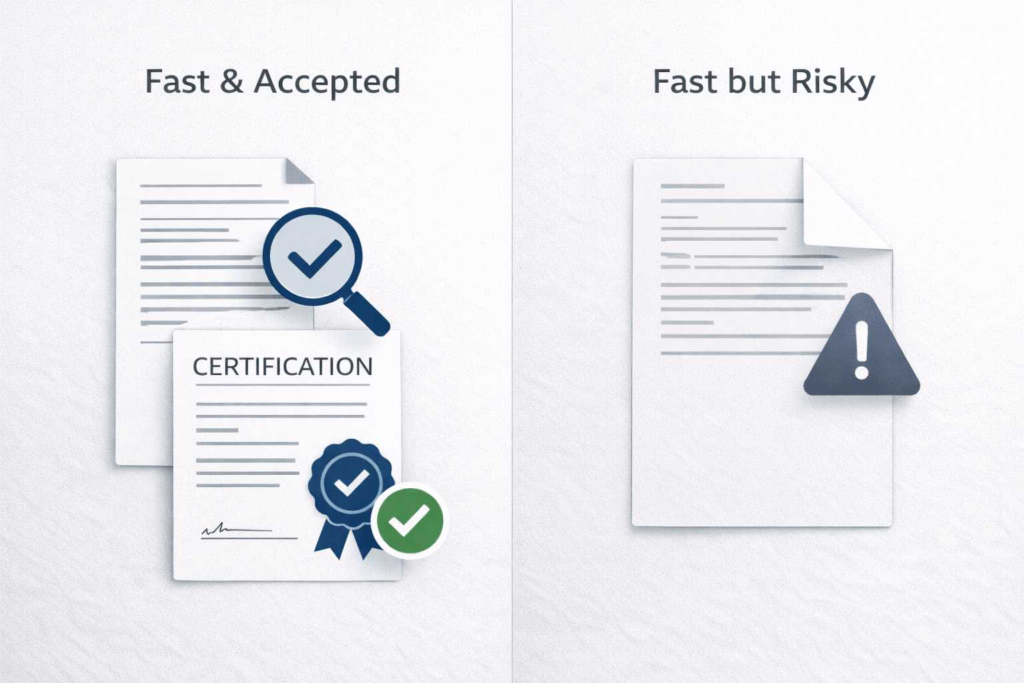
A real rush service accelerates the process by:
- Assigning your job immediately (front of the queue)
- Using experienced translators familiar with official standards
- Running a quick but meaningful QA check
- Providing the correct certification statement for the intended use
A risky rush service “accelerates” by:
- Skipping review
- Guessing unclear text
- Ignoring layout, stamps, or footnotes
- Delivering a certificate that lacks the required details
If your document is going to USCIS/UKVI/court, the cost of a rejection is usually far higher than the cost of doing it right the first time.
A realistic rush timeline (with examples)
Example 1: Same-day (6 hours)
Document: 1-page birth certificate, Spanish → English
Submitted: 9:15 am
Delivered: ~3:00pm
Why it was fast: clean scan, common language, simple layout
Example 2: Next-day (24 hours)
Document: 4-page bank statement + 2-page employment letter
Submitted: 4:30 pm
Delivered: next business day
Why it took longer: multiple documents, financial formatting, late-day submission
Example 3: 48-hour (complex)
Document: 18-page contract with tables, signatures, and annexes
Submitted: Tuesday morning
Delivered: Thursday
Why: dense legal content + layout-heavy formatting + higher QA requirement
The “Rush Readiness” checklist (do this and you’ll save hours)
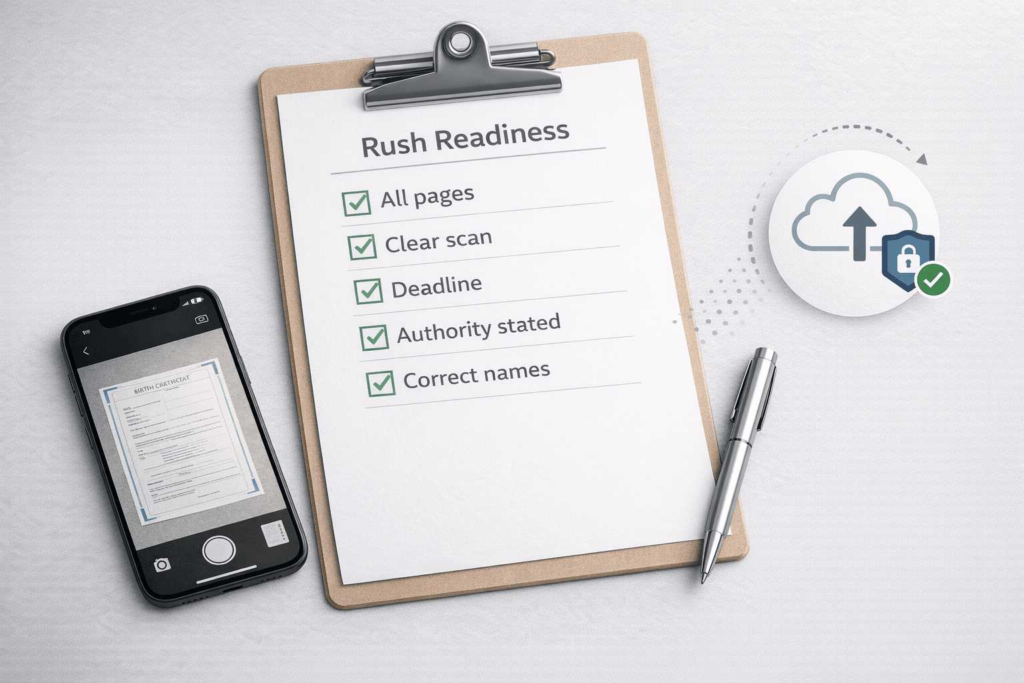
Before you upload, make sure you have:
- ✅ All pages included (front/back where applicable)
- ✅ Clean scan or high-res photos (no blur, no shadows)
- ✅ Correct spelling of names in Latin letters (as per passport)
- ✅ Destination authority stated (USCIS/UKVI/university/court)
- ✅ Deadline with time zone (e.g., “tomorrow 2pm GMT”)
- ✅ Delivery preference (digital PDF vs printed copy)
Ready? Upload your file now
What you’ll receive (so you can submit with confidence)
For rush certified translations, you should expect:
- A translated document that matches the original structure
- A separate certification page (signed statement of accuracy)
- Correct formatting of names, dates, stamps, and official notations
- A print-ready PDF (and editable format on request)
If your destination requires a specific format (for example, a particular certification wording or signature placement), mention it at upload time.
Emergency translation services for immigration, legal, and academic deadlines
Different use cases tend to have different “gotchas” that affect speed:
Immigration (USCIS / UKVI / visa applications)
- Accuracy in names, dates, and document numbers is critical
- Missing pages can trigger delays or re-requests
- Certification wording must be compliant with the authority
Helpful starting point: Certified translation services
If you’re submitting immigration documents frequently, Immigration document translation
Legal / court deadlines
- Formatting and completeness matter as much as wording
- Exhibits, annotations, and stamps often need careful handling
See: Legal translation services
Universities and credential evaluation
- Transcripts, diplomas, and multi-page records often need consistent formatting
- Sometimes sealed or stamped layouts must be preserved
See: Academic translation services
“Fast and cheap” vs “fast and accepted”: what to look for
If you’re comparing providers, these trust signals matter more than bold promises:
- Clear turnaround commitments tied to your document
- Transparent rush pricing (no surprise add-ons after you pay)
- A defined process (translation + review + certification)
- Secure upload and privacy protection
- Responsive support when the deadline is tight
How to compare the fastest providers in the UK
Before you choose a rush service, ask:
- Can you confirm the delivery time based on this exact file, not a generic promise?
- Does the price include the certification statement?
- Will I receive a print-ready PDF first?
- Can you work from a phone photo if needed?
- Is same-day realistic for my language pair and document type?
- Will you flag if notarisation, apostille, or hard-copy shipping will slow things down?
Those six questions help you avoid providers that sound fast in search results but become slower once formatting, certification, or missing details are involved.
If you want the fastest option that still protects acceptance, the best next step is simple: upload your document and deadline, and we’ll confirm feasibility immediately.
Get a rush quote
FAQs
How fast can I get a certified translation?
For short, clear documents, you can often receive a certified translation the same day (6–12 hours). Many standard rush jobs are delivered within 24 hours, depending on language, length, and formatting.
What are the best rush-certified translation options for tomorrow?
If your deadline is tomorrow, the safest choice is usually a 24-hour rush (or same-day if submitted early). Upload the file with your deadline so the provider can confirm feasibility before starting.
Do emergency translation services include the certification page?
They should. A proper rush service delivers the translation plus a signed certification statement confirming accuracy and completeness, ready for official submission.
Same-day translation—how do I make it possible?
Submit early, upload a clean scan, include every page, label files clearly, and specify the destination authority (e.g., USCIS, UKVI, court). These steps remove the most common blockers.
Is the fastest certified translation always accepted?
Speed alone doesn’t determine acceptance—compliance and accuracy do. A fast translation can still be rejected if the certification statement is incomplete, pages are missing, or critical details are wrong.
Does notarisation make rush certified translation slower?
It can. Notarisation and hard-copy delivery add steps and logistics. If you need notarisation, mention it upfront so timelines can be confirmed accurately.
Which certified translation services are fastest in the UK?
The fastest services are typically agencies that offer same-day or 24-hour certified translations for short, clear documents and confirm feasibility before starting. Look for digital delivery, including certification, and realistic turnaround based on document length and language.
Will a same-day certified translation be accepted by UKVI or the Home Office?
It can be, provided the translation is complete, accurate, properly certified, and contains the details required for the authority you are submitting to. Speed does not cause rejection; missing certification details, incomplete pages, or inaccurate names and dates do.
Can I send a phone photo instead of a scan?
Usually, yes, as long as the image is sharp, flat, fully visible, and readable at the edges. For urgent jobs, a clear phone photo is often enough to begin.
Can I get a certified translation overnight or on the weekend?
Sometimes yes. Weekend and overnight availability is usually limited to shorter documents and common language pairs, so the safest approach is to send the file and exact deadline as early as possible.
Do I need the original paper document?
Not usually for a standard certified translation. In most cases, a clear scan or photo is enough to produce a certified digital PDF. Physical originals only become relevant when a receiving authority asks for hard copies, notarisation, or apostille handling.