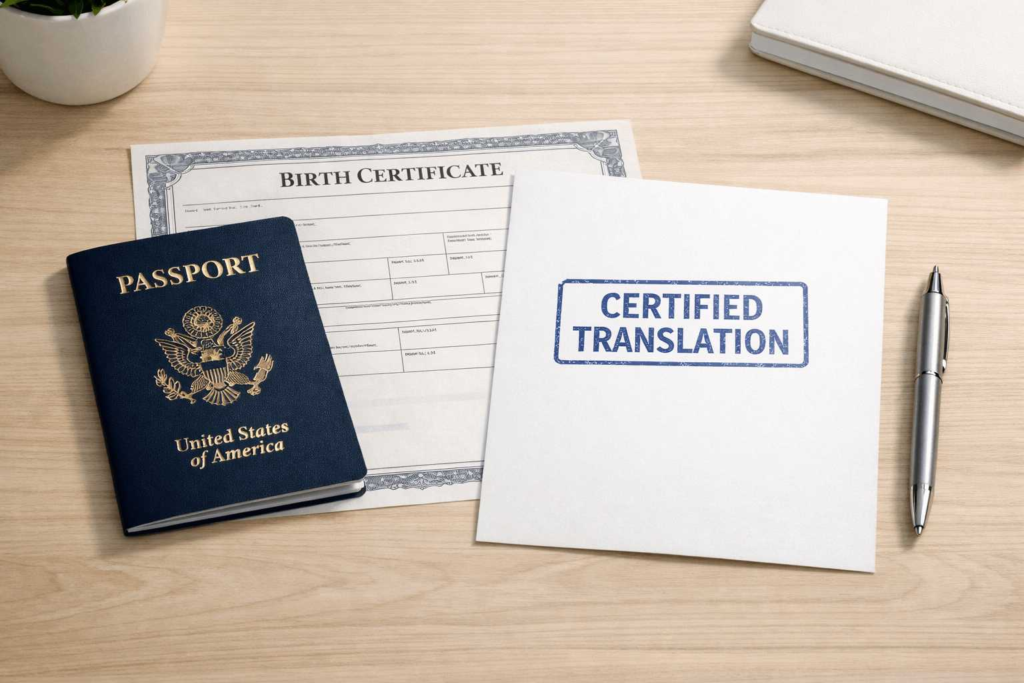
If you’re asking how long a certified translation takes, you probably have a real deadline: an immigration filing, a university submission, a court date, a job offer, or a last-minute request from an authority.
Here’s the honest answer: many certified translations for short personal documents are completed in 24–72 hours, but the true certified translation turnaround time depends on a handful of factors that can either speed things up dramatically or quietly add days.
For most short official documents in the UK, a certified translation typically takes 1–3 business days. A single-page birth certificate, marriage certificate, divorce certificate, passport, or ID document may sometimes be completed the same day or within 24–48 hours, while longer, denser, or more complex files often take 3–7 business days. If you also need notarisation, apostille/legalisation, or hard-copy shipping, the total timeline can extend beyond the translation itself.
To make planning easier, this guide breaks down:
- typical timelines by document size and type
- what “turnaround time” includes (and what it doesn’t)
- what slows delivery (and how to avoid it)
- how to get urgent service without risking rejection
- a simple estimator you can use today
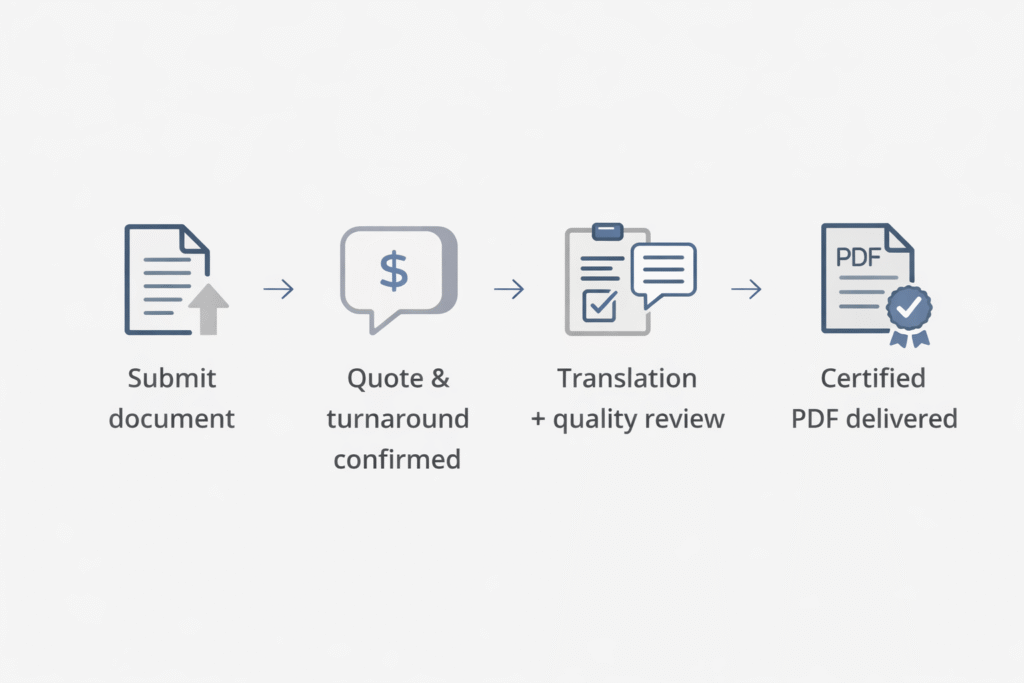
If you’re working to a deadline, start here: certified translation services.
At-a-Glance: Typical Certified Translation Timeline
Most requests fall into one of these lanes:
- Single-page certificates (birth, marriage, divorce): often same day to 2 business days
- 2–5 pages: typically 1–3 business days
- 6–15 pages: typically 2–4 business days
- 15+ pages or complex formatting: typically 3–7 business days, sometimes more
Add extra time if you need:
- notarisation: often +1–3 business days, depending on availability
- apostille/legalisation workflows: can add days to weeks, depending on the country and issuing authority
- printed copies shipped: shipping time depends on destination and courier option
Typical Certified Translation Turnaround by Document Type
Some people think only page count matters. In reality, document type can affect turnaround just as much as length.
Birth certificates, marriage certificates, divorce certificates, passports, ID cards, and police certificates are often the quickest to complete. If the scan is clear and the language pair is common, these are frequently delivered the same day to 2 business days.
Academic transcripts, diploma supplements, and course records usually take longer because they often contain tables, abbreviations, stamps, and repeated terminology that must stay consistent. These commonly take 2–4 business days.
Bank statements, payslips, employment letters, and short supporting documents are often completed in 1–3 business days, depending on volume and formatting.
Medical records, court documents, legal letters, contracts, and technical files often require a slower, more controlled process because accuracy, terminology, and presentation matter more. These usually take 2–5 business days or more.
Large mixed bundles for immigration, court, academic, or employer submissions commonly take 3–7 business days or longer, especially if they include multiple document types, handwriting, or extra services.
What “Certified Translation Turnaround Time” Really Includes
People often think the timeline is just “translate the words”. In practice, translation delivery time usually includes several stages.
Intake and Checks
The document is reviewed for language pair, page count or word count, legibility, deadline, and any special submission requirements.
Translation
The text is translated carefully, line by line, including names, dates, places, document numbers, official terms, and labels.
Quality Review
Certified work is usually checked carefully because small errors can lead to rework, questions from the receiving authority, or rejection.
Formatting for Comparison
Official documents often need clear labelling of stamps, seals, signatures, tables, headings, and marginal notes so the translation is easy to compare against the original.
Certification Statement
A signed Certificate of Translation Accuracy, or equivalent certification wording, is added for submission use.
At Urgent Certified Translation, certified documents are prepared with a quality check and signed certification and delivered as a professional PDF. For an overview of what’s included, see certified translation services.
This is one reason certified translation can take longer than people expect. The timeline is not just about translating text. It is also about producing a submission-ready document that clearly reflects the original and includes the certification needed for official use.
Typical Turnaround Time by Document Size (with Real-World Expectations)
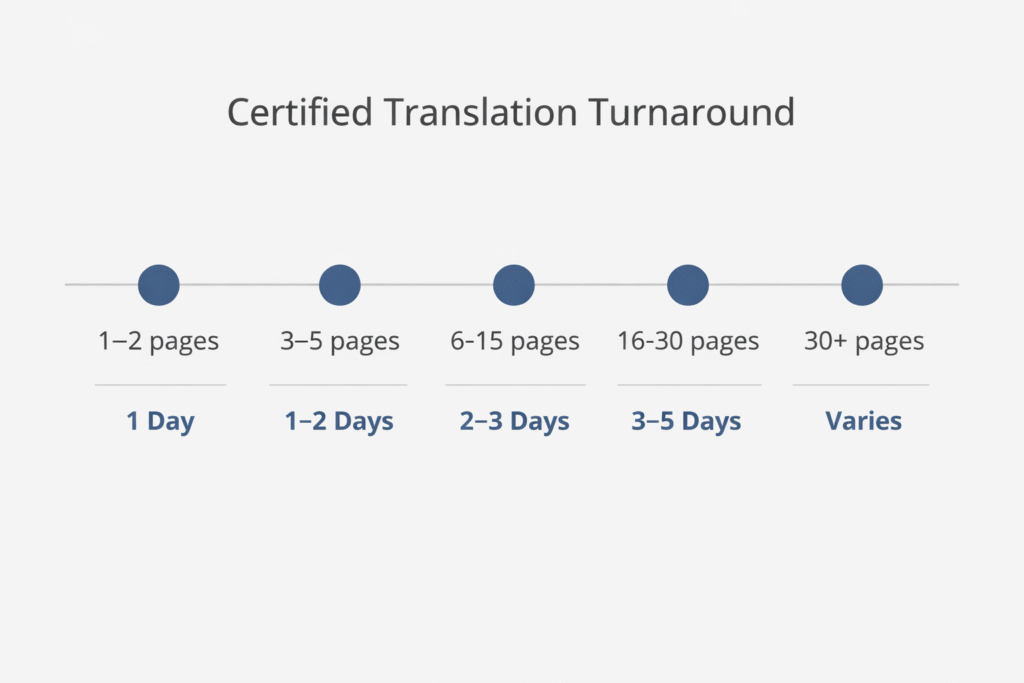
Use this table as a planning baseline. It’s designed for common official-use documents such as certificates, ID documents, transcripts, and statements.
Estimated Timelines (Standard Service)
1 page
Typical use cases: birth certificate, marriage certificate, ID card, passport page
Typical delivery: same day to 2 business days
2–5 pages
Typical use cases: multiple certificates, short statements, simple supporting documents
Typical delivery: 1–3 business days
6–15 pages
Typical use cases: academic transcripts, longer statements, multi-page records
Typical delivery: 2–4 business days
16–30 pages
Typical use cases: legal bundles, case files, dense academic packs
Typical delivery: 3–6 business days
30+ pages
Typical use cases: large case files, extensive supporting document packs
Typical delivery: 5–10 business days
When Same-Day Certified Translation Is Realistic
Same-day certified translation is most realistic when all of the following are true:
- the file is only 1–2 pages
- the scan is clean, readable, and complete
- the language pair is common
- there is little or no complex layout recreation
- names and spellings are confirmed exactly as required
- no notarisation, apostille, or hard-copy shipping is needed
If you need it urgently, the fastest path is to send your document and deadline clearly via contact us so your turnaround can be confirmed upfront.
What Affects Certified Translation Turnaround Time
1) Document Length and Density
A “page” can be misleading. One page may contain only a few lines, while another may be packed with small text, notes, and technical language.
A one-page certificate might contain 150–350 words. A one-page legal letter could contain 900 or more. A transcript page may contain tables, abbreviations, stamps, handwriting, and tight formatting.
The denser the page, the more time it takes to translate accurately and review.
2) Language Pair and Translator Availability
Turnaround is usually faster for widely used language pairs because more specialist translators are available and terminology resources are easier to access.
For rarer language pairs or regional variants, the timeline can extend because the right linguist must be scheduled.
3) Complexity and Subject Matter
Some documents need slower, more controlled work. Examples include:
- court pleadings and evidence bundles
- medical records with specialised terminology
- financial statements with regulated language
- technical certificates with standards and codes
If your document needs to be submission-ready, speed is possible, but only if enough review time is built in.
4) Formatting Requirements
Official documents often contain non-text elements that must be shown clearly in the translation, such as:
- stamps and seals
- signatures
- handwritten entries
- tables
- marginal notes
- multi-column layouts
If the receiving authority needs the translation to be easy to compare with the original, formatting can add time.
5) Scan Quality
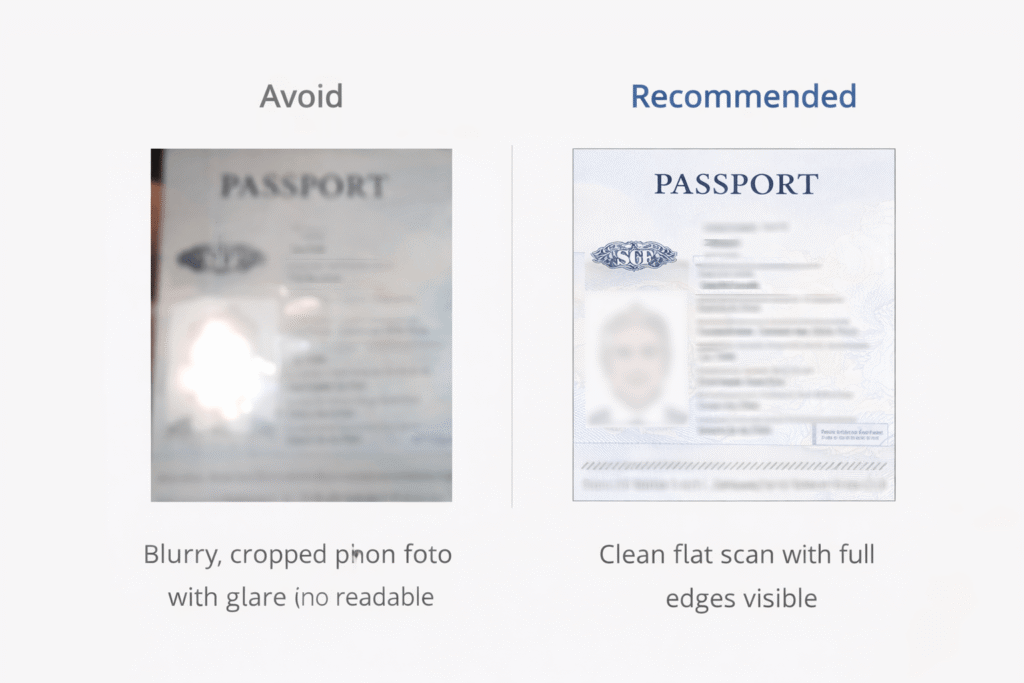
This is one of the most underestimated delay factors.
Blur, glare, cropped edges, missing sections, low resolution, or shadows can slow delivery because translators may need clarification before proceeding. Names, numbers, dates, and document references cannot be guessed safely.
If you want the fastest certified translation timeline, start with a clean scan or a bright, square-on phone photo.
6) Extra Services
Certified translation is one step. Some organisations ask for more.
Notarisation
Notarisation often adds 1–3 business days, depending on coordination and appointment availability.
Apostille or Legalisation
The translation may be fast, but the legalisation chain can be much longer. Requirements vary by country and document type.
Hard Copies Shipped
Digital delivery is usually quickest. Shipping adds transit time and may also involve courier cut-off times.
How Fast Can Documents Be Translated? A Realistic Speed Guide
A practical way to think about translation speed is this: many professional translators plan for roughly 1,500–2,500 words per day for careful, official-use translation, plus time for review and certification.
Dense formatting, handwriting, tables, and mixed document types reduce that pace.
That is why a short certificate can sometimes be completed in hours, while a 25-page file may still require several days, even when work begins immediately.
Certified work includes more than translation alone. It includes checking, presentation, and the certification statement, so “translation time” is not the full timeline.
A Simple Turnaround-Time Estimator You Can Use Today
If you need a quick estimate before ordering, use this rule of thumb:
Estimated business days = Base time + Formatting time + Add-ons
Step 1: Pick a Base Time by Volume
- 1–2 pages: 0–2 business days
- 3–5 pages: 1–3 business days
- 6–15 pages: 2–4 business days
- 16–30 pages: 3–6 business days
- 30+ pages: 5–10 business days
Step 2: Add Formatting Time if Needed
Add 0–2 business days if your file includes:
- heavy tables, such as transcripts or statements
- multiple stamps or seals per page
- handwriting throughout
- multiple mixed document types in one bundle
Step 3: Add Service Extras
- notarisation: +1–3 business days
- hard-copy shipping: +1–5 business days, depending on destination and courier
If you want a confirmed estimate based on your exact file, not just a general range, send the document and your deadline to us, and you’ll get a clear turnaround confirmation before anything proceeds.
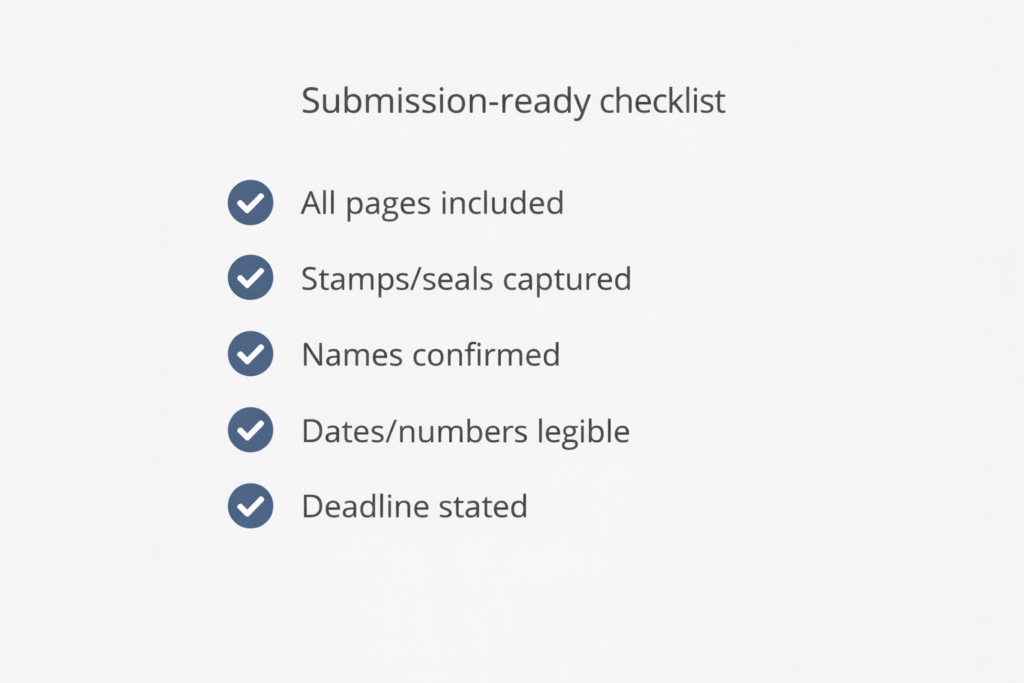
The Submission-Ready Checklist That Prevents Last-Minute Delays
If you do these five things, you’ll usually get the fastest translation delivery time.
Send Every Page
Even backs, attachments, or pages that look unimportant may contain stamps, notes, or references.
Capture Stamps, Seals, Signatures, and Marginal Notes Clearly
These are often the first items that lead to rework if missed.
Confirm Name Spellings Exactly as Required
Match your passport or ID spelling, including spacing, order, and special characters where relevant.
Make Sure Dates and Document Numbers Are Legible
If a number is unclear, the translation cannot be safely finalised.
Say Where the Translation Is Being Submitted
Requirements can differ between immigration authorities, universities, courts, employers, and regulators.
For a streamlined intake-to-delivery process built around these checks, see certified translation services.
Common Timeline Mistakes and How to Avoid Them
Mistake 1: Assuming “Certified” Means “Instant”
Certification requires a signed statement and careful verification, especially of names, numbers, dates, and completeness.
Fix: Build in a small buffer where possible. If your deadline is Friday, try to order by Wednesday.
Mistake 2: Sending Low-Quality Photos
A single blurry character in a passport number or name can stall the job.
Fix: Retake photos in daylight with no glare, full frame, and a straight angle.
Mistake 3: Ordering the Wrong Service Level
Some authorities accept certified translations only. Others may require notarisation, apostille, or other additional steps.
Fix: Check the receiving authority’s wording and send that requirement with your document if you are unsure.
Mistake 4: Uploading Mixed Documents at the Last Minute
Different document types may require different terminology, formatting styles, and quality checks.
Fix: Group your uploads by type where possible, such as certificates together, IDs together, and transcripts together.
Real-World Examples of Certified Translation Timelines
These examples show how timelines change depending on document type, not just page count.
Example A: 1-Page Birth Certificate with a Clean Scan
Translation, review, and certification statement.
Typical delivery: same day to 1 business day
Example B: 6-Page Academic Transcript with Tables and Stamps
Table formatting, abbreviations, course title consistency, and review.
Typical delivery: 2–4 business days
Example C: 18-Page Legal Bundle with Mixed Exhibits
Terminology consistency, line-by-line checking, formatting, and exhibit labelling.
Typical delivery: 4–7 business days, though expedited options may be possible depending on language pair and file quality.
Authority Requirements That Can Affect the Timeline
This is one of the most important parts of planning properly.
Sometimes people ask, “How long does a certified translation take?” when what they really mean is, “How long until I have a version I can safely submit?”
That depends partly on what the receiving authority expects.
Some submissions only need:
- a professional translation
- a signed certification statement
Others may require:
- specific certification wording
- translator or company details
- notarisation
- apostille or legalisation
- paper copies rather than just a PDF
As a practical rule, certified translation only is usually the fastest route. Certified translation plus notarisation usually takes longer. Certified translation plus apostille or legalisation usually takes longer still.
If your document is for a visa, immigration application, university, court, employer, or regulator, sending the exact requirement wording before ordering can help avoid delays caused by choosing the wrong service level.
If You Need Certified Translation Urgently, Do This
When time is tight, the goal is fast without introducing risk.
- send a complete, readable file with all pages included
- state your hard deadline clearly, including date, time, and time zone
- confirm name spellings exactly as per your passport or ID
- mention where the translation will be submitted
- ask for the delivery format you actually need, as PDF is usually quickest
If you’re on a clock, use contact us to share the document and deadline and get a confirmed turnaround.
What You Receive and What to Check Before Submitting
Your certified translation should be:
- complete, with no missing pages, notes, stamps, or seals
- easy to compare against the original
- clearly labelled
- accompanied by a signed certification statement
- delivered in the format your authority accepts, often PDF
Before you submit, do a quick check:
- names match your ID spelling
- dates are consistent
- document numbers are accurate
- all seals, stamps, and signatures are represented and labelled
That one-minute review can help prevent a painful resubmission later.
Frequently Asked Questions
How long does a certified translation usually take for a birth certificate?
For a clean, single-page certificate, it is often the same day to 2 business days, depending on the language pair and review requirements.
What is the typical certified translation turnaround time for 5 pages?
A common range is 1–3 business days, with extra time if the file includes complex tables, stamps, or handwriting.
How fast can documents be translated if I need a certified translation urgently?
Urgent options may be available for 1–2 pages and are sometimes possible the same day. The fastest results usually come from clear scans, common language pairs, and confirmed name spellings.
Does notarisation change the certified translation timeline?
Yes. Notarisation usually adds extra processing time, often 1–3 business days, because it involves coordination beyond the translation itself.
Why do certified translations sometimes take longer than standard translations?
Certified work usually includes extra checking, formatting for comparison, and a signed certification statement. That process helps reduce avoidable errors and follow-up delays.
What’s the best way to speed up translation delivery time?
Send a complete, readable document, include all pages, state your deadline clearly, and confirm the spelling of names exactly as required for submission.
How long does a certified translation typically take in the UK?
In the UK, many short certified translations are completed in 1–3 business days. Single-page certificates may be completed the same day or within 24–48 hours, while longer or more complex files often take 3–7 business days.
Can I get same-day certified translation in the UK?
Yes, in some cases. Same-day service is most realistic for 1–2 clean pages in a common language pair when no notarisation, apostille, or shipping is required.
How long does it take to translate a marriage certificate in the UK?
A clean one-page marriage certificate is often completed the same day to 2 business days. Add more time if the scan is poor, the language pair is less common, or extra certification steps are needed.
Is 24 hours realistic for certified translation?
Yes, for some short documents. A 24-hour turnaround is most realistic when the file is short, readable, and straightforward to certify.
What usually causes the biggest delays in certified translation?
The most common delay factors are poor scan quality, missing pages, unclear spellings of names, heavy formatting, handwriting, rare language pairs, and extra services such as notarisation or legalisation.
Does the receiving authority affect how long certified translation takes?
Yes. If the authority expects specific certification wording, translator details, notarisation, or hard copies, the timeline can be longer than for a standard certified PDF.