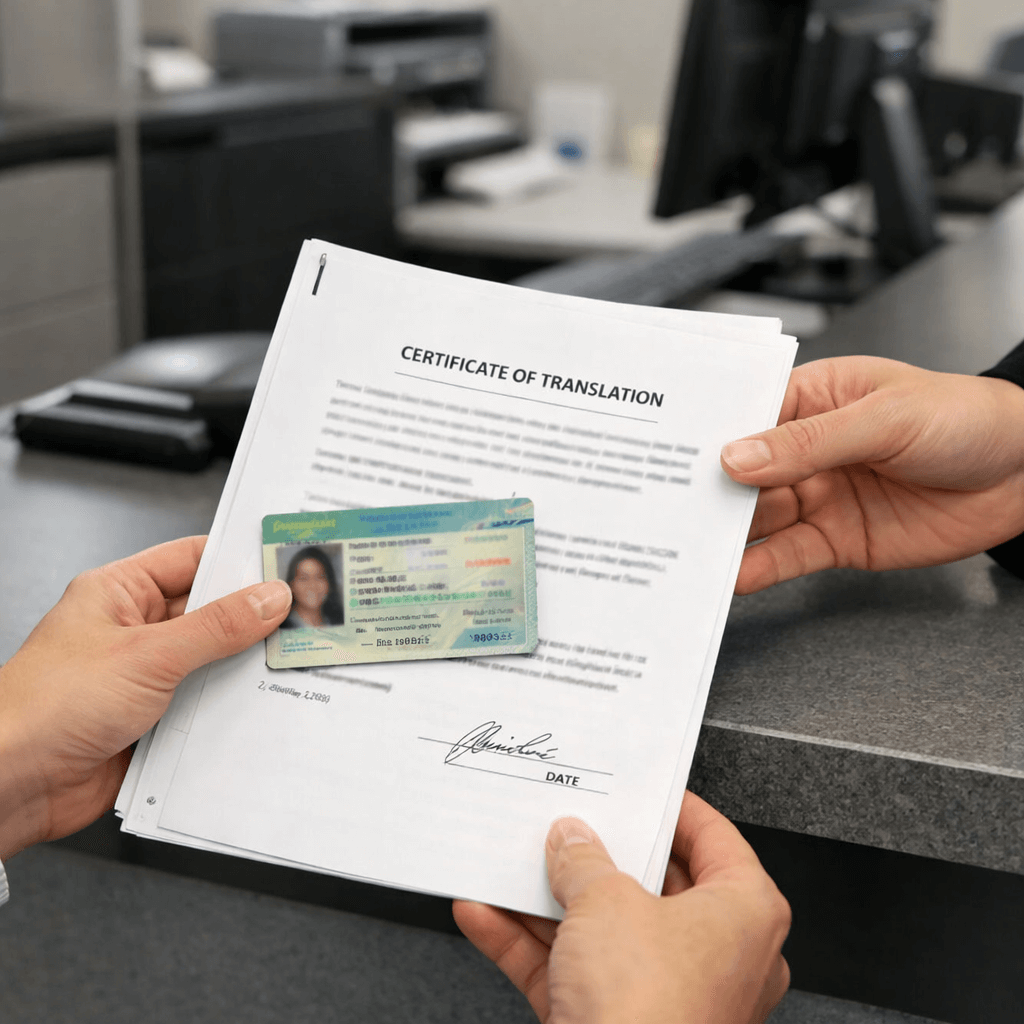
If your driver’s license isn’t in English, you may be asked for a certified translation when you apply for a US driver’s license, book a road test, convert a foreign license, prove identity for REAL ID, or use certain reciprocity routes.
The frustrating part: DMV translation requirements vary by state, and the “right” translation in one state can be rejected in another. This guide shows you what “certified translation for driver’s license” typically means, how state rules differ, what to include to prevent delays, and how to check your exact requirement before your appointment.
Quick next step: If you’re on a deadline, upload a clear photo of the front and back of your licence, and we’ll confirm what your state usually expects and deliver a DMV-ready certified translation.
Where can I get a certified translation for my driver’s license in the UK?
If you’re in the UK and your driver’s licence is not in English, you can usually get a certified translation from a professional translation company or a qualified translator that provides a signed statement confirming the translation is a true and accurate translation of the original document, together with the translator’s details and date of translation.
This is the type of wording many UK authorities expect when they review non-English documents. If you’re using the translation for a DVLA application, licence exchange, insurance check, employer verification, or another official process, the safest route is to order a full certified translation of the front and back of the licence so the receiving organisation can verify all key details quickly.
A strong UK-ready driver’s licence translation should cover:
- Full name
- Date of birth
- Licence number
- Issue and expiry dates
- Issuing country or authority
- Vehicle categories/classes
- Restrictions or codes
- Front and back content
- Any notes, stamps, or endorsements
If the receiving organisation wants something more than a standard certified translation, ask whether they also require notarisation or a specific certificate format before you submit your documents.
When do you need a certified translation for a driver’s licence in the UK?
In the UK, people most often look for a certified translation of a driver’s licence when they are:
- Exchanging or reviewing a non-GB licence
- Supplying supporting documents for a DVLA-related process
- Using a non-English licence for insurance or employer checks
- Providing identity documents for immigration or residency-related applications
- Dealing with a licensing, compliance, or verification process where the original licence is not in English
Practical rule: if the organisation reviewing your documents cannot easily read the original licence, you should expect them to ask for a complete English translation that is certified for accuracy.
Where can I get a certified translation for a foreign driver’s license in the US?
If you need a certified translation for DMV use in the US, the safest option is a professional translation company or a qualified translator experienced with official document translations. The translation should be complete, match the licence exactly, and include a Certificate of Translation Accuracy. Depending on your state, you may also need a company stamp, notarised affidavit, or another state-specific certification format.
To avoid delays, choose a provider that can translate both the front and back of the licence, including categories and restriction codes, and format the English version so DMV staff can compare it quickly against the original.
When do you need a certified translation for a driver’s license?
You’re most likely to need a certified translation if you’re doing any of the following:
- Applying for a first-time US driver’s license and presenting foreign documents
- Using a foreign license as part of a road test process (some states require proof in English)
- Converting or exchanging a foreign license (especially where reciprocity is involved)
- Applying for REAL ID (where non-English documents often need certified translation)
- Using your foreign license for insurance, employment, or verification where an English version is required
In some states and scenarios, you may be told an International Driving Permit (IDP) is enough. In others, an IDP is optional, and a certified translation is preferred or required.
Rule of thumb: If the DMV staff must verify the details on your licence (name, DOB, expiry, classes, restrictions), you should expect to be asked for an English version that’s certified to confirm it’s complete and accurate.
What “certified translation” usually means in the US (and what it doesn’t)
A certified translation is typically:
- A complete English translation of the document (front and back)
- A signed Certificate of Translation Accuracy
- The translator’s details (name, contact details) and confirmation of competence
- Sometimes: a company stamp and/or notarisation, depending on the state
It is not the same as:
- Notarisation: A notary verifies the identity of the signer (not the translation quality). Some DMVs request notarisation as an extra layer.
- Apostille: Used for international verification between countries, not usually needed for US DMV use.
- IDP: A travel document that translates key licence details; some DMVs accept it for certain purposes, others don’t.
If you’re unsure whether you need notarisation as well, see Notarised translation guidance here: notarised translation services.
Certified translation for a driver’s licence in the UK: what should be included?
If you need a certified translation for UK use, your translation should be prepared so the receiving body can independently verify both the document and the translator’s certification statement.
A UK-ready certified translation for a driver’s licence should usually include:
- A complete English translation of the licence
- Translation of both the front and back
- A statement confirming it is a true and accurate translation of the original document
- The date of translation
- The translator’s full name
- The translator’s contact details
- A signature or company sign-off, where appropriate
- Clear presentation of categories, codes, restrictions, endorsements, and issuing authority details
If your licence contains abbreviations, local language category labels, or restriction codes, those should be translated or explained clearly rather than omitted. This is especially important when the translation is being reviewed by an authority, insurer, or employer that needs to understand your driving entitlement.
Do you need notarisation for a driver’s licence translation in the UK?
Usually, a standard certified translation is enough unless the receiving organisation specifically asks for notarisation. In many UK document-review scenarios, the key requirement is that the translation can be independently verified and includes the translator’s certification details. If an organisation asks for a notarised translation, that is an extra authentication step rather than a substitute for a proper certified translation.
Why DMV translation requirements vary by state
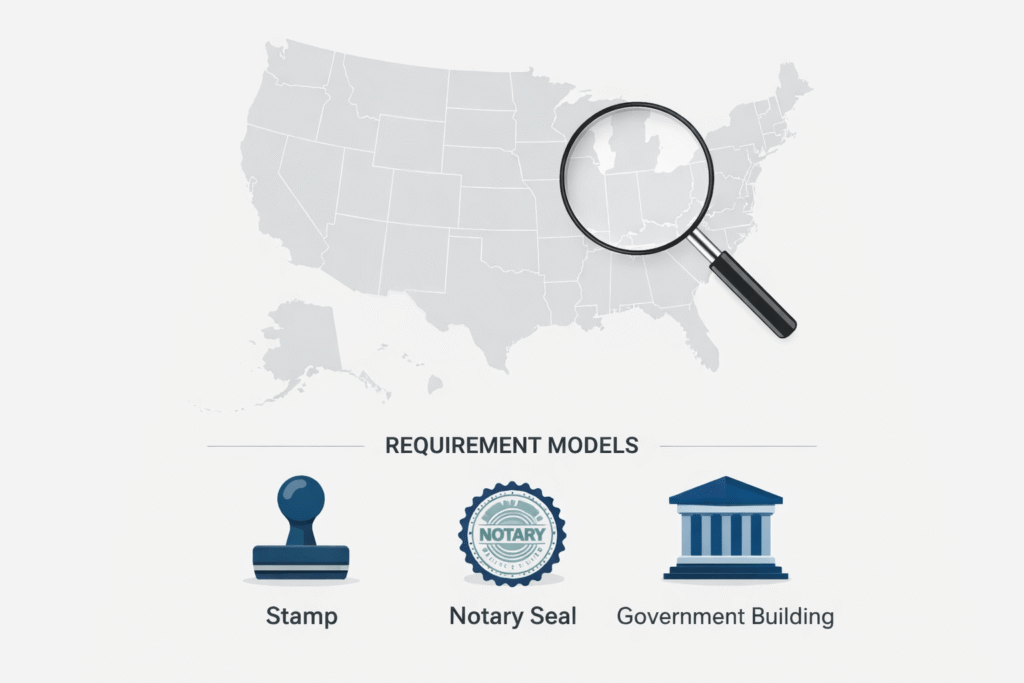
DMVs aren’t one national agency. Each state sets its own acceptance rules, and they tend to fall into three common “models”:
Model 1: Government/consulate-certified translations
Some states prefer (or require) translations certified by a government authority, consulate, or another official agency.
Model 2: Translation company certification (sometimes with a stamp)
Many states accept a certified translation from a professional translation company, often expecting a certificate page and sometimes a company stamp.
Model 3: Certified translation + notarised affidavit
A number of DMVs accept a certified translation, but add: “notarised affidavit required” or “notarised certification accepted.”
Practical takeaway: Don’t guess. Identify your state’s model before you book your appointment.
State requirement snapshots (how the rules differ in real life)
Below are examples of how requirements can change from state to state. Always confirm with your local DMV page or appointment instructions.
New York: Road test-specific translation rules
New York is known for having clear road test documentation requirements when your licence isn’t in English—this is a classic example of “Model 1” (official certification expectations). If you’re road-test bound, plan your translation early and make sure it includes the key data points DMVs look for.
Washington, DC: Company certification or notarised affidavit
DC is a strong example of “Model 2/3,” where translations from companies may need to be certified with a translation stamp or supported by a notarised affidavit confirming completeness and accuracy.
New Jersey: “Certified translation” definition + a certificate format
New Jersey is unusually practical: it defines what counts as a certified translation and even provides a certificate template structure. If you’re applying under NJ’s identity rules, your translated driver’s licence and other non-English documents may need a certified translation that matches their format expectations.
Texas: Translation requirements for foreign licences
Texas explicitly flags translation needs for foreign licences not in English (and sometimes Spanish). It’s a good example of a state that gives direct guidance on what to do before arriving at an office.
Florida and other states: Language policy can change quickly
Some states periodically update their language/testing policies. That’s why it’s smart to check the latest DMV guidance close to your appointment date.
How to confirm your state’s exact DMV translation requirement (in 10 minutes)
Use this quick method, and you’ll avoid 90% of preventable rejections:
- Go to your state DMV site and search these exact phrases:
- “foreign driver’s license translation”
- “certified translation”
- “out-of-country license”
- “road test documents”
- “REAL ID non-English documents”
- Check the page tied to your exact task (road test vs conversion vs REAL ID vs first-time licence).
- Look for one of these acceptance statements:
- “certified translation” (and who may certify it)
- “translation stamp”
- “notarised affidavit”
- “consulate/government agency”
- Confirm whether the DMV wants originals, copies, or both (many offices want to see originals in-person).
- Save a screenshot of the requirement page and bring it to your appointment.
If you’d rather not do the digging, upload your document and tell us your state and purpose (road test, conversion, REAL ID). We’ll format the translation to match the most common DMV expectations for that scenario.
What must be translated on a driver’s license (to avoid rejection)
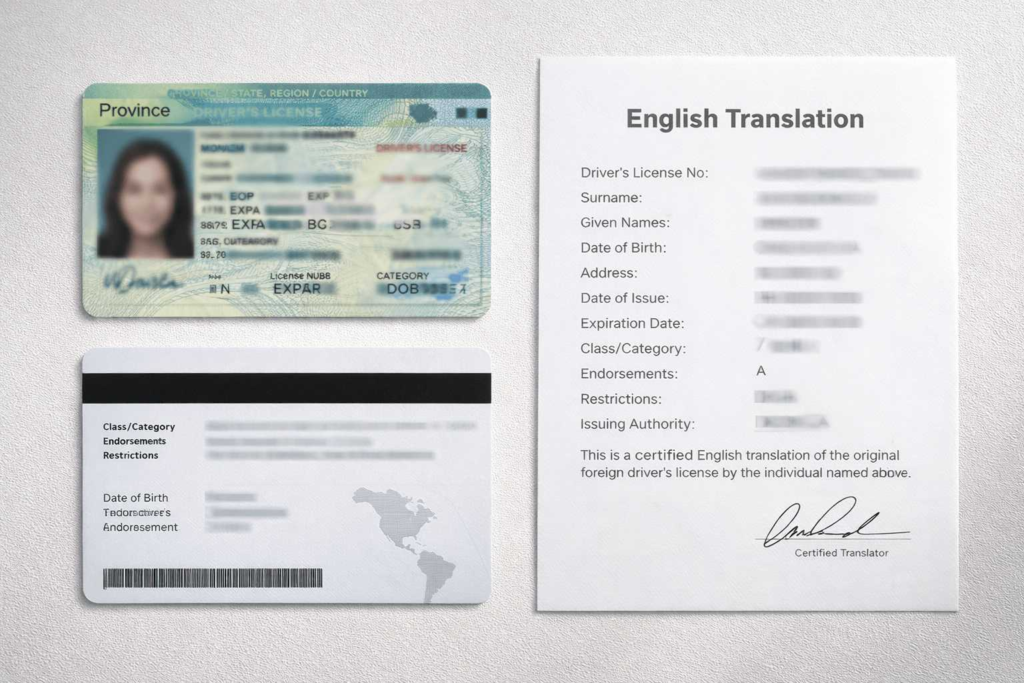
DMVs typically expect the entire licence to be translated, not just your name and date of birth.
Your translation should include:
- Full name (matching spelling on the document)
- Date of birth
- Licence number
- Issue date and expiration date
- Issuing authority
- Address (if shown)
- Vehicle classes/categories
- Endorsements
- Restrictions (including codes)
- Notes, stamps, or seals
- Front and back content (yes, even small print and codes)
Common rejection trigger: missing restriction codes or back-of-licence details.
Fix: translate everything, then present it in a clean, readable layout.
For best results, we also preserve the structure so DMV staff can compare line-by-line quickly. Start here: driver’s license translation service.
Certified vs notarised translation: do you need both?
Most DMV-related cases are solved with a certified translation alone. But some offices (or specific applications) add a notarisation request.
You may be asked for notarisation when:
- The DMV’s instruction specifically says “notarised translation” or “notarised affidavit”
- You’re using the translation for multiple official purposes (DMV + court + employer)
- The office wants a stronger identity verification chain for the signer
If your DMV requirement is unclear, a safe approach is:
- Order a certified translation first (fastest and most commonly accepted)
- Add notarisation only if your DMV requires it
You can request notarisation here: notarised translation services.
International Driving Permit (IDP) vs certified translation: which one do you need?
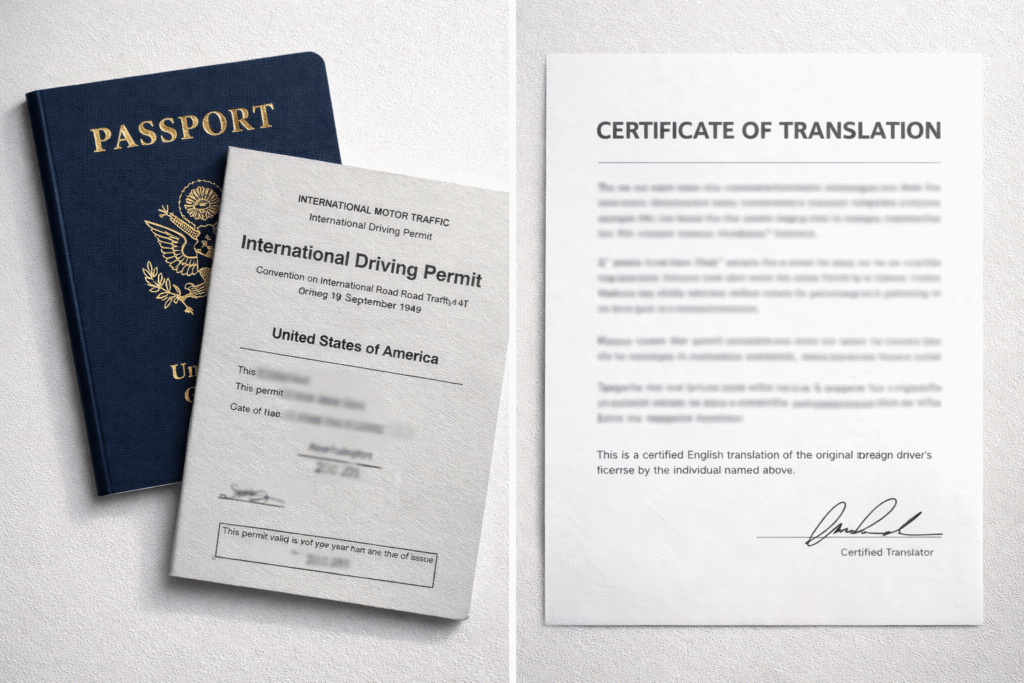
Think of them as different tools:
- IDP: primarily for driving as a visitor, travel, and car rental scenarios. It’s not a replacement for a US licence.
- Certified translation: used when an authority needs a formal English version of your document for processing, verification, or recordkeeping.
You might need an IDP if:
- You’re visiting and want to drive temporarily
- A rental car company requires it in addition to your foreign licence
You might need a certified translation if:
- You’re applying for a US licence
- You’re taking a road test where English documentation is required
- You’re presenting non-English identity documents as part of the application process
If you’re not sure which applies to your situation, upload your licence, and we’ll point you to the fastest compliant route.
The DMV-ready checklist (copy/paste this before your appointment)
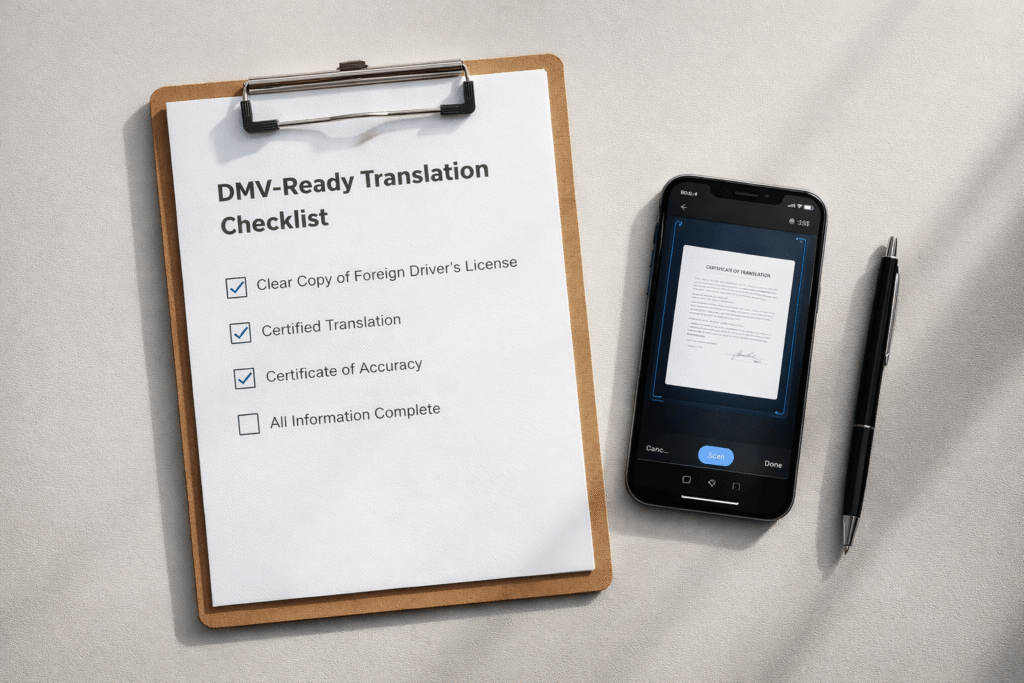
Document prep
- Front and back are clearly readable (no glare, no blur)
- All corners visible
- Any stamps/seals are legible
- Your name matches your other documents (watch spelling and order)
Translation content
- Includes every field (including codes and restrictions)
- Dates are formatted clearly (no ambiguity between DD/MM and MM/DD)
- Licence classes and categories are explained where needed
- A certificate page confirms completeness and accuracy
Submission readiness
- Printed copy available if your DMV requires physical paperwork
- Digital PDF version saved on your phone/email
- Screenshot of DMV requirement page saved (just in case)
Want this packaged as a one-page printable checklist? Upload your file, and we’ll include it with your DMV-ready delivery.
Common reasons driver’s license translations get rejected (and how to prevent them)
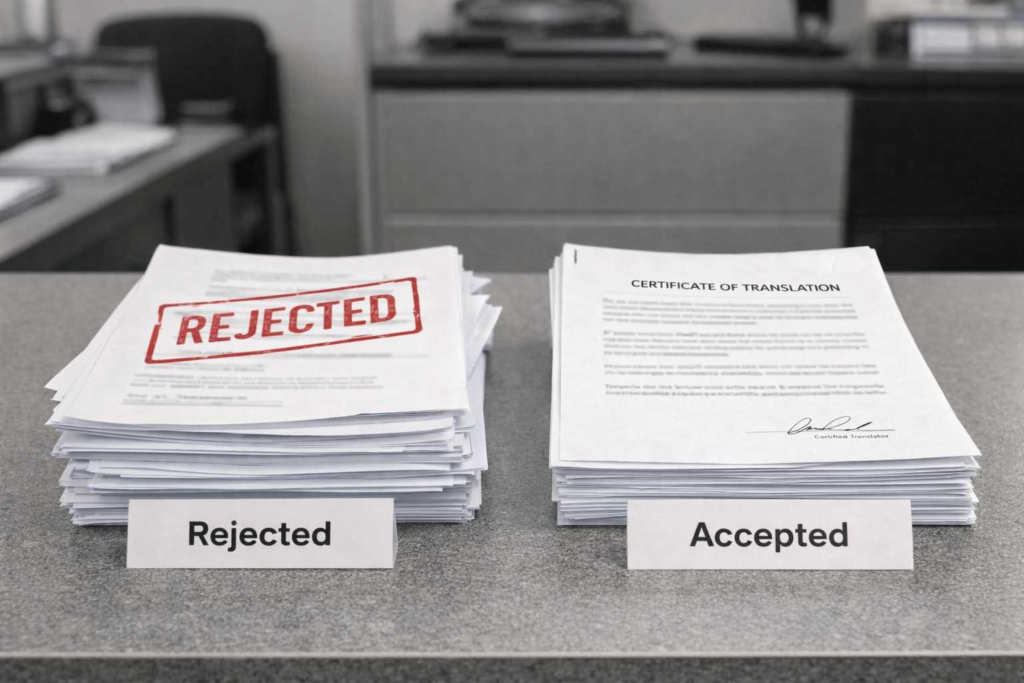
1) Partial translation
Problem: only the front is translated.
Fix: translate front + back + codes + notes.
2) Missing certification statement
Problem: The translation looks correct, but it isn’t certified.
Fix: include a certificate page with translator competence and language accuracy.
3) Incorrect names or date formats
Problem: mismatch with DMV application or REAL ID documents.
Fix: mirror spelling exactly; clarify date format in the translation.
4) Low-quality scans/photos
Problem: DMV staff can’t verify the original details.
Fix: retake photos in daylight; avoid flash glare; keep it flat.
5) Wrong certification “type” for your state
Problem: your state expects a consulate/government-certified translation or a notarised affidavit.
Fix: confirm the state model first, then order the right package.
Turnaround, delivery, and what you’ll receive
Most driver’s license translations are short, but precision matters. A DMV-ready package typically includes:
- The complete English translation
- A Certificate of Translation Accuracy
- Optional notarisation (if required)
- Digital PDF delivery, plus print-ready formatting if you need hard copies
If you’re working against an appointment date, choose the fastest path: upload your licence now, and you’ll receive a confirmed quote and delivery timeline based on your state and purpose.
For broader document bundles (licence + birth certificate + passport page), start with certified translation services.
Ready to translate your foreign driver’s license for the DMV?
The simplest way to avoid DMV delays is to start with a translation that’s complete, certified, and formatted for quick verification.
Upload a clear photo of the front and back of your driver’s license, tell us your state and what you’re doing (road test, conversion, REAL ID, first-time licence), and we’ll deliver a DMV-ready certified translation you can submit with confidence.
If you also need other documents translated for your application, you can bundle them here: same-day certified translation.
FAQ Section
Do I need a certified translation for drivers license at the DMV?
Often, yes—especially if your licence isn’t in English and the DMV must verify your details for a road test, conversion, REAL ID, or first-time application. Requirements vary by state.
Can I translate my foreign driver’s license myself for DMV use?
In most cases, self-translation is risky and commonly rejected. DMVs typically expect a certified translation with a certificate of accuracy from a qualified translator or translation company.
What should a certified translation for a driver’s license include?
A complete translation of the front and back, including licence classes, restrictions, endorsements, issue/expiry dates, and a signed certificate confirming the translation is accurate and complete.
Do DMV translation requirements vary by state?
Yes. Some states prefer government/consulate-certified translations, others accept certified translations from translation companies, and some require notarised affidavits.
Is an International Driving Permit the same as a certified translation?
No. An IDP is mainly for temporary driving as a visitor and for travel. A certified translation is often used for official processing (DMV applications, verification, and documentation).
Do I need a notarised translation for the DMV?
Only if your state’s DMV explicitly requires notarisation or an affidavit. Many cases are accepted with a certified translation alone.
Where can I get a certified translation of my driving licence in the UK?
You can get it from a qualified, registered translator (for example, an ITI or CIOL member) or from a professional translation company that issues a signed Certificate of Translation Accuracy. If you want a quick way to vet a provider, use the ITI Directory, CIOL Find-a-Translator, or the ATC member directory.
What should a certified translation include for UK use?
At minimum: a complete translation of the front and back, plus a written statement that it is a “true and accurate translation of the original document”, the date of translation, and the translator/agency’s full name and contact details.
Does DVLA require notarisation for a driving licence translation?
Sometimes a receiving organisation may ask for a notarised translation or an affidavit, but many UK uses only require the translator’s certification statement. Follow the specific instruction you’ve been given — if it does not mention notarisation, it’s usually not necessary.
Can a solicitor or notary certify my translation in the UK?
A solicitor or notary can witness/certify signatures (and in some cases certify copies), but they are not confirming the translation is accurate. The translation itself should be certified by the translator or translation company.
Do I need a hard copy certified translation in the UK, or will a PDF do?
Some organisations prefer paper copies with a wet signature/stamp, while others accept digitally signed PDFs. Always check the receiving organisation’s guidance before ordering, so you don’t pay for extras you don’t need.
Is an International Driving Permit (IDP) enough in the UK?
An IDP is mainly a driving/travel document. If an organisation needs an English version of your licence for administration (for example, insurance or employment checks), they may ask for a certified translation instead.